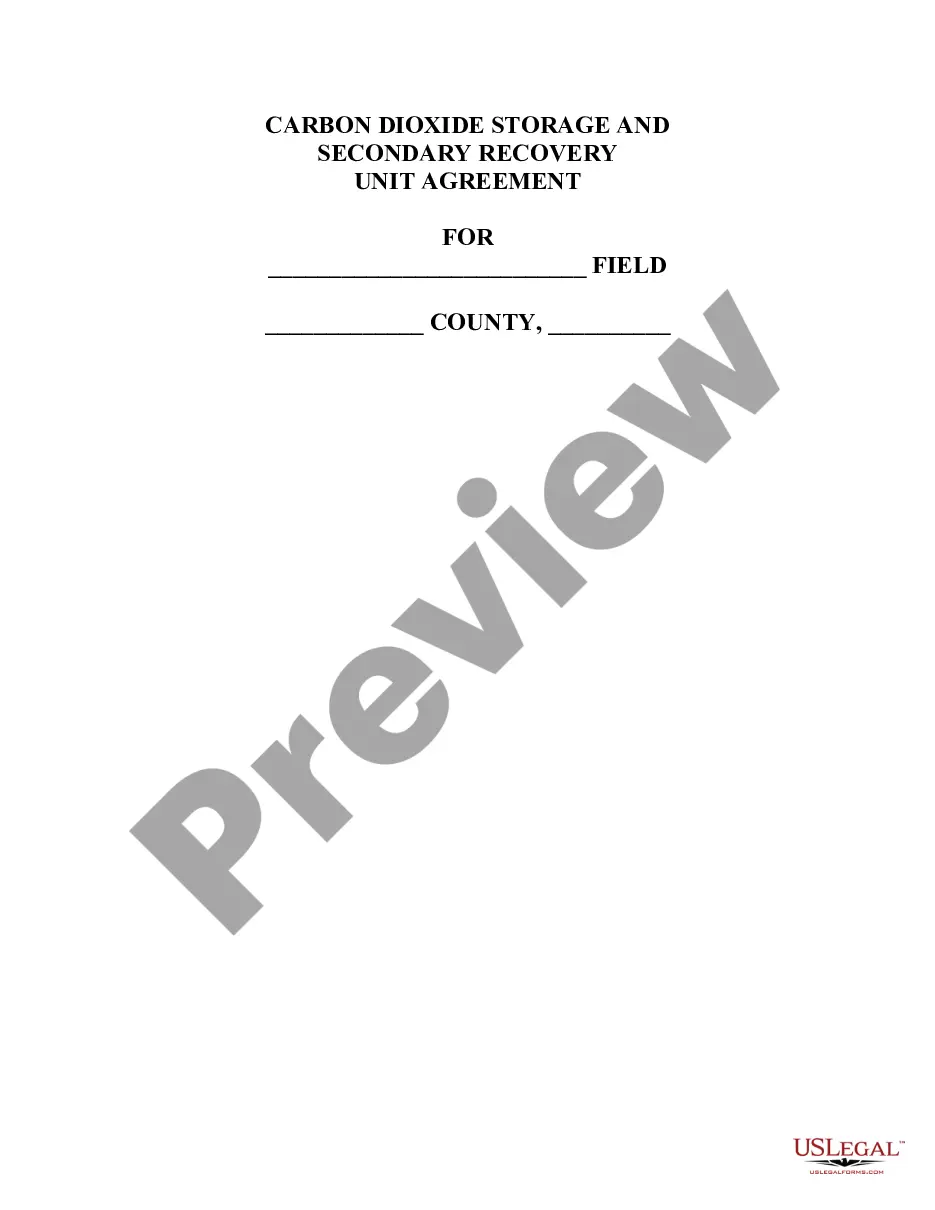
Carbon Dioxide Storage and Secondary Recovery Unit Agreement
What is this form?
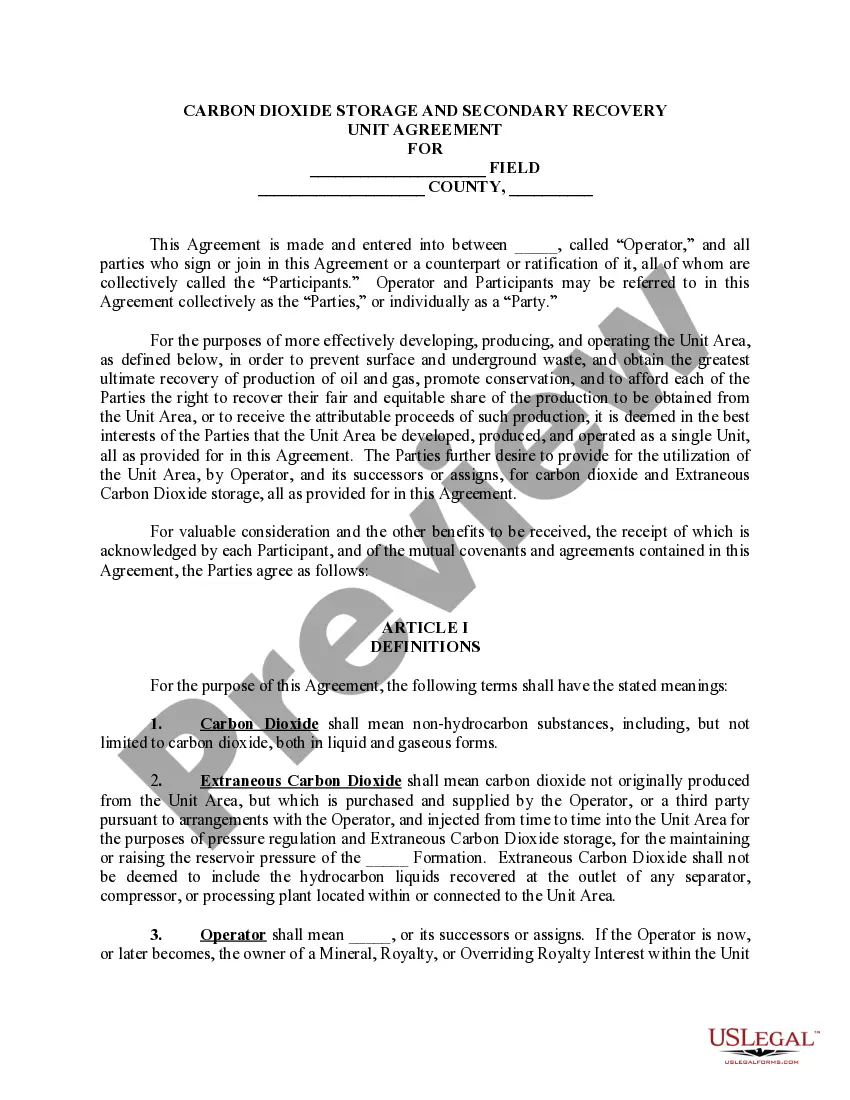
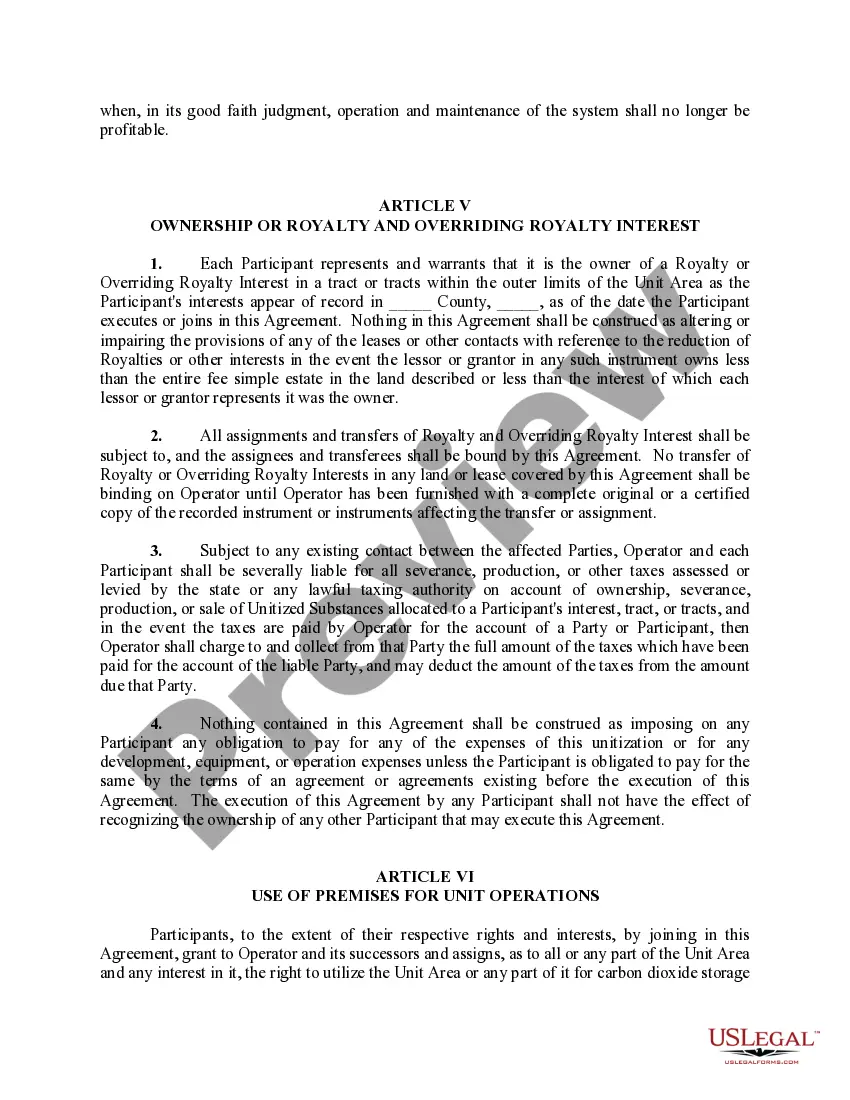
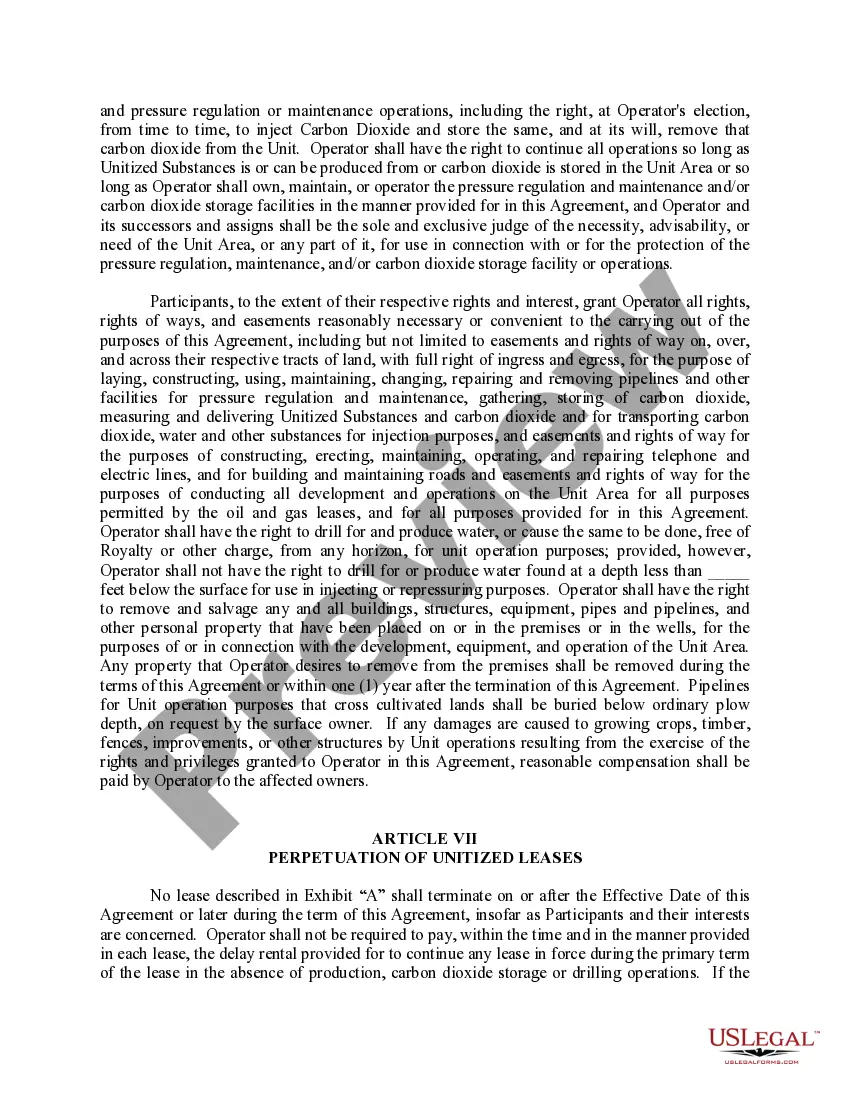
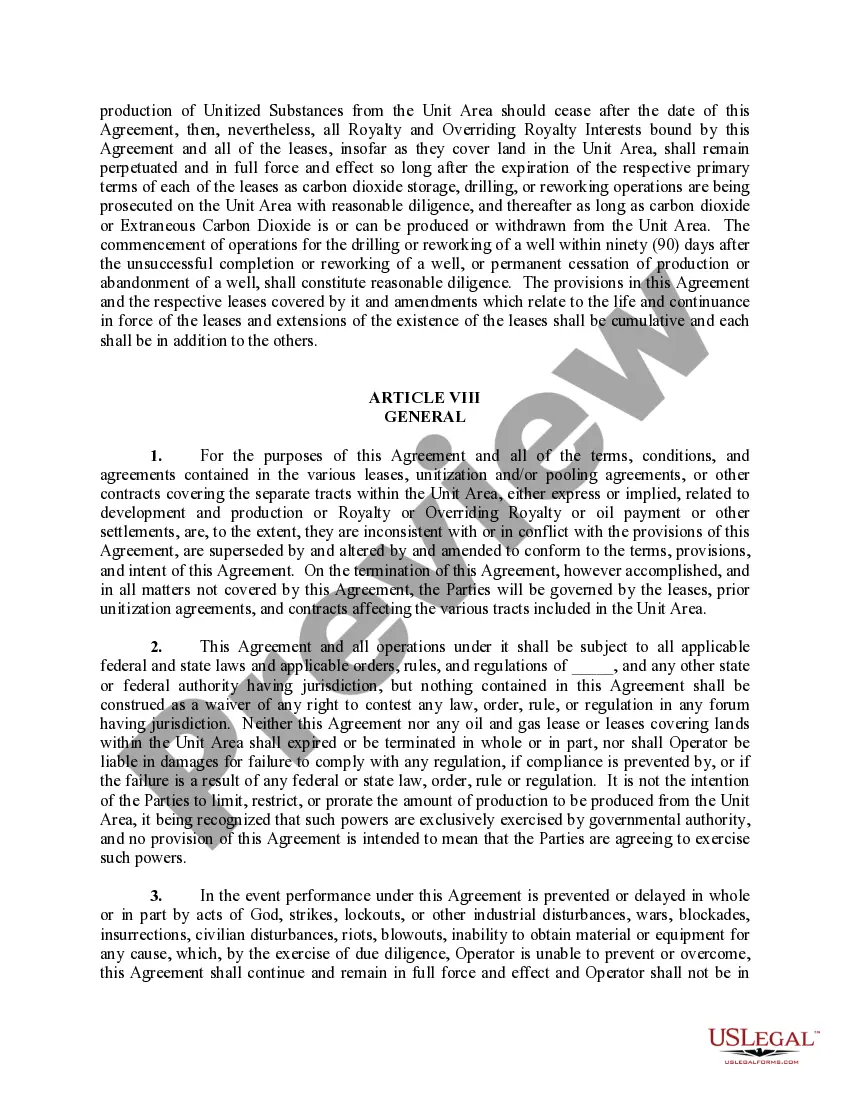
The Carbon Dioxide Storage and Secondary Recovery Unit Agreement is a legal document designed to establish the terms under which parties may cooperate in the storage of carbon dioxide and the secondary recovery of oil and gas resources. This form outlines the rights and obligations of participants within a designated unit area, differentiating it from other standard agreements by its focus on carbon dioxide management and enhanced recovery techniques in oil and gas production.
Key parts of this document
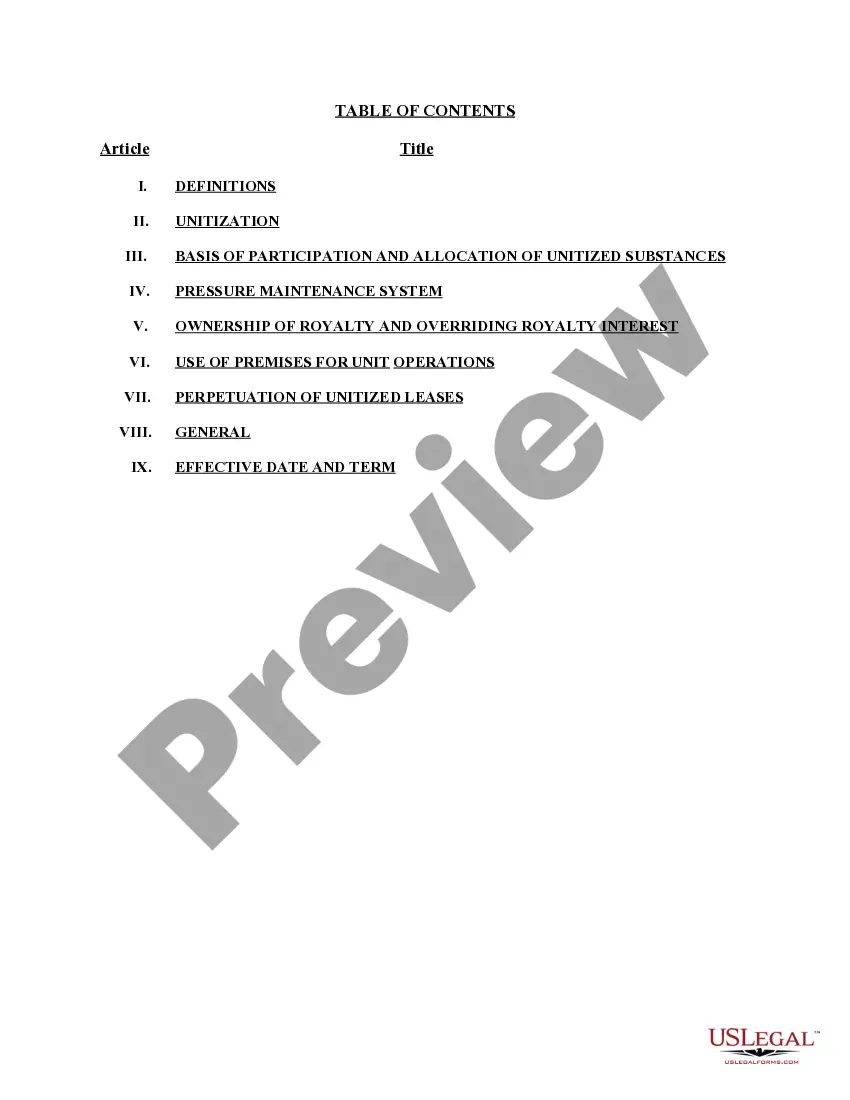
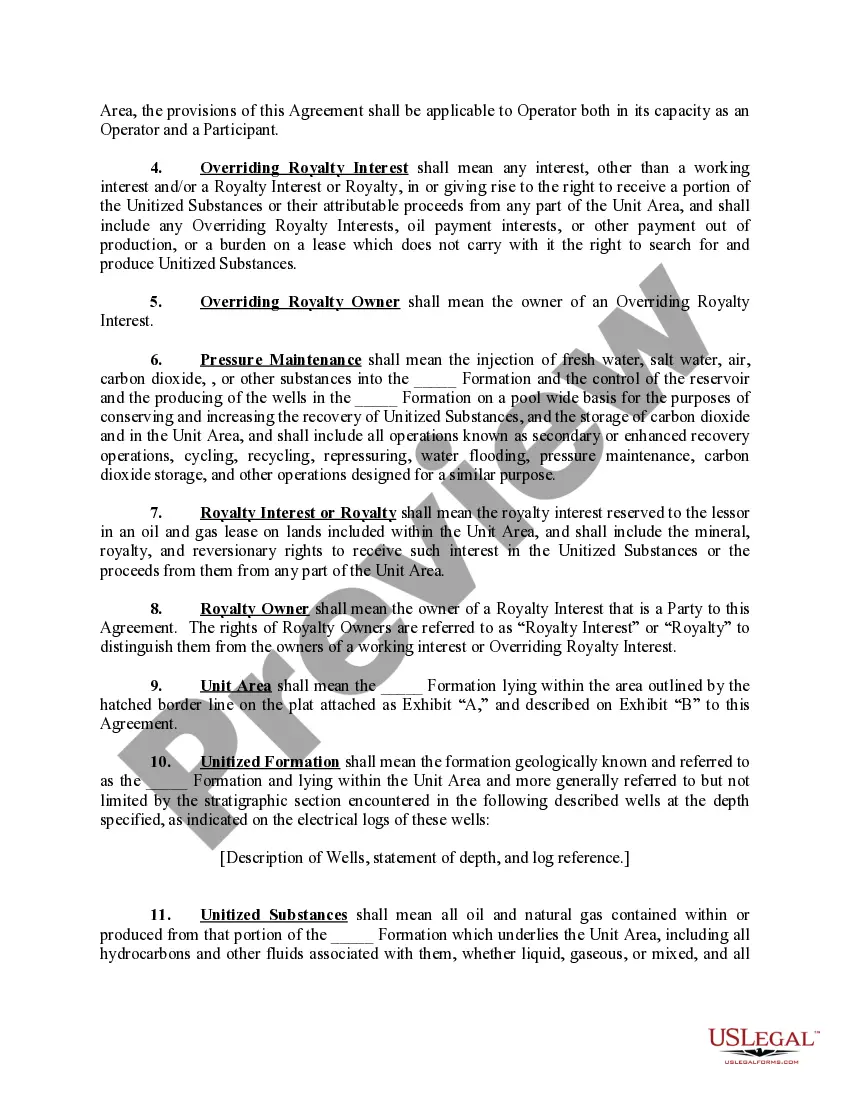
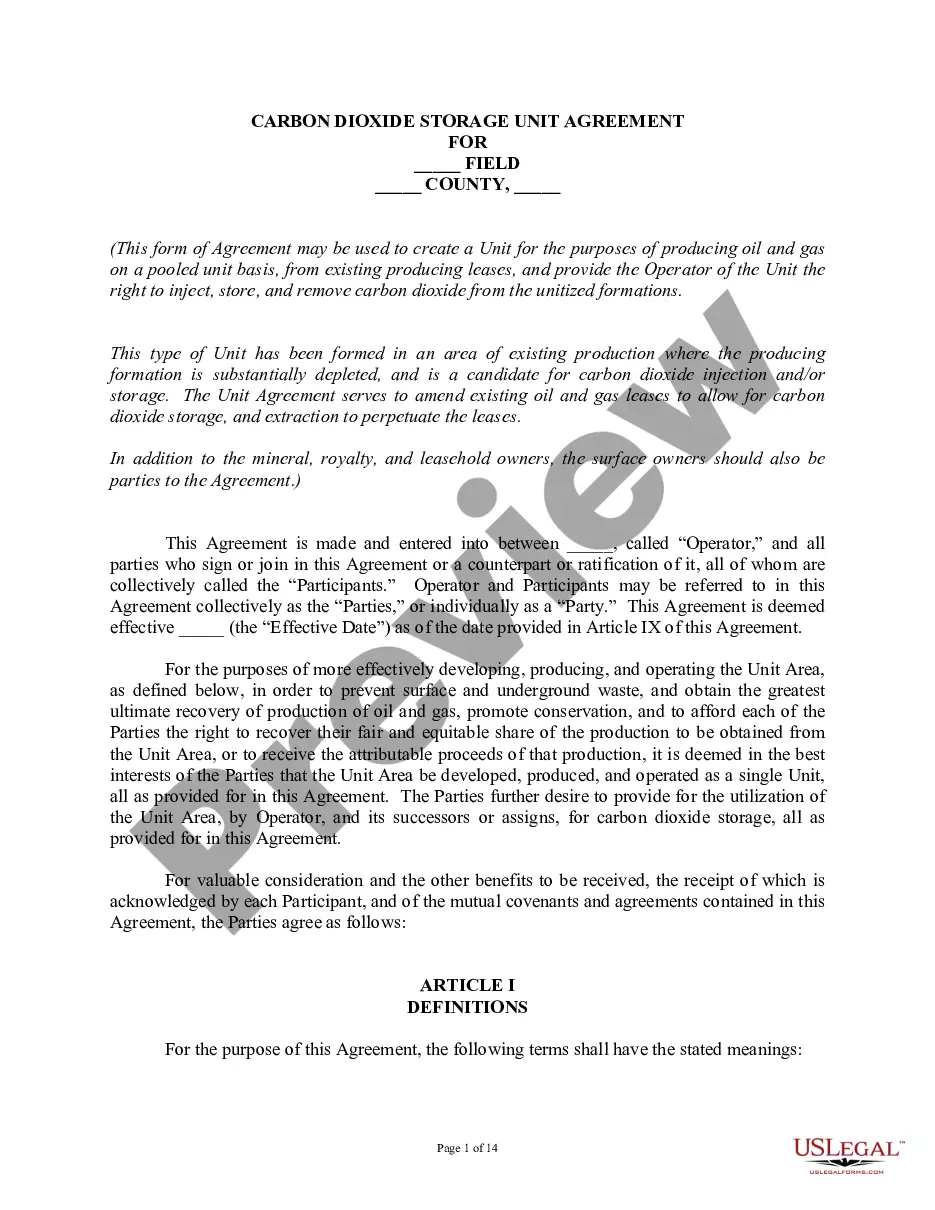
- Definitions: Clarifies terms related to carbon dioxide, unitized substances, and the roles of participants.
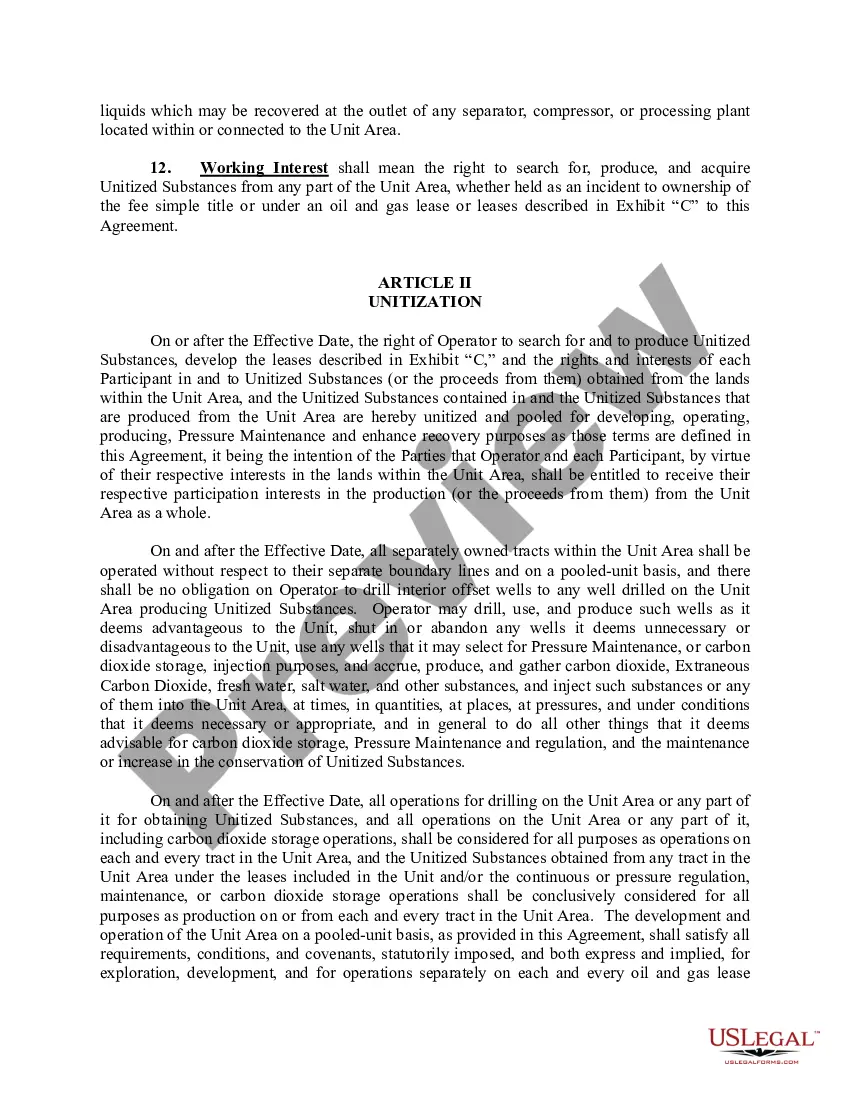
- Unitization: Outlines how separate tracts of land are pooled and operated as one unit for production and storage purposes.
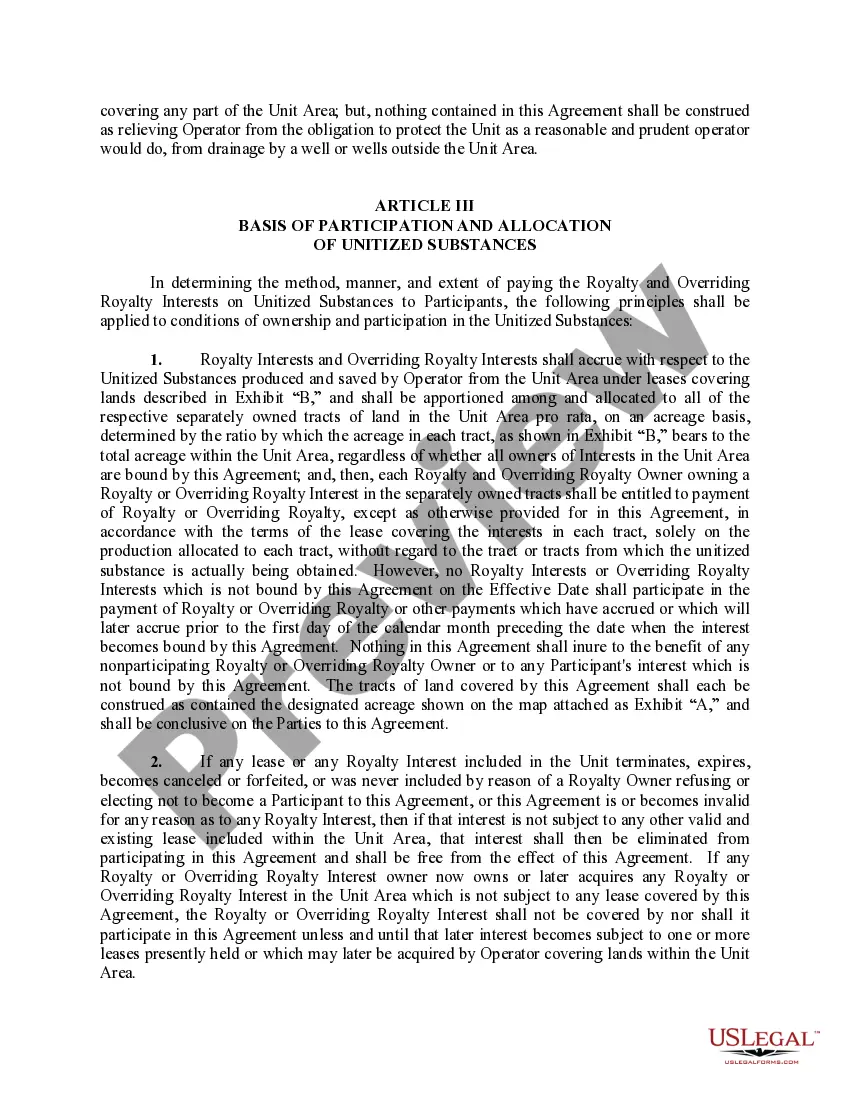
- Ownership and Royalty Interests: Details how royalty interests are calculated and allocated among participants.
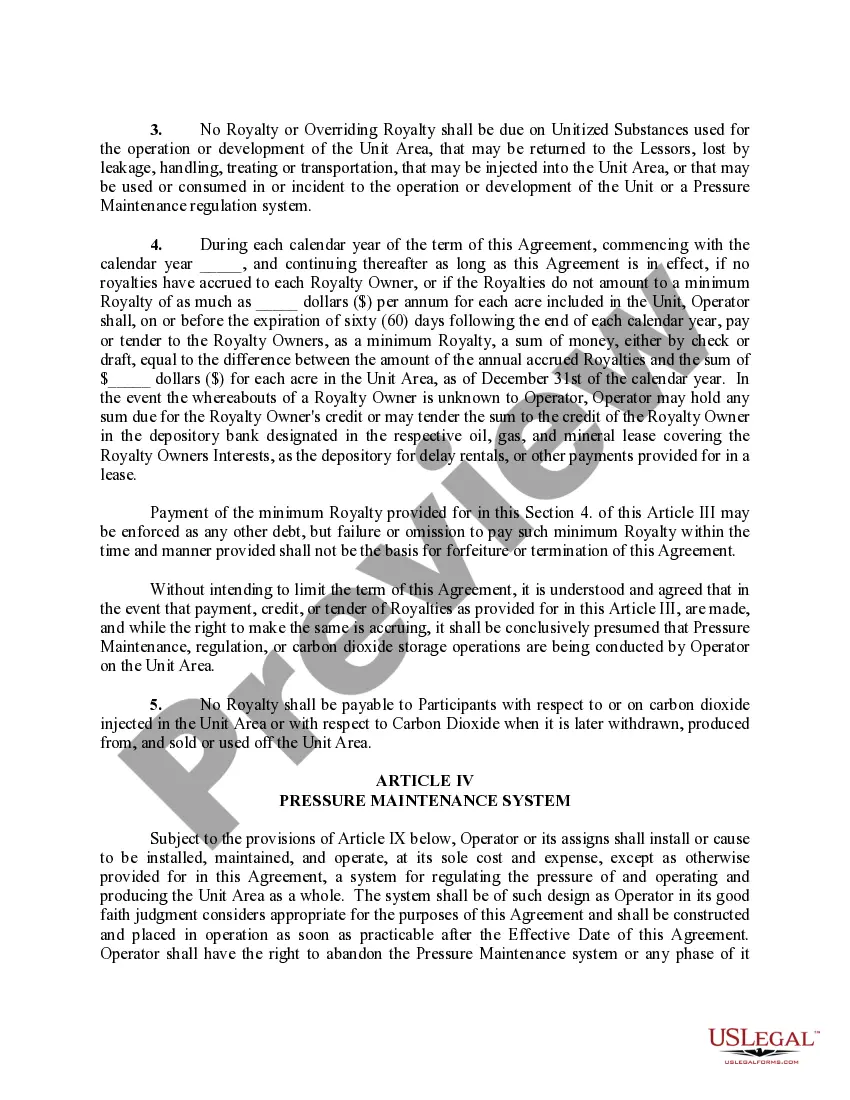
- Pressure Maintenance System: Describes the system for regulating pressure within the unit for effective operation and recovery.
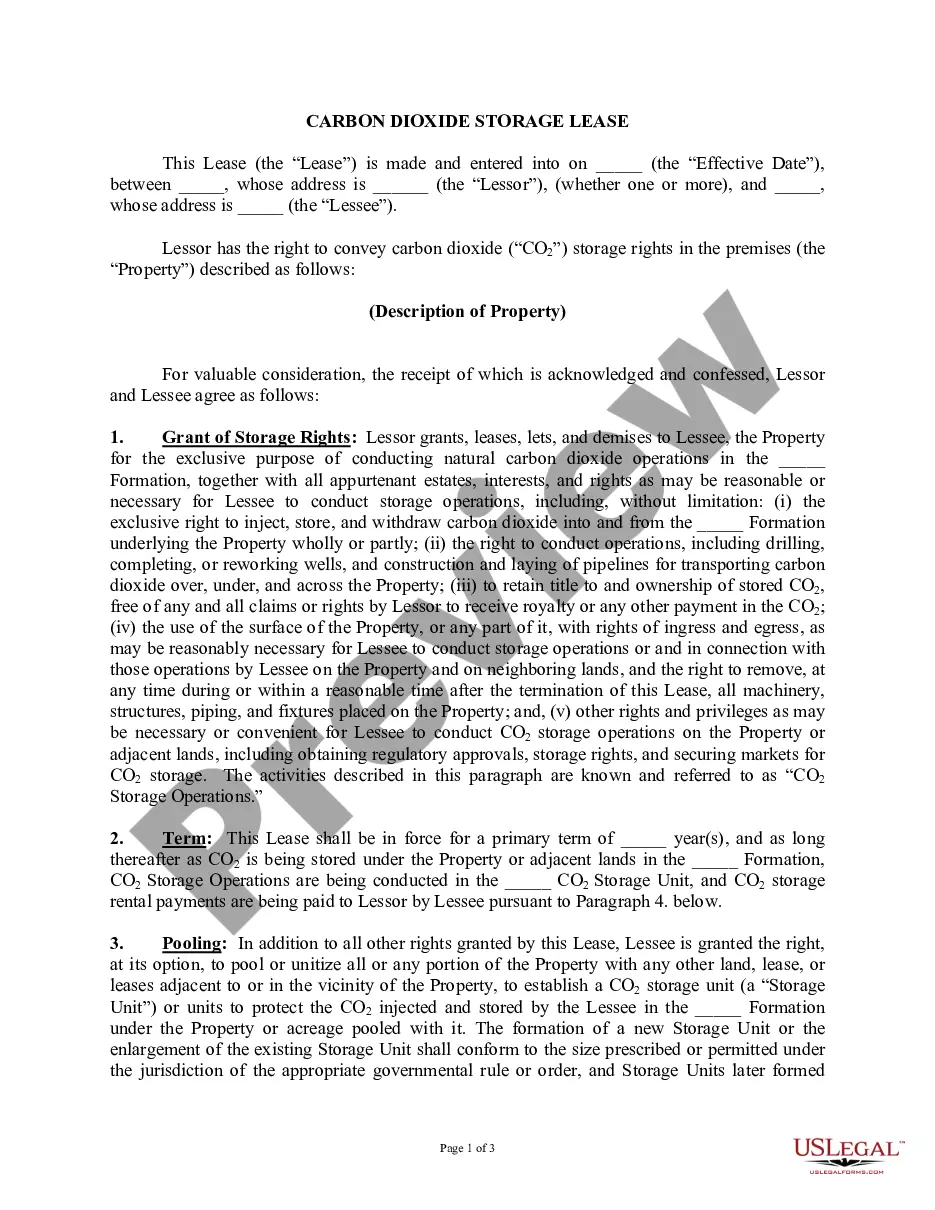
- Use of Premises: Grants operator rights to use the unit area for carbon dioxide storage and related operations.

Situations where this form applies
This form is commonly used in the oil and gas industry when parties wish to collaborate on a carbon dioxide storage project or enhance the recovery of oil and gas resources. It is particularly essential when multiple stakeholders have interests in the same geological formation, as it helps establish clear terms for operation and division of resources, preventing disputes and ensuring optimal recovery of natural resources.
Who needs this form
- Oil and gas operators looking to implement carbon dioxide storage solutions.
- Resource rights holders who wish to ensure their interests are protected during CO2 storage and recovery projects.
- Investors or corporate entities interested in entering into agreements regarding collective oil and gas recovery operations.
- Landowners who are part of a larger unit operation involving carbon dioxide storage and secondary recovery.
Steps to complete this form
- Identify the parties involved, including the operator and all participants.
- Clearly define the unit area and any applicable land tracts.
- Specify the terms of royalty interests and the basis of participation in production and operations.
- Detail the rights granted to the operator regarding the use of the premises for carbon dioxide storage and recovery processes.
- Ensure all parties sign and date the agreement to formalize the agreement.
Does this document require notarization?
This form does not typically require notarization to be legally valid. However, some jurisdictions or document types may still require it. US Legal Forms provides secure online notarization powered by Notarize, available 24/7 for added convenience.
Get your form ready online
Our built-in tools help you complete, sign, share, and store your documents in one place.
Make edits, fill in missing information, and update formatting in US Legal Forms—just like you would in MS Word.
Download a copy, print it, send it by email, or mail it via USPS—whatever works best for your next step.
Sign and collect signatures with our SignNow integration. Send to multiple recipients, set reminders, and more. Go Premium to unlock E-Sign.
If this form requires notarization, complete it online through a secure video call—no need to meet a notary in person or wait for an appointment.
We protect your documents and personal data by following strict security and privacy standards.

Make edits, fill in missing information, and update formatting in US Legal Forms—just like you would in MS Word.

Download a copy, print it, send it by email, or mail it via USPS—whatever works best for your next step.

Sign and collect signatures with our SignNow integration. Send to multiple recipients, set reminders, and more. Go Premium to unlock E-Sign.

If this form requires notarization, complete it online through a secure video call—no need to meet a notary in person or wait for an appointment.

We protect your documents and personal data by following strict security and privacy standards.
Mistakes to watch out for
- Failing to clearly define the unit area can lead to disputes over rights and responsibilities.
- Not specifying the mechanism for royalty calculations can cause confusion among participants.
- Overlooking necessary signatures may result in the agreement being deemed invalid.
Advantages of online completion
- Convenience: Download and complete the form at your own pace, from anywhere at any time.
- Editability: Modify the document as needed prior to finalizing and signing it.
- Reliability: Use a professionally drafted document, ensuring compliance with legal standards.
Legal use & context
- The agreement facilitates cooperation among various stakeholders, allowing for efficient resource management.
- It serves as a binding contract, ensuring all parties adhere to agreed terms regarding the unit area and operations.
- Non-compliance or failure to follow the agreement can lead to legal disputes or loss of rights.
Quick recap
- The Carbon Dioxide Storage and Secondary Recovery Unit Agreement is essential for managing collaborative oil and gas recovery projects.
- Clear definitions and structured terms help prevent legal disputes among participants in the unit area.
- Proper completion and potential notarization of the document enhance its legal standing and enforceability.
Looking for another form?


Form popularity
FAQ
Gases used include CO2, natural gas or nitrogen. The fluid most commonly used for miscible displacement is carbon dioxide because it reduces the oil viscosity and is less expensive than liquefied petroleum gas.
Carbon dioxide is slightly soluble in water and denser than air, so another way to collect it is in a dry, upright gas jar. As the carbon dioxide falls out of the delivery tube and into the gas jar, it pushes the less dense air out of the top of the gas jar.
When the injected CO2 and residual oil are miscible, the physical forces holding the two phases apart (interfacial tension) effectively disappears. This enables the CO2 to displace the oil from the rock pores, pushing it towards a producing well just as a cleaning solvent would remove oil from your tools.
CO2 EOR is a type of tertiary oil recovery that can recover even more oil from these existing wells and reservoirs. In CO2 EOR, carbon dioxide is pumped into the oil-bearing rock formation to recover even more oil. CO2 EOR has the potential to recover an additional 15% to 20% of the original oil.
One of the steps is the fermentation of the yeast.Here, a low-pressure compressor supplies oxygen to bacteria which in turn creates alcohol using micro-organisms. During this process, CO2 is created and released.
An enhanced oil recovery method in which carbon dioxide (CO2) is injected into a reservoir to increase production by reducing oil viscosity and providing miscible or partially miscible displacement of the oil.
1) Forests. 2) Farms. 3) Bio-energy with Carbon Capture and Storage (BECCS) 4) Direct Air Capture. 5) Carbon Mineralization. 6) Ocean-based Concepts. The Future of Carbon Removal.
Photosynthesis by plants and the absorption of CO2 from atmosphere by ocean water helps to remove CO2 from the atmosphere. Explanation: Photosynthesis is a process of making food and essential nutrients by absorbing in sunlight and carbon dioxide and releasing oxygen into the atmosphere.
Carbon capture and storage (CCS) is the process of capturing and storing carbon dioxide (CO2) before it is released into the atmosphere. The technology can capture up to 90%feff of CO2 released by burning fossil fuels in electricity generation and industrial processes such as cement production.