Carbon Dioxide Storage Lease
What this document covers
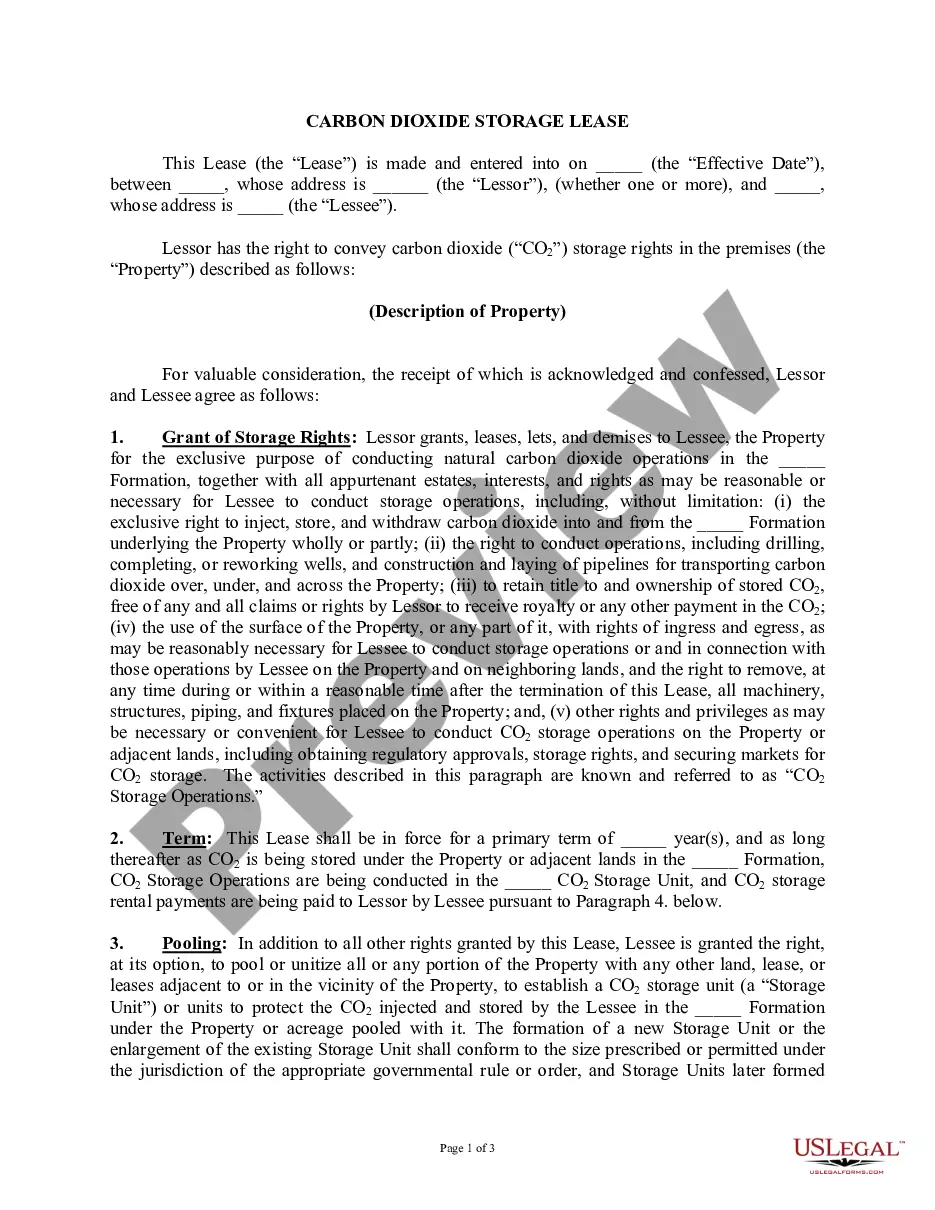
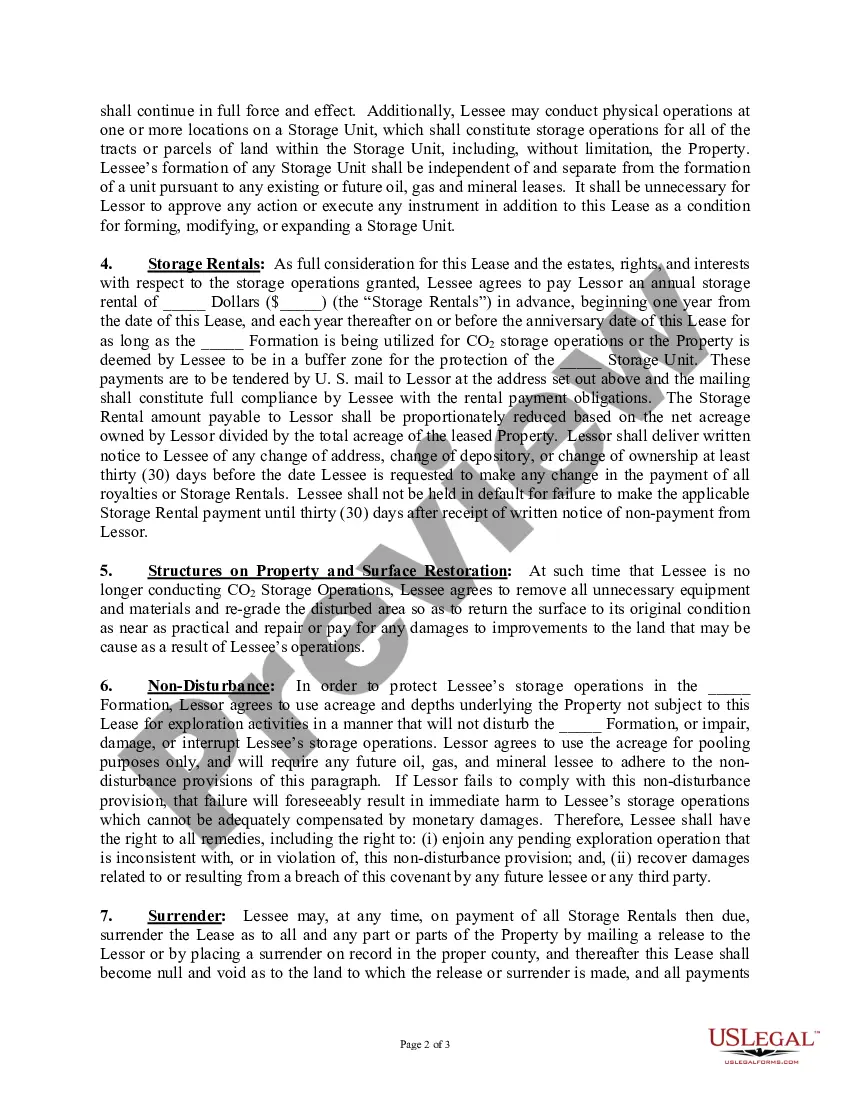
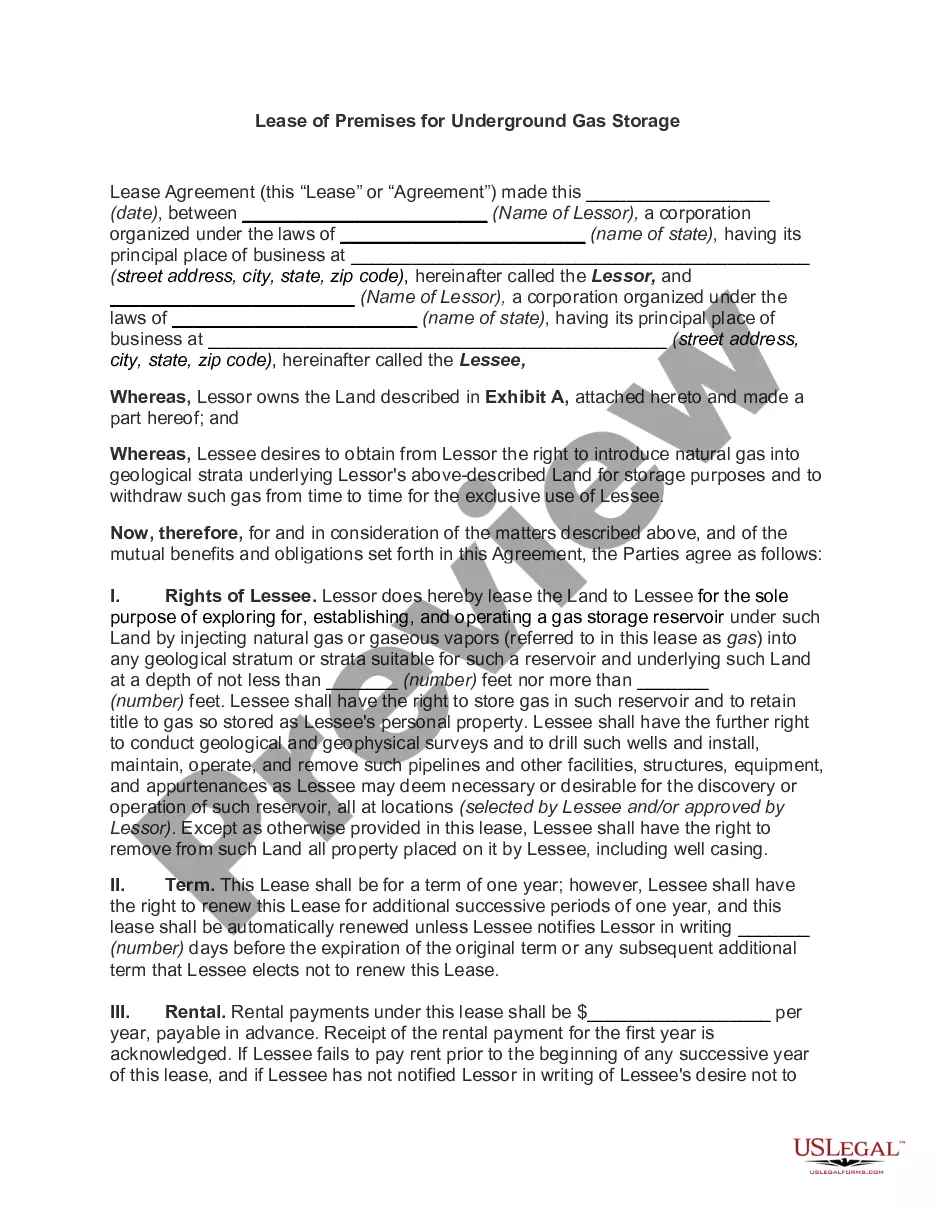
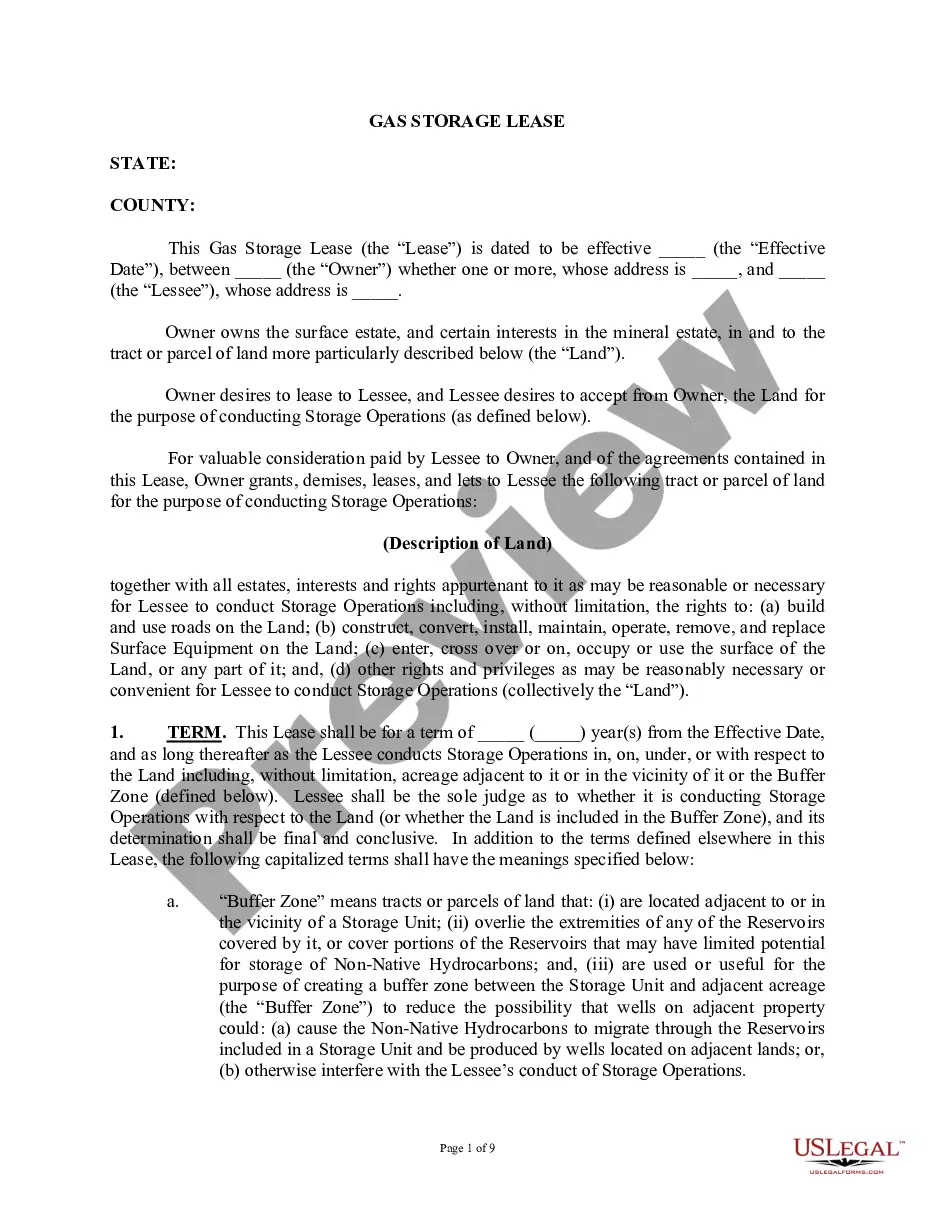
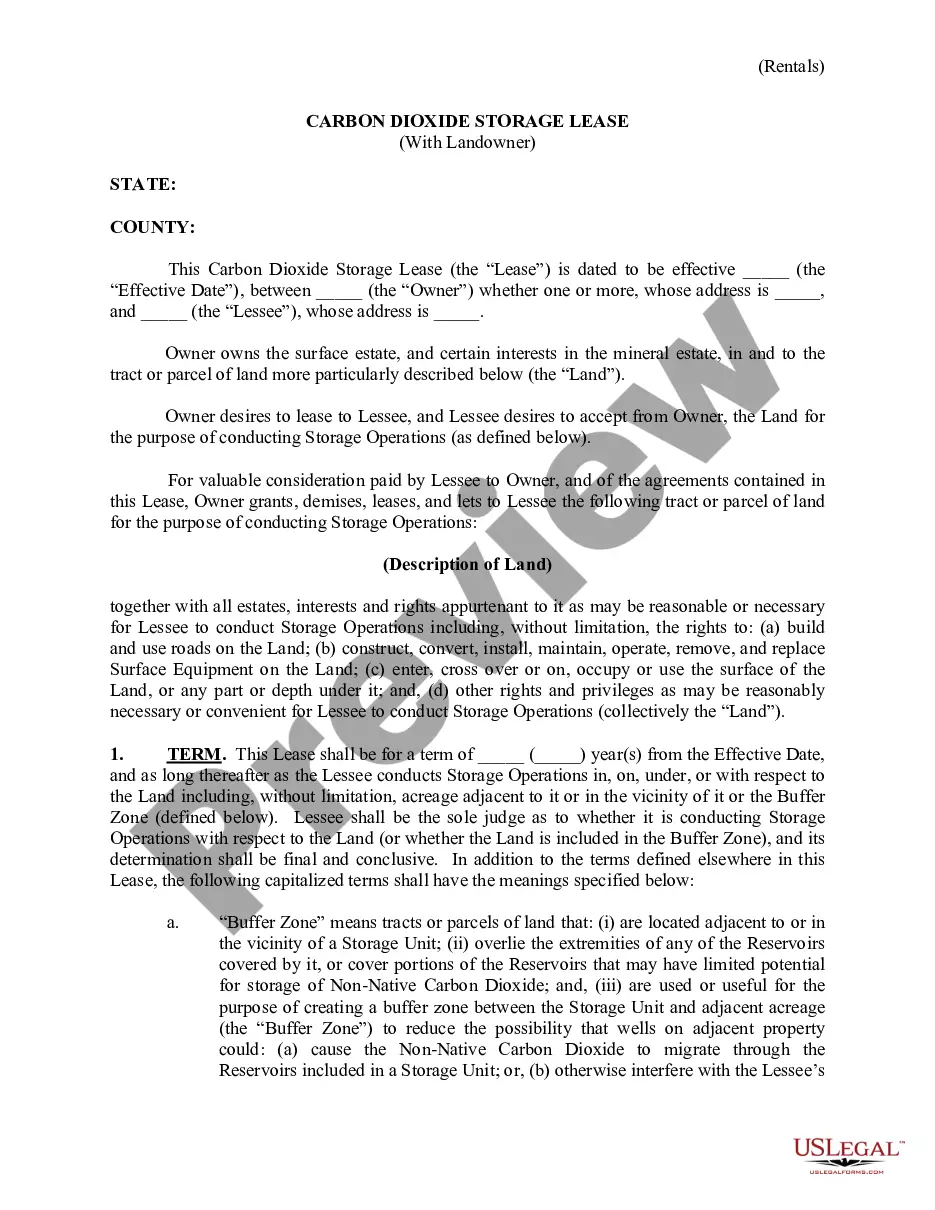
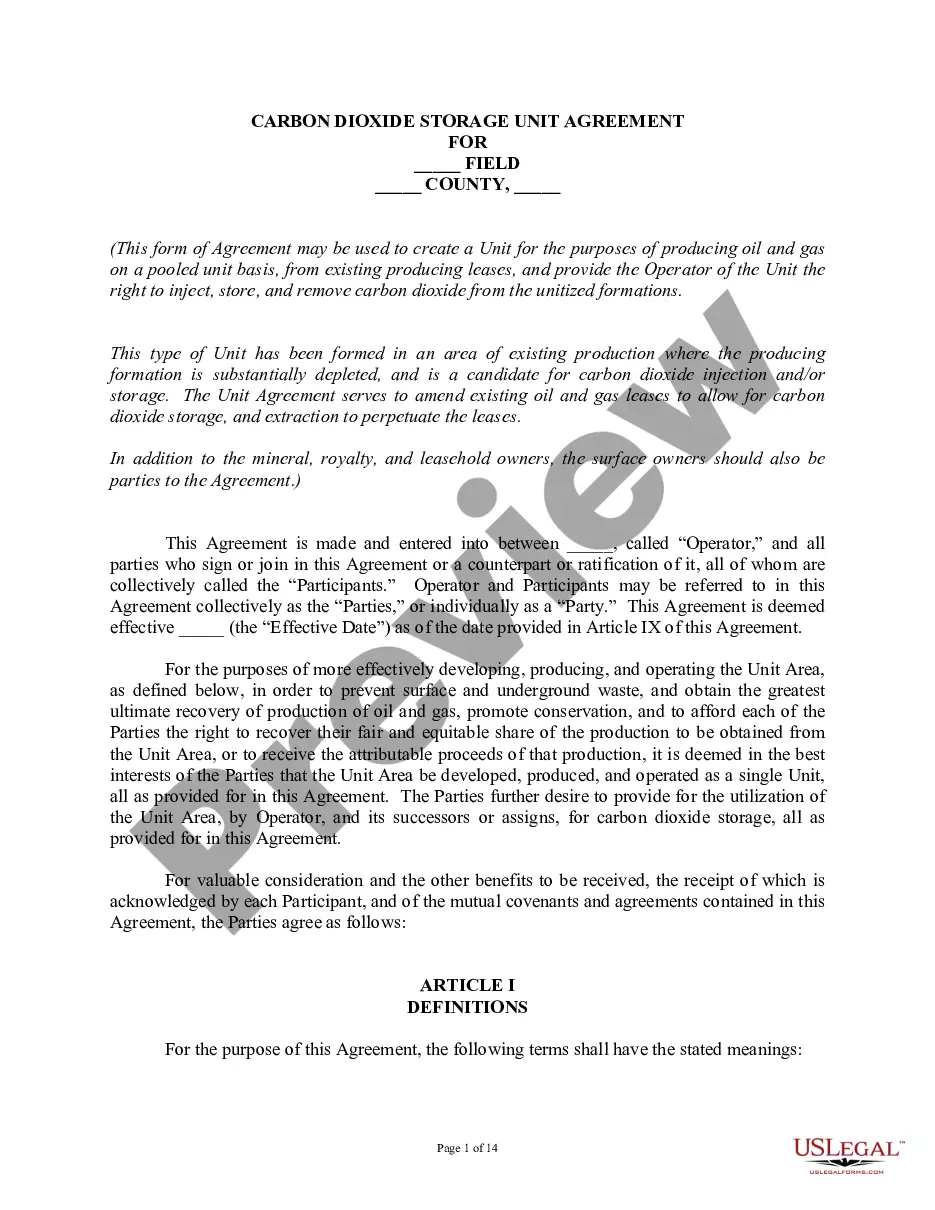
The Carbon Dioxide Storage Lease is a legal agreement that grants a lessee the rights to store carbon dioxide in a specified underground formation. Unlike other leasing agreements, this form specifically addresses the unique requirements and operations involved in carbon dioxide storage, ensuring both parties understand their rights and obligations regarding the property, storage operations, and rental payments.
Key components of this form
- Grant of Storage Rights: Details the rights of the lessee to inject, store, and withdraw carbon dioxide.
- Term: Specifies the duration of the lease based on storage operations and rental payments.
- Pooling: Allows the lessee to pool the property with adjacent lands for enhanced storage operations.
- Storage Rentals: Outlines the payment structure for storage services to the lessor.
- Non-Disturbance: Protects the lessee's operations from activities that could disrupt storage activities.
- Surrender: Describes the process for the lessee to terminate their rights to the property under specified conditions.

When this form is needed
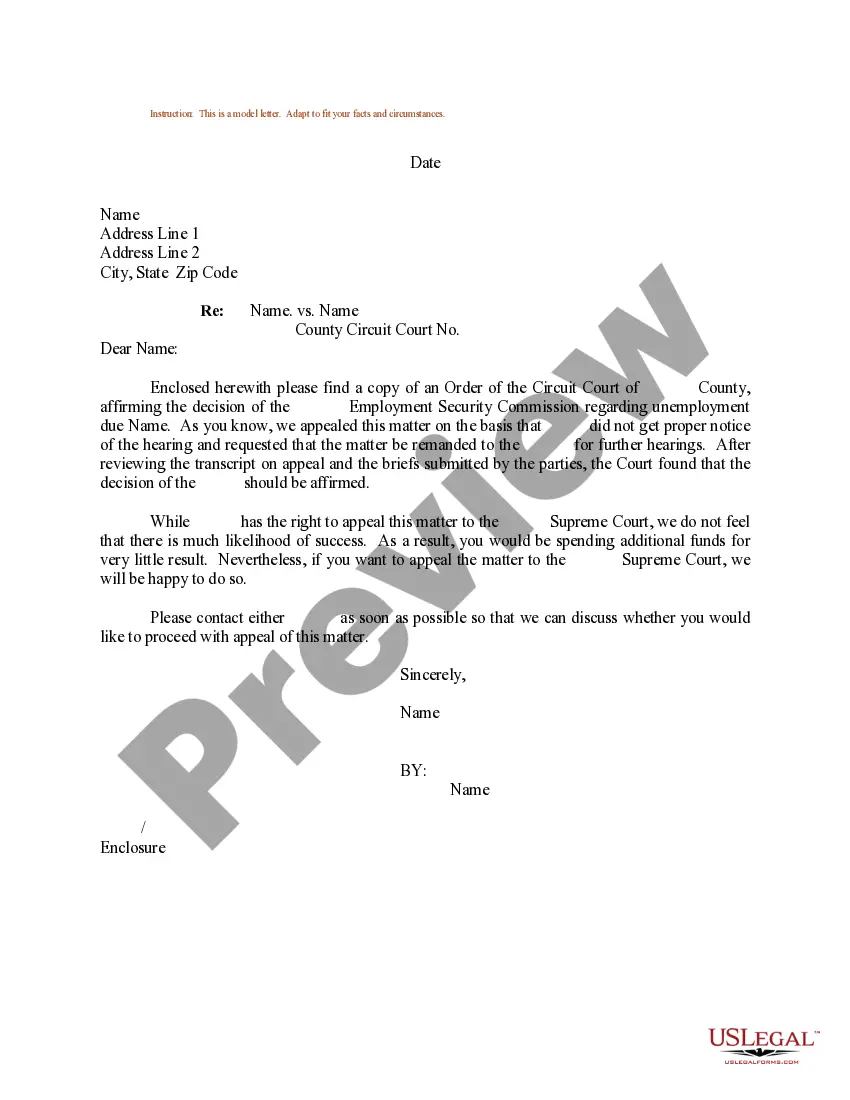
This form should be utilized when a company or individual intends to conduct carbon dioxide storage operations in a designated geological formation. It is applicable for businesses involved in environmental management, carbon capture and storage initiatives, or landowners seeking to monetize their property for carbon storage purposes.
Who this form is for
This lease is suitable for:
- Landowners who want to lease their land for carbon dioxide storage.
- Companies or entities specializing in carbon capture and storage operations.
- Environmental organizations looking to establish carbon offset projects.
How to prepare this document
- Identify the parties involved: Fill in the names and addresses of both the lessor and lessee.
- Specify the property: Describe the property where the CO2 storage operations will occur.
- Enter the effective date: Indicate the date when the lease agreement will commence.
- Outline terms: Fill in the primary term length and annual storage rental amount.
- Review non-disturbance agreements: Ensure compliance with any provisions that prohibit activities disrupting storage operations.
Is notarization required?
Notarization is not commonly needed for this form. However, certain documents or local rules may make it necessary. Our notarization service, powered by Notarize, allows you to finalize it securely online anytime, day or night.
Get your form ready online
Our built-in tools help you complete, sign, share, and store your documents in one place.
Make edits, fill in missing information, and update formatting in US Legal Forms—just like you would in MS Word.
Download a copy, print it, send it by email, or mail it via USPS—whatever works best for your next step.
Sign and collect signatures with our SignNow integration. Send to multiple recipients, set reminders, and more. Go Premium to unlock E-Sign.
If this form requires notarization, complete it online through a secure video call—no need to meet a notary in person or wait for an appointment.
We protect your documents and personal data by following strict security and privacy standards.

Make edits, fill in missing information, and update formatting in US Legal Forms—just like you would in MS Word.

Download a copy, print it, send it by email, or mail it via USPS—whatever works best for your next step.

Sign and collect signatures with our SignNow integration. Send to multiple recipients, set reminders, and more. Go Premium to unlock E-Sign.

If this form requires notarization, complete it online through a secure video call—no need to meet a notary in person or wait for an appointment.

We protect your documents and personal data by following strict security and privacy standards.
Typical mistakes to avoid
- Failing to accurately describe the property being leased.
- Not specifying the duration of the lease term properly.
- Neglecting to include all necessary parties' signatures.
Benefits of completing this form online
- Convenience: Access and complete the form from anywhere at any time.
- Editability: Easily modify fields to suit specific leasing needs.
- Accuracy: Minimizes errors with legal language crafted by licensed attorneys.
Looking for another form?

Form popularity
FAQ
Once the carbon dioxide has been transported, it is stored in porous geological formations that are typically located several kilometers under the earth's surface, with pressure and temperatures such that carbon dioxide will be in the liquid or supercritical phase. Suitable storage sites include former gas and oil
The most well-developed approach to storing CO2 is injecting it underground into naturally occurring, porous rock formations such as former natural gas or oil reservoirs, coal beds that can't be mined, or saline aquifers.
Carbon sequestration refers in UFORE to the removal of carbon (in the form of carbon dioxide) from the atmosphere through the process of photosynthesis. carbon storage refers to the amount of carbon bound up in woody material above and below ground.
Carbon dioxide is first dissolved into a beaker containing an electrolyte liquid, then a small amount of the liquid metal catalyst is added. When an electrical current is applied, the catalyst chemically activates the surface of the mixture, which slowly converts the CO2 into solid flakes of carbon.
By studying a natural reservoir in Utah, USA, where CO2 released from deeper formations has been trapped for around 100,000 years, a Cambridge-led research team has now shown that CO2 can be securely stored underground for far longer than the 10,000 years needed to avoid climatic impacts.
In the case of saline aquifers, as well as structural and mineral storage, the CO2 can dissolve into the salty water in a process called 'dissolution storage'. Here, the dissolved CO2 slowly descends to the bottom of the aquifer. In any given reservoir, each (or all) of these processes work to store CO2 indefinitely.
One major concern with CCS is that CO2 could leak out of these underground reservoirs into the surrounding air and contribute to climate change, or taint nearby water supplies. Another is the risk of human-made tremors caused by the build-up of pressure underground, known as induced seismicity.
Once the carbon dioxide has been transported, it is stored in porous geological formations that are typically located several kilometers under the earth's surface, with pressure and temperatures such that carbon dioxide will be in the liquid or supercritical phase. Suitable storage sites include former gas and oil
The three main types of geological storage are oil and gas reservoirs, deep saline formations, and un-minable coal beds. CO2 can for instance be physically trapped under a well-sealed rock layer or in the pore spaces within the rock.