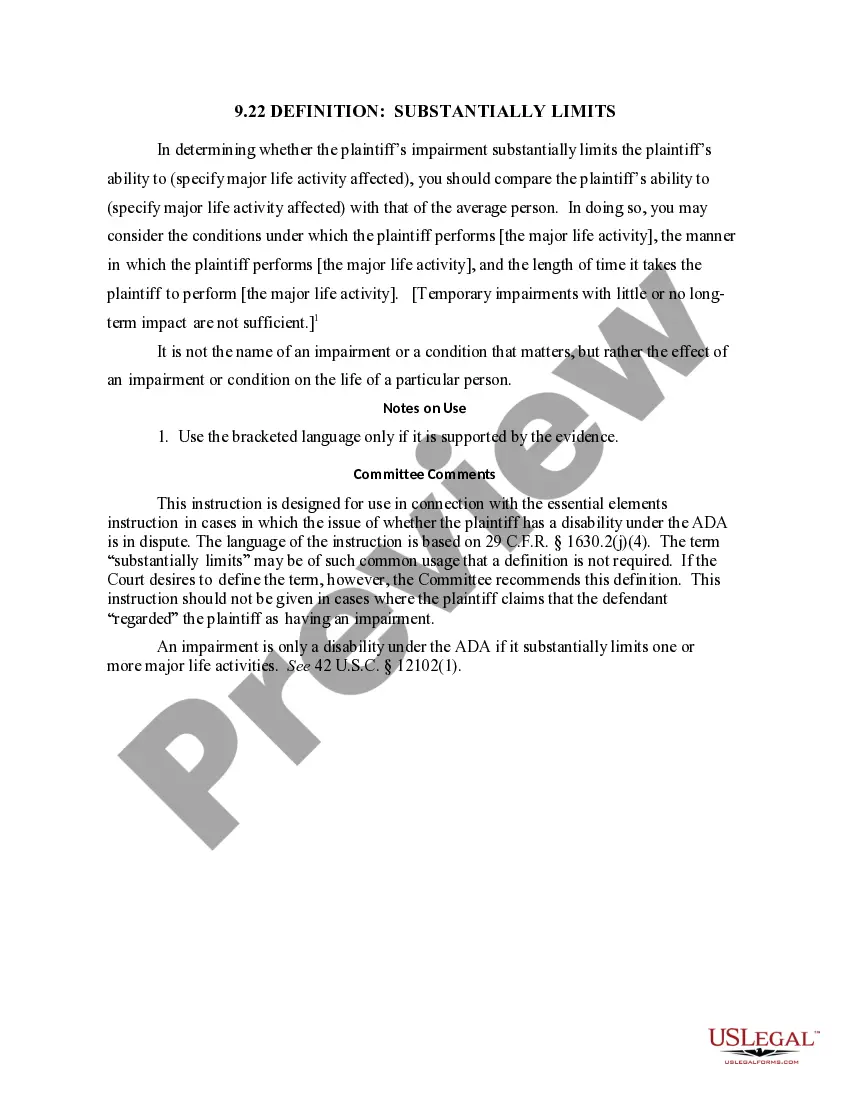
9.22 DEFINITION: SUBSTANTIALLY LIMITS
What is this form?
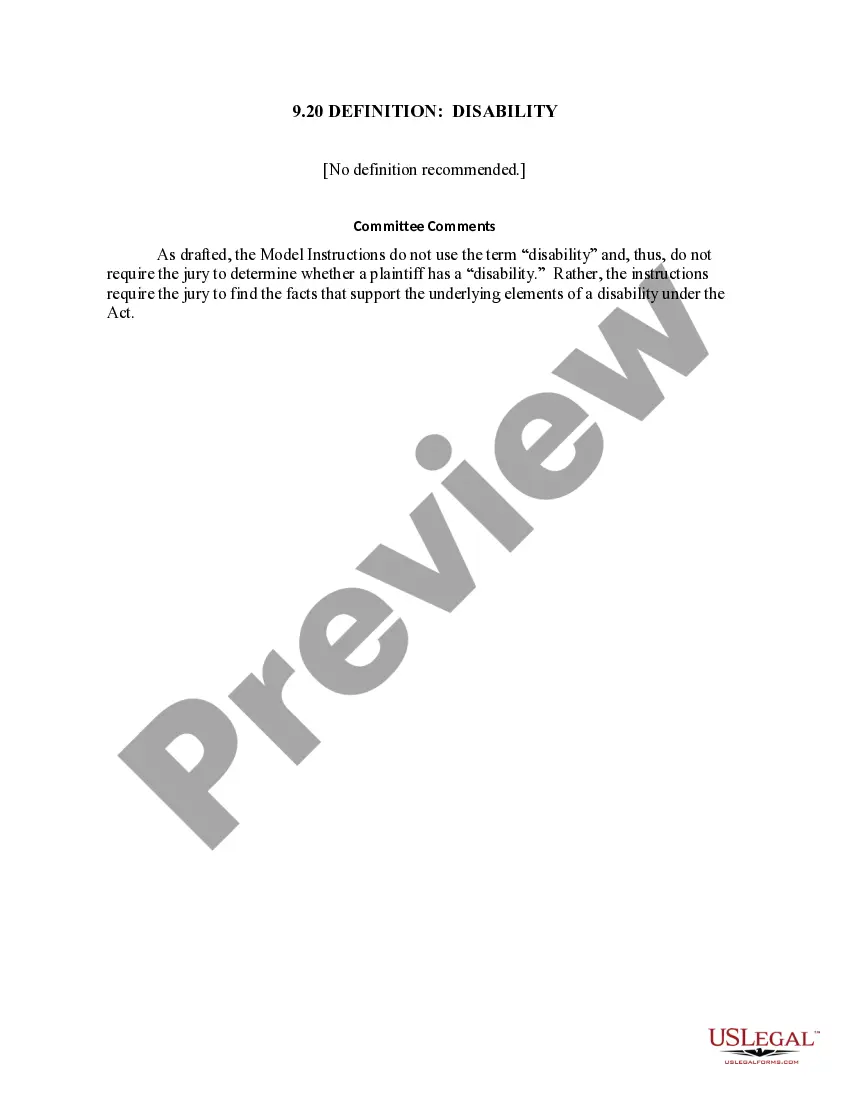
The form titled "9.22 Definition: Substantially Limits" is designed to define and evaluate the concept of a disability as recognized under the Americans with Disabilities Act (ADA). It assists in determining whether a plaintiff's impairment significantly restricts their ability to perform major life activities when compared to an average person. This form is essential for legal cases where the status of a disability is contested, ensuring a clear understanding of the criteria used to assess it.
Key parts of this document
- Definition of "substantially limits" in relation to major life activities.
- Comparison of the plaintiff's capabilities to those of an average person.
- Factors to consider: conditions, manner, and duration of activity performance.
- Clarification that temporary impairments with minimal long-term effects do not qualify.
- Exclusion of certain contexts, such as claims of perceived disability.
Common use cases
This form is applicable in legal situations where a plaintiff's disability claim under the ADA is challenged. Use it to provide a legal framework for evaluating whether an impairment significantly limits the plaintiff's ability to engage in major life activities. This form is essential in personal injury, employment discrimination, and disability rights cases where the definition and impact of a disability must be established.
Who can use this document
Individuals or entities engaged in legal proceedings pertaining to disability claims should utilize this form, including:
- Plaintiffs seeking to establish the existence of a disability in a legal context.
- Attorneys representing clients in personal injury or employment discrimination lawsuits.
- Judges or juries considering disability claims involving the ADA.
How to prepare this document
To complete this form, follow these steps:
- Identify the major life activity affected by the plaintiffâs impairment.
- Assess the plaintiffâs ability to perform this activity versus an average person.
- Consider the conditions under which the activity is performed.
- Evaluate the manner in which the plaintiff engages in this activity.
- Determine the duration it takes for the plaintiff to perform the activity compared to others.
Notarization requirements for this form
Notarization is not commonly needed for this form. However, certain documents or local rules may make it necessary. Our notarization service, powered by Notarize, allows you to finalize it securely online anytime, day or night.
Get your form ready online
Our built-in tools help you complete, sign, share, and store your documents in one place.
Make edits, fill in missing information, and update formatting in US Legal Forms—just like you would in MS Word.
Download a copy, print it, send it by email, or mail it via USPS—whatever works best for your next step.
Sign and collect signatures with our SignNow integration. Send to multiple recipients, set reminders, and more. Go Premium to unlock E-Sign.
If this form requires notarization, complete it online through a secure video call—no need to meet a notary in person or wait for an appointment.
We protect your documents and personal data by following strict security and privacy standards.

Make edits, fill in missing information, and update formatting in US Legal Forms—just like you would in MS Word.

Download a copy, print it, send it by email, or mail it via USPS—whatever works best for your next step.

Sign and collect signatures with our SignNow integration. Send to multiple recipients, set reminders, and more. Go Premium to unlock E-Sign.

If this form requires notarization, complete it online through a secure video call—no need to meet a notary in person or wait for an appointment.

We protect your documents and personal data by following strict security and privacy standards.
Typical mistakes to avoid
- Failing to provide clear evidence to support claims of substantial limitation.
- Overlooking temporary impairments that do not significantly affect long-term capabilities.
- Misunderstanding the role of "average person" in the evaluation process.
- This form provides a structured approach to understanding disabilities under the ADA.
- It emphasizes that the determination of a disability is based on the effects on the plaintiff's life, not the condition itself.
- The framework offered helps in presenting evidence effectively in court.
Summary of main points
- The form defines "substantially limits" as it pertains to the ADA.
- It sets criteria for understanding the impact of impairments on major life activities.
- Specific judgments should be made based on comparison to an average person's capabilities.
Looking for another form?


Form popularity
FAQ
Examples of major life activities are breathing, walking, talking, hearing, seeing, sleeping, caring for one's self, performing manual tasks, and working.
Who Is Protected Under the ADA? The ADA protects qualified individuals with disabilities. An individual with a disability is a person who has a physical or mental impairment that substantially limits major life activities; has a record of such an impairment; or is regarded as having such an impairment.
Major life activities are those functions that are important to most people's daily lives. Examples of major life activities are breathing, walking, talking, hearing, seeing, sleeping, caring for one's self, performing manual tasks, and working.
The regulations provide three factors to consider in determining whether a person's impairment substantially limits a major life activity. its nature and severity; how long it will last or is expected to last; its permanent or long term impact, or expected impact.
If the major life activity is substantially limited, then it would qualify as disability under the ADA. Other forms of major life activities could include being able to drive, or being able to read, or see.
Substantially limits: An impairment is a disability under the ADA only if it substantially limits one or more major life activities. An impairment is substantially limiting if a person is unable to perform an activity as compared to an average person in the general population.
Physical or mental impairments include, but are not limited to: visual, speech, and hearing impairments; mental retardation, emotional illness, and specific learning disabilities; cerebral palsy; epilepsy; muscular dystrophy; multiple sclerosis; orthopedic conditions; cancer; heart disease; diabetes; and contagious and