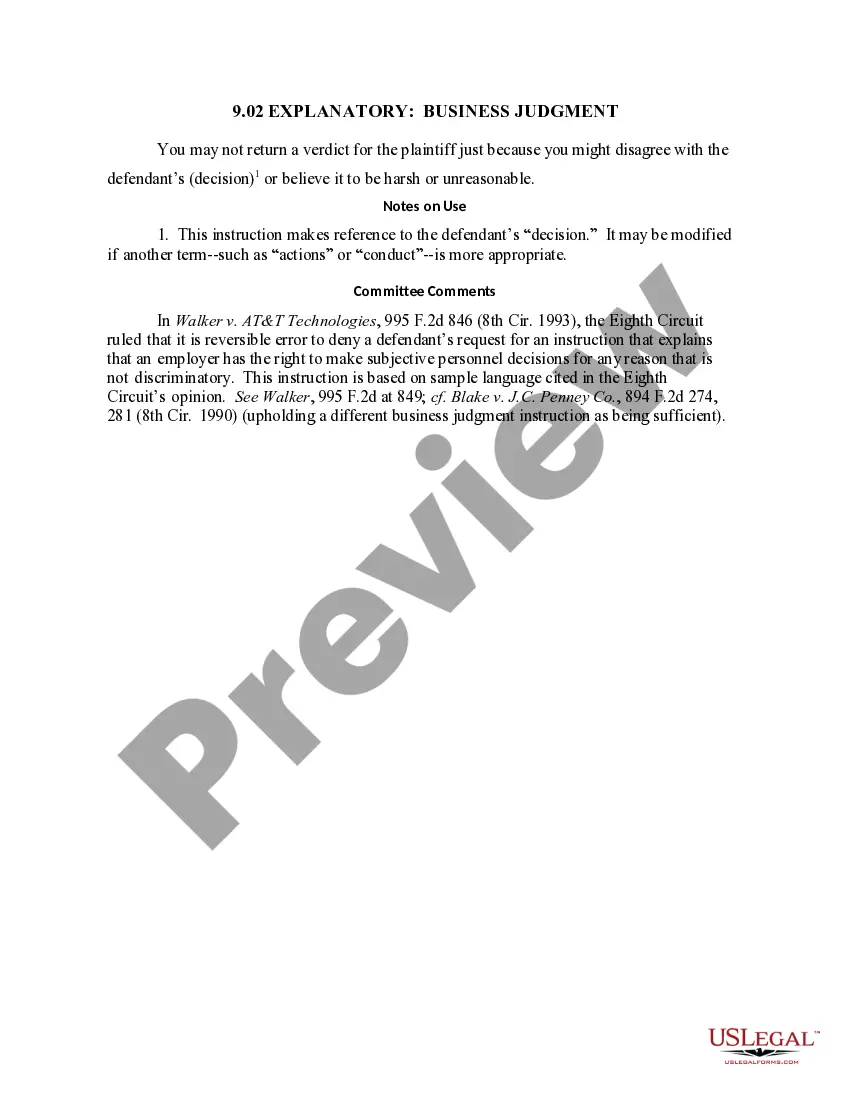
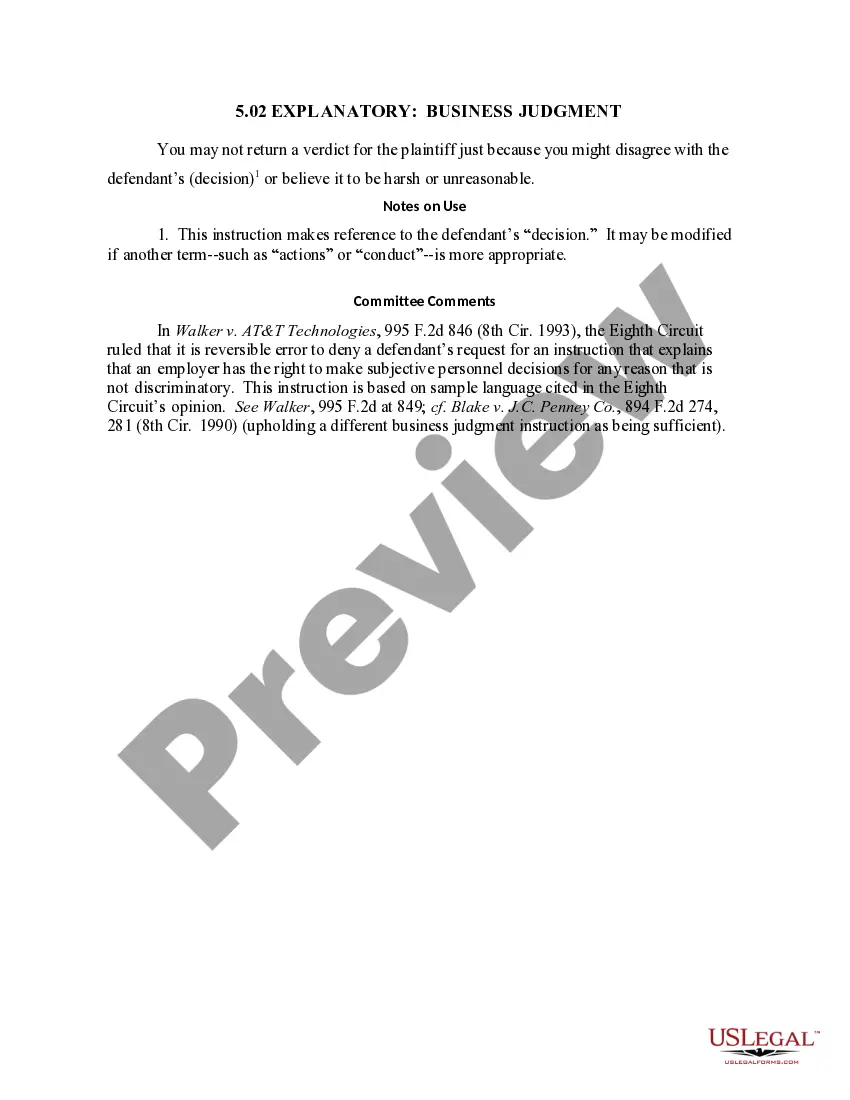
9.02 EXPLANATORY: BUSINESS JUDGMENT
Overview of this form
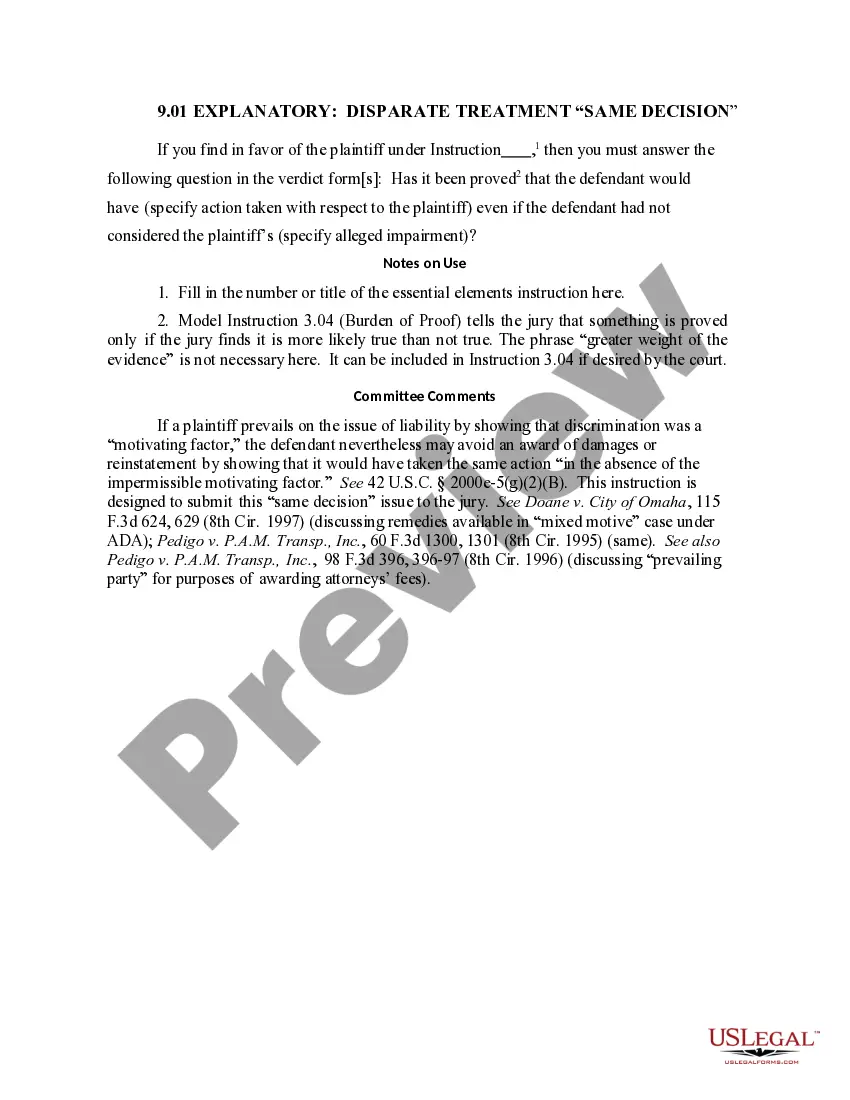
The 9.02 Explanatory: Business Judgment form is a legal instruction used in court cases where a defendant's decision-making process is examined. This form is essential for clarifying that a jury should not rule against a defendant simply because they disagree with the defendant's choices or view them as unreasonable. It emphasizes the principle that employers have the right to make subjective personnel decisions as long as they are not discriminatory.
Key parts of this document
- A clear definition of the defendant's decision and its importance in the case.
- Instructions to the jury about the limitations on their ability to second-guess business judgments.
- Reference to legal precedents establishing the context for business judgment claims.
- Guidance on modifications to terms used, such as "decision," based on case specifics.
When to use this document
This form is used in legal scenarios where a defendant's business decisions are challenged in court. It is particularly relevant in employment law cases where a plaintiff claims that the employer's decisions were unjust or discriminatory. This instruction helps protect the defendant by reinforcing the legitimacy of their decision-making process, provided it is non-discriminatory.
Who this form is for
- Attorneys representing defendants in employment-related litigation.
- Court officials who need to educate juries on business judgment rules.
- Employers seeking to understand their legal rights regarding personnel decisions.
Steps to complete this form
- Identify the key business decision made by the defendant.
- Specify the context and rationale behind the decision.
- Review relevant legal precedents that support business judgment claims.
- Ensure that terms describing the defendant's actions are clear and appropriate for the case.
- Prepare accompanying instructions for the jury that emphasize the legal standards in business judgment situations.
Notarization guidance
This form does not typically require notarization to be legally valid. However, some jurisdictions or document types may still require it. US Legal Forms provides secure online notarization powered by Notarize, available 24/7 for added convenience.
Get your form ready online
Our built-in tools help you complete, sign, share, and store your documents in one place.
Make edits, fill in missing information, and update formatting in US Legal Forms—just like you would in MS Word.
Download a copy, print it, send it by email, or mail it via USPS—whatever works best for your next step.
Sign and collect signatures with our SignNow integration. Send to multiple recipients, set reminders, and more. Go Premium to unlock E-Sign.
If this form requires notarization, complete it online through a secure video call—no need to meet a notary in person or wait for an appointment.
We protect your documents and personal data by following strict security and privacy standards.

Make edits, fill in missing information, and update formatting in US Legal Forms—just like you would in MS Word.

Download a copy, print it, send it by email, or mail it via USPS—whatever works best for your next step.

Sign and collect signatures with our SignNow integration. Send to multiple recipients, set reminders, and more. Go Premium to unlock E-Sign.

If this form requires notarization, complete it online through a secure video call—no need to meet a notary in person or wait for an appointment.

We protect your documents and personal data by following strict security and privacy standards.
Typical mistakes to avoid
- Failing to clearly define the business decision at issue.
- Overlooking to reference relevant case law that may impact the jury's understanding.
- Using ambiguous language when describing the defendant's actions.
Advantages of online completion
- Convenient access to legally drafted materials from licensed attorneys.
- Editability allows for customization to fit specific case scenarios quickly.
- Reliable format ensures compliance with legal standards.
Legal use & context
- This form is grounded in legal precedent, reinforcing the defendant's rights in business decision-making.
- It is intended to guide juries, reducing the risk of perplexity about the rationale behind personnel decisions.
- Understanding its application helps protect employers from unfair liability claims.
Looking for another form?
Form popularity
FAQ
More globally, the court stated, therefore, that the business judgment rule does not apply if the board (i) committed fraud, corporate waste, engaged in self-dealing, made decisions affected by a conflict of interest, acted in bad faith or with corrupt motive, or breached the duty of due care by having reached their
The Business Judgment Rule 1 Officers and directors must make decisions that they believe, in good faith, to be in the best interests of their companies and must make decisions after appropriate research and due diligence inquiries. The decisions must be the products of appropriate care and thought.
The business judgment rule gives directors protections from honest mistakes if they act with due care and loyalty. It is inapplicable if directors commit oppression or breach their fiduciary duties, e.g., if the directors stand to gain a personal benefit.
The business judgment rule provides a director of a corporation immunity from liability when a plaintiff sues on grounds that the director violated the duty of care to the corporation so long as the director's actions fall within the parameters of the rule.
Example of the Business Judgment Rule The board decides that discontinuing the product would free up resources necessary to focus on more profitable areas. In this case, the business judgment rule protects directors from prosecution by shareholders who disagree with their decision or who are adversely affected by it.
Under this standard, a court will uphold the decisions of a director as long as they are made (1) in good faith, (2) with the care that a reasonably prudent person would use, and (3) with the reasonable belief that the director is acting in the best interests of the corporation.
Fraud or Bad Faith If the director chooses to lie or to deliberately conceal information from the company or the rest of the board, any decisions made on the basis of those lies will ultimately result in civil and/or criminal liability on the part of the director committing the fraud.
The initial burden of proof is on the party challenging a director's decision. If the claimant fails to meet the evidentiary burden, the business judgment rule attaches to protect directors and the decisions they make.