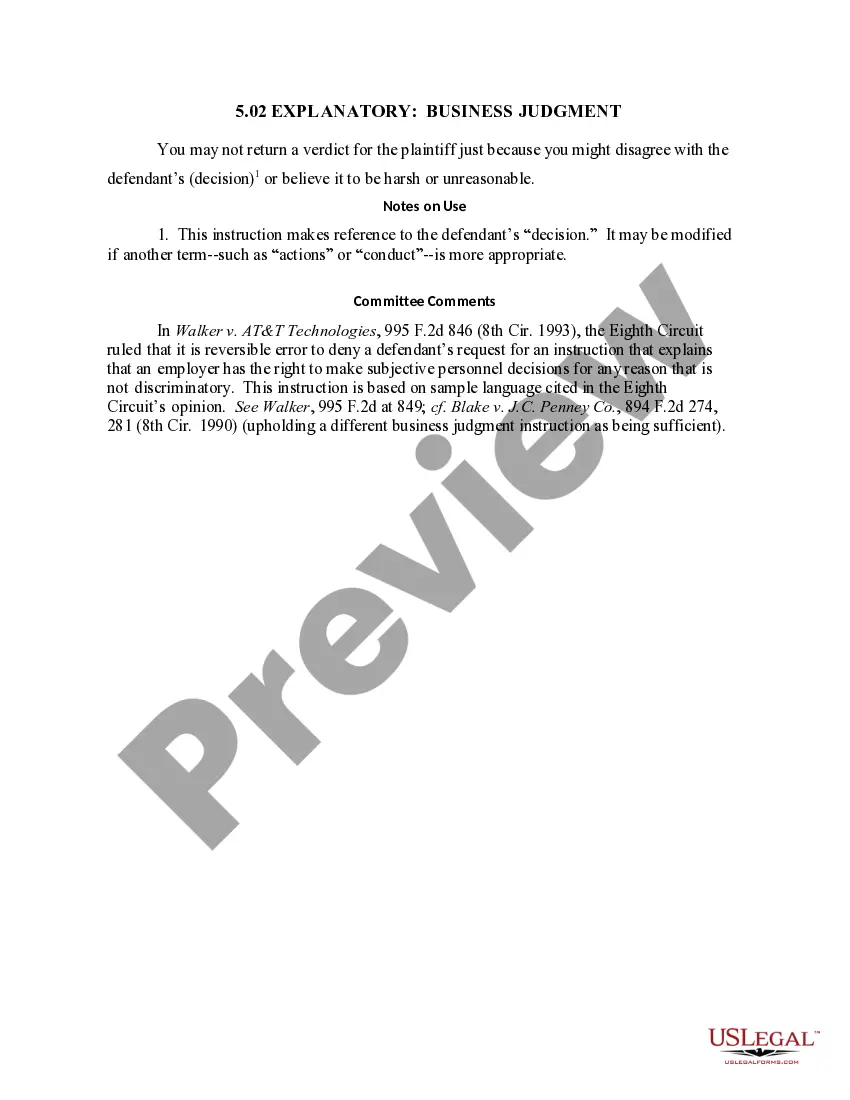
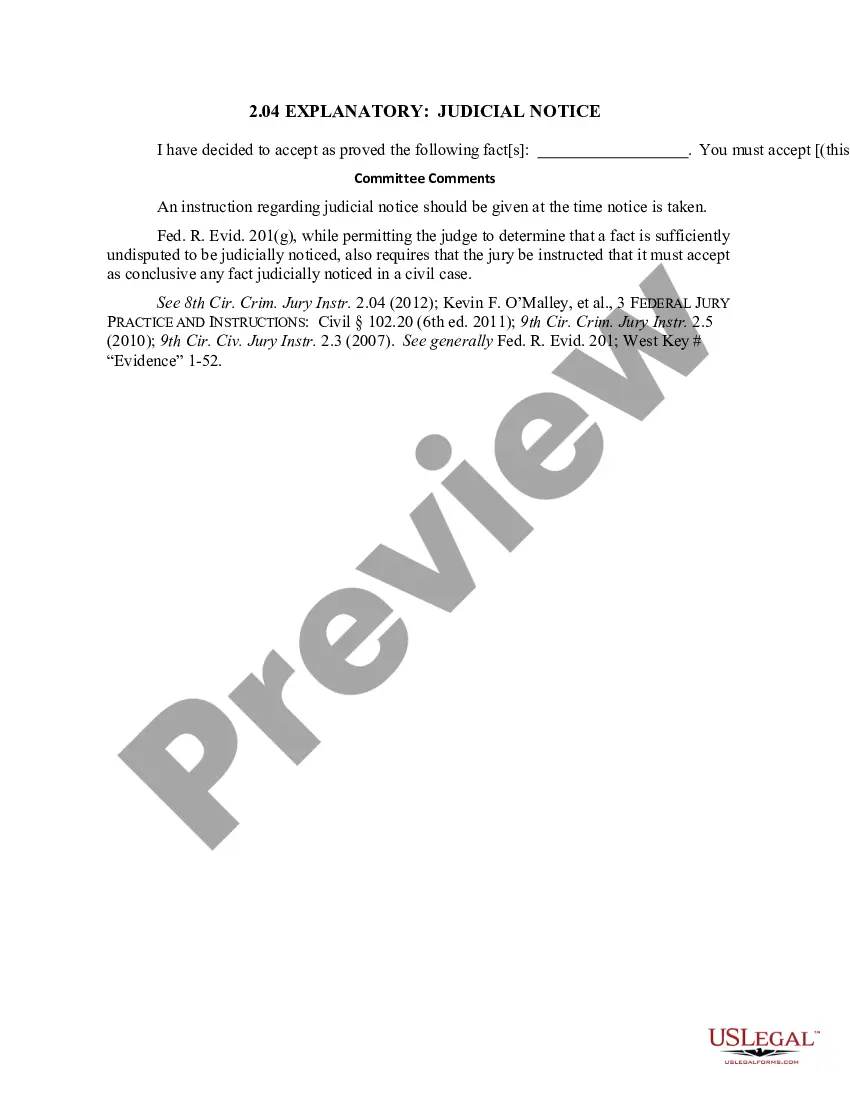
5.02 EXPLANATORY: BUSINESS JUDGMENT
What is this form?
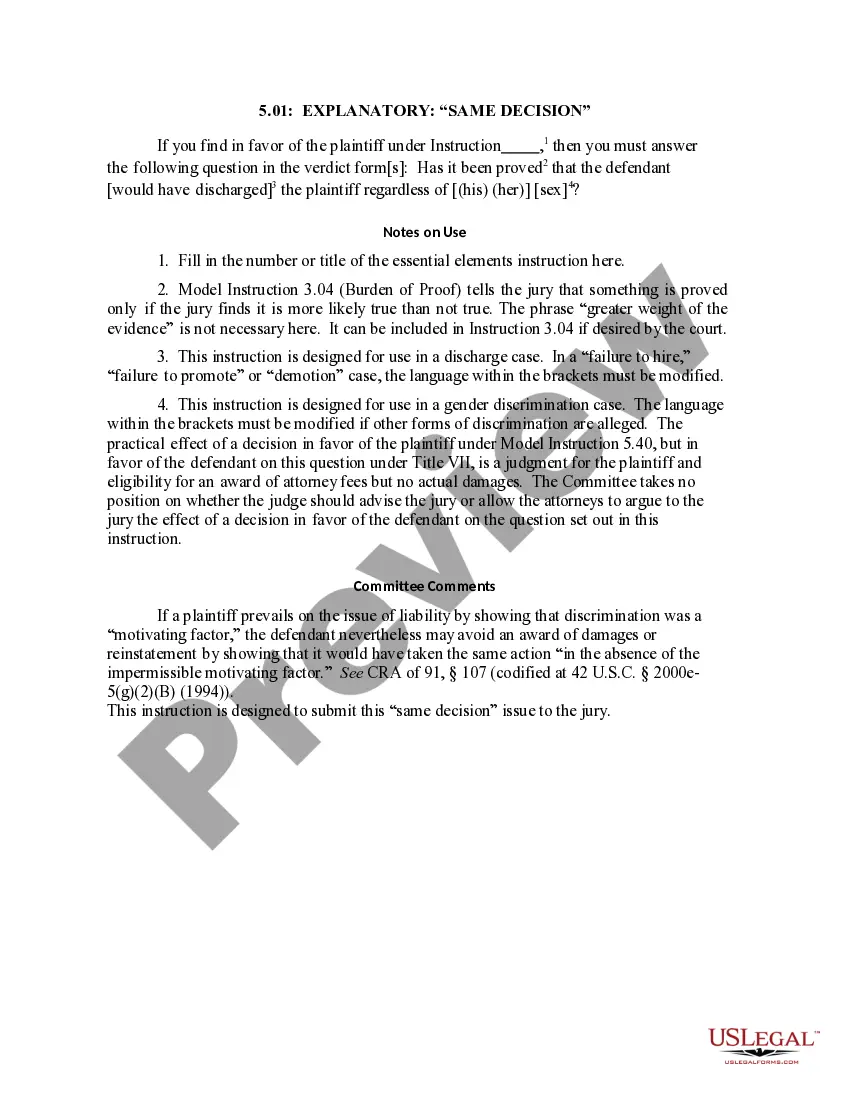
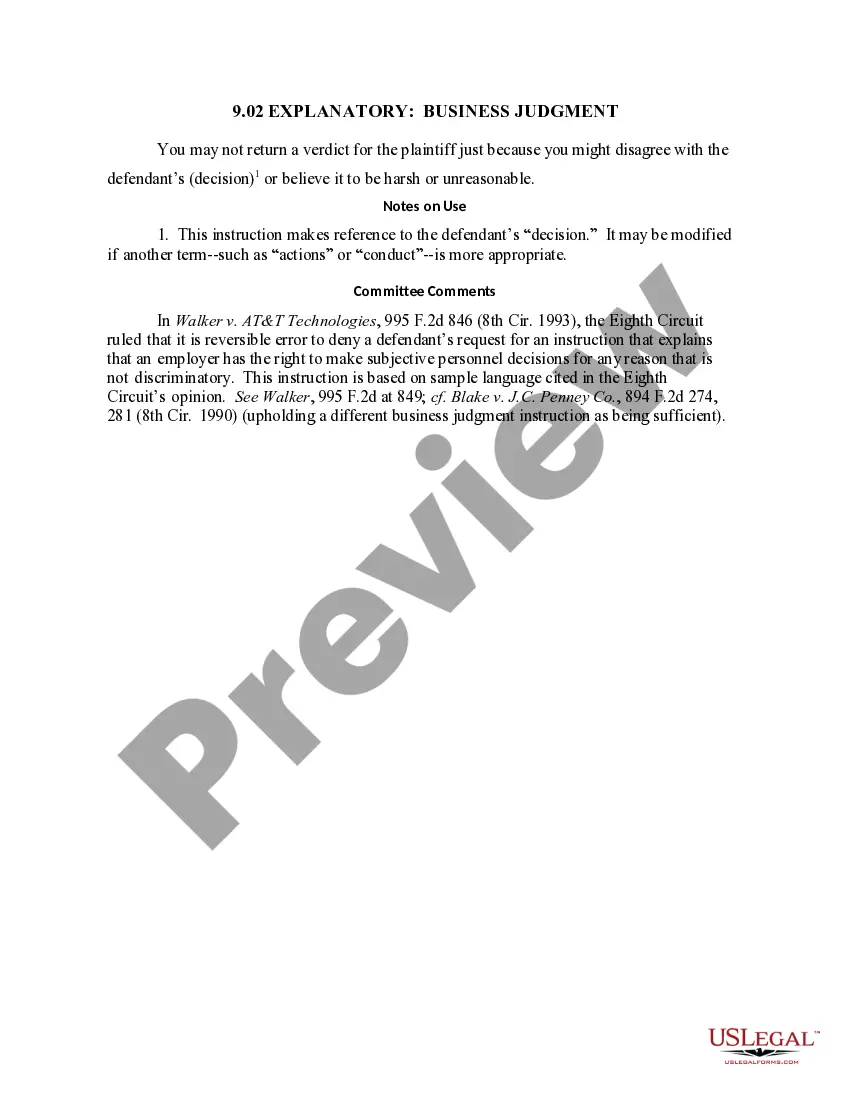
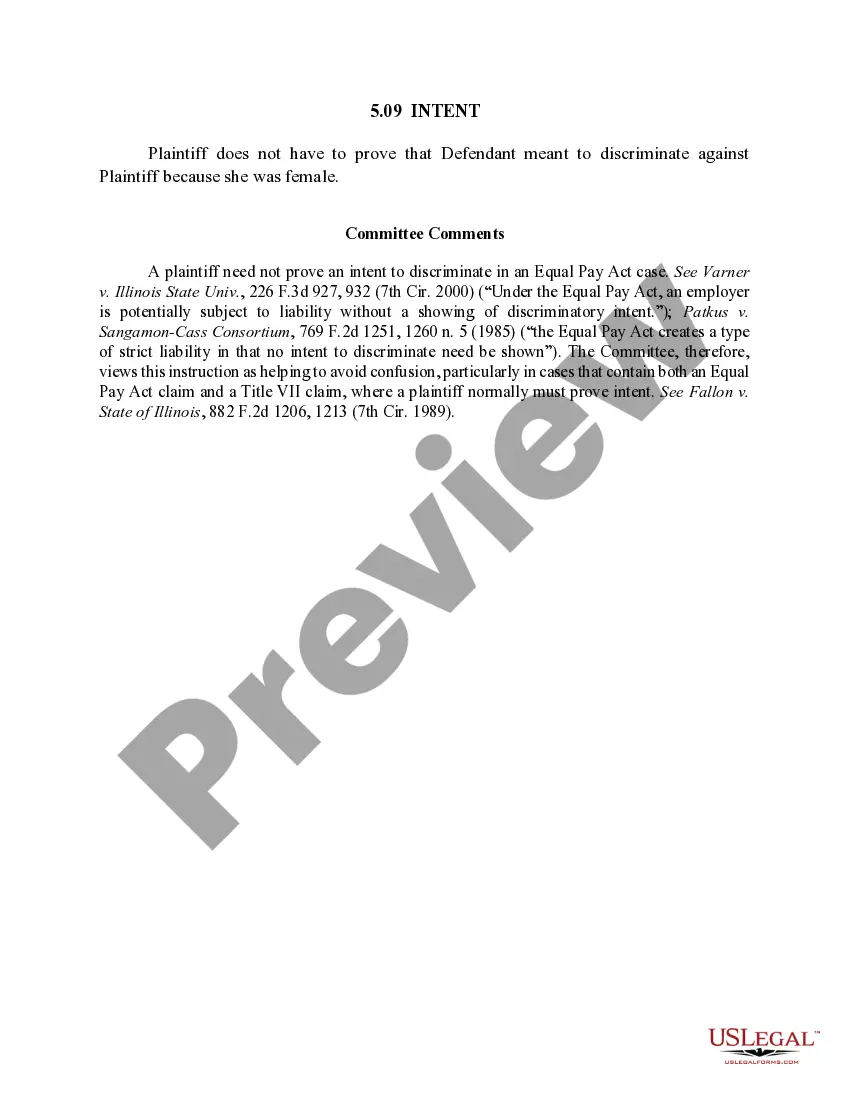
The Business Judgment form is a legal instruction that addresses the principles surrounding a defendant's decision-making in business contexts. It underscores that jurors should not penalize a defendant merely because they disagree with the decision made, unless the decision stems from discriminatory motives. This form is crucial in cases where subjective personnel decisions are questioned, ensuring that a distinction is made between lawful judgment and unlawful discrimination.
Key parts of this document
- Definition of business judgment principles.
- Clarification that jurors cannot decide against a defendant solely based on disagreement with their decisions.
- References to relevant case law illustrating the enforceability of these principles.
- Notes on modifying terms to fit specific cases (e.g., "actions" or "conduct").
Situations where this form applies
This form should be utilized in legal cases involving disputes over business decisions made by employers or corporations. It is particularly relevant in discrimination lawsuits where a plaintiff challenges an employer's subjective decisions regarding employment actions, such as hiring, promotion, or termination. The form guides jurors in understanding the boundaries of business judgment and reinforces the principle that not all unfavorable decisions are unlawful.
Who needs this form
- Attorneys representing defendants in discrimination lawsuits.
- Corporate legal teams protecting their decision-making processes from legal scrutiny.
- Judges and jurors interpreting the context of business decisions during trials.
Steps to complete this form
- Identify the defendant's specific decision in question.
- Gather relevant evidence that supports the business rationale behind the decision.
- Determine if modifications to terminology (e.g., "actions" or "conduct") are needed for clarity.
- Refer to applicable case law to support the business judgment defense.
- Prepare to explain these principles clearly during proceedings.
Is notarization required?
In most cases, this form does not require notarization. However, some jurisdictions or signing circumstances might. US Legal Forms offers online notarization powered by Notarize, accessible 24/7 for a quick, remote process.
Get your form ready online
Our built-in tools help you complete, sign, share, and store your documents in one place.
Make edits, fill in missing information, and update formatting in US Legal Forms—just like you would in MS Word.
Download a copy, print it, send it by email, or mail it via USPS—whatever works best for your next step.
Sign and collect signatures with our SignNow integration. Send to multiple recipients, set reminders, and more. Go Premium to unlock E-Sign.
If this form requires notarization, complete it online through a secure video call—no need to meet a notary in person or wait for an appointment.
We protect your documents and personal data by following strict security and privacy standards.

Make edits, fill in missing information, and update formatting in US Legal Forms—just like you would in MS Word.

Download a copy, print it, send it by email, or mail it via USPS—whatever works best for your next step.

Sign and collect signatures with our SignNow integration. Send to multiple recipients, set reminders, and more. Go Premium to unlock E-Sign.

If this form requires notarization, complete it online through a secure video call—no need to meet a notary in person or wait for an appointment.

We protect your documents and personal data by following strict security and privacy standards.
Common mistakes
- Failing to adequately support the rationale behind the business judgment with evidence.
- Misapplying the legal standard for subjective decision-making.
- Not modifying language to fit the specific context of the case.
Why complete this form online
- Convenient access to professionally drafted legal templates.
- Customizability to fit specific needs and case details.
- Reliable formatting that follows legal standards, reducing errors.
- Direct download for immediate use in legal proceedings.
Legal use & context
- This form outlines the business judgment rule, which allows employers to make subjective decisions without fear of liability as long as those decisions are not discriminatory.
- The instruction is based on precedents set by the Eighth Circuit, ensuring its relevance and applicability in similar cases.
Looking for another form?
Form popularity
FAQ
The business judgment rule gives directors protections from honest mistakes if they act with due care and loyalty. It is inapplicable if directors commit oppression or breach their fiduciary duties, e.g., if the directors stand to gain a personal benefit.
The New Jersey Offer of Judgment Rule permits any party to make an ?offer to take judgment? either in the party's favor (if a plaintiff) or against the offeror (if a defendant).
The business judgment rule provides a director of a corporation immunity from liability when a plaintiff sues on grounds that the director violated the duty of care to the corporation so long as the director's actions fall within the parameters of the rule.
Business Judgement Rule (BJR) is a presumption that directors, by default, act while (1) sufficiently informed, in (2) good faith, and with (3) an honest belief that they have the best interest of the corporation and stockholders in mind.
The business judgment rule protects companies from frivolous lawsuits by assuming that, unless proved otherwise, management is acting in the interests of the corporation and its stakeholders. The rule assumes that managers will not make optimal decisions all the time.
The business judgment rule protects the directors and officers of a corporation from liability for intra vires decisions within their authority and made in good faith, uninfluenced by any consideration other than an honest belief that the action promotes the corporation's best interest.
Courts refer to the business judgment rule when determining whether or not the actions of a board or board member are permissible under the law and under the governing documents of the cooperative in question. The rule is used regularly in other states, as well as in New Jersey.
The Business Judgment Rule 1 Officers and directors must make decisions that they believe, in good faith, to be in the best interests of their companies and must make decisions after appropriate research and due diligence inquiries. The decisions must be the products of appropriate care and thought.