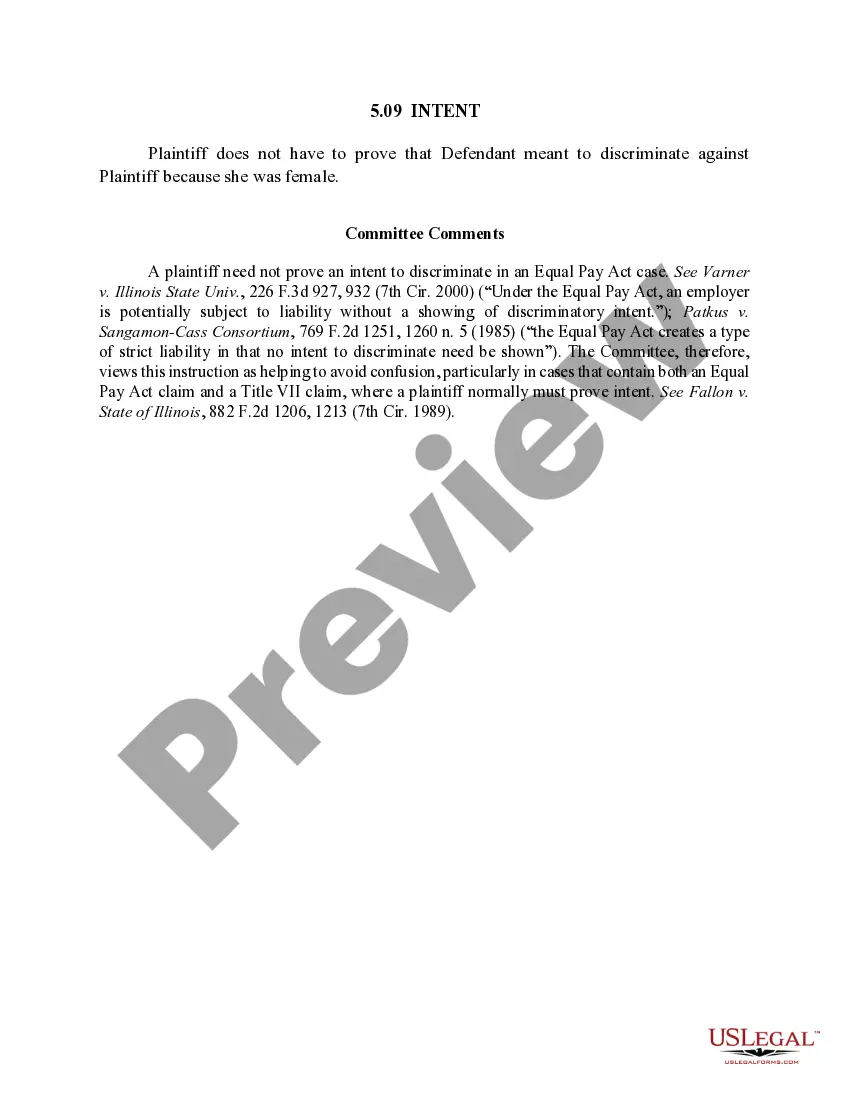
5.09 Intent
Overview of this form
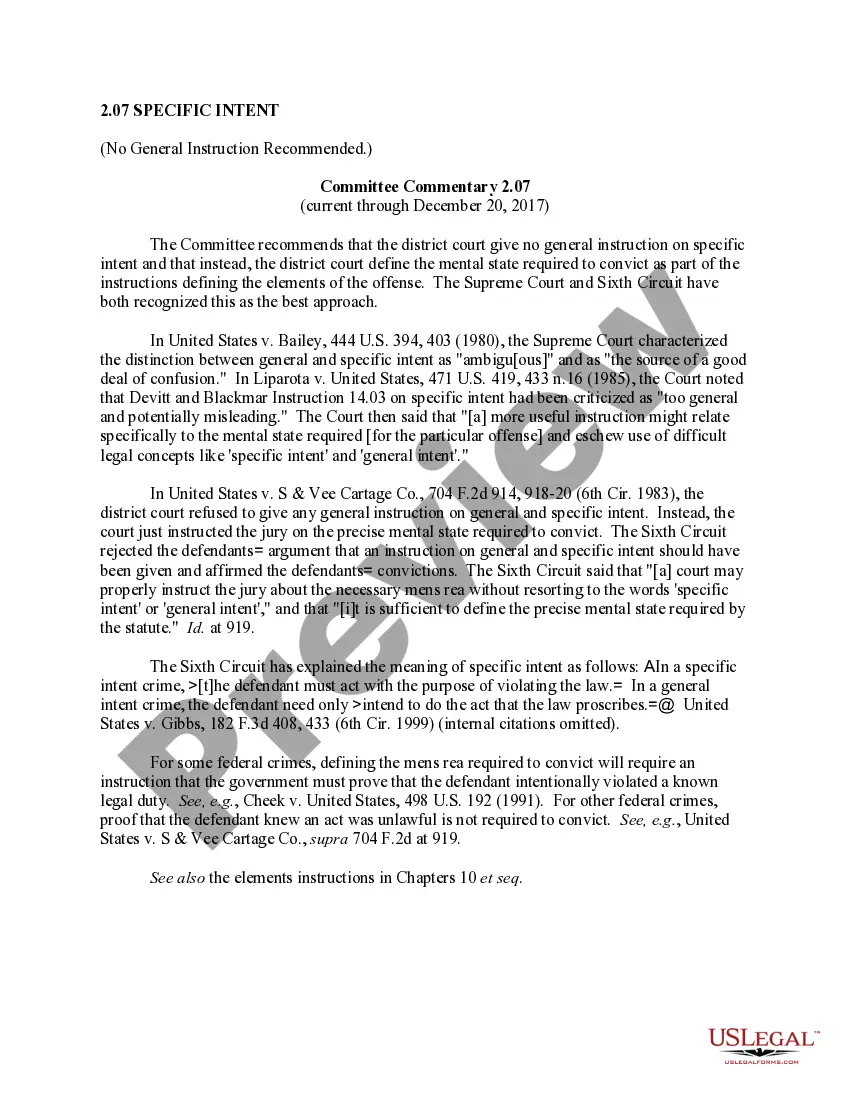
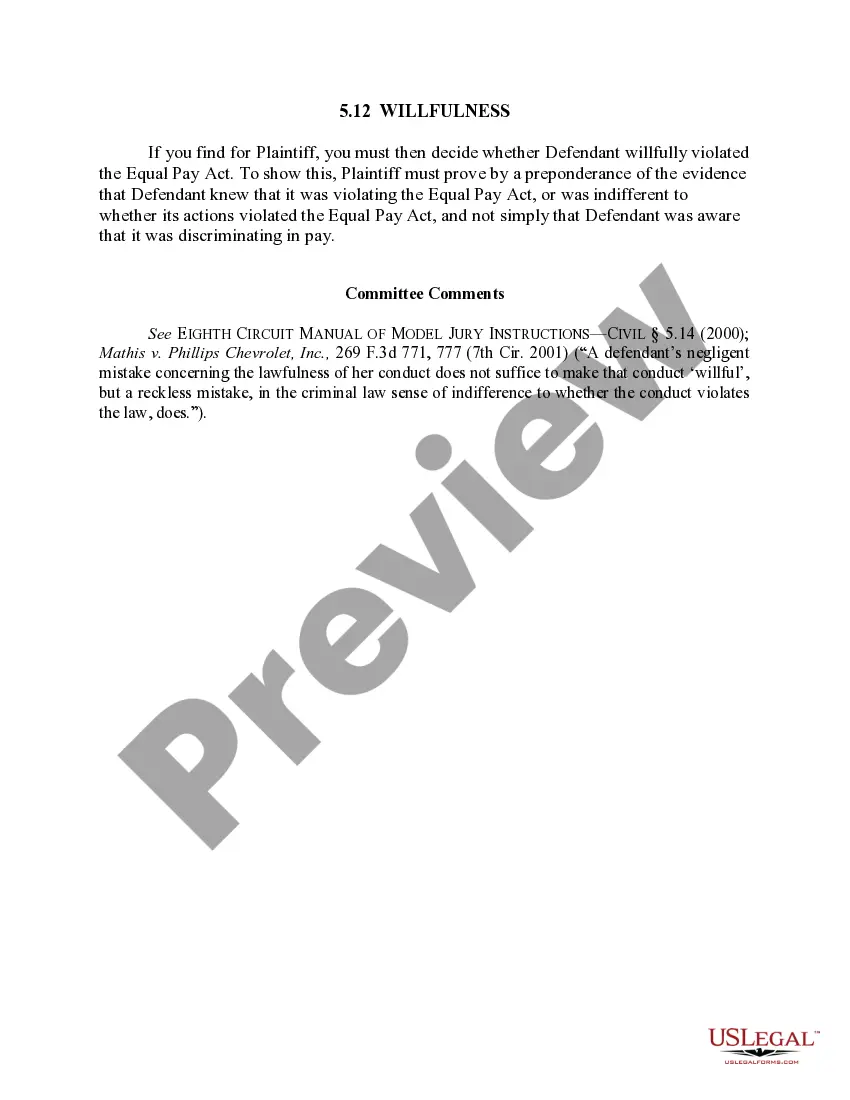
The 5.09 Intent form is an official instruction adopted by the Federal 7th Circuit Court, specifically designed for cases under the Equal Pay Act. Unlike other discrimination claims, this form clarifies that a plaintiff does not need to prove the defendant's intent to discriminate based on gender. This distinction is vital in cases where both Equal Pay Act and Title VII claims are present, ensuring that jurors understand the specific legal standards that apply.
Main sections of this form
- Definition of intent in discrimination cases.
- Clarification that intent does not need to be proven under the Equal Pay Act.
- Citation of relevant case law and committee comments to support the instruction.

When to use this document
This form is used in legal proceedings involving alleged violations of the Equal Pay Act. It is applicable when a plaintiff claims they were paid less than their male counterparts for similar work, allowing the case to proceed without the necessity of proving discriminatory intent. It helps to streamline the focus on wage disparity rather than the defendant's motivations.
Intended users of this form
- Plaintiffs alleging wage discrimination based on gender under the Equal Pay Act.
- Attorneys representing clients in employment discrimination cases.
- Legal professionals seeking clarity on jury instructions related to intent in discrimination lawsuits.
Instructions for completing this form
- Identify the parties involved in the case.
- Reference previous case law that supports the application of this form.
- Clearly state the allegations of wage discrimination.
- Ensure all relevant factual information is provided to support the claim.
- Review the completed form for compliance with jurisdictional requirements.
Notarization requirements for this form
This form usually doesn’t need to be notarized. However, local laws or specific transactions may require it. Our online notarization service, powered by Notarize, lets you complete it remotely through a secure video session, available 24/7.
Get your form ready online
Our built-in tools help you complete, sign, share, and store your documents in one place.
Make edits, fill in missing information, and update formatting in US Legal Forms—just like you would in MS Word.
Download a copy, print it, send it by email, or mail it via USPS—whatever works best for your next step.
Sign and collect signatures with our SignNow integration. Send to multiple recipients, set reminders, and more. Go Premium to unlock E-Sign.
If this form requires notarization, complete it online through a secure video call—no need to meet a notary in person or wait for an appointment.
We protect your documents and personal data by following strict security and privacy standards.

Make edits, fill in missing information, and update formatting in US Legal Forms—just like you would in MS Word.

Download a copy, print it, send it by email, or mail it via USPS—whatever works best for your next step.

Sign and collect signatures with our SignNow integration. Send to multiple recipients, set reminders, and more. Go Premium to unlock E-Sign.

If this form requires notarization, complete it online through a secure video call—no need to meet a notary in person or wait for an appointment.

We protect your documents and personal data by following strict security and privacy standards.
Mistakes to watch out for
- Failing to reference applicable case law that relates to the Equal Pay Act.
- Overlooking the necessity to clarify the absence of discriminatory intent.
- Confusing this instruction with those applicable to claims under Title VII, which require proof of intent.
Advantages of online completion
- Convenience of immediate access to legal documents anytime.
- Editability allows tailoring the form to specific case details.
- Reliability with forms drafted by licensed attorneys to meet legal standards.
Legal use & context
- This form is essential for cases regarding wage discrimination under the Equal Pay Act.
- It serves to clarify the judicial approach towards discriminatory intent, which differs from traditional discrimination claims.
- Legal precedent establishes the framework used for interpretation and application of this form.
Looking for another form?


Form popularity
FAQ
A fly out is a term for when a fly ball is caught by a fielder before hitting the ground, resulting in the batter being ruled out. These do not include balls designated for line drives.
An infield fly is any fair fly ball (not including a line drive or a bunt) which can be caught by an infielder with ordinary effort when first and second or first, second and third base are occupied, before two men are out.
The Infield Fly only calls the batter out. It does NOT create a dead-ball situation. Runners are allowed to advance at their own jeopardy the same as any other fly ball. If caught, the runners must re-touch the base or risk being called out on appeal.
In baseball, a catch occurs when a fielder gains secure possession of a batted ball before it bounces, and maintains possession until they voluntarily or intentionally release the ball.
A batter is out when: (1) His fair or foul fly ball (other than a foul tip) is legally caught by a fielder; Rule 5.09(a)(1) Comment: A fielder may reach into, but not step into, a dugout to make a catch, and if he holds the ball, the catch shall be allowed.
Definition. An infield fly is any fair fly ball (not including a line drive or a bunt) which can be caught by an infielder with ordinary effort when first and second or first, second and third base are occupied, before two men are out.
In a force situation, the fielder must have the ball held securely in hand or the glove. He cannot have the ball pinned to his chest, for example, or in his lap, between his legs, or any other way than "securely in hand or glove."
It is a force out when a runner is called out for not tagging up on a fly ball. An appeal on a runner who missed a base cannot be a force out. A runner is out if he runs out of the baseline to avoid a fielder who is fielding a batted ball.