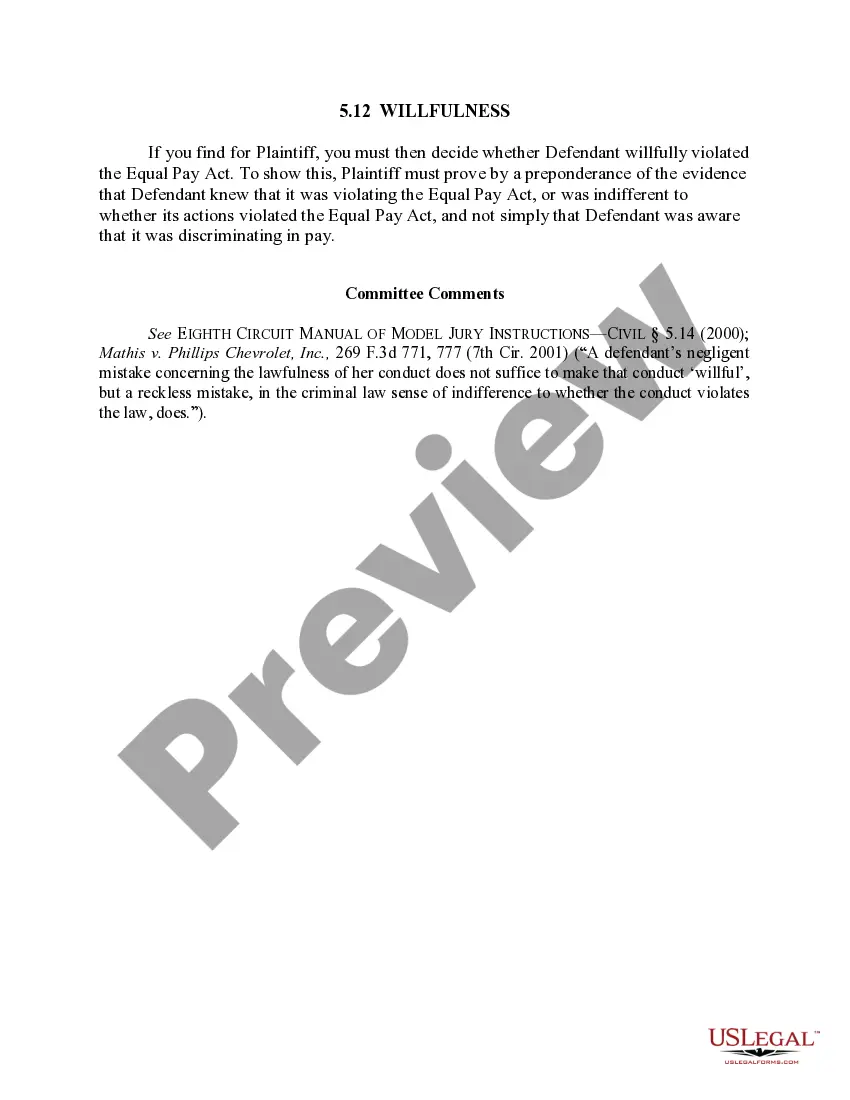
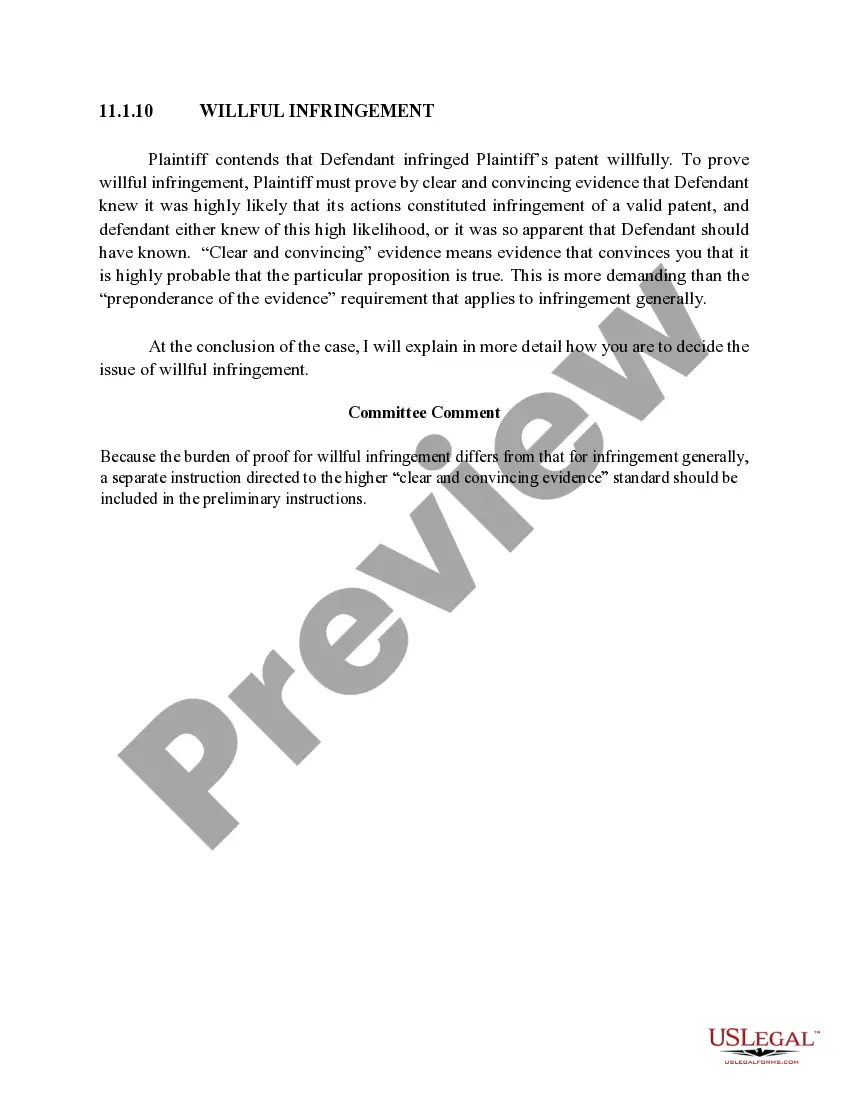
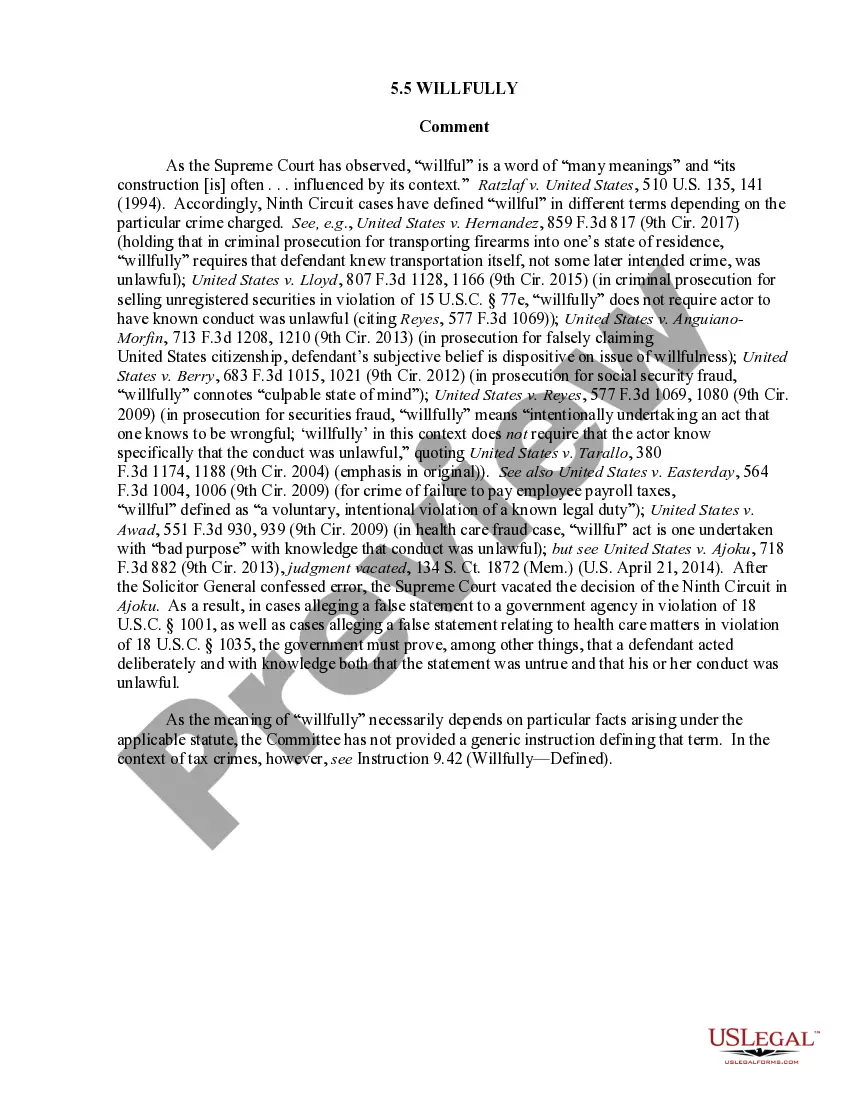
5.12 Willfulness
What this document covers
The 5.12 Willfulness form is an official pattern jury instruction that assists in determining whether a defendant willfully violated the Equal Pay Act. This form outlines the legal standard that plaintiffs must meet to prove willful violations, distinguishing it from other jury instructions by focusing specifically on the intent and knowledge of the defendant regarding pay discrimination. Utilizing this form can help ensure that juries have a clear understanding of the necessary criteria for willfulness in cases of equal pay claims.
Key components of this form
- Definition of willfulness in relation to the Equal Pay Act violations.
- Criteria for proving that the defendant had knowledge or indifference to their conduct.
- Clear instructions for jurors on the standard of evidence required for a finding of willfulness.
- References to relevant case law that illustrates the application of this standard.
- Comments to clarify the intent behind the jury instruction and its practical application.
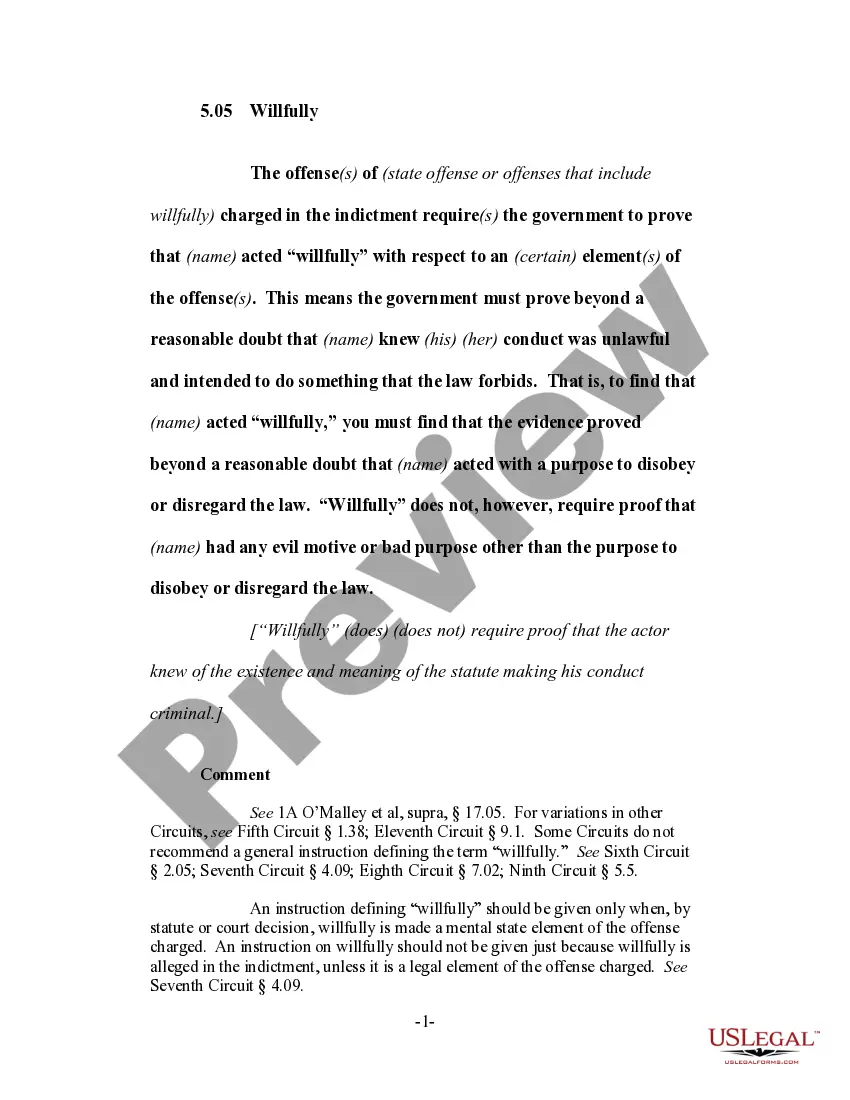
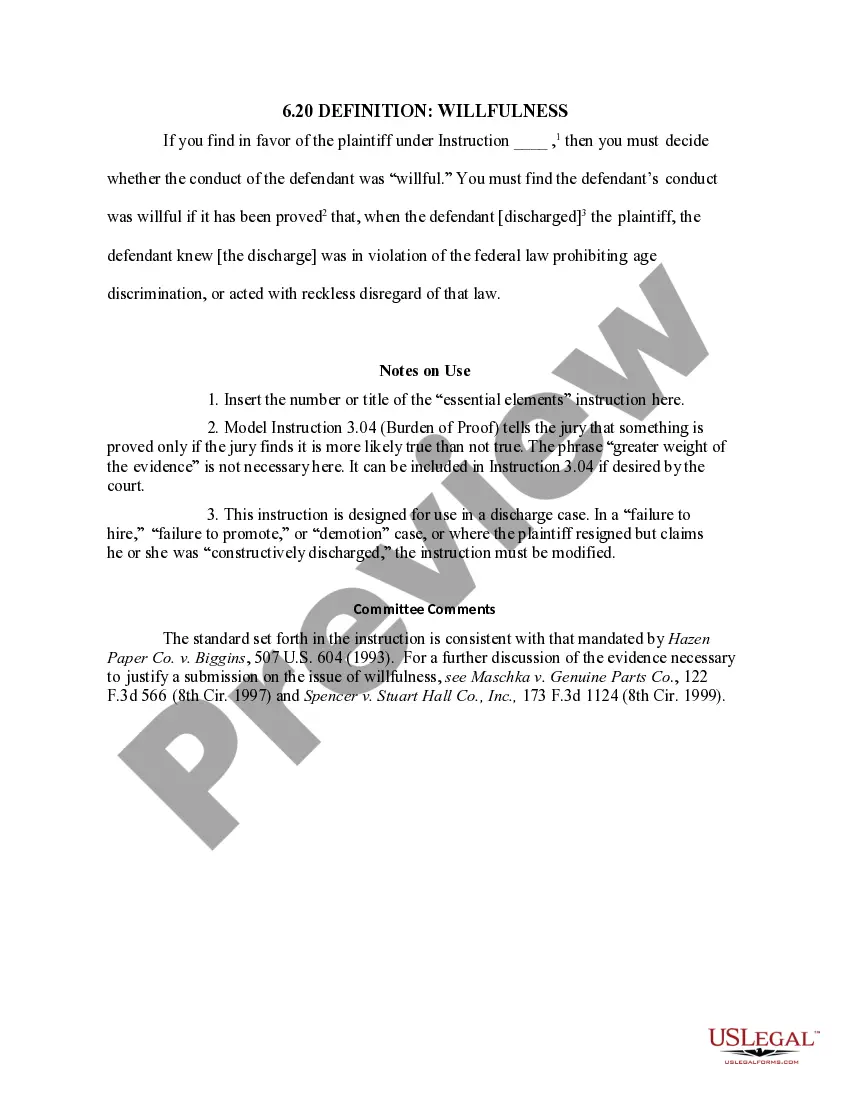
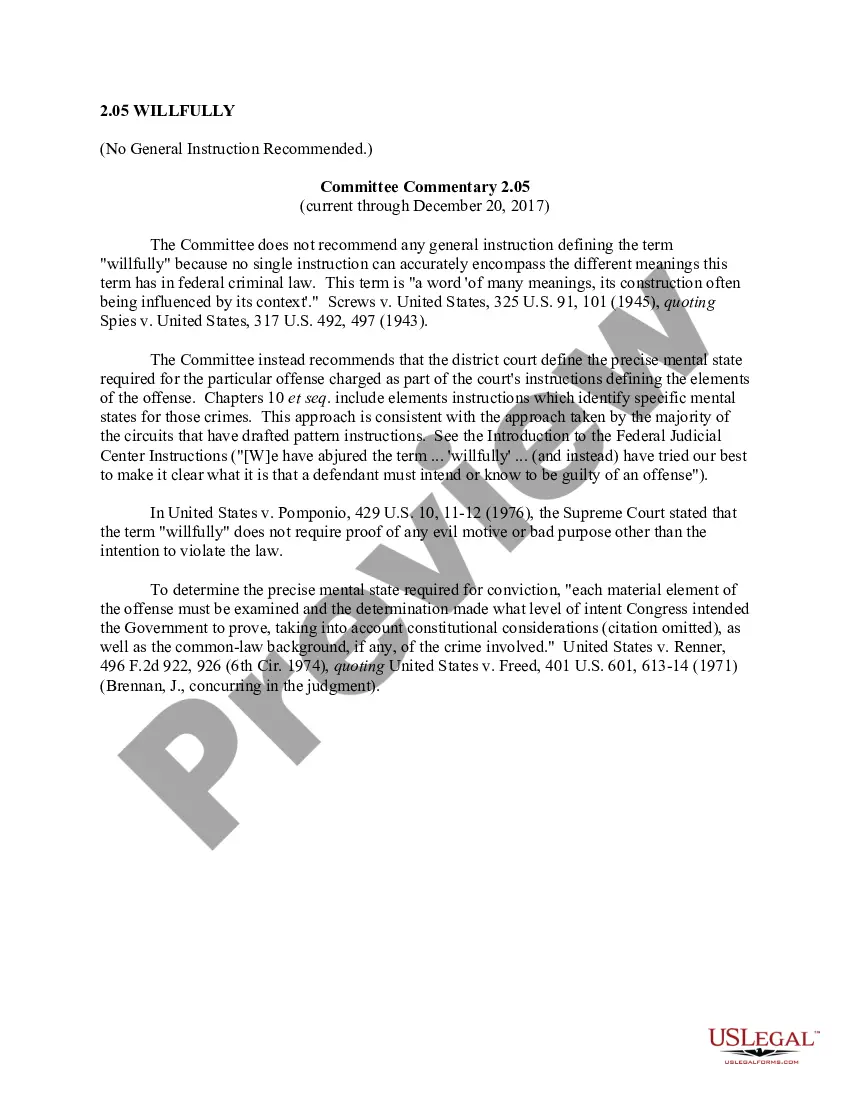
Situations where this form applies
This form should be used in cases where there is an allegation that an employer violated the Equal Pay Act. It is particularly relevant when the plaintiff needs to demonstrate that the defendant's actions were willful rather than merely negligent. Situations may include disputes over unequal pay between employees performing similar work, especially when there are indicators of intentional discrimination or indifference to the pay disparities.
Who can use this document
- Plaintiffs pursuing claims under the Equal Pay Act.
- Attorneys representing clients in employment discrimination cases.
- Legal practitioners involved in jury trials related to wage discrimination.
- Members of juries needing clear guidelines for evaluating claims of willfulness.
How to complete this form
- Review the situation to determine if a claim of willfulness under the Equal Pay Act is applicable.
- Gather evidence that demonstrates the defendant's knowledge or indifference regarding the pay disparity.
- Ensure that the instruction is clearly understood by jurors and that they are aware of the burden of proof.
- Present the case in a structured manner, emphasizing key components outlined in the form.
- Follow legal procedures for presenting jury instructions during the trial.
Does this document require notarization?
This form does not typically require notarization to be legally valid. However, some jurisdictions or document types may still require it. US Legal Forms provides secure online notarization powered by Notarize, available 24/7 for added convenience.
Get your form ready online
Our built-in tools help you complete, sign, share, and store your documents in one place.
Make edits, fill in missing information, and update formatting in US Legal Forms—just like you would in MS Word.
Download a copy, print it, send it by email, or mail it via USPS—whatever works best for your next step.
Sign and collect signatures with our SignNow integration. Send to multiple recipients, set reminders, and more. Go Premium to unlock E-Sign.
If this form requires notarization, complete it online through a secure video call—no need to meet a notary in person or wait for an appointment.
We protect your documents and personal data by following strict security and privacy standards.

Make edits, fill in missing information, and update formatting in US Legal Forms—just like you would in MS Word.

Download a copy, print it, send it by email, or mail it via USPS—whatever works best for your next step.

Sign and collect signatures with our SignNow integration. Send to multiple recipients, set reminders, and more. Go Premium to unlock E-Sign.

If this form requires notarization, complete it online through a secure video call—no need to meet a notary in person or wait for an appointment.

We protect your documents and personal data by following strict security and privacy standards.
Avoid these common issues
- Assuming that mere awareness of pay discrepancies constitutes willfulness.
- Failing to provide sufficient evidence to show the defendant's intent or indifference.
- Not addressing the legal standards for willfulness in the context of the Equal Pay Act.
- Overlooking relevant case law that can support the argument for willfulness.
Benefits of completing this form online
- Easy to access and download from the US Legal Forms website.
- Editable Word format allows customization for specific case needs.
- Convenient for legal practitioners who require quick reference during trials.
- Provides reliable information drafted by licensed attorneys, ensuring legal accuracy.
Legal use & context
- Applicable in federal and state court cases involving equal pay violations.
- Designed to provide clarity to jurors about the legal expectations regarding willfulness.
- Helps mitigate confusion related to the burden of proof in employment discrimination cases.
Key takeaways
- The 5.12 Willfulness form is essential for cases involving allegations of willful violations of the Equal Pay Act.
- Plaintiffs must meet specific criteria to prove willfulness, which differs from mere negligence.
- This form offers jurors clear guidance on how to assess evidence related to willfulness.
Looking for another form?
Form popularity
FAQ
Punitive damages are awarded when the defendant's conduct is determined to have been so "willful, malicious, or fraudulent" that it exceeds the legal criteria for mere or gross negligence. Punitive damages typically involve awards over and above the compensatory damage award.
In a case of ordinary negligence, the government entity would assume liability. In a case of gross negligence, however, liability falls on the worker him or herself. The second reason it matters is for compensatory purposes.
New Jersey law allows you to receive punitive damages of up to five times your compensatory damages or $350,000, whichever is greater. However, you should know that these damages being mandated in a New Jersey lawsuit is an extraordinary measure that is rarely taken.
N.J.S.A. 2A:15-5.13 (e). (e) There is a cap on punitive damages ? five times the amount of compensatory damages or $350,000, whichever is greater.
Punitive damages, sometimes called exemplary damages, are additional damages that can be taken from the defendant to punish them for grievous negligence and to prevent them ? and others ? from making the same mistake again. A common example of punitive damages is drunk driving cases.
Ing to the New Jersey Punitive Damages Act, N.J.S.A. 2A:15-5.9, the amount of punitive damages that can be sought is limited to either five times the amount of compensatory damages awarded in the case or $350,000, whichever is greater.
Punitive damages, also known as exemplary damages, can be awarded to a plaintiff in New Jersey in addition to compensatory damages (i.e., to cover medical bills, lost wages, pain and suffering, disability, impairment, and/or loss of enjoyment of life), when the conduct of the individual who caused the victim harm is