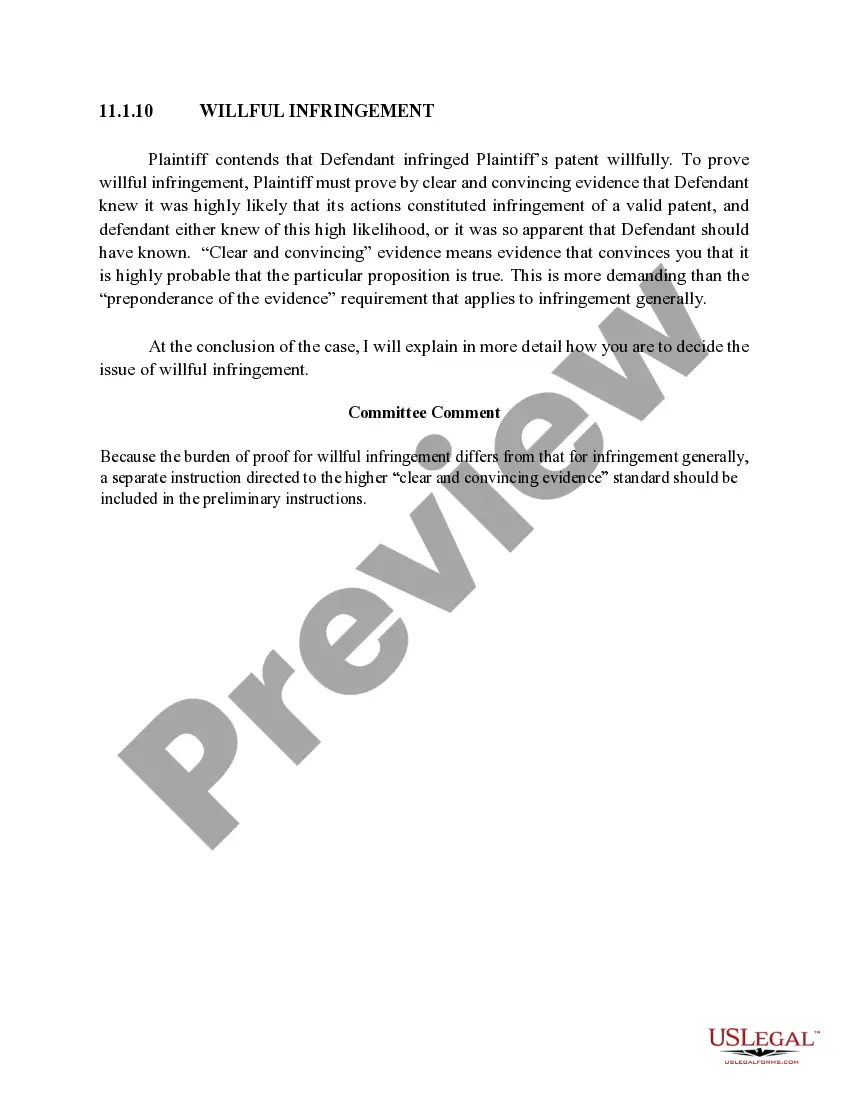
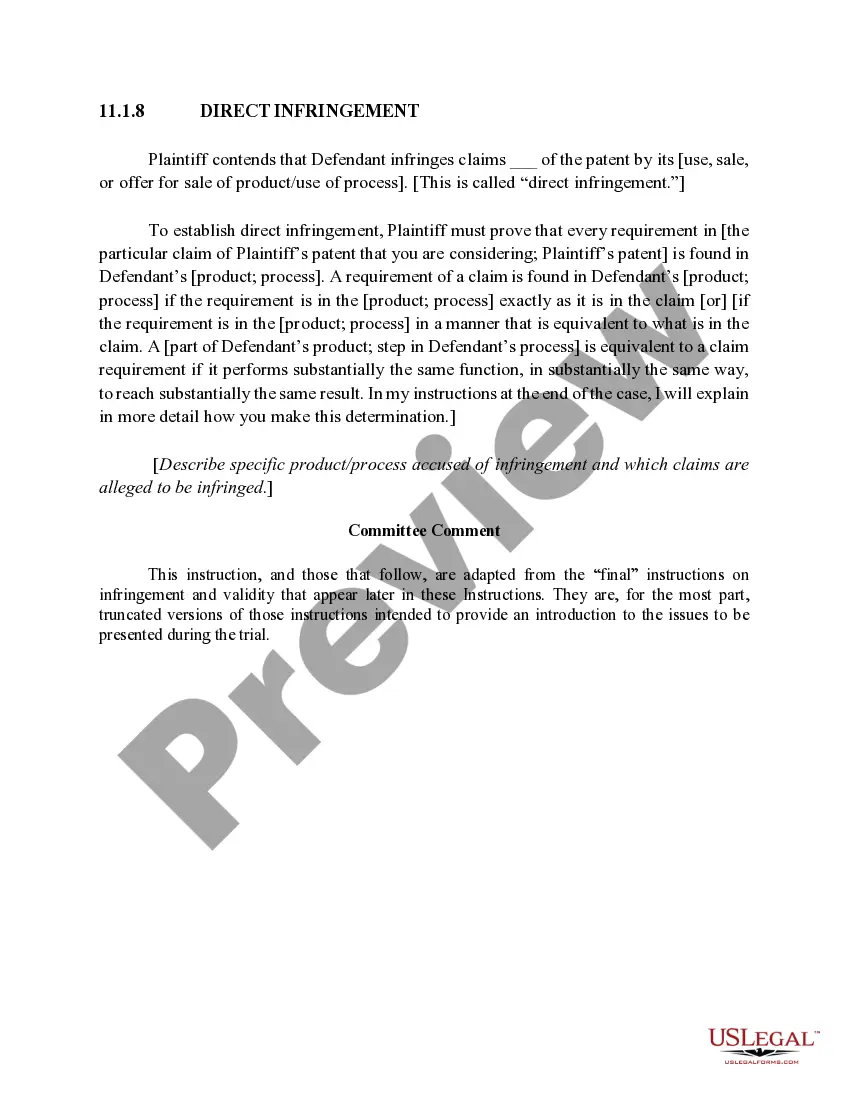
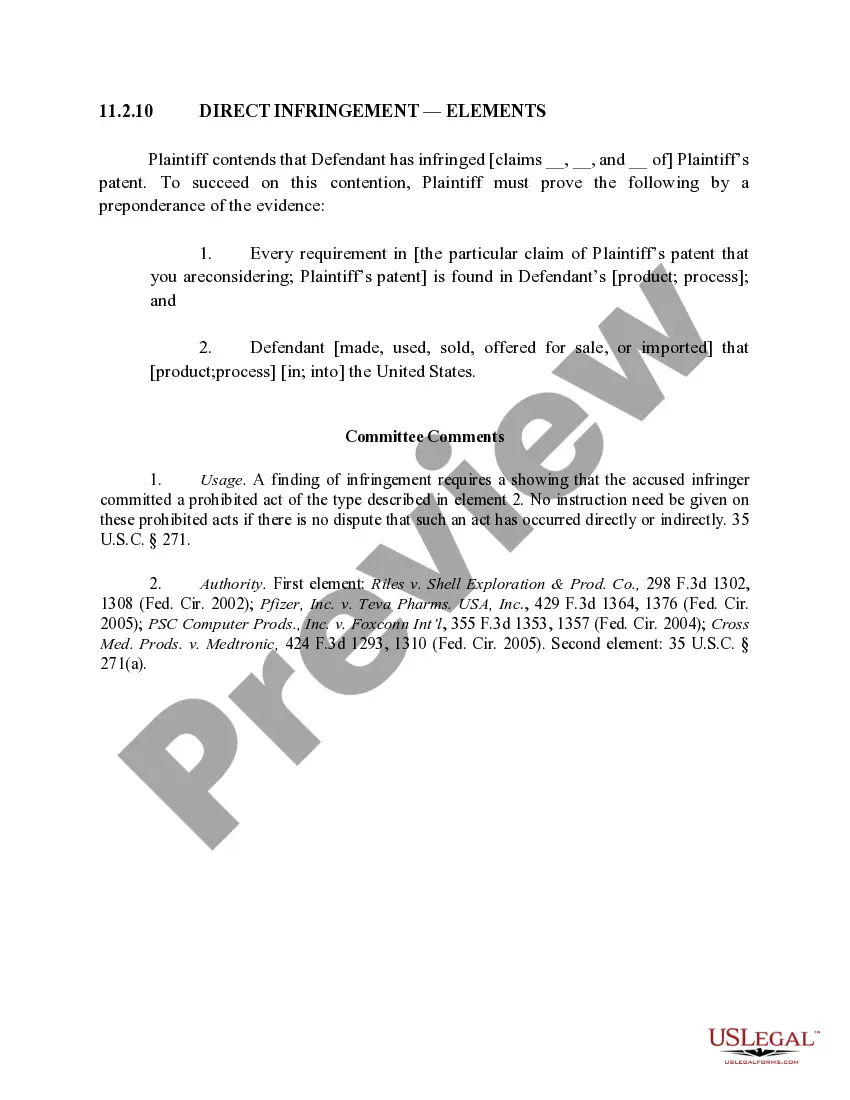
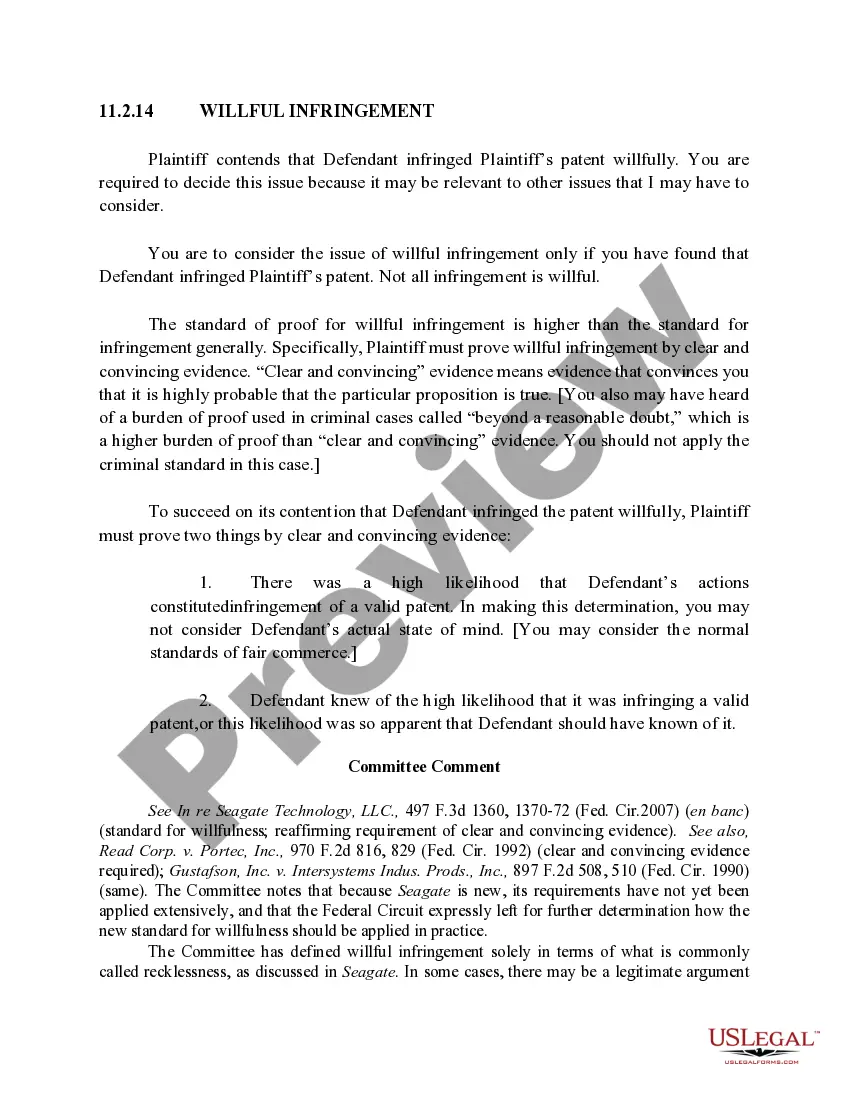
11.1.10 Willful Infringement
Understanding this form
The Willful Infringement form is a legal instruction template that guides jury deliberation regarding claims of willful patent infringement. This form outlines the specific requirements that must be met for a plaintiff to prove that a defendant knowingly infringed on a patent. It differs from general infringement claims by requiring a higher standard of evidence, termed "clear and convincing evidence," making it crucial in patent litigation cases.
Main sections of this form
- Definition of willful infringement and its legal implications.
- Explanation of the "clear and convincing evidence" standard necessary for proving willfulness.
- Distinction between willful infringement and general patent infringement.
- Instructions for the jury on how to evaluate the evidence presented in court.
- Committee commentary on the burden of proof differences for willful infringement cases.
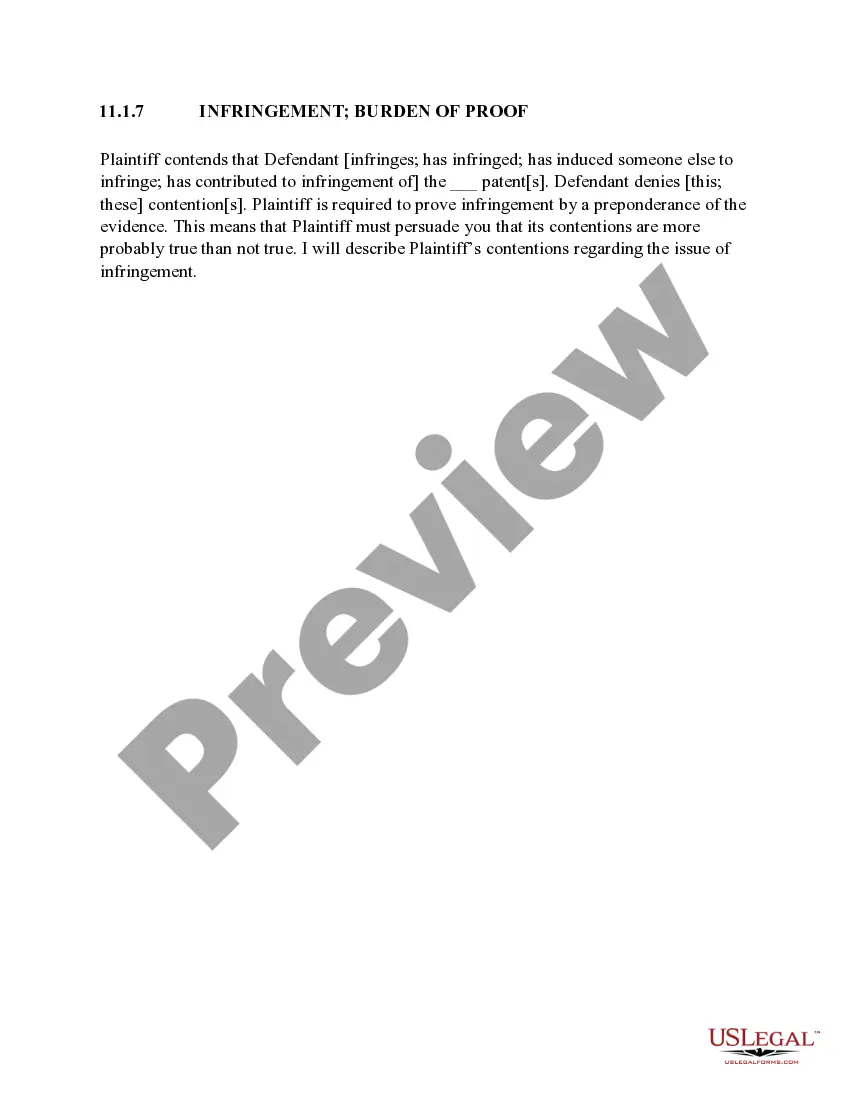
When to use this document
This form should be used in patent infringement cases where the plaintiff alleges that the defendant willfully infringed on their patent rights. It is applicable in scenarios where there is clear evidence suggesting that the defendant knowingly acted in violation of a valid patent, thereby potentially leading to increased damages if found liable.
Intended users of this form
- Plaintiffs in patent infringement lawsuits seeking to prove willfulness.
- Attorneys representing clients in patent litigation cases.
- Juries hearing cases involving claims of willful patent infringement.
Steps to complete this form
- Identify the parties involved in the case, including the plaintiff and the defendant.
- Gather evidence that demonstrates the defendant's knowledge of the patent and likelihood of infringement.
- Prepare to present arguments that meet the "clear and convincing evidence" standard.
- Instruct the jury about their responsibilities in determining willful infringement based on the evidence.
- Conclude with an explanation of the potential legal implications for the defendant if found liable.
Does this form need to be notarized?
In most cases, this form does not require notarization. However, some jurisdictions or signing circumstances might. US Legal Forms offers online notarization powered by Notarize, accessible 24/7 for a quick, remote process.
Get your form ready online
Our built-in tools help you complete, sign, share, and store your documents in one place.
Make edits, fill in missing information, and update formatting in US Legal Forms—just like you would in MS Word.
Download a copy, print it, send it by email, or mail it via USPS—whatever works best for your next step.
Sign and collect signatures with our SignNow integration. Send to multiple recipients, set reminders, and more. Go Premium to unlock E-Sign.
If this form requires notarization, complete it online through a secure video call—no need to meet a notary in person or wait for an appointment.
We protect your documents and personal data by following strict security and privacy standards.

Make edits, fill in missing information, and update formatting in US Legal Forms—just like you would in MS Word.

Download a copy, print it, send it by email, or mail it via USPS—whatever works best for your next step.

Sign and collect signatures with our SignNow integration. Send to multiple recipients, set reminders, and more. Go Premium to unlock E-Sign.

If this form requires notarization, complete it online through a secure video call—no need to meet a notary in person or wait for an appointment.

We protect your documents and personal data by following strict security and privacy standards.
Common mistakes to avoid
- Failing to provide sufficient evidence to meet the "clear and convincing" standard.
- Neglecting to differentiate between general infringement and willful infringement during the trial.
- Not explaining the consequences of willful infringement to the jury clearly.
Benefits of completing this form online
- Accessible and easy to download for immediate use in legal proceedings.
- User-friendly format allows for editing to fit specific case needs.
- Provides clarity on legal requirements directly from licensed attorneys.
Legal use & context
- Willful infringement can lead to enhanced damages in patent cases, making its proper establishment crucial.
- The instruction must adhere to judicial standards set forth by the Federal 7th Circuit Court.
Main things to remember
- Willful infringement requires a higher burden of proof than general infringement cases.
- Understanding the legal terms and requirements is essential for both plaintiffs and juries.
- This form is instrumental in guiding juries through complex patent law considerations.
Looking for another form?
Form popularity
FAQ
Under the theory of willful infringement, a court may increase ?damages up to three times the amount found or assessed,? after finding a defendant to have willfully infringed.
Willful copyright infringement can result in criminal penalties including imprisonment of up to five years and fines of up to $250,000 per offense.
Specifically, willful infringement, typically a finding by a jury, requires ?no more than deliberate or intentional infringement.? On the other hand, an award of enhanced damages, decided by a judge, must find a defendant engaged in ?wanton, malicious and bad-faith behavior.?
Once a person or company is found liable for infringing on another's patent, damages are awarded against the infringer to compensate the patent holder for any loss caused by the infringement. These damages are known as compensatory damages. Under 35 U.S.C.
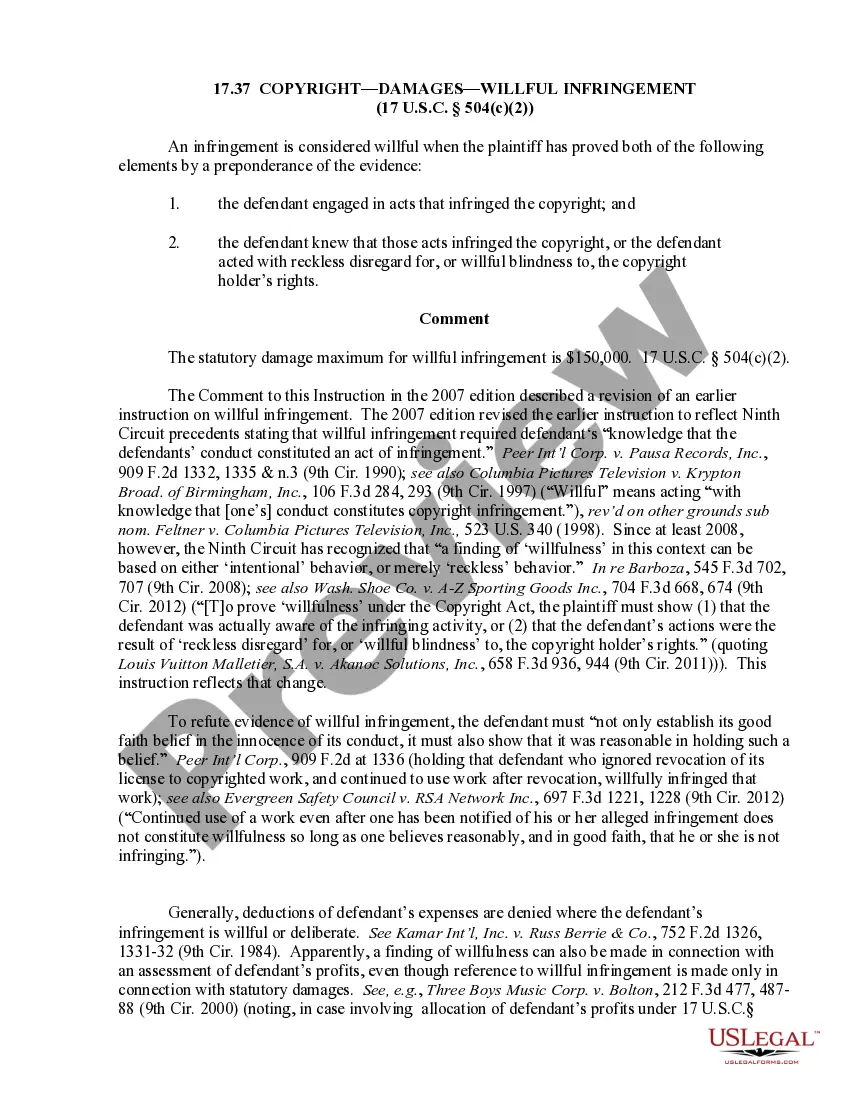
Willful Infringement: What Is It? Willful infringement is when someone copies a claimed invention and knew the entire time that the invention was patented, thus committing patent infringement. An infringement is considered willful when: A defendant engaged in acts that infringed the patent or copyright.
Post-Halo, willful infringement requires only that the patent holder prove to the jury that the infringer actually knew or should have known that its actions constituted an unjustifiably high risk of infringement of a valid and enforceable patent.
2012) (?To prove 'willfulness' under the Copyright Act, the plaintiff must show (1) that the defendant was actually aware of the infringing activity, or (2) that the defendant's actions were the result of 'reckless disregard' for, or 'willful blindness' to, the copyright holder's rights.? (quoting Louis Vuitton