Complaint for Specific Performance to Enforce Settlement and for Punitive Damages
Overview of this form
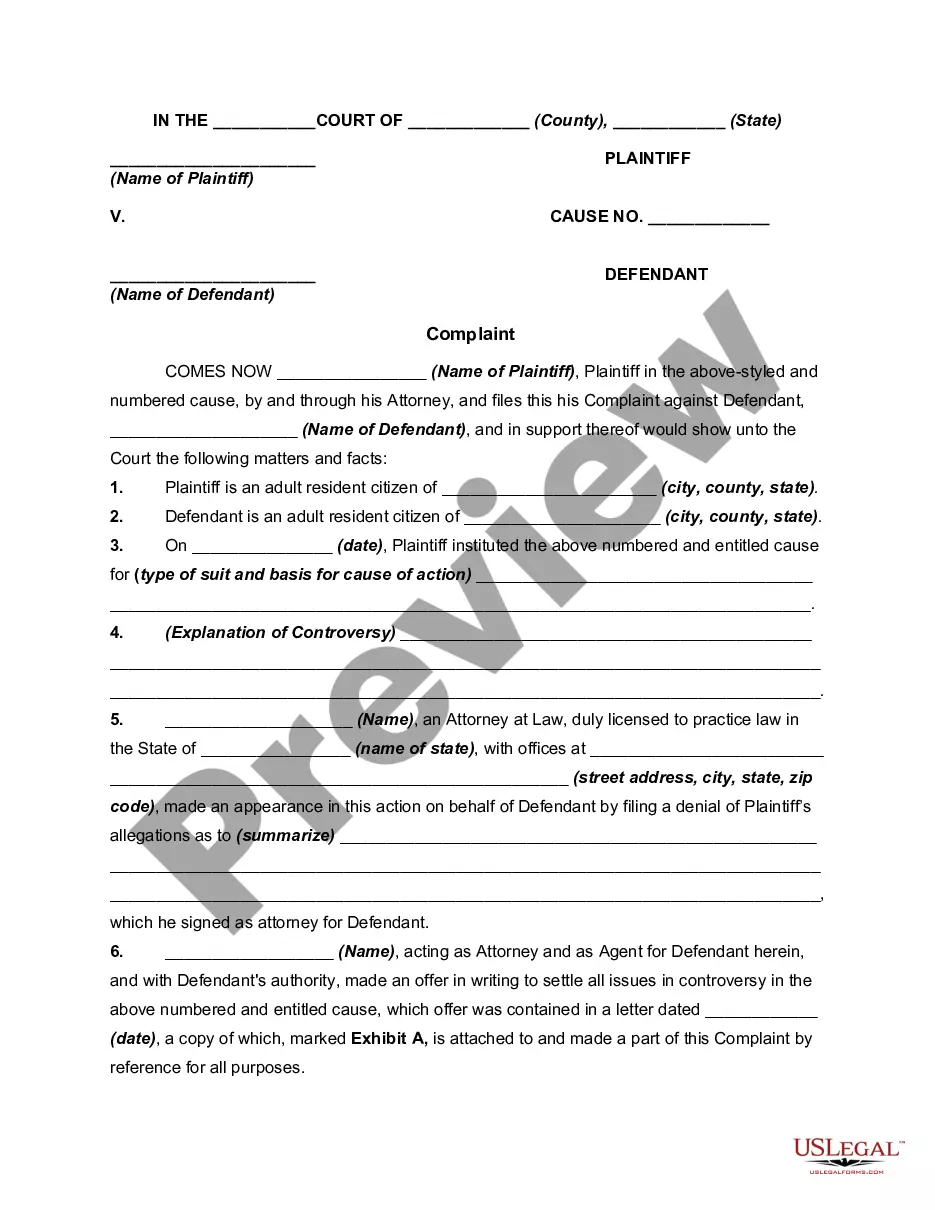
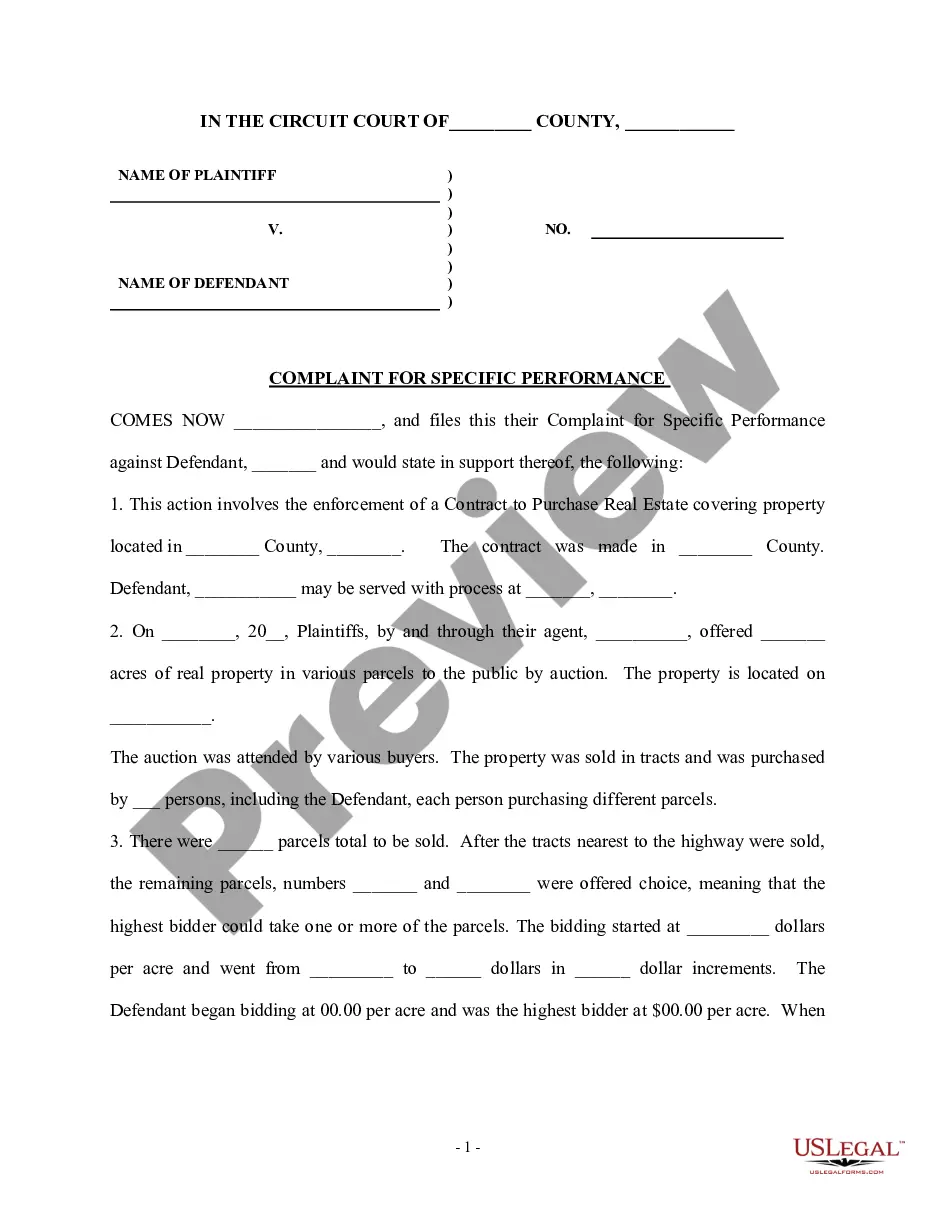
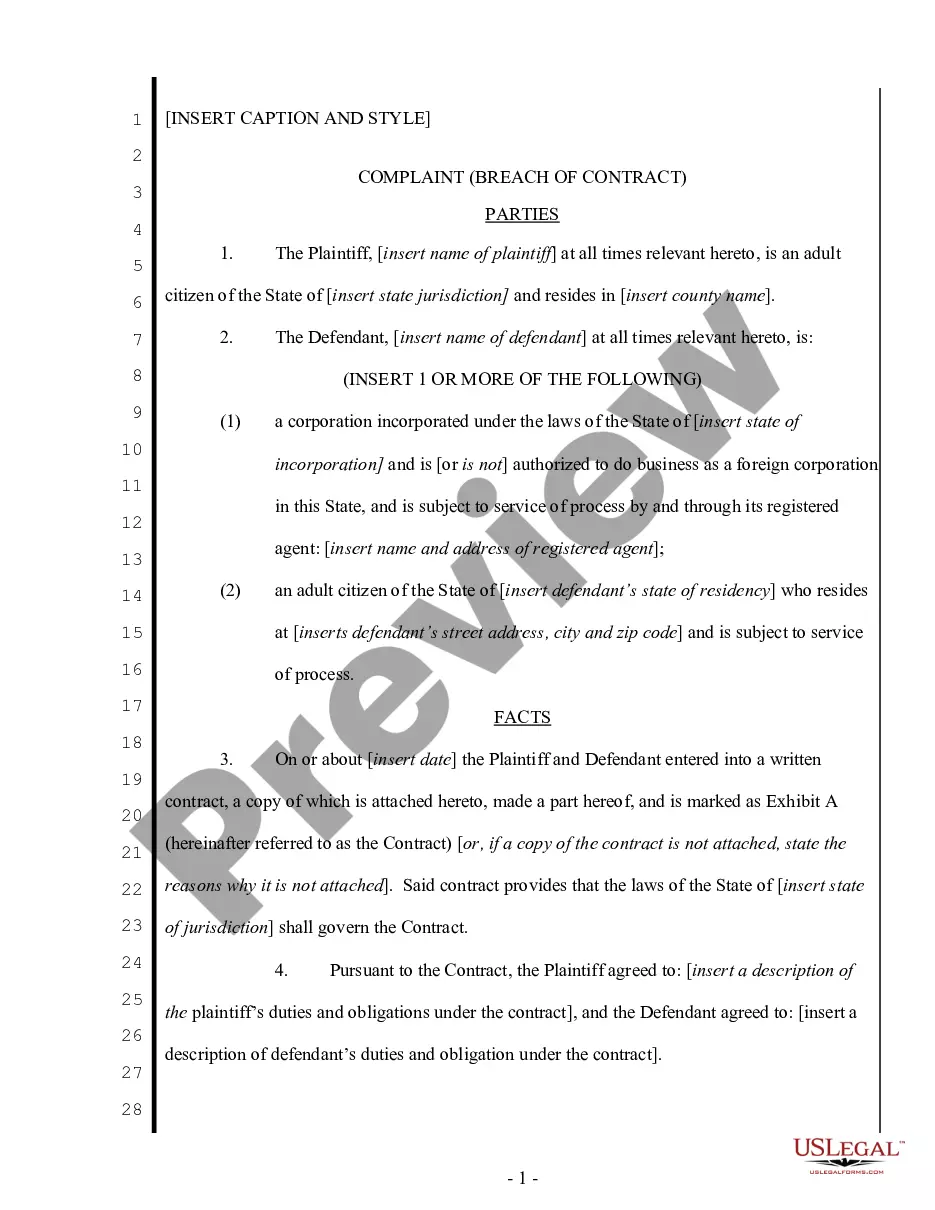
The Complaint for Specific Performance to Enforce Settlement and for Punitive Damages is a legal document used to enforce a settlement agreement in disputes where one party has failed to comply with the terms. This form serves as a formal complaint to the court, requesting enforcement of the settlement and seeking punitive damages for any misconduct. Unlike other types of complaints, this form specifically focuses on the enforcement of previously agreed-upon terms rather than the initiation of a new claim.
Key parts of this document
- Plaintiff and defendant information and identification.
- Date and description of the original cause of action.
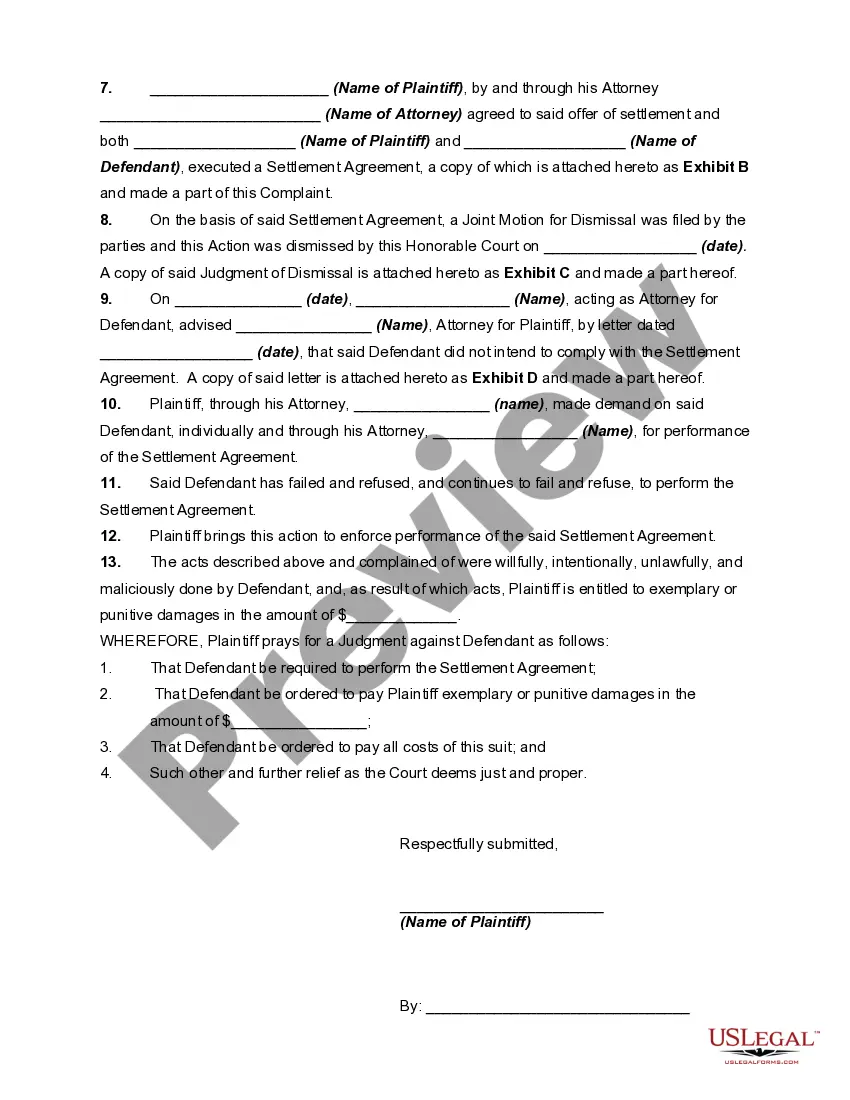
- Details of the settlement agreement and its execution.
- Allegations of breach of settlement and demand for performance.
- Request for punitive damages and costs of the suit.

Common use cases
This form is used when one party in a legal dispute has agreed to a settlement but has failed to fulfill their obligations under that agreement. It is appropriate when all attempts to resolve the matter amicably have failed, and the plaintiff needs to take legal action to enforce the settlement terms and seek compensation for any damages incurred as a result of the breach.
Who can use this document
This form is suitable for the following individuals:
- Individuals who have reached a settlement agreement in a legal dispute.
- Parties seeking to enforce the terms of a settlement due to non-compliance by the other party.
- Individuals pursuing punitive damages related to breaches of contract or settlement agreements.
Steps to complete this form
- Identify the names and addresses of both the plaintiff and defendant.
- Fill in the date when the original complaint was filed and describe the type of suit.
- Detail the settlement agreement and reference attached documents as exhibits.
- Document the breach of agreement and your demands for performance.
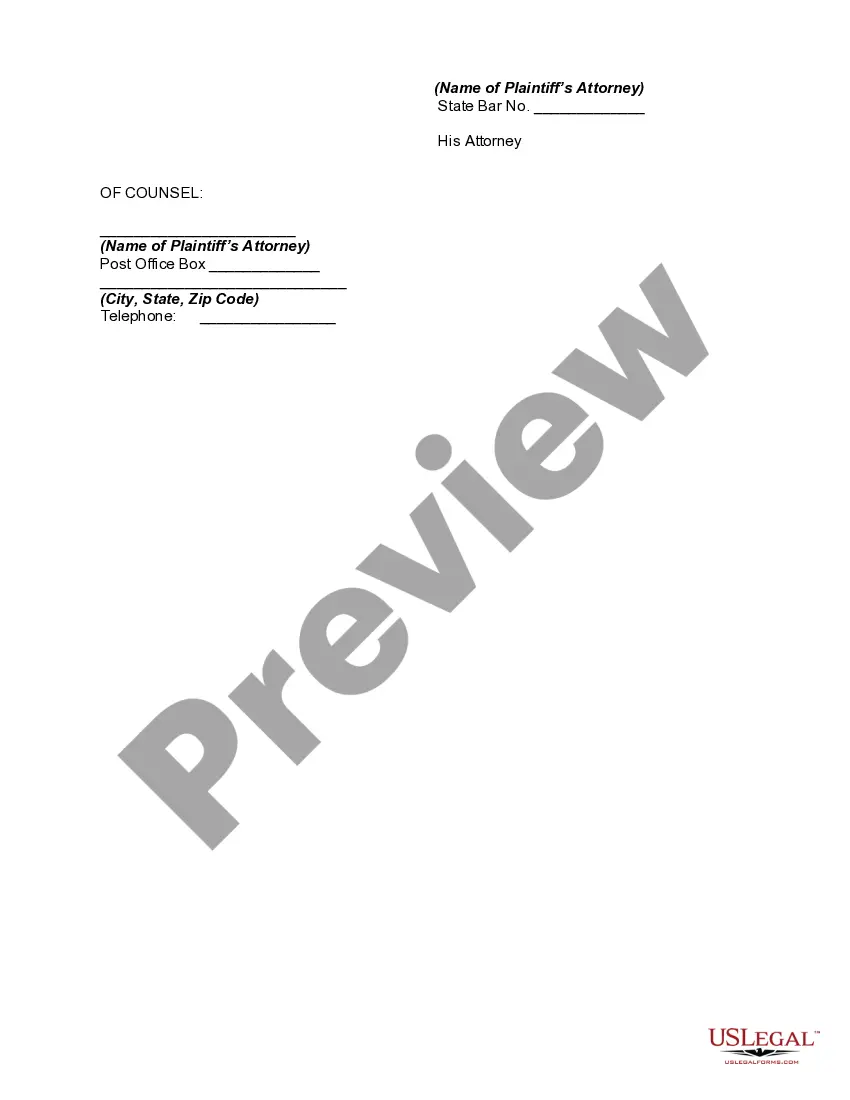
- Sign the form and include the attorney information if applicable.
Is notarization required?
Notarization is not commonly needed for this form. However, certain documents or local rules may make it necessary. Our notarization service, powered by Notarize, allows you to finalize it securely online anytime, day or night.
Get your form ready online
Our built-in tools help you complete, sign, share, and store your documents in one place.
Make edits, fill in missing information, and update formatting in US Legal Forms—just like you would in MS Word.
Download a copy, print it, send it by email, or mail it via USPS—whatever works best for your next step.
Sign and collect signatures with our SignNow integration. Send to multiple recipients, set reminders, and more. Go Premium to unlock E-Sign.
If this form requires notarization, complete it online through a secure video call—no need to meet a notary in person or wait for an appointment.
We protect your documents and personal data by following strict security and privacy standards.

Make edits, fill in missing information, and update formatting in US Legal Forms—just like you would in MS Word.

Download a copy, print it, send it by email, or mail it via USPS—whatever works best for your next step.

Sign and collect signatures with our SignNow integration. Send to multiple recipients, set reminders, and more. Go Premium to unlock E-Sign.

If this form requires notarization, complete it online through a secure video call—no need to meet a notary in person or wait for an appointment.

We protect your documents and personal data by following strict security and privacy standards.
Common mistakes to avoid
- Failing to attach all necessary exhibits, such as the original settlement agreement.
- Not properly identifying the parties involved in the dispute.
- Leaving out key dates related to the settlement or the breach.
- Not specifying the amount of punitive damages clearly.
Why use this form online
- Easy access and instant download of legally vetted templates.
- Editable fields simplify customization for your specific situation.
- Available guidance ensures that all necessary information is included.
- Elimination of guesswork about legal terminology and requirements.
Looking for another form?
Form popularity
FAQ
Specific Performance asks the court to force the opposing party into a contract that binds them to actually perform the contract at issue, rather than award damages for breach of contract. In real estate litigation, a buyer can force a reluctant seller to live up to the purchase and sale agreement.
Specific performance is a remedy in contract law that is most often applied in real estate litigation and disputes where a court issues an order requiring a party to perform a specific act, and to specifically perform according to the terms of a contract.
In a suit for specific performance, plaintiff must approach Court with clean hands . Right from the date of the execution till date of the decree he must prove that he is ready and has always been willing to perform his part of the contract.
When Should a Court Enforce Specific Performance? Succinctly, specific performance is available when there exists: 1) a valid and binding contract; 2) definite and certain terms; 3) mutuality of obligation and remedy; 4) freedom from fraud and overreaching; and 5) lack of remedy at law.
A suit for specific performance can be filed by any party, in a court of competent jurisdiction, who has suffered loss due to non-performance of contract on part of the other party to the contract. Remedy of specific performance which is affected in case of breach of contracts is provided by the equity courts.
Although the plaintiff can elect to claim specific performance from the defendant, the court has a discretion to grant or decline the order of specific performance.Plaintiff has a right of election whether to claim specific performance from the defendant or damages for breach of contract.
Specific Performance asks the court to force the opposing party into a contract that binds them to actually perform the contract at issue, rather than award damages for breach of contract. In real estate litigation, a buyer can force a reluctant seller to live up to the purchase and sale agreement.