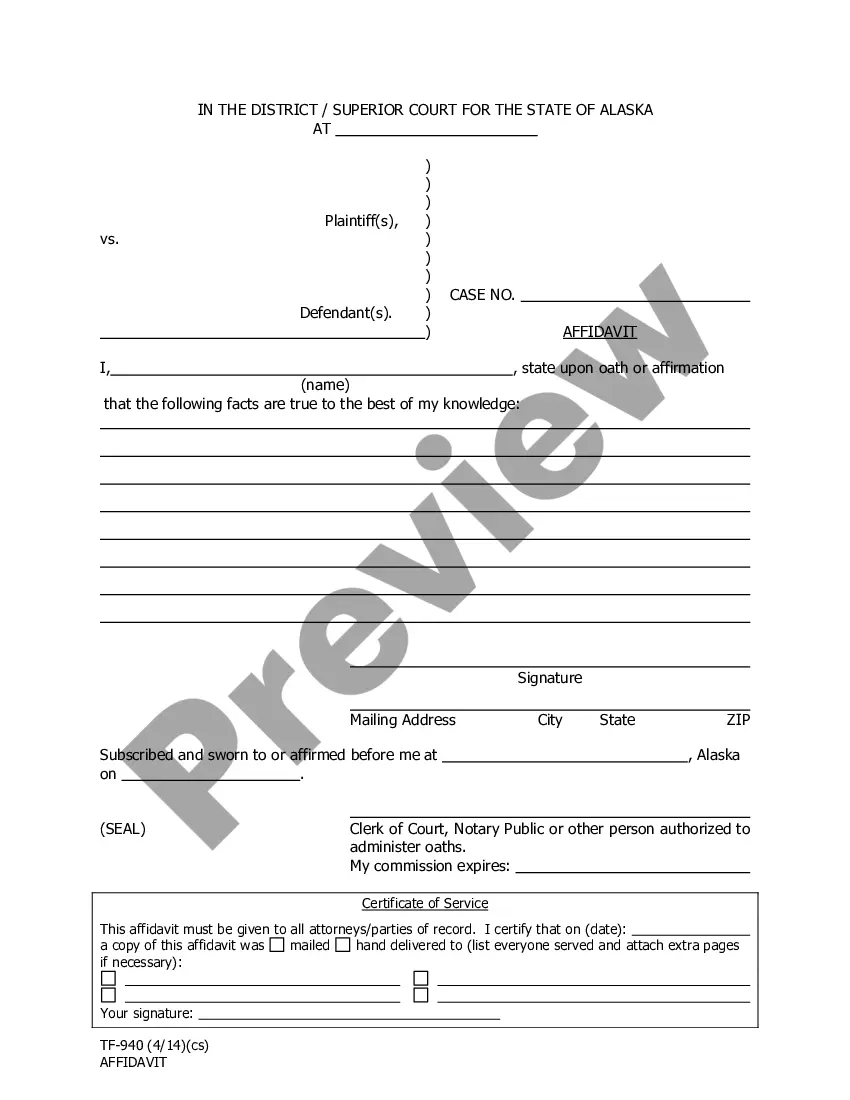
Complaint for Damages and Declaratory Judgment
Understanding this form
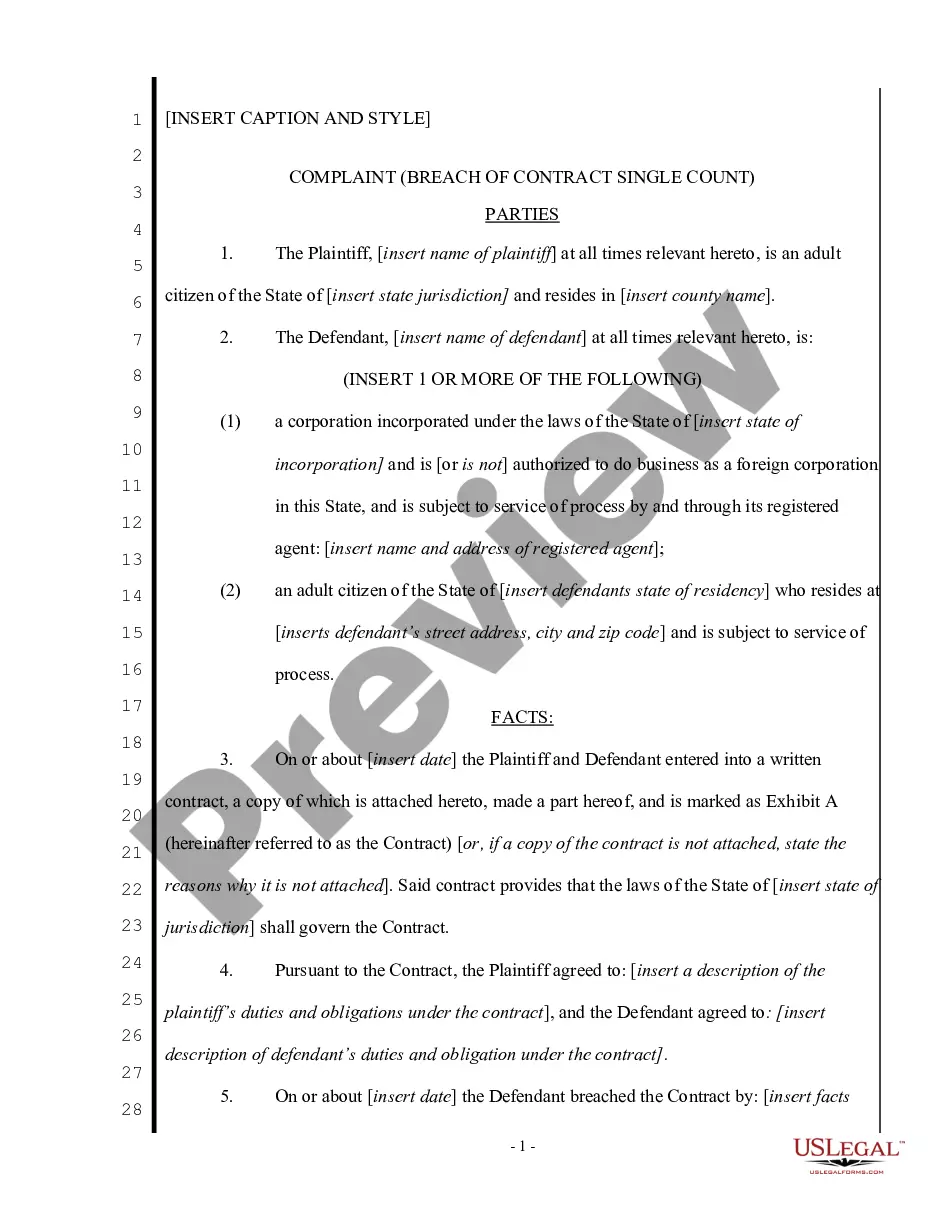
The Complaint for Damages and Declaratory Judgment is a legal document used to initiate a civil lawsuit against a defendant for damages caused by harmful actions, along with a request for a court's declaration regarding the legal issues at stake. This form serves as a model to structure your complaint, ensuring it meets the necessary legal requirements in your state. It differs from other forms by combining claims for monetary damages with the need for a judicial declaration of rights or obligations pertinent to the case.
Main sections of this form
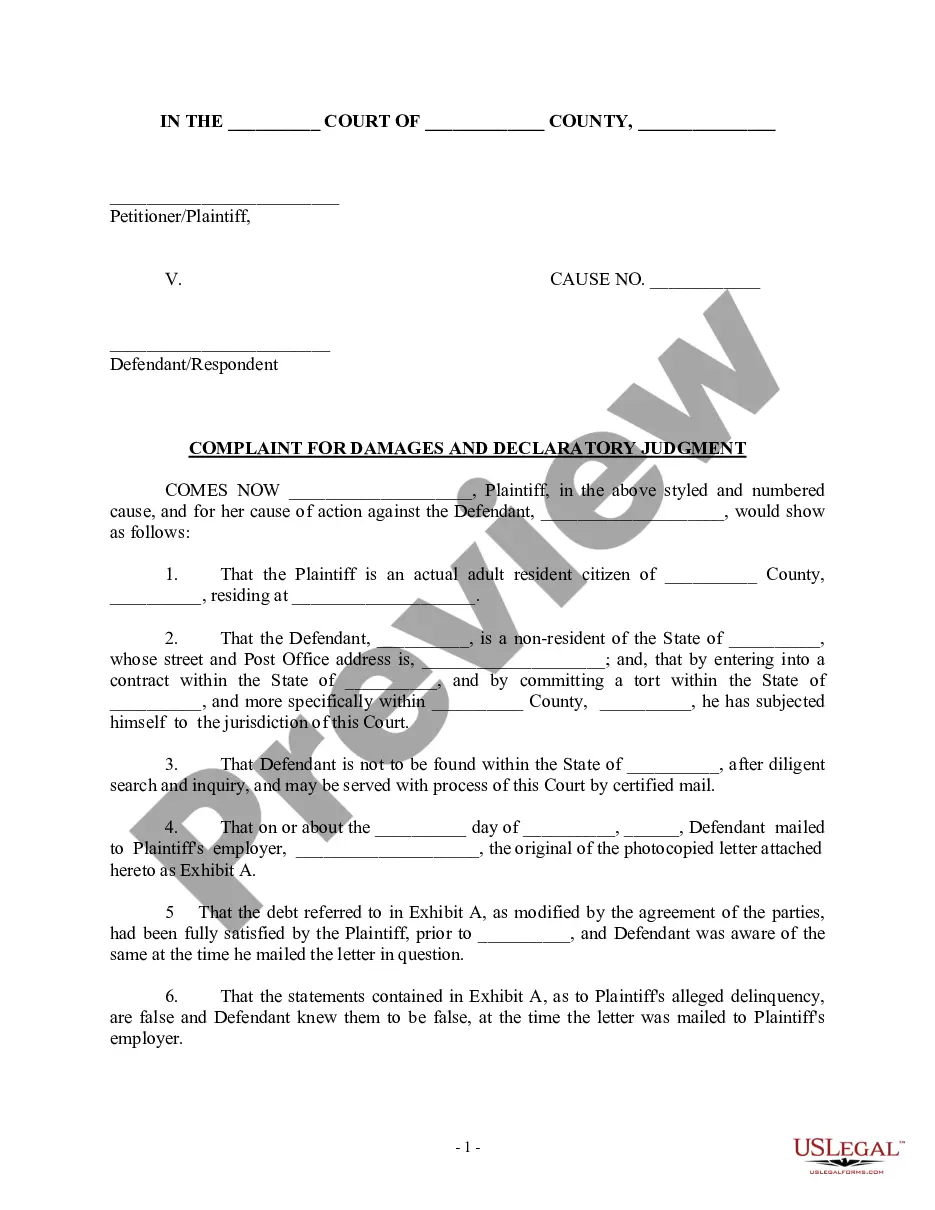
- Identification of the parties involved in the lawsuit: the plaintiff and the defendant.
- Jurisdictional statements establishing the court's authority over the defendant.
- Accurate detailing of the facts of the case and the alleged wrongful actions by the defendant.
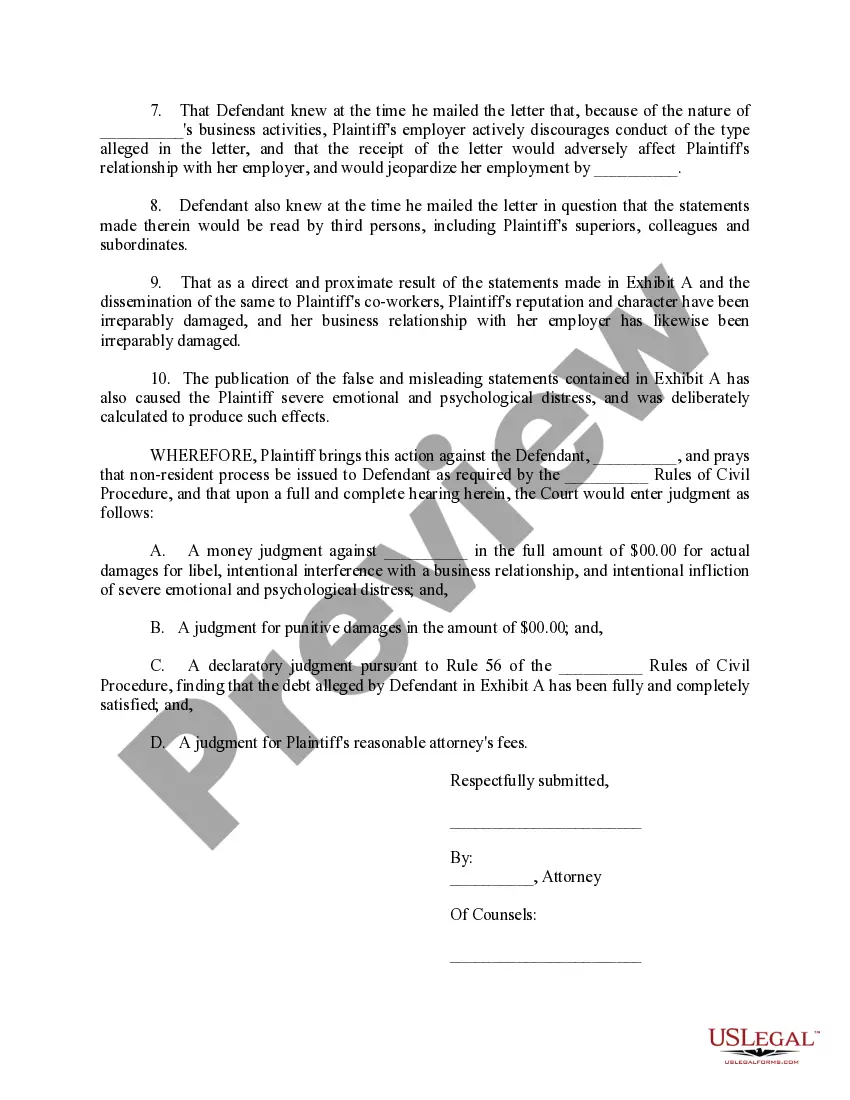
- Claims for specific damages, including actual damages and punitive damages.
- A request for declaratory judgment regarding the satisfaction of the alleged debt.


When to use this document
This form is commonly used when an individual or entity believes they have been wronged by another party, leading to reputational harm or financial loss. Scenarios where this form may be necessary include disputes over libel, interference with business relationships, or instances where a declaratory judgment is needed to clarify debts and obligations after a disagreement. It can also be applicable when emotional distress is claimed resulting from the defendant's actions.
Who should use this form
This form is intended for:
- Individuals seeking legal remedy for damages caused by another party.
- Parties who require a declaration of rights or obligations from a court.
- Those who feel they have been wronged and wish to formally initiate a legal claim.
How to complete this form
- Identify the plaintiff and defendant by entering their full names and addresses in the appropriate fields.
- State the jurisdictional basis for filing the complaint, including references to the applicable court rules.
- Detail the facts surrounding the case, including dates, events, and the specific harmful actions of the defendant.
- Clearly articulate the claims for damages and specify the amounts sought in the action.
- Sign the document, including the attorney's details if represented.
Does this document require notarization?
In most cases, this form does not require notarization. However, some jurisdictions or signing circumstances might. US Legal Forms offers online notarization powered by Notarize, accessible 24/7 for a quick, remote process.
Get your form ready online
Our built-in tools help you complete, sign, share, and store your documents in one place.
Make edits, fill in missing information, and update formatting in US Legal Forms—just like you would in MS Word.
Download a copy, print it, send it by email, or mail it via USPS—whatever works best for your next step.
Sign and collect signatures with our SignNow integration. Send to multiple recipients, set reminders, and more. Go Premium to unlock E-Sign.
If this form requires notarization, complete it online through a secure video call—no need to meet a notary in person or wait for an appointment.
We protect your documents and personal data by following strict security and privacy standards.

Make edits, fill in missing information, and update formatting in US Legal Forms—just like you would in MS Word.

Download a copy, print it, send it by email, or mail it via USPS—whatever works best for your next step.

Sign and collect signatures with our SignNow integration. Send to multiple recipients, set reminders, and more. Go Premium to unlock E-Sign.

If this form requires notarization, complete it online through a secure video call—no need to meet a notary in person or wait for an appointment.

We protect your documents and personal data by following strict security and privacy standards.
Common mistakes to avoid
- Failing to provide sufficient details about the events leading to the complaint.
- Missing signatures or attorney information where applicable.
- Not adhering to state-specific rules regarding formatting and content.
- Overlooking the necessity for factual evidence to support claims for damages.
Advantages of online completion
- Easy access to professionally drafted legal templates.
- Ability to customize the form according to specific circumstances and legal requirements.
- Convenience of downloading and filling out forms at your own pace.
- Digital format allows for easy storage and retrieval of completed documents.
Looking for another form?
Form popularity
FAQ
A court-issued declaratory judgment outlines the rights and responsibilities of each involved party. This judgment does not require action or award damages. It helps to resolve disputes and prevent lawsuits.
The above submissions of counsel for the defendants are the mainstay of the contention for the defendants by their counsel, Chief Benson, S.A.N., that declaratory judgments can sometimes be stayed having accepted, as I understand him to have done, that, generally speaking, declaratory judgments cannot be stayed.
The Court clarified that declaratory judgment jurisdiction required disputes to be 'definite and concrete, touching the legal relations of the parties having adverse legal interests'; and that it be 'real and substantial' and 'admit of specific relief through a decree of a conclusive character, as distinguished from
Enforceability. A declaratory judgment does not provide for any enforcement, however. In other words, it states the court's authoritative opinion regarding the exact nature of the legal matter without requiring the parties to do anything.
A declaratory judgment, also called a declaration, is the legal determination of a court that resolves legal uncertainty for the litigants.A declaratory judgment does not by itself order any action by a party, or imply damages or an injunction, although it may be accompanied by one or more other remedies.
A declaratory judgment is a binding judgment from a court defining the legal relationship between parties and their rights in a matter before the court. Typically, a party will first send a cease and desist letter prior to seeking declaratory judgment from a court.
A declaratory judgment like any other judgment is reviewable on appeal.Therefore, a plaintiff who wins a declaratory judgment may seek further relief in an action on the same claim which prompted the action for a declaratory judgment.