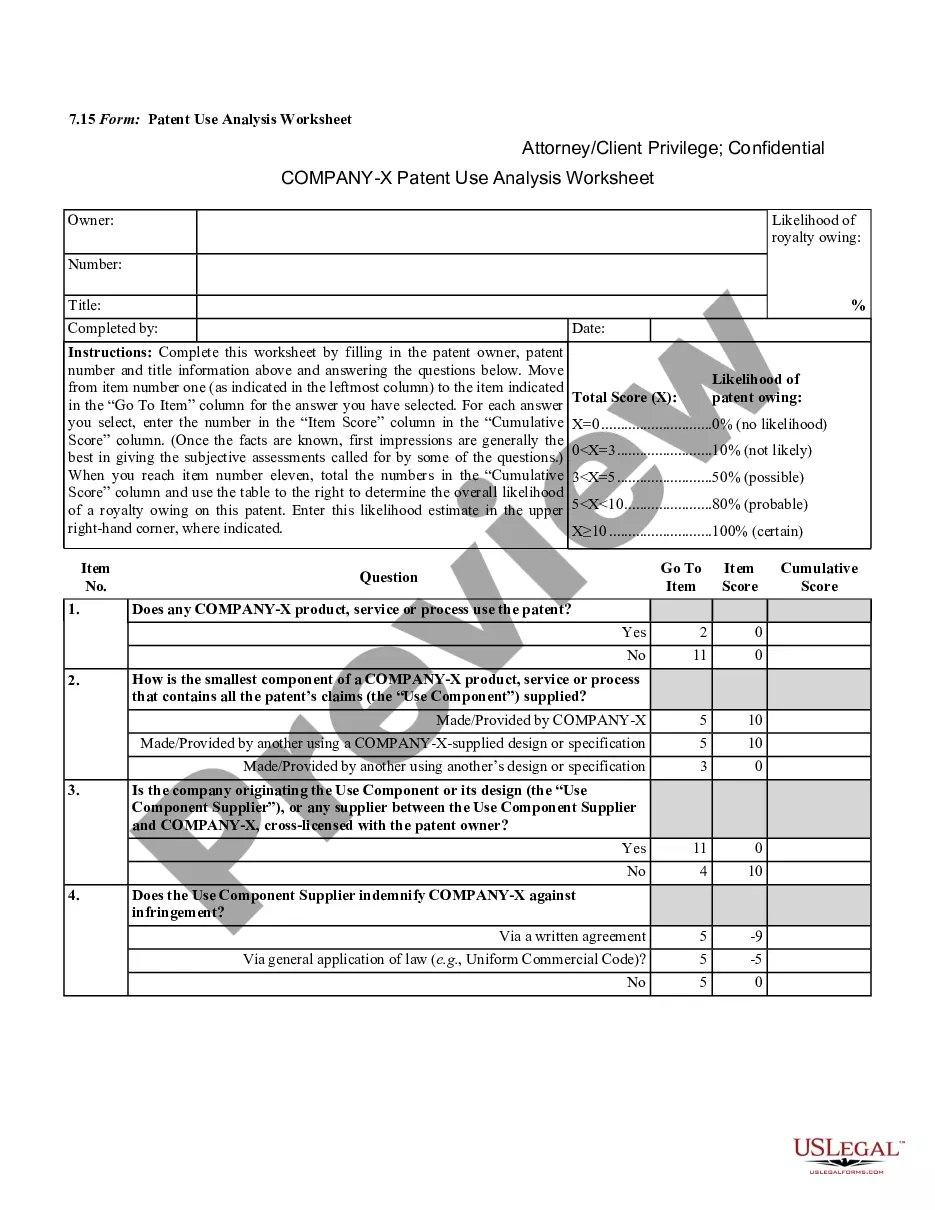
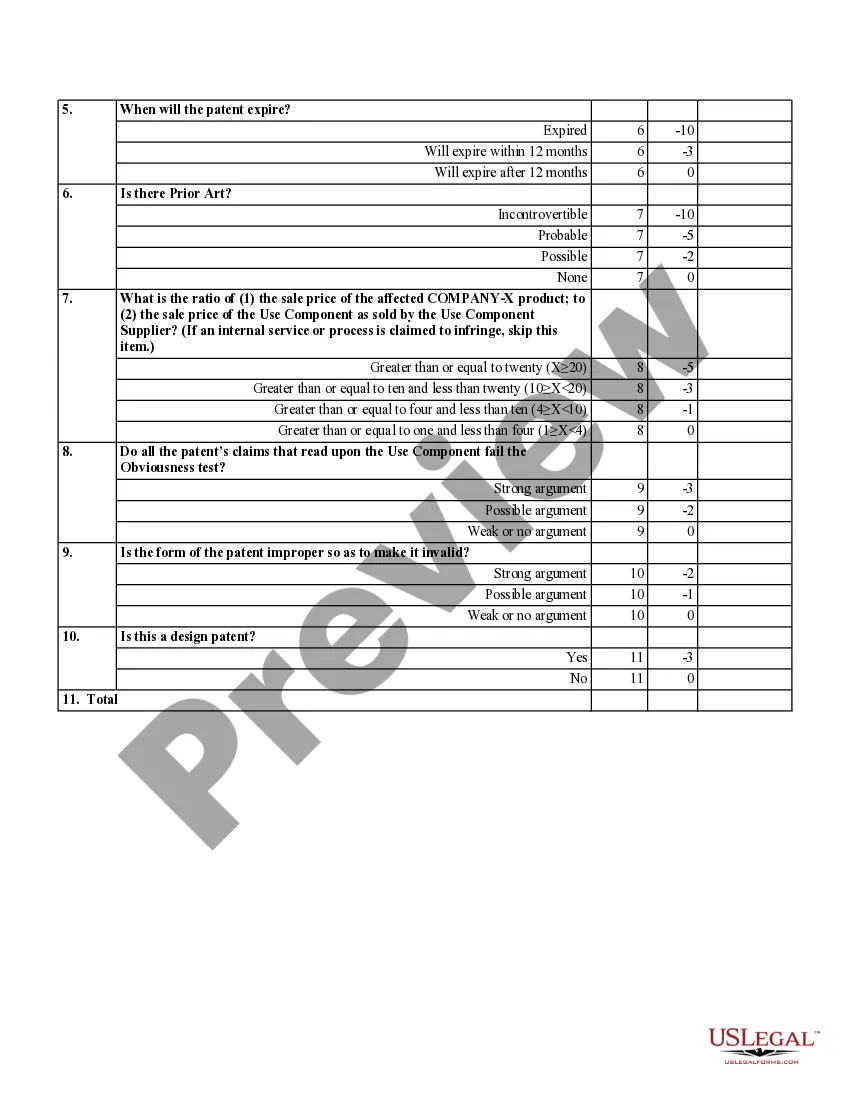
Patent Use Analysis Worksheet
About this form
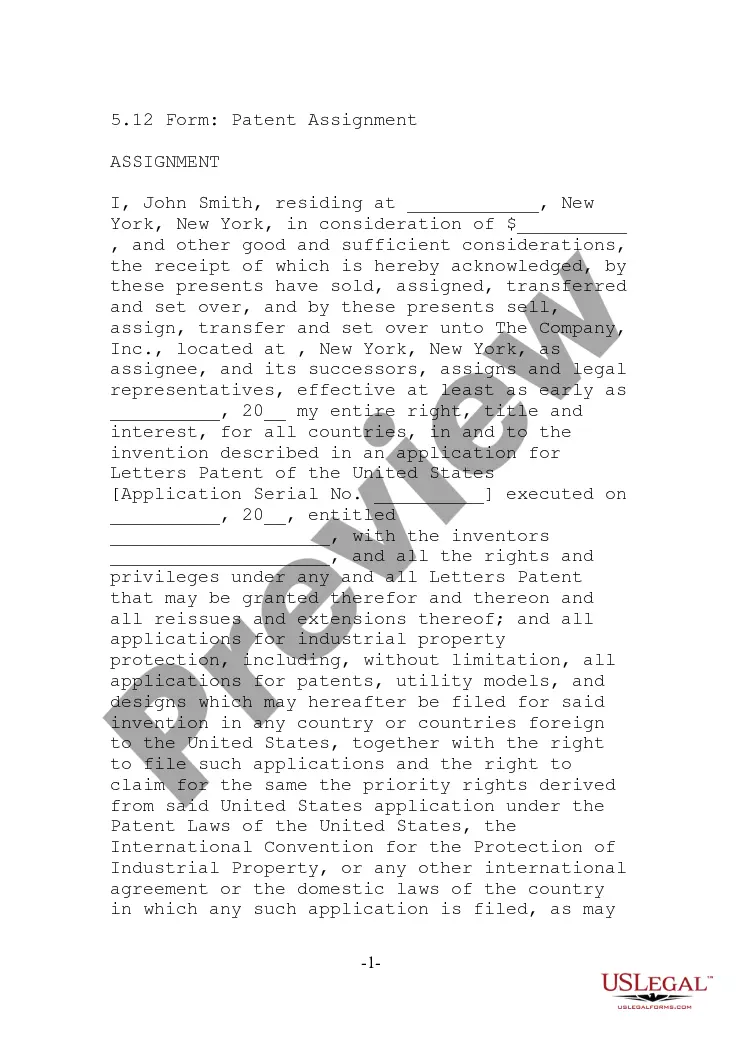
The Patent Use Analysis Worksheet is designed for evaluating the potential for earning royalties from a patent. This worksheet helps you assess various factors that contribute to the likelihood of a royalty being owed, differentiating it from other patent forms that may not focus specifically on royalty analysis.
Key components of this form
- Identification of patent details.
- Assessment of commercial applicability.
- Analysis of competitive landscape.
- Evaluation of potential revenue streams.
- Summary of conclusions regarding royalty potential.
Situations where this form applies
This worksheet is ideal when you need to determine the potential for earning royalties from a specific patent. Use it when preparing to negotiate licensing agreements, assessing patent value for sale, or conducting internal evaluations of patent portfolios to refine business strategies.
Who should use this form
- Patent attorneys conducting licensing negotiations.
- Business owners assessing the value of their patents.
- Inventors exploring commercial opportunities for their inventions.
- Companies managing patent portfolios for revenue generation.
- Investors evaluating the potential of patented technologies.
Instructions for completing this form
- Identify the patent number and title.
- Assess the market potential by detailing the target audience.
- Analyze competitors and their products related to the patent.
- Estimate potential revenues based on market analysis.
- Summarize your findings and conclusions regarding the likelihood of royalty obligations.
Does this document require notarization?
This form does not typically require notarization to be legally valid. However, some jurisdictions or document types may still require it. US Legal Forms provides secure online notarization powered by Notarize, available 24/7 for added convenience.
Get your form ready online
Our built-in tools help you complete, sign, share, and store your documents in one place.
Make edits, fill in missing information, and update formatting in US Legal Forms—just like you would in MS Word.
Download a copy, print it, send it by email, or mail it via USPS—whatever works best for your next step.
Sign and collect signatures with our SignNow integration. Send to multiple recipients, set reminders, and more. Go Premium to unlock E-Sign.
If this form requires notarization, complete it online through a secure video call—no need to meet a notary in person or wait for an appointment.
We protect your documents and personal data by following strict security and privacy standards.

Make edits, fill in missing information, and update formatting in US Legal Forms—just like you would in MS Word.

Download a copy, print it, send it by email, or mail it via USPS—whatever works best for your next step.

Sign and collect signatures with our SignNow integration. Send to multiple recipients, set reminders, and more. Go Premium to unlock E-Sign.

If this form requires notarization, complete it online through a secure video call—no need to meet a notary in person or wait for an appointment.

We protect your documents and personal data by following strict security and privacy standards.
Typical mistakes to avoid
- Failing to provide accurate patent information.
- Overlooking key competitors in the analysis.
- Not considering all potential revenue streams.
- Underestimating the market demand for the patented product.
Why use this form online
- Conveniently downloadable for immediate use.
- Editable to fit specific business needs and scenarios.
- Drafted by licensed attorneys, ensuring legal reliability.
- Access to updated versions reflecting current law and practice.
Legal use & context
- This worksheet serves as an analytical tool, not a legally binding document.
- Findings can inform negotiations or strategic business decisions.
- Ensure compliance with patent laws when applying your analysis.
Main things to remember
- The Patent Use Analysis Worksheet is essential for evaluating royalty potential on patents.
- Proper completion can enhance negotiation tactics and business strategy.
- This resource is useful for a range of users involved in patent management and commercialization.
Looking for another form?

Form popularity
FAQ
An invention is a unique or novel device, method, composition or process. The invention process is a process within an overall engineering and product development process. It may be an improvement upon a machine or product or a new process for creating an object or a result.
Search, review, and refine the subject matter. Data cleanup and normalization. Review data, create categories and populate. Create charts/tables and visualizations. Ongoing monitoring and analysis.
Search the United States Patent and Trademark Office. Find a patent attorney. Determine what type of patent you need. File a provisional patent application. Become a Registered eFiler. Gather information for your formal application. Complete and review your formal application.
Title. Technical area. Background details and previous artwork. A description of the problem your invention solves. A list of included drawings. Your in-depth description of the invention. An example of invention use.
Patent specification As such, a specification generally contains a section detailing the background and overview of the invention, a description of the invention and embodiments of the invention and claims, which set out the scope of the protection.
Search, review, and refine the subject matter. Data cleanup and normalization. Review data, create categories and populate. Create charts/tables and visualizations. Ongoing monitoring and analysis.
2 Answers. The law requires that the application provide a complete "written description of the invention, and of the manner and process of making and using it, in such full, clear, concise, and exact terms as to enable any person skilled in the art to which it pertains" to make and use the invention.
Title of Invention. Field of Invention. Background. Summary of Invention. Brief description of drawings. Description of invention. Examples if any. Specific embodiments if any.
37 CFR 1.72 Title and abstract. The title of the invention should be placed at the top of the first page of the specification unless it is provided in the application data sheet (see 37 CFR 1.76). The title should be brief but technically accurate and descriptive and should contain fewer than 500 characters.