Mississippi Motion for Emergency Hearing in Child Support regarding Health Insurance
What this document covers
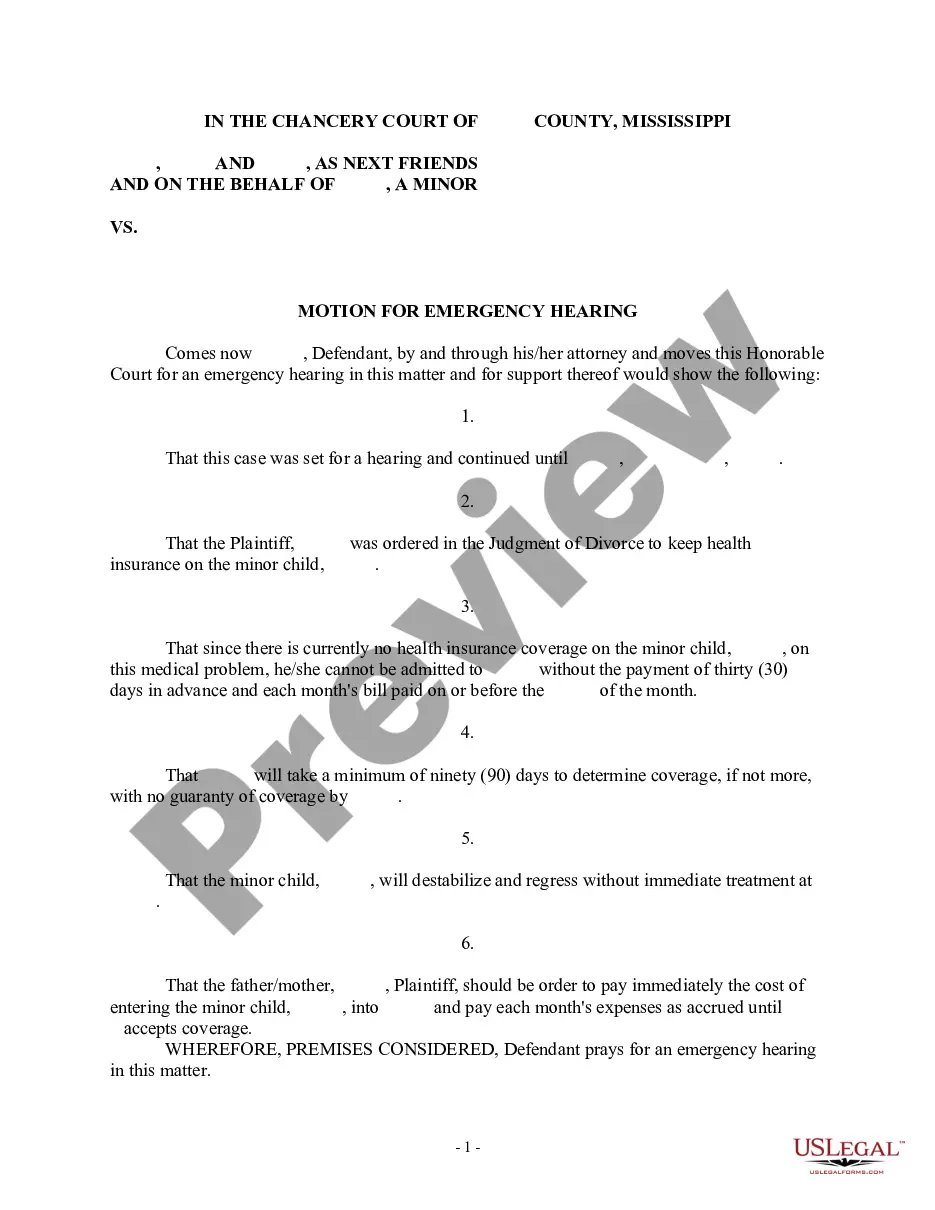
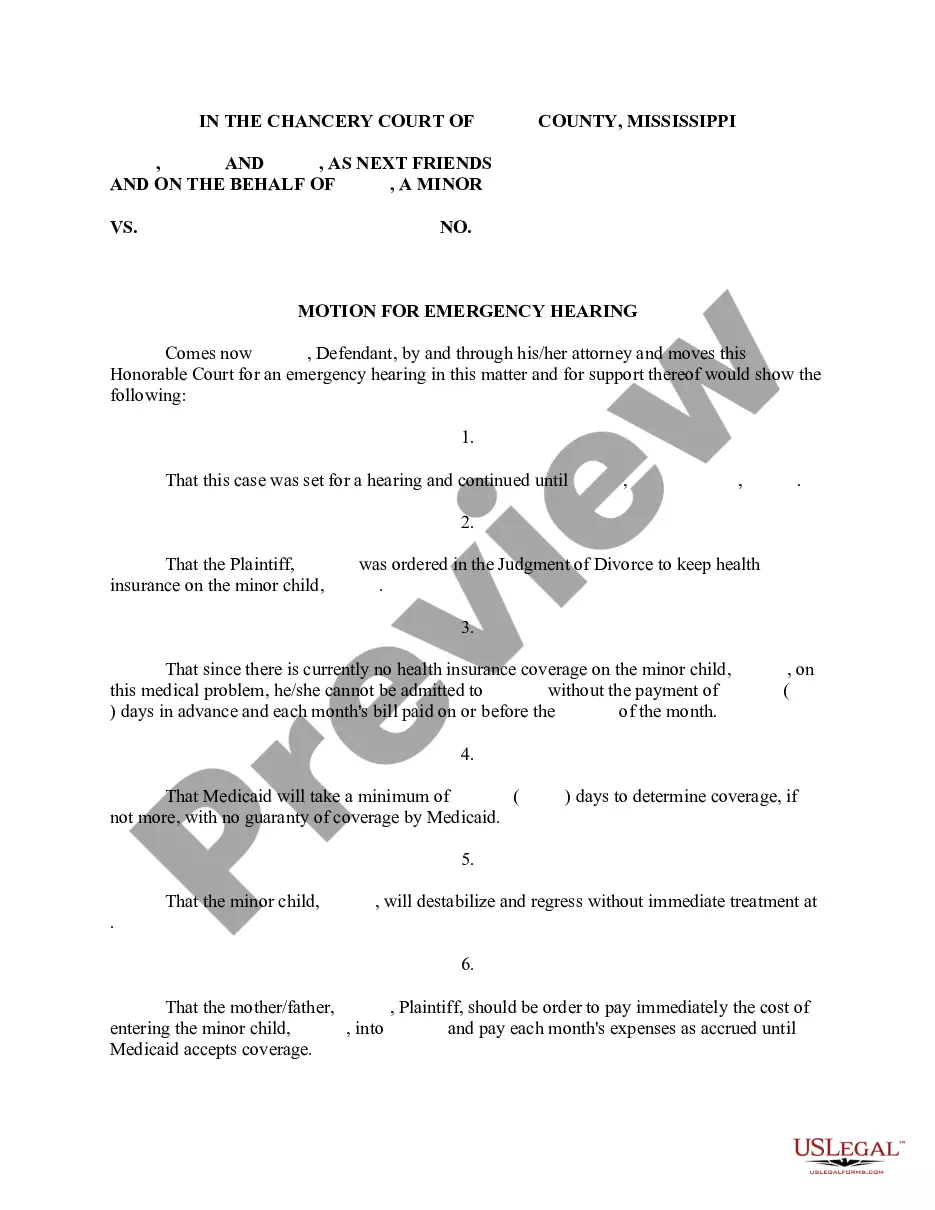
The Motion for Emergency Hearing in Child Support regarding Health Insurance is a legal document used to request a court hearing on urgent matters related to child support payments, specifically focusing on health insurance coverage. This motion differs from other motions related to child support because it addresses urgent situations that require immediate judicial attention to ensure the well-being of a child. It serves as a formal request for the court to intervene promptly.
Key components of this form
- Identification of the parties involved in the child support case.
- Details regarding the current child support arrangements.
- Explanation of the emergency situation necessitating an immediate hearing.
- Request for a specific action or ruling from the court regarding health insurance coverage.
- Signatures of the parties involved to validate the motion.

When to use this document
This form should be used when a custodial parent needs to address urgent issues surrounding health insurance for a child. For instance, it may be appropriate to file this motion if the current health insurance coverage is inadequate, if there is a lapse in coverage, or if there are changes in health care needs that require immediate court intervention. It helps ensure that health insurance issues are resolved swiftly to protect the child's welfare.
Who needs this form
- Custodial parents seeking to ensure their child's health insurance needs are met.
- Non-custodial parents who need to address their responsibilities regarding health insurance payments.
- Legal guardians acting on behalf of a child in urgent health insurance matters.
Instructions for completing this form
- Identify the parties by entering their full names and addresses.
- Provide details about the current child support arrangement, including the existing health insurance coverage.
- Clearly articulate the emergency situation requiring immediate attention.
- Specify the relief or action you are requesting from the court.
- Ensure all parties involved sign the motion where indicated.
Notarization requirements for this form
This form does not typically require notarization unless specified by local law. However, ensuring all signatures are properly executed is important for the motion's acceptance in court.
Get your form ready online
Our built-in tools help you complete, sign, share, and store your documents in one place.
Make edits, fill in missing information, and update formatting in US Legal Forms—just like you would in MS Word.
Download a copy, print it, send it by email, or mail it via USPS—whatever works best for your next step.
Sign and collect signatures with our SignNow integration. Send to multiple recipients, set reminders, and more. Go Premium to unlock E-Sign.
If this form requires notarization, complete it online through a secure video call—no need to meet a notary in person or wait for an appointment.
We protect your documents and personal data by following strict security and privacy standards.

Make edits, fill in missing information, and update formatting in US Legal Forms—just like you would in MS Word.

Download a copy, print it, send it by email, or mail it via USPS—whatever works best for your next step.

Sign and collect signatures with our SignNow integration. Send to multiple recipients, set reminders, and more. Go Premium to unlock E-Sign.

If this form requires notarization, complete it online through a secure video call—no need to meet a notary in person or wait for an appointment.

We protect your documents and personal data by following strict security and privacy standards.
Common mistakes
- Failing to include all necessary parties in the motion.
- Not providing sufficient detail about the emergency situation.
- Omitting signatures from all required parties to validate the motion.
- Using unclear language that could confuse the court.
Why use this form online
- Convenient access to the form from anywhere, at any time.
- Editable templates allow you to fill in information easily.
- Reliable resources drafted by licensed attorneys for accuracy.
- This motion is legally binding once filed and correctly processed by the court.
- While it serves to expedite judicial review, outcomes depend on the court's assessment of the urgency presented.
Summary of main points
- The Motion for Emergency Hearing in Child Support regarding Health Insurance is crucial for urgent health needs.
- Filing this motion can lead to quicker resolution of critical issues affecting children's health insurance.
- Compliance with state requirements is essential to ensure the motion's acceptance.
Looking for another form?




Form popularity
FAQ
Child support responsibilities usually end when the child turns 21 years of age, enters the military, gets married, becomes self-supporting or is adopted by a third party. A parent can seek a reduction in his/her child support payments if his/her salary decreases.
The guideline formula for determining the amount of child support is 14% of noncustodial parent's income for one child, 20% for two children, 22% for three children, 24% for four children and 26% for five or more children.
The statute of limitations for child support arrears in Mississippi is 7 years past age of majority.
Child support responsibilities usually end when the child turns 21 years of age, enters the military, gets married, becomes self-supporting or is adopted by a third party. A parent can seek a reduction in his/her child support payments if his/her salary decreases.
In Mississippi for one child the non-custodial parent pays 14% of their adjusted gross income.For four children the non-custodial parent pays 24% of their adjusted gross income. For five or more children the non-custodial parent pays 26% of their adjusted gross income.
Setting Age-Appropriate Limits. Understanding and Responding to the Child's Needs. History of Childcare Involvement. Methods for Resolving the Custody Conflict with the Other Parent. Child Abuse. Domestic Violence. Substance Abuse. Psychiatric Illness.
Support shall terminate at 18 years of age unless parents agree, by written agreement, to pay support beyond 18. 18 years of age, 19 if attending high school.
One of the most misunderstood obligations in Mississippi is the obligation to pay support for children until the age of 21 or until they become emancipated and self-supporting. Many states only require support until 18.