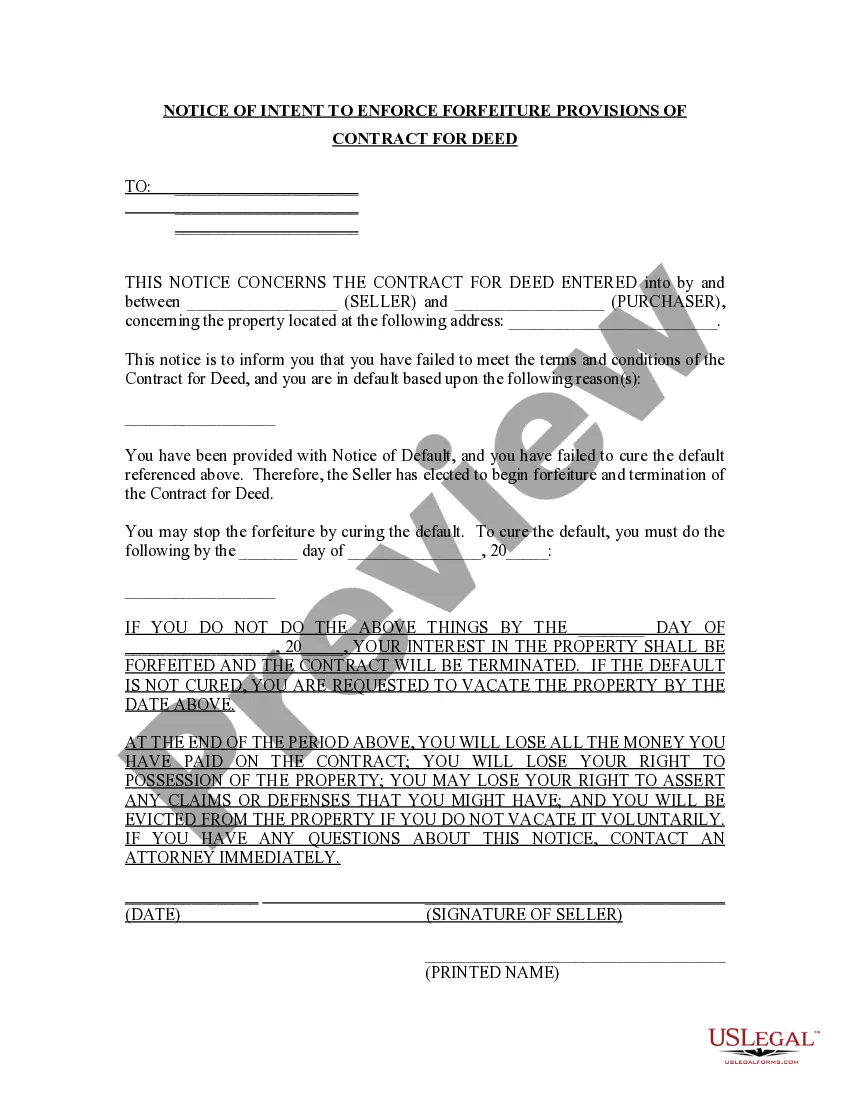
This Notice of Intent to Enforce Forfeiture Provisions of Contract for Deed is an initial notice of Seller's intent to enforce the forfeiture remedy of contract for deed if nonpayment or other breach is not cured. It is used specifically to inform the buyer that he/she has failed to meet the terms and conditions of the Contract for Deed and as a result, are in default based upon the reasons specified.
California Notice of Intent to Enforce Forfeiture Provisions of Contact for Deed
State:
California
Control #:
CA-00470-11
Format:
Word;
Rich Text
Instant download
Description
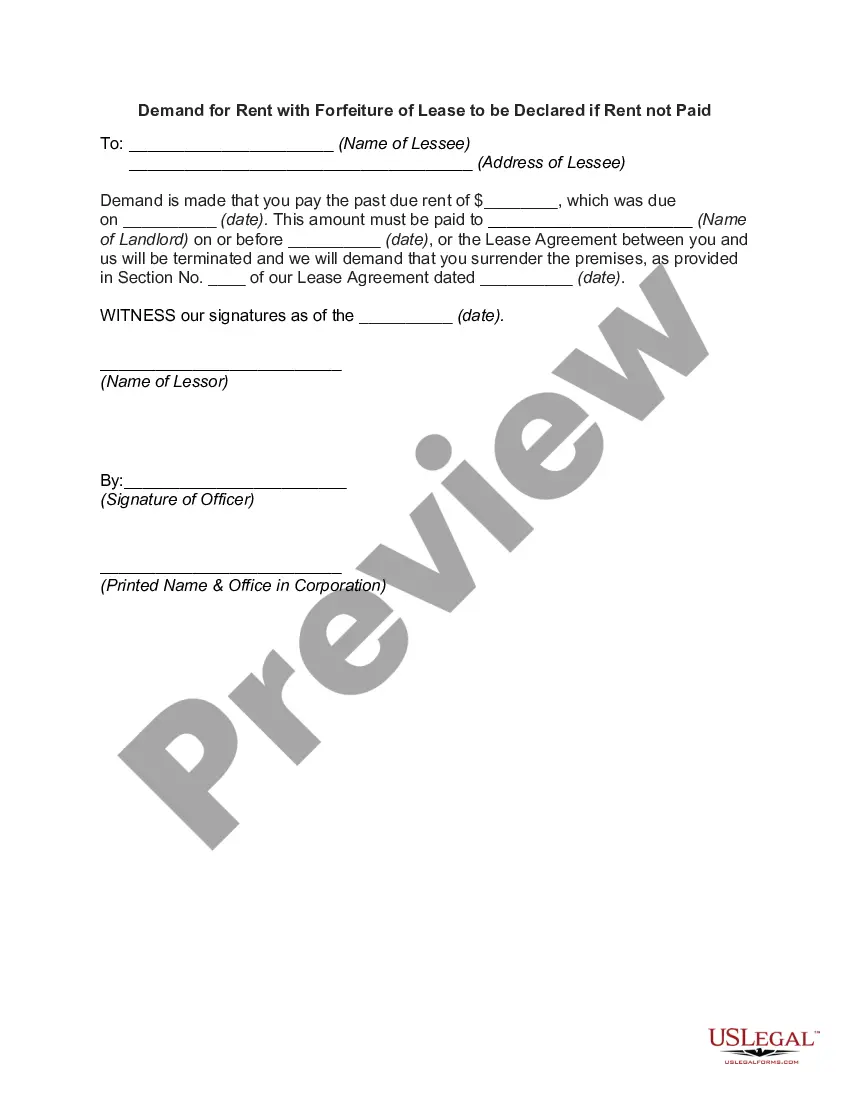
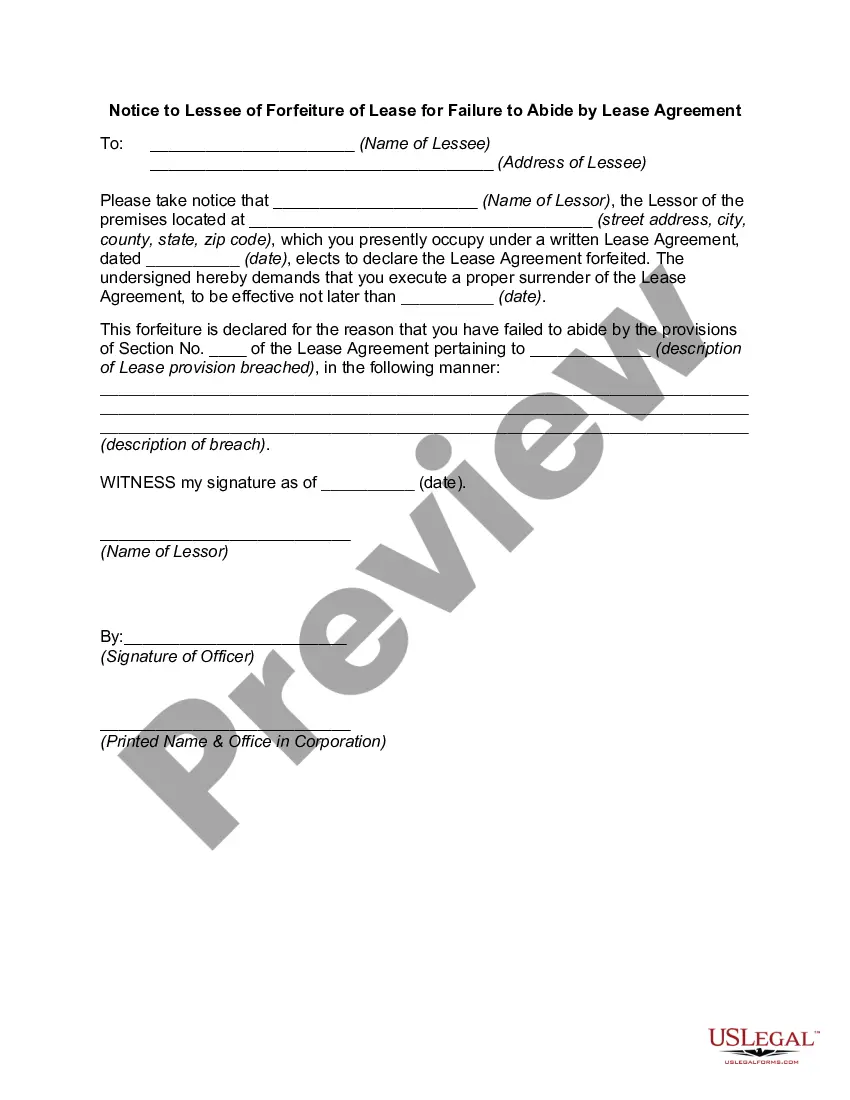
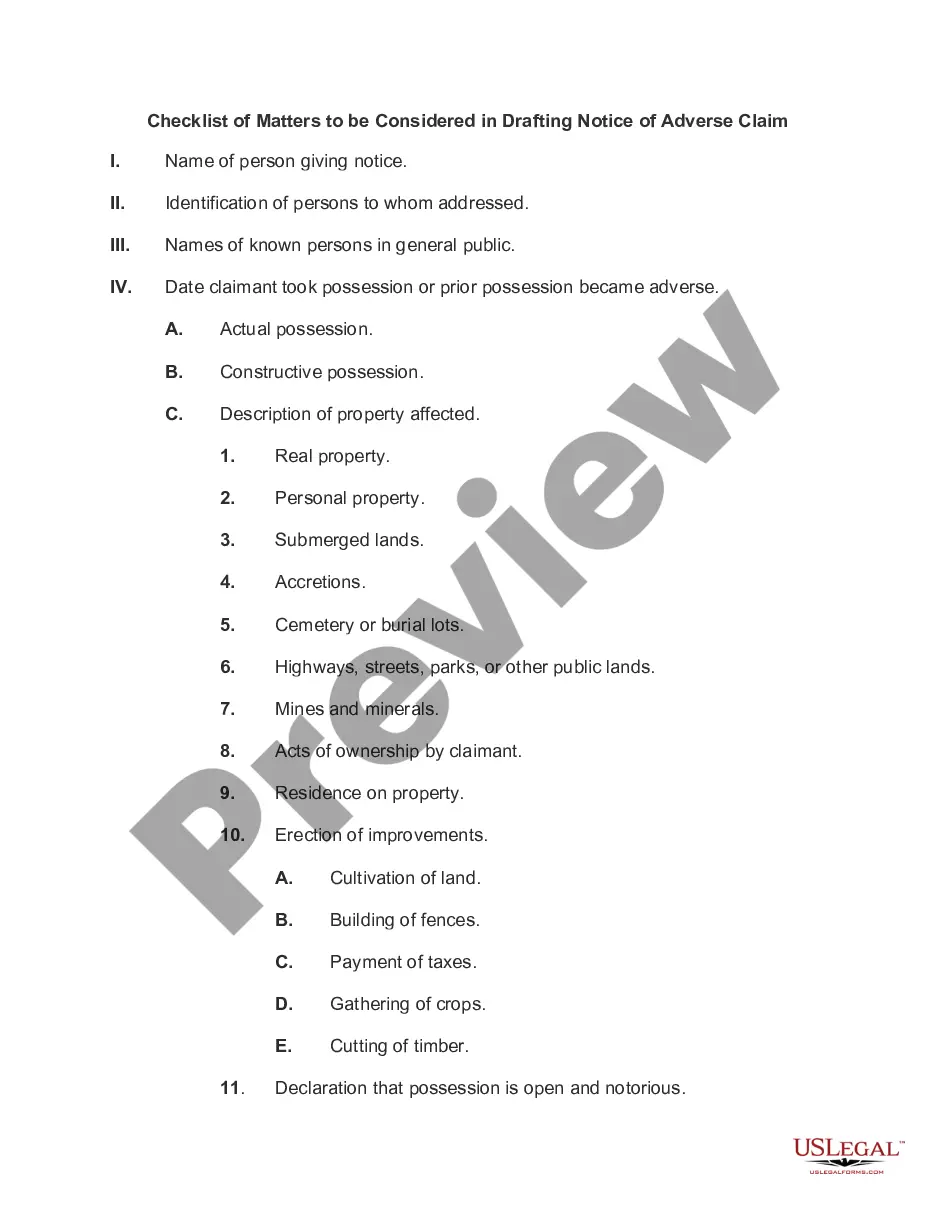

How to fill out California Notice Of Intent To Enforce Forfeiture Provisions Of Contact For Deed?
Utilize US Legal Forms to obtain a printable California Notice of Intent to Enforce Forfeiture Provisions of Contract for Deed.
Our court-acceptable forms are created and routinely revised by qualified attorneys.
Ours is the most extensive Forms catalog available online and offers economical and precise templates for individuals, lawyers, and small to medium businesses.
US Legal Forms offers countless legal and tax templates and packages for both business and personal purposes, including the California Notice of Intent to Enforce Forfeiture Provisions of Contract for Deed. More than three million users have successfully used our service. Choose your subscription plan and obtain high-quality documents in just a few clicks.
- The templates are categorized by state, and some can be previewed before download.
- To access templates, users must have a subscription and Log In to their account.
- Click Download next to any required form and locate it in My documents.
- For users without a subscription, follow the steps below to easily locate and download the California Notice of Intent to Enforce Forfeiture Provisions of Contract for Deed.
- Ensure you possess the accurate form for the state it is intended for.
- Examine the document by browsing the description and utilizing the Preview option.
- Select Buy Now if it’s the form you require.
- Set up your account and pay via PayPal or debit/credit card.
- Download the form to your device and feel free to reuse it multiple times.
- Utilize the Search function if you wish to find another document template.
Form popularity
FAQ
Yes, a trust deed must be recorded in California to be enforceable against third parties. Once recorded, it provides public notice of the lender's interest in the property, which helps protect their investment. Failing to record the trust deed may result in complications when invoking the California Notice of Intent to Enforce Forfeiture Provisions of Contact for Deed. Recording the deed is a crucial step in the process, and platforms like US Legal Forms can assist you in ensuring that you follow the correct procedures.
Filing a deed of trust in California requires you to submit the signed document to the county recorder's office where the property is located. It's essential to include the appropriate filing fees along with your submission. This action provides public notice of the lien associated with the property. If you are addressing issues related to the California Notice of Intent to Enforce Forfeiture Provisions of Contact for Deed, proper filing ensures that all parties are aware of their rights.
For buyers, a forfeiture clause represents a significant disadvantage as it often leads to the loss of both the property and any payments previously made. When activated, this clause can swiftly strip away the buyer's investment and rights. Understanding the California Notice of Intent to Enforce Forfeiture Provisions of Contract for Deed can empower buyers to take protective actions and better navigate these agreements. Therefore, informed decisions are always beneficial.
The forfeiture clause on a land contract functions similarly to that in other agreements, allowing the seller to regain possession if the buyer defaults. It is crucial for the buyer to understand the implications of this clause, as it can lead to unforeseen financial loss. Knowledge of the California Notice of Intent to Enforce Forfeiture Provisions of Contract for Deed is vital in such instances, ensuring that buyers respect their contractual obligations. Awareness can significantly reduce risks associated with defaults.
A land contract can be voided for various reasons, including failure to meet terms, fraudulent activities, or misrepresentation. If either party does not fulfill their obligations, the contract may be considered nullified. Familiarity with the California Notice of Intent to Enforce Forfeiture Provisions of Contract for Deed can help parties navigate these situations more effectively. Thus, staying informed is essential to safeguarding interests.
The forfeiture clause outlines the circumstances under which a contract can be terminated, often favoring the seller. When activated, this clause allows the seller to reclaim the property without returning any funds received. Thus, knowing about the California Notice of Intent to Enforce Forfeiture Provisions of Contract for Deed is vital for buyers. It ensures they remain informed and can take necessary precautions.
Forfeiting a contract implies that the buyer has failed to fulfill their obligations, resulting in the loss of rights to the property. In many cases, this includes the seller regaining ownership without compensating the buyer for previous payments. Understanding the California Notice of Intent to Enforce Forfeiture Provisions of Contract for Deed is essential, as it sheds light on this serious consequence. Awareness can help buyers take preventive measures.
A contract for deed poses risks to the buyer, primarily the potential for forfeiture if the buyer fails to meet terms. If this happens, the seller can reclaim the property without returning payments made. This situation highlights the importance of understanding the California Notice of Intent to Enforce Forfeiture Provisions of Contract for Deed. Therefore, it's crucial to know your rights and obligations before entering such agreements.
The terms and provisions of a contract for deed encompass payment schedules, default procedures, and property maintenance responsibilities. These details ensure that both the buyer and seller understand their roles throughout the transaction. By incorporating the California Notice of Intent to Enforce Forfeiture Provisions of Contract for Deed into the agreement, both parties can secure their interests and clarify expectations. A well-structured contract fosters trust and minimizes potential conflicts.
Assignment provisions in a contract determine whether a party can transfer their rights and obligations to another individual. Typically, these provisions specify if the original buyer can assign their interest to a third party, and under what conditions. Understanding the California Notice of Intent to Enforce Forfeiture Provisions of Contract for Deed is vital as it can impact the enforceability of such assignments. This feature can provide flexibility, but clear agreement is essential to avoid misunderstandings.