Delaware Warranty Deed from Individual to Husband and Wife
What this document covers
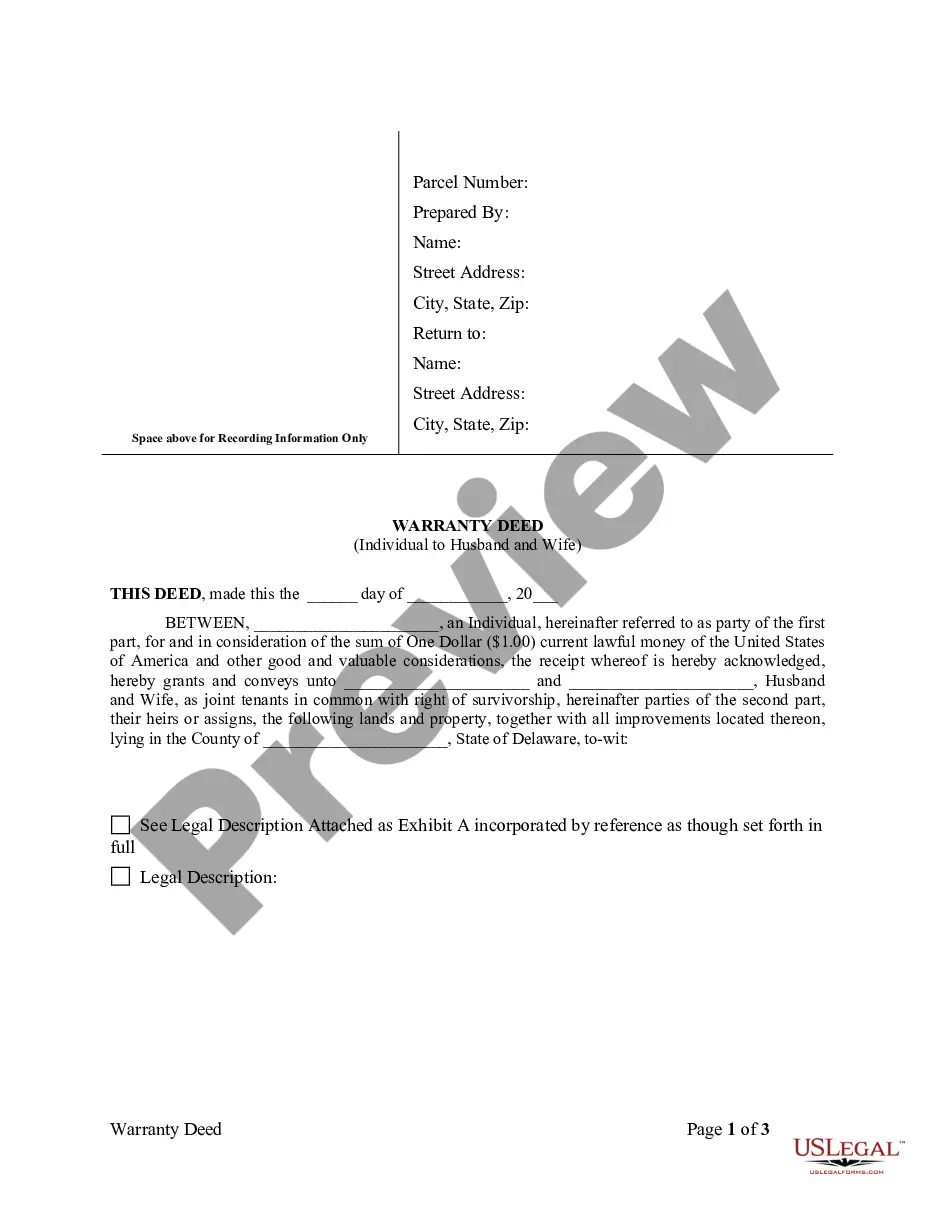
The Warranty Deed from Individual to Husband and Wife is a legal document used to transfer ownership of real property from one individual (Grantor) to a married couple (Grantees). This form includes warranties regarding the property's title and ensures it is free from encumbrances, with specific reservations noted. It is tailored for transactions between individuals and their spouses, making it distinct from other types of deeds, such as quitclaim deeds or general warranty deeds used for different arrangements.
Main sections of this form
- Identification of the Grantor and Grantees, including names and marital status.
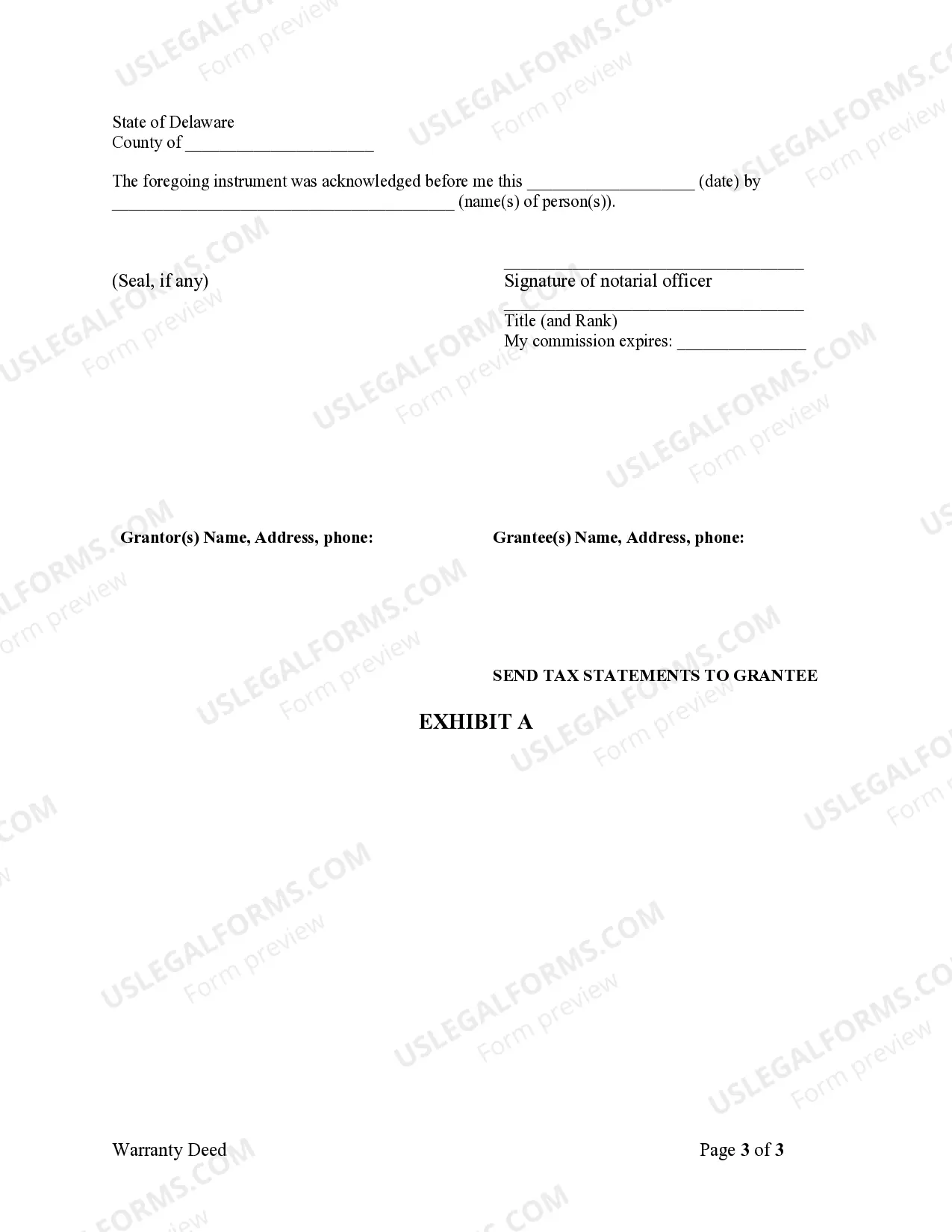
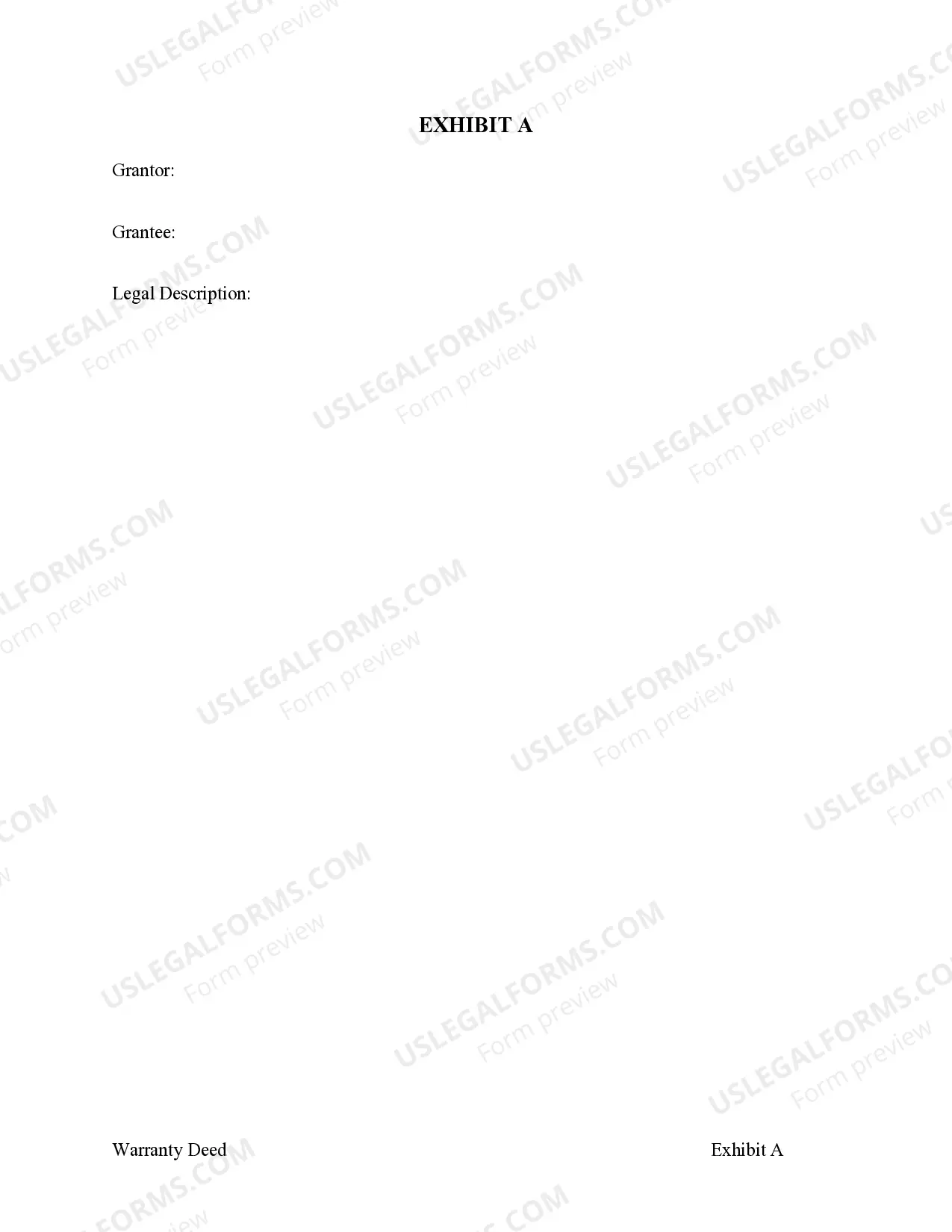
- Legal description of the property being conveyed, referenced in an attached exhibit.
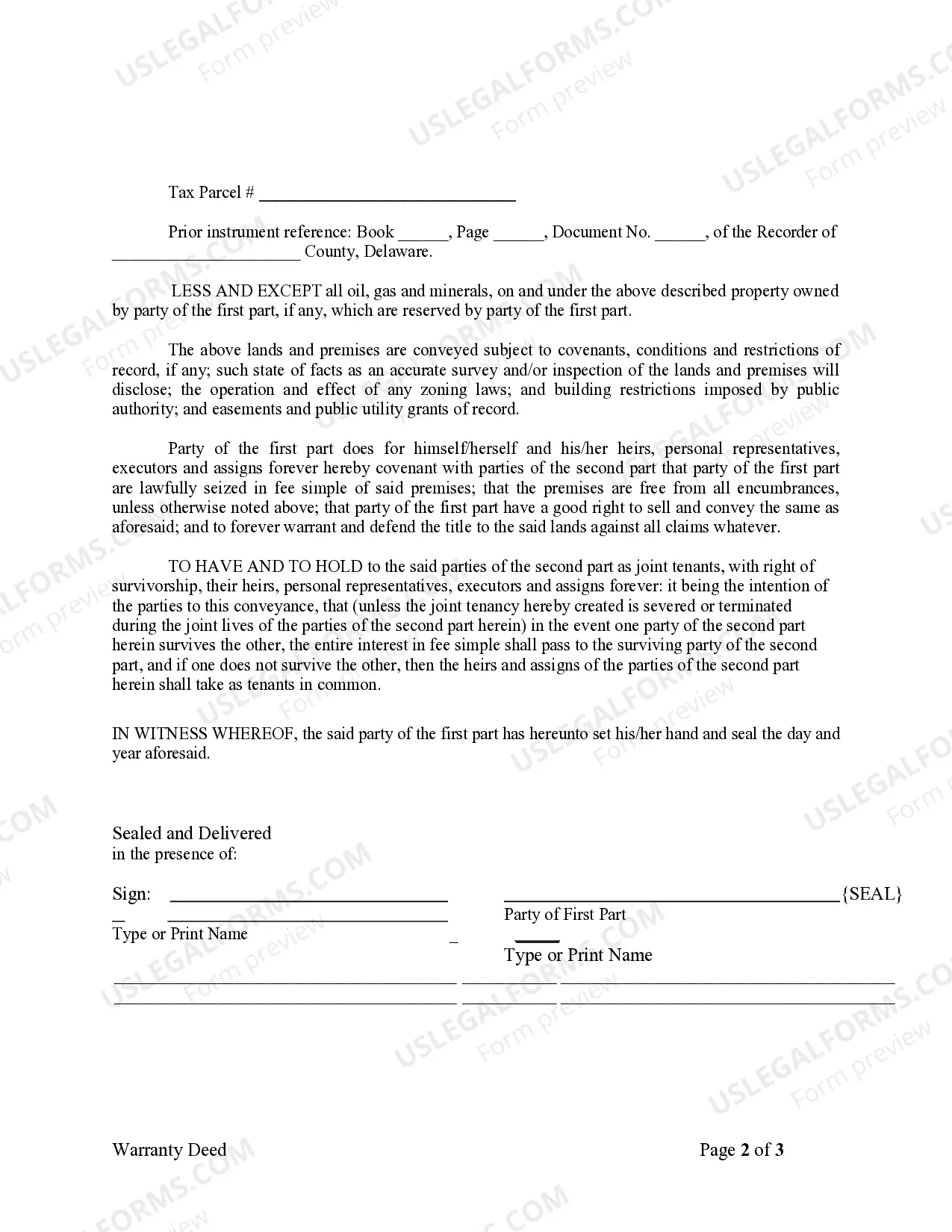
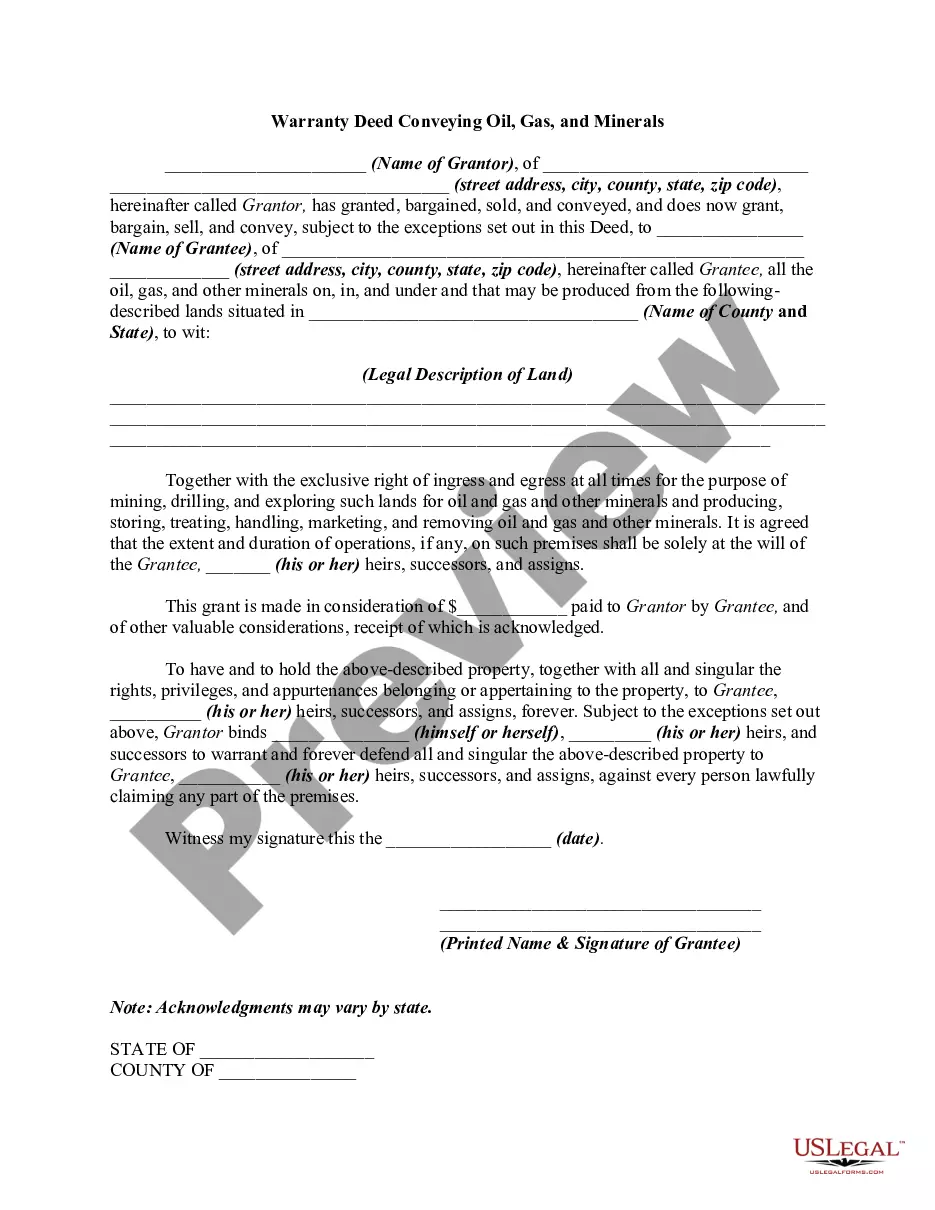
- Details regarding the reservation of oil, gas, and minerals beneath the property.
- Covenants ensuring the Grantor has a clear title and the ability to transfer ownership.
- Provisions for joint tenancy with right of survivorship for the Grantees.
- Notary and witness lines for validation of the deed.




Common use cases
This form is ideal for couples who wish to secure their joint ownership of a property, ensuring that in the event of one spouseâs death, the surviving spouse automatically inherits full ownership. It is commonly used when individuals want to transfer their property to their spouse to strengthen their marital estate or for estate planning purposes. Additionally, it is useful in real estate transactions where certain rights or mineral rights require addressing.
Who should use this form
- Individuals looking to transfer property ownership to their spouse.
- Married couples who want to establish joint tenancy of a property.
- Homeowners wishing to clarify property title and survivorship rights.
- Anyone engaged in real estate transactions involving family members.
How to prepare this document
- Identify the Grantor and the Grantees, ensuring their names are correctly spelled.
- Specify the property's legal description, referring to the attached Exhibit A.
- Include any reservations regarding mineral rights as necessary.
- Sign the document in the presence of a notary public and witnesses, if required.
- File the completed and notarized form with the appropriate local authority, if necessary.
Notarization guidance
Yes, this form must be notarized to be legally valid. Notarization ensures that the identities of the parties involved are confirmed, adding an extra layer of security and validity to the document. US Legal Forms offers integrated online notarization services, allowing you to complete the process conveniently and securely via a video call at any time, without the need to travel.
Get your form ready online
Our built-in tools help you complete, sign, share, and store your documents in one place.
Make edits, fill in missing information, and update formatting in US Legal Forms—just like you would in MS Word.
Download a copy, print it, send it by email, or mail it via USPS—whatever works best for your next step.
Sign and collect signatures with our SignNow integration. Send to multiple recipients, set reminders, and more. Go Premium to unlock E-Sign.
If this form requires notarization, complete it online through a secure video call—no need to meet a notary in person or wait for an appointment.
We protect your documents and personal data by following strict security and privacy standards.

Make edits, fill in missing information, and update formatting in US Legal Forms—just like you would in MS Word.

Download a copy, print it, send it by email, or mail it via USPS—whatever works best for your next step.

Sign and collect signatures with our SignNow integration. Send to multiple recipients, set reminders, and more. Go Premium to unlock E-Sign.

If this form requires notarization, complete it online through a secure video call—no need to meet a notary in person or wait for an appointment.

We protect your documents and personal data by following strict security and privacy standards.
Common mistakes
- Failing to accurately complete the legal description of the property.
- Not including required reservations for mineral rights, if applicable.
- Neglecting to have the deed notarized or to include witness signatures when required.
- Leaving out important details concerning ownership, such as joint tenancy provisions.
Why use this form online
- Convenience of downloading the form instantly without visiting a lawyer.
- Editability allows you to customize the form for your specific needs.
- Access to a reliable and legally compliant template prepared by licensed attorneys.
- Reduces the time and complexity associated with traditional legal processes.
Looking for another form?





Form popularity
FAQ
Including both names on a deed can provide clarity and security for a married couple. A Delaware Warranty Deed from Individual to Husband and Wife allows both partners to have legal rights to the property, simplifying ownership complications down the road. It can also protect both parties in case of divorce or the passing of one partner.
Adding a name to a deed can have several disadvantages. For example, it may affect property tax assessments and liability issues, as both owners share responsibility. Additionally, once someone is added to the deed, you may lose some control over the property, as both parties must agree on any future transactions.
Filling out a warranty deed form involves several steps. First, enter the current owner's details and the details of the person receiving the property. Then, describe the property accurately, using its legal description. Finally, sign the warranty deed before a notary, ensuring compliance with Delaware law before submitting it to the appropriate county office.
To add someone to a deed in Delaware, you must draft a Delaware Warranty Deed that includes the current owner and the new owner's details. Ensure that both parties sign the document in front of a notary, confirming their agreement. Once signed, submit the deed to the county recorder's office to record the addition legally.
To add your spouse to your deed in Delaware, you will need to complete a Delaware Warranty Deed from Individual to Husband and Wife. Start by filling out the deed form, ensuring you enter both your name and your spouse's name correctly. After completing the document, have it signed before a notary, then file it with the local county recorder's office to make it official.
One disadvantage of a Delaware Warranty Deed from Individual to Husband and Wife is that it carries more risk for the seller. If any issues arise regarding the title, the seller may be held responsible even after the sale is complete. This responsibility can sometimes lead to disputes, potentially requiring legal assistance to resolve.
Yes, warranty deeds are transferable. This means that a Delaware Warranty Deed from Individual to Husband and Wife allows the new owners to transfer their rights to others in the future. Proper legal procedures must be followed to ensure the transfer is valid, providing protection for all parties involved.
Yes, you can transfer a deed without an attorney, especially when using a Delaware Warranty Deed from Individual to Husband and Wife. However, ensure that you follow all legal requirements for your state to avoid mistakes. Using online platforms like USLegalForms can simplify the process, providing you with the necessary forms and guidance.
Yes, a Delaware Warranty Deed from Individual to Husband and Wife proves ownership of the property. This legal document guarantees that the individual transferring the property holds valid title without any hidden claims. By executing this deed, both parties affirm their rights regarding the property, increasing legal security for ownership.
To obtain your Delaware Warranty Deed from Individual to Husband and Wife, you can request it from your local county recorder or register of deeds. You may need to provide relevant details about the property and the previous owners. Additionally, US Legal Forms offers resources that can help you understand the process and provide templates for creating your deed efficiently. Consider leveraging our platform to streamline your efforts.