Utah Renunciation And Disclaimer of Property received by Intestate Succession
Understanding this form
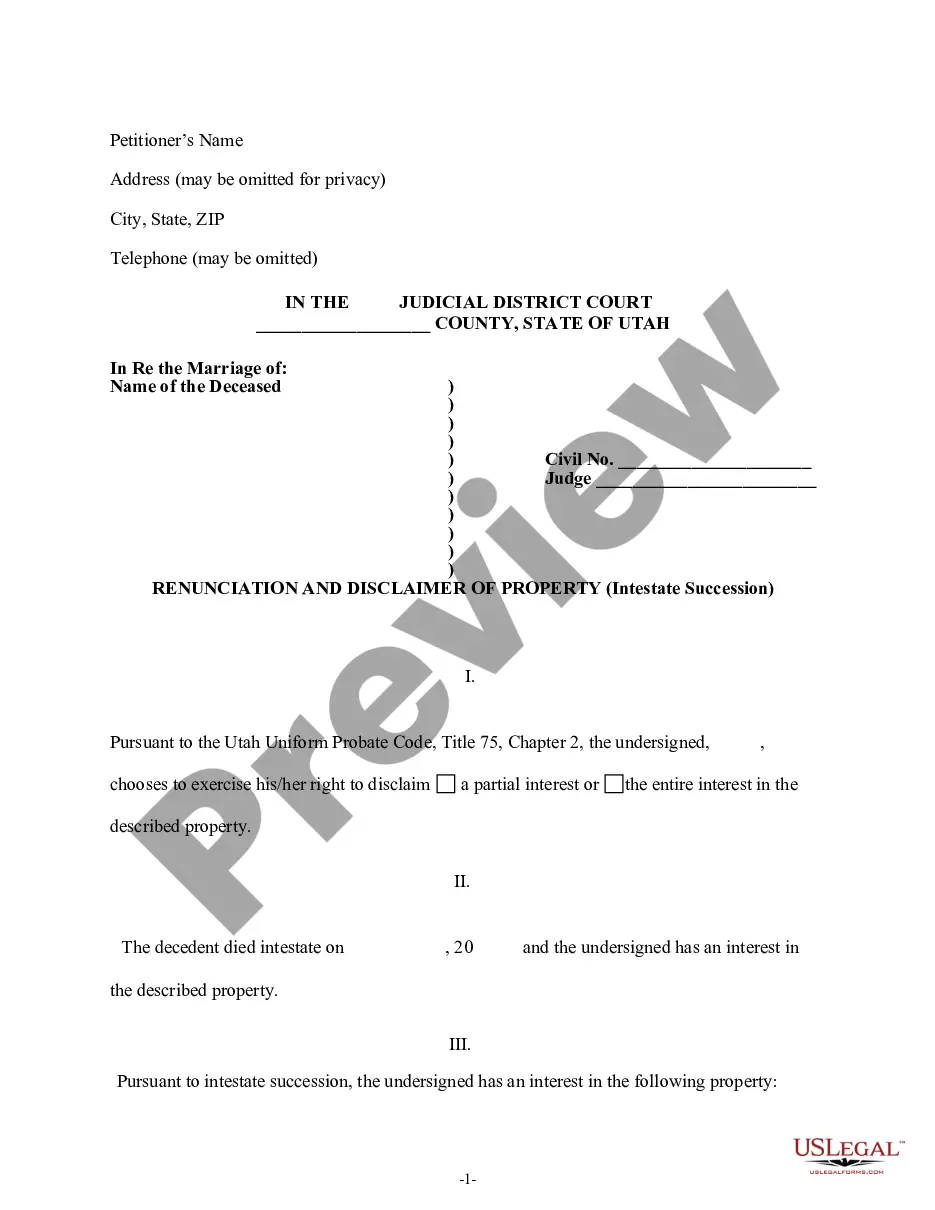
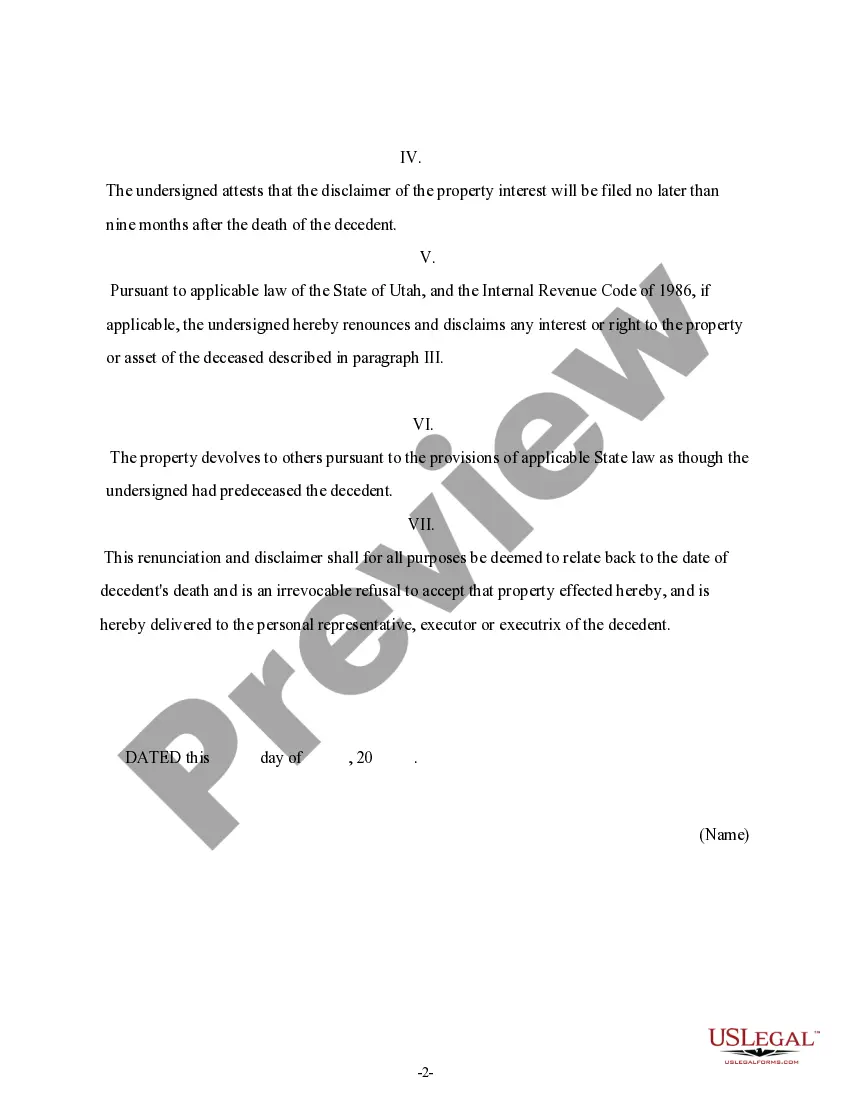
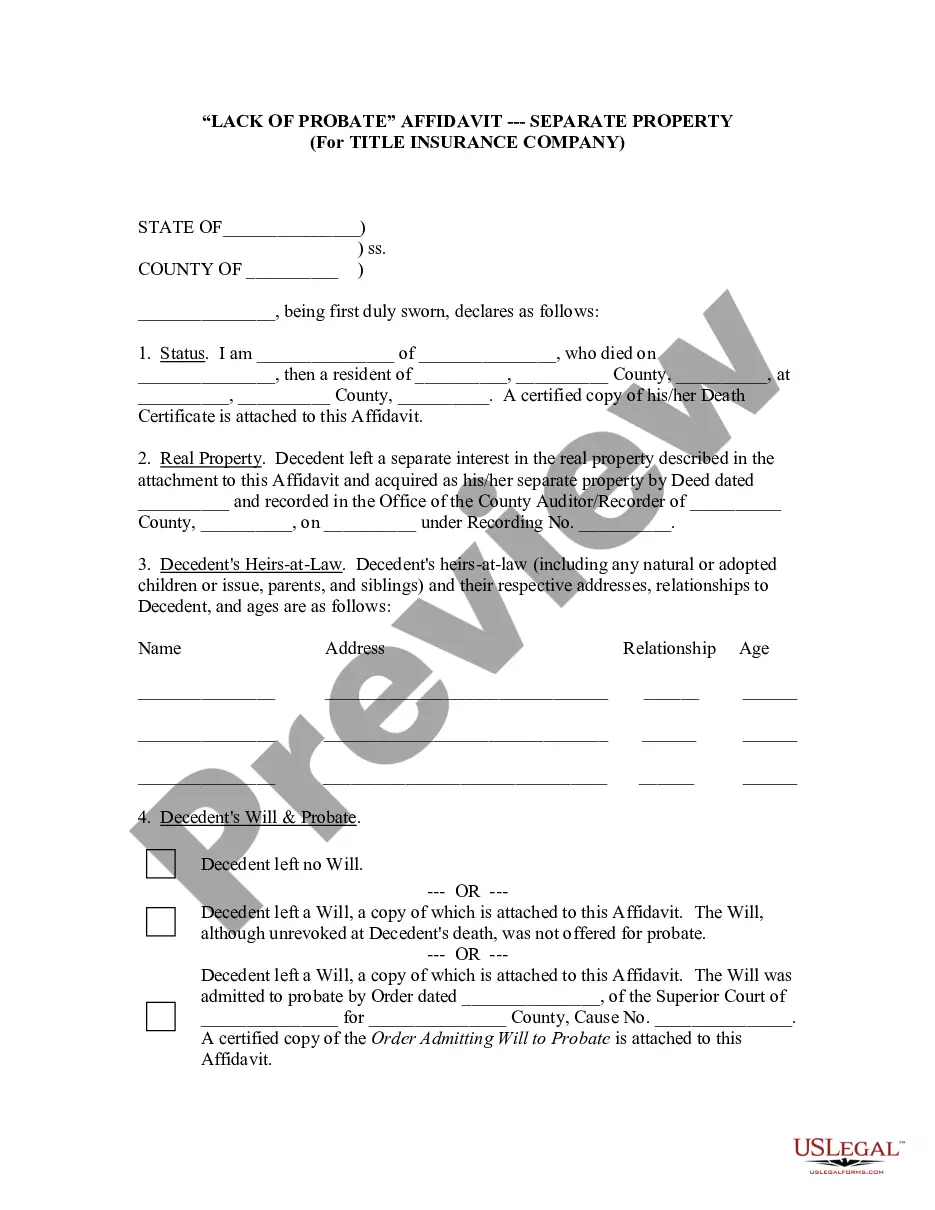
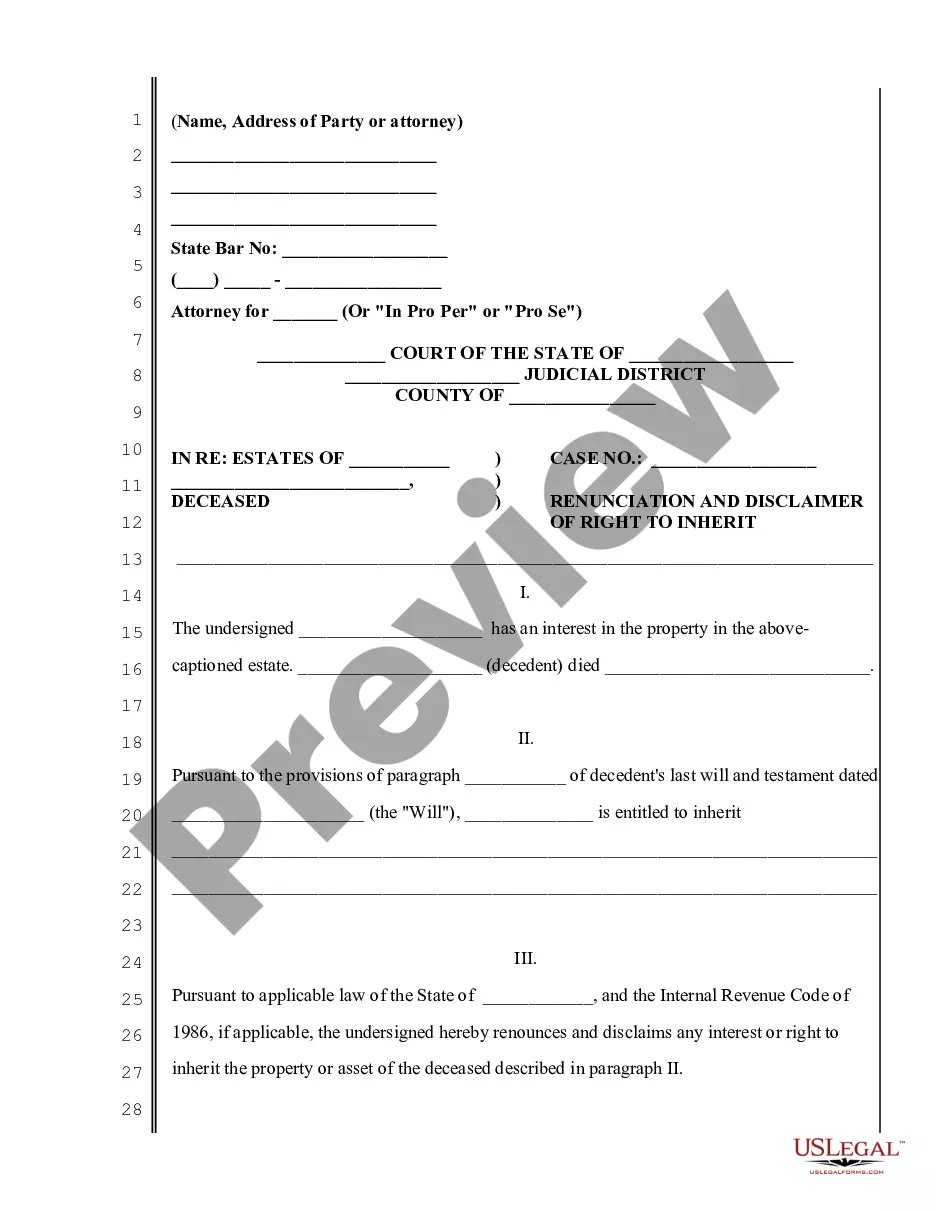
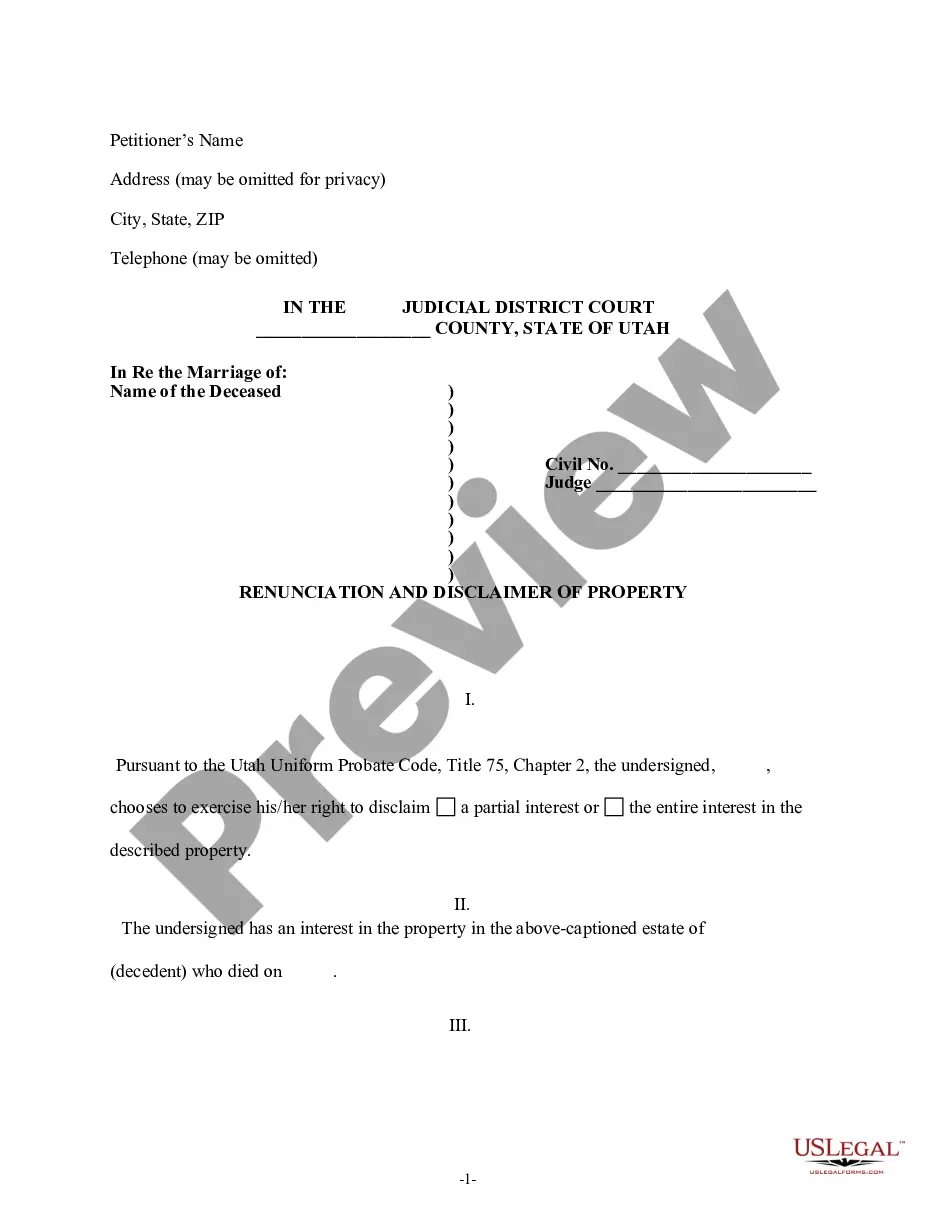
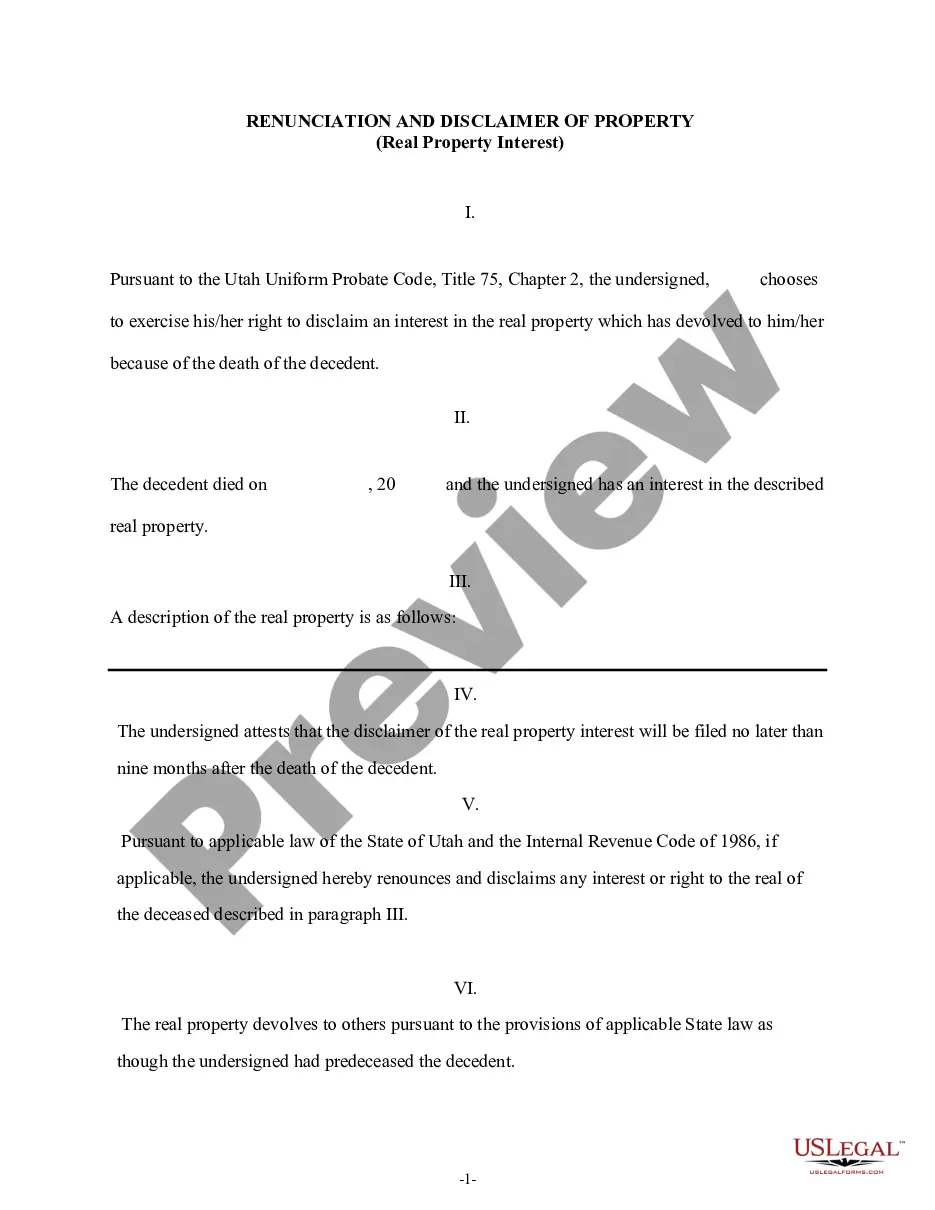
The Renunciation and Disclaimer of Property received by Intestate Succession is a legal document that allows a beneficiary to renounce their interest in property inherited from a deceased person. By completing this form, the beneficiary effectively terminates their claim to the property, allowing it to pass on as if they had predeceased the decedent. This form is crucial for those who do not wish to accept the property, potentially for financial or personal reasons, differentiating it from other estate planning forms like wills or trusts that deal with the distribution of assets.
Main sections of this form
- Identification of the decedent and the beneficiary.
- Description of the property being renounced.
- Statement of renunciation of interest in the property.
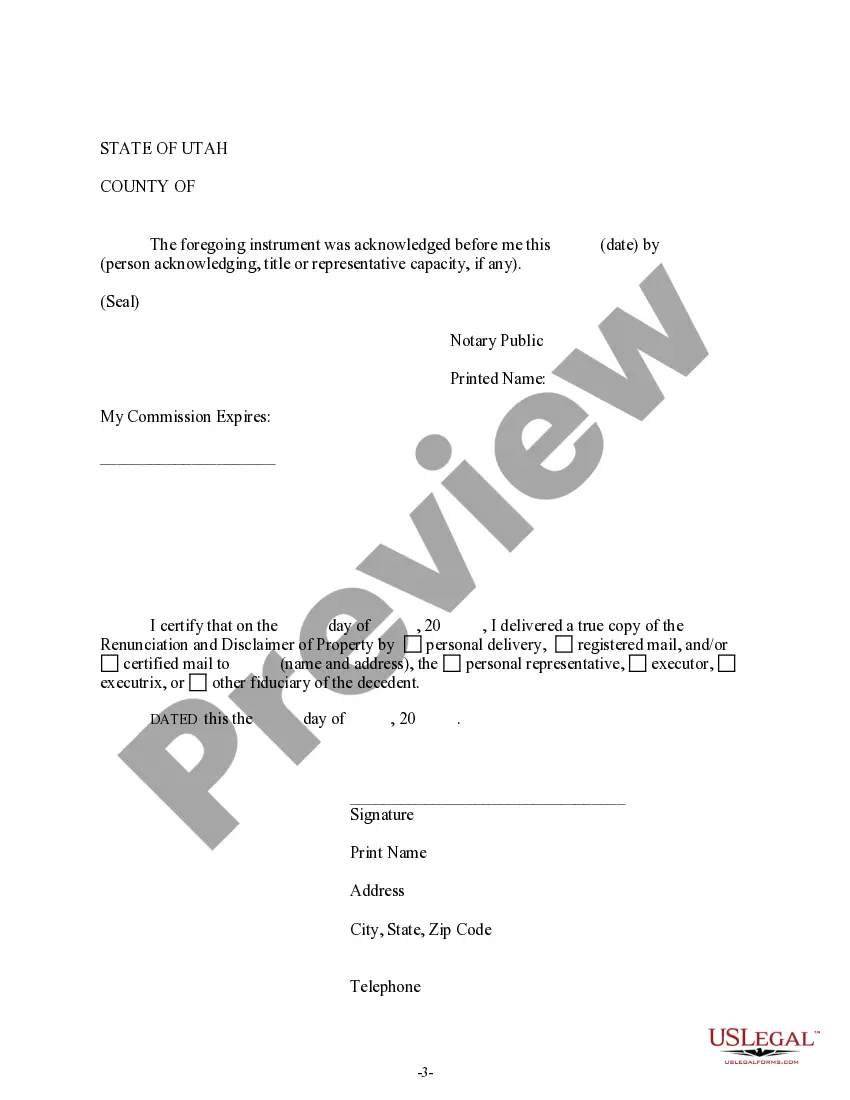
- Legal acknowledgment relevant to state laws.
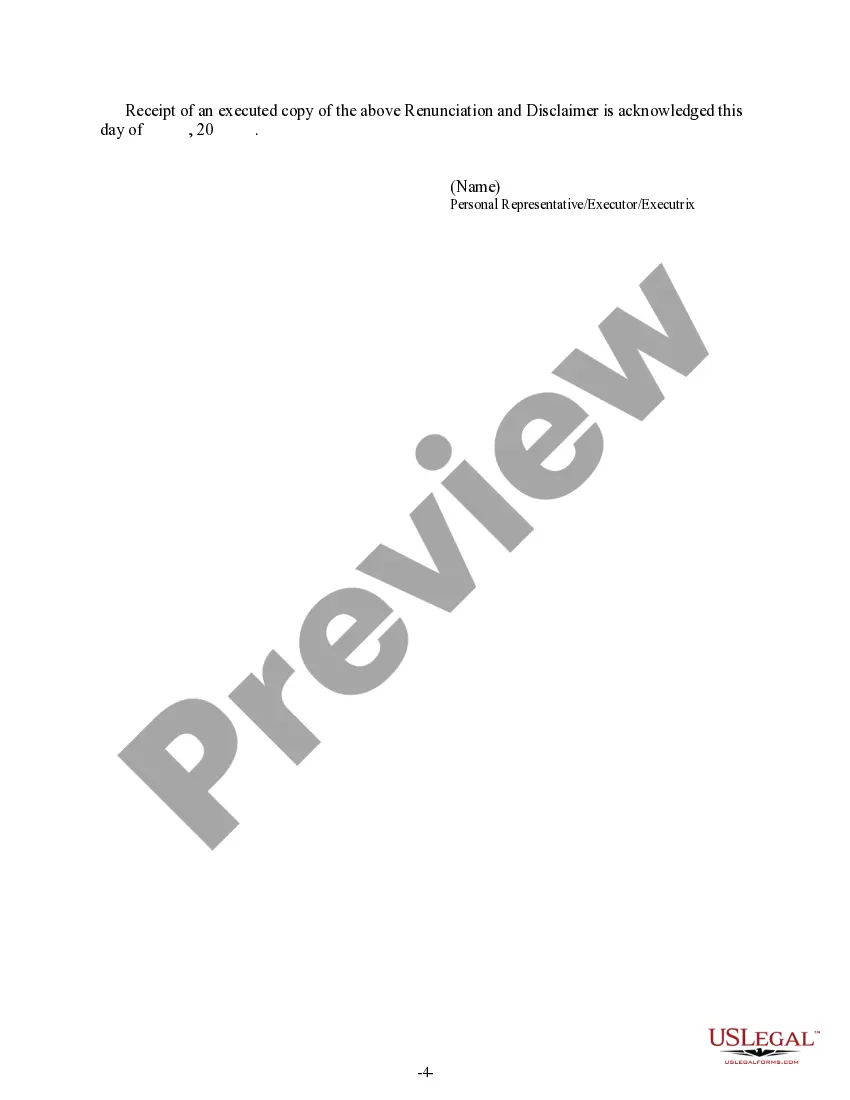
- A certificate of delivery to verify the form's submission.
When this form is needed
This form is typically used when a beneficiary inherits property through intestate succession but decides not to accept the property. Common scenarios include when the property carries significant debt, when there are personal reasons to reject the inheritance, or when the beneficiary wishes to allow the property to pass to other heirs in a more favorable manner. The form ensures that the property is redistributed according to state laws as if the beneficiary had never been an heir.
Who can use this document
This form is suitable for:
- Beneficiaries who have inherited property from a decedent without a will.
- Individuals seeking to legally renounce their rights to inherited property.
- Heirs wanting to clarify their intentions regarding intestate property.
How to complete this form
- Identify the decedent by including their full name and date of death.
- Specify the property you are renouncing, including a clear description.
- Complete the statement of renunciation, confirming your intention to disclaim the property.
- Review state-specific acknowledgment requirements to ensure compliance.
- Sign and date the form, ensuring proper delivery if needed.
Does this form need to be notarized?
This document requires notarization to meet legal standards. US Legal Forms provides secure online notarization powered by Notarize, allowing you to complete the process through a verified video call, available 24/7.
Get your form ready online
Our built-in tools help you complete, sign, share, and store your documents in one place.
Make edits, fill in missing information, and update formatting in US Legal Forms—just like you would in MS Word.
Download a copy, print it, send it by email, or mail it via USPS—whatever works best for your next step.
Sign and collect signatures with our SignNow integration. Send to multiple recipients, set reminders, and more. Go Premium to unlock E-Sign.
If this form requires notarization, complete it online through a secure video call—no need to meet a notary in person or wait for an appointment.
We protect your documents and personal data by following strict security and privacy standards.

Make edits, fill in missing information, and update formatting in US Legal Forms—just like you would in MS Word.

Download a copy, print it, send it by email, or mail it via USPS—whatever works best for your next step.

Sign and collect signatures with our SignNow integration. Send to multiple recipients, set reminders, and more. Go Premium to unlock E-Sign.

If this form requires notarization, complete it online through a secure video call—no need to meet a notary in person or wait for an appointment.

We protect your documents and personal data by following strict security and privacy standards.
Avoid these common issues
- Failing to provide complete information about the decedent or property.
- Not signing or dating the form properly.
- Neglecting to check state-specific requirements that could affect the form's validity.
- Overlooking the certificate of delivery, which may be required for certain jurisdictions.
Benefits of using this form online
- Convenient access to the form anytime, eliminating the need for in-person visits.
- Editable templates allow you to fill in your specific details efficiently.
- Drafted by licensed attorneys, ensuring the form complies with legal standards.
- Easy downloading and storage options for your records.
Main things to remember
- This form allows you to renounce ownership of property received through intestate succession.
- It ensures the property is passed down in accordance with state law.
- Completing this form can have significant legal implications; understanding your rights and obligations is essential.
Looking for another form?
Form popularity
FAQ
The laws are different in every state, but if you're married and die without a will, your estate will probably go to your spouse if you both own it.If he passes away without a will, the law says his surviving spouse will inherit the first $50,000 of his personal assets (not any shared assets) plus half the balance.
If you die intestate in Utah, your children will receive an intestate share of your property.Your spouse will inherit the first $75,000 of your intestate property, and half of what remains of your intestate property after that. Your descendants will then inherit everything else.
Probate is required if: the estate includes real property (land, house, condominium, mineral rights) of any value, and/or. the estate has assets (other than land, and not including cars) whose net worth is more than $100,000.
Children - if there is no surviving married or civil partner If there is no surviving partner, the children of a person who has died without leaving a will inherit the whole estate. This applies however much the estate is worth. If there are two or more children, the estate will be divided equally between them.
In Utah, how long do I have to begin the probate process? You have up to three years after decedent's death to initiate the probate process. If more than three years have lapsed, you can no longer probate the will, and should instead file a determination of heirs to administer decedent's estate.
Children - if there is no surviving married or civil partnerIf there is no surviving partner, the children of a person who has died without leaving a will inherit the whole estate. This applies however much the estate is worth. If there are two or more children, the estate will be divided equally between them.
Who Inherits When There's No Will? Intestate succession laws determine how to distribute assets among them when no will is in place. This varies between states. Generally, a spouse receives most of the assets and property, followed by children, parents, grandparents, and other blood relatives of the deceased.
In Utah, you can make a living trust to avoid probate for virtually any asset you ownreal estate, bank accounts, vehicles, and so on. You need to create a trust document (it's similar to a will), naming someone to take over as trustee after your death (called a successor trustee).
Who Gets What: The Basic Rules of Intestate Succession.Generally, only spouses, registered domestic partners, and blood relatives inherit under intestate succession laws; unmarried partners, friends, and charities get nothing. If the deceased person was married, the surviving spouse usually gets the largest share.