Comprehensive Pre-IPO Memo for High-Tech Companies
About this form
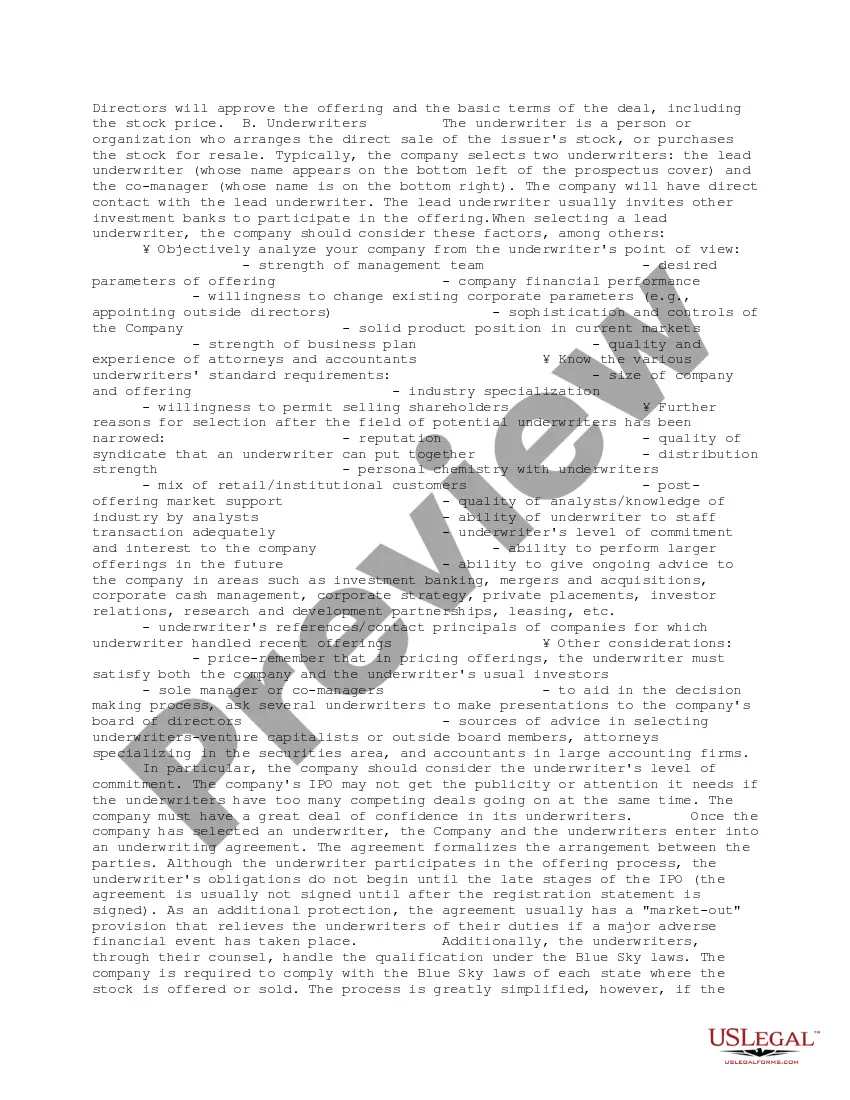
The Comprehensive Pre-IPO Memo for High-Tech Companies is a detailed memorandum that outlines the Initial Public Offering (IPO) process specifically for high-tech firms. This document addresses essential topics such as company disclosure policies, stock plans, and insider trading policies, providing a broad overview for those unfamiliar with going public. Unlike simpler forms, this memo offers a comprehensive analysis of the complexities and considerations involved in the IPO process, serving as a guide for management and stakeholders.
Key parts of this document
- Introduction: Overview of the IPO process for high-tech companies.
- Going Public: Examination of advantages and disadvantages associated with becoming a public company.
- Participants in the Process: Roles of company management, underwriters, and legal advisors during the IPO.
- Due Diligence: Process of verifying information in the prospectus to ensure accuracy.
- Registration Statement and Prospectus: Drafting and filing requirements with the SEC.
- Post-IPO Disclosure: Ongoing reporting obligations and how to communicate material information to the public.












Situations where this form applies
This form should be used when a high-tech company is preparing to go public and needs a detailed understanding of the IPO process. It is particularly valuable for management teams, legal advisors, and financial analysts who need to navigate the complexities of public offerings, ensuring compliance with regulatory standards.
Who this form is for
This form is suitable for:
- Company executives contemplating an IPO.
- Legal counsel advising high-tech firms on compliance and regulatory matters.
- Financial advisors and underwriters involved in the IPO process.
- Investors and stakeholders seeking to understand the implications of a company going public.
How to prepare this document
To complete this form, follow these steps:
- Review the introduction to familiarize yourself with the IPO process.
- Analyze the advantages and disadvantages of going public as outlined in the memo.
- Identify the key participants involved in the IPO process and their respective roles.
- Conduct due diligence to ensure all corporate information is accurate and up-to-date before finalizing the prospectus.
- Complete the registration statement as required by the SEC and prepare for public disclosures.
Notarization guidance
This form does not typically require notarization to be legally valid. However, some jurisdictions or document types may still require it. US Legal Forms provides secure online notarization powered by Notarize, available 24/7 for added convenience.
Get your form ready online
Our built-in tools help you complete, sign, share, and store your documents in one place.
Make edits, fill in missing information, and update formatting in US Legal Forms—just like you would in MS Word.
Download a copy, print it, send it by email, or mail it via USPS—whatever works best for your next step.
Sign and collect signatures with our SignNow integration. Send to multiple recipients, set reminders, and more. Go Premium to unlock E-Sign.
If this form requires notarization, complete it online through a secure video call—no need to meet a notary in person or wait for an appointment.
We protect your documents and personal data by following strict security and privacy standards.

Make edits, fill in missing information, and update formatting in US Legal Forms—just like you would in MS Word.

Download a copy, print it, send it by email, or mail it via USPS—whatever works best for your next step.

Sign and collect signatures with our SignNow integration. Send to multiple recipients, set reminders, and more. Go Premium to unlock E-Sign.

If this form requires notarization, complete it online through a secure video call—no need to meet a notary in person or wait for an appointment.

We protect your documents and personal data by following strict security and privacy standards.
Common mistakes
- Overlooking the importance of due diligence, which can lead to inaccurate disclosures.
- Failing to understand the roles of various participants in the IPO process.
- Neglecting to draft the prospectus in plain English, making it difficult for investors to comprehend.
- Ignoring ongoing post-IPO disclosure obligations, which can lead to regulatory penalties.
Why complete this form online
- Access to professionally drafted legal documents tailored for the IPO process.
- Ability to download forms quickly for immediate use.
- Reliability of document templates created by licensed attorneys with expertise in securities law.
- Convenience of having all essential information regarding IPOs in one comprehensive memo.
- This memorandum serves as guidance and is not a substitute for legal advice.
- Proper completion of the form is essential for compliance with federal securities regulations.
- Incorrect handling of the IPO process can expose the company to legal liabilities and regulatory scrutiny.
Summary of main points
- This memo serves as a comprehensive guide for high-tech companies planning an IPO.
- Understanding the roles of participants is crucial for a successful IPO process.
- Preparation and strategic planning are essential for navigating the complexities of going public.
Looking for another form?
Form popularity
FAQ
The company has predictable and consistent revenue. There is extra cash to fund the IPO process. There is still plenty of growth potential in the business sector. The company should be one of the top players in the industry. There should be a strong management team in place.
A) Net tangible assets of at least Rs. 3 crore in each of the preceding three full years of which not more than 50% are held in monetary assets. However, the limit of 50% on monetary assets shall not be applicable in case the public offer is made entirely through offer for sale.
Advisors. Choose experienced advisors early, including attorneys and auditors. Underwriters. Identify prospective investment bankers and leading analysts in your market space. Audited Financial Statements. Other Financial Statements. Accounting Issues. Key Metrics. Cheap Stock. Stock Valuations.
Typically a firm will launch in IPO when it reaches a plateau in what it can achieve through private capital and will use those funds to expand or continue growing.
The company has predictable and consistent revenue. There is extra cash to fund the IPO process. There is still plenty of growth potential in the business sector. The company should be one of the top players in the industry. There should be a strong management team in place.
Now Let's Dive Into How to Value a Company Pre-IPO You have three main valuation techniques at your disposal: (i) comparable company analysis, (ii) precedent transactions analysis, and (iii) discounted cash flow (DCF) analysis.
How big is the market? How fast can you grow? How disruptive is your product? Is your product a new way of doing something? How predictable is the business model? Finally, how much leverage do you have?