Start-Up / Early Stage Company Presentation Model
Overview of this form
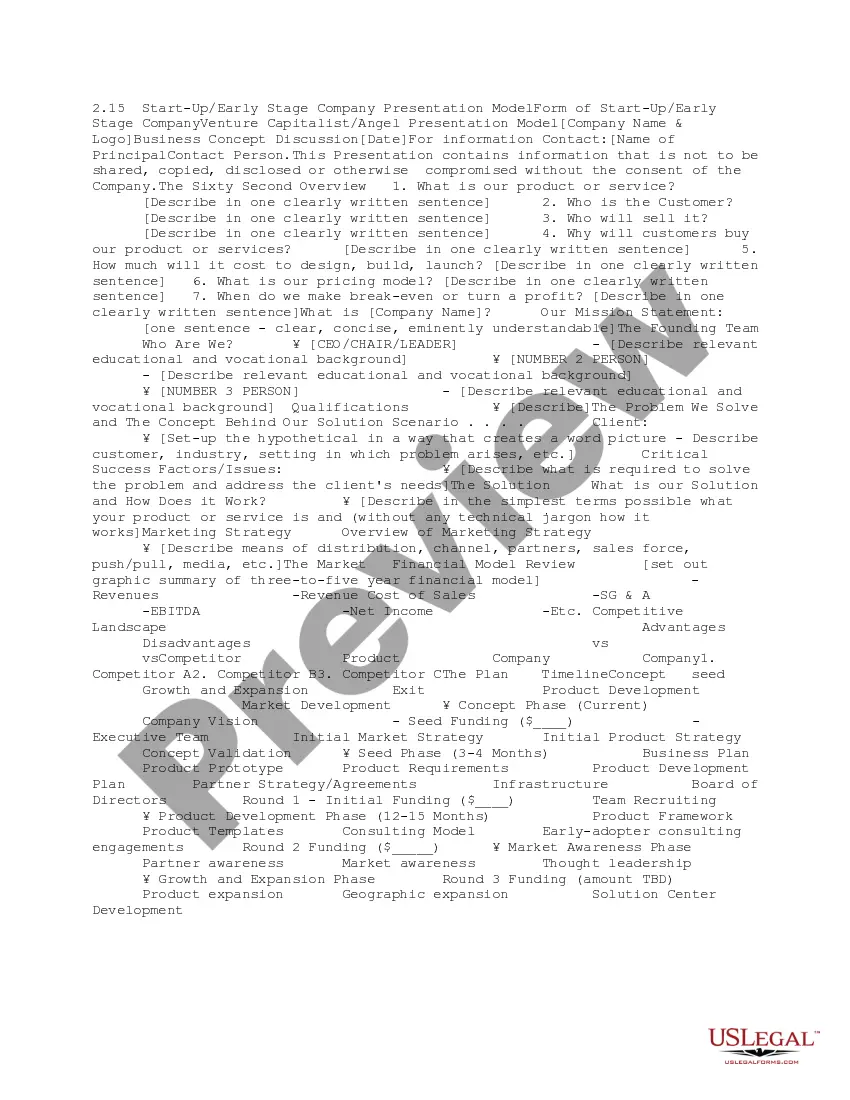
The Start-Up / Early Stage Company Presentation Model is a structured outline designed for emerging high-tech companies to prepare presentations for potential investors, such as venture capitalists or angel investors. This form helps startups effectively communicate their business concept, market, and solutions, setting it apart from generic presentation templates by focusing on the unique elements vital for attracting investment.
Main sections of this form
- Company name and logo
- Business concept discussion
- Sixty-second overview covering product, customer, sales strategy, cost, and pricing model
- Mission statement
- Overview of the founding team and their qualifications
- Description of the problem being solved and the proposed solution
- Marketing strategy overview
- Financial model review including key metrics
- Competitive landscape analysis
- Growth, expansion, and exit strategy timeline


Common use cases
This form is ideal for start-up or early-stage businesses looking to secure funding from investors. Use it when preparing for pitch meetings where you need to succinctly present your business concept, market analysis, and financial projections to garner interest and investment.
Who should use this form
- Start-up founders seeking investment
- Entrepreneurs in the early stages of business development
- Individuals preparing a pitch for venture capitalists or angel investors
- Business teams needing a structured format to present their plans and qualifications
Instructions for completing this form
- Enter the company name and logo at the top of the presentation model.
- Clearly define the business concept in the provided section.
- Outline the sixty-second overview summarizing key aspects of the business.
- Detail the qualifications of the founding team members and what problems your service addresses.
- Include the marketing strategy and financial model with relevant data points.
- Provide a comprehensive view of the competitive landscape and your planned growth strategies.
Notarization guidance
This form does not typically require notarization unless specified by local law. Ensure to check for specific requirements in your state before submitting your presentation to potential investors.
Get your form ready online
Our built-in tools help you complete, sign, share, and store your documents in one place.
Make edits, fill in missing information, and update formatting in US Legal Forms—just like you would in MS Word.
Download a copy, print it, send it by email, or mail it via USPS—whatever works best for your next step.
Sign and collect signatures with our SignNow integration. Send to multiple recipients, set reminders, and more. Go Premium to unlock E-Sign.
If this form requires notarization, complete it online through a secure video call—no need to meet a notary in person or wait for an appointment.
We protect your documents and personal data by following strict security and privacy standards.

Make edits, fill in missing information, and update formatting in US Legal Forms—just like you would in MS Word.

Download a copy, print it, send it by email, or mail it via USPS—whatever works best for your next step.

Sign and collect signatures with our SignNow integration. Send to multiple recipients, set reminders, and more. Go Premium to unlock E-Sign.

If this form requires notarization, complete it online through a secure video call—no need to meet a notary in person or wait for an appointment.

We protect your documents and personal data by following strict security and privacy standards.
Mistakes to watch out for
- Failing to clearly articulate the product or service offering.
- Neglecting to define the target customer succinctly.
- Overcomplicating the solution description with technical jargon.
- Missing key financial projections that could impact investor interest.
- Not including a clear growth and exit strategy.
Benefits of using this form online
- Convenient access to a professionally structured presentation model.
- Editable content allows for customization to fit specific business needs.
- Immediate download ensures you can start your preparation right away.
- Drafted by licensed attorneys, ensuring legal soundness and reliability.
Summary of main points
- The Start-Up / Early Stage Company Presentation Model is essential for attracting investment.
- Clearly defining your business concept and market strategy is crucial for effective presentations.
- This template aids in organizing key information that resonates with potential investors.
Looking for another form?



Form popularity
FAQ
Presentation title. agenda or some kind of table of content. company profile and philosophy what and why it does. main products and services (can include website screenshots in case of online products). timeline of company history.
Follow the 10 / 20 / 30 rule. Start with an elevator pitch slide that boils your startup and its vision down to one or two sentences. Include a demo to engage with potential investors. Talk about market opportunity. Talk about how your startup does (or will) make money.
Cover Page. The cover page should have your logo, business name and a tagline. Summary. Summarize all of the information before you present it, and use this opportunity to get your audience interested in your company. Team. Problem. Solution. Marketing/Sales. Projections or Milestones. Competition.
First section: status quo. The first two slides should provide the company name, founder team members, hero images and an elevator pitch. Second section: how we are disrupting the market. Third section: we rock and you should invest in us.
Cover Page. The cover page should have your logo, business name and a tagline. Summary. Summarize all of the information before you present it, and use this opportunity to get your audience interested in your company. Team. Problem. Solution. Marketing/Sales. Projections or Milestones. Competition.
Company Overview. Mission/Vision of the Company. The Team. The Problem. The Solution. The Market Opportunity. The Product. The Customers.
Company Overview. Mission/Vision of the Company. The Team. The Problem. The Solution. The Market Opportunity. The Product. The Customers.
A company presentation is often the first stage in a meeting with new or existing customers as well as other important stakeholders. It forms the basis for further discussion, which hopefully leads to important goals like sealing contracts or development partnerships or being invited to a follow-up meeting.
Focus the audience's attention. Your visuals should focus attention on what you're saying, not distract from it. Be terse. Likewise, the fewer the words, the better. Use images smartly. Anchor the audience in your presentation.