IPO Time and Responsibility Schedule
About this form
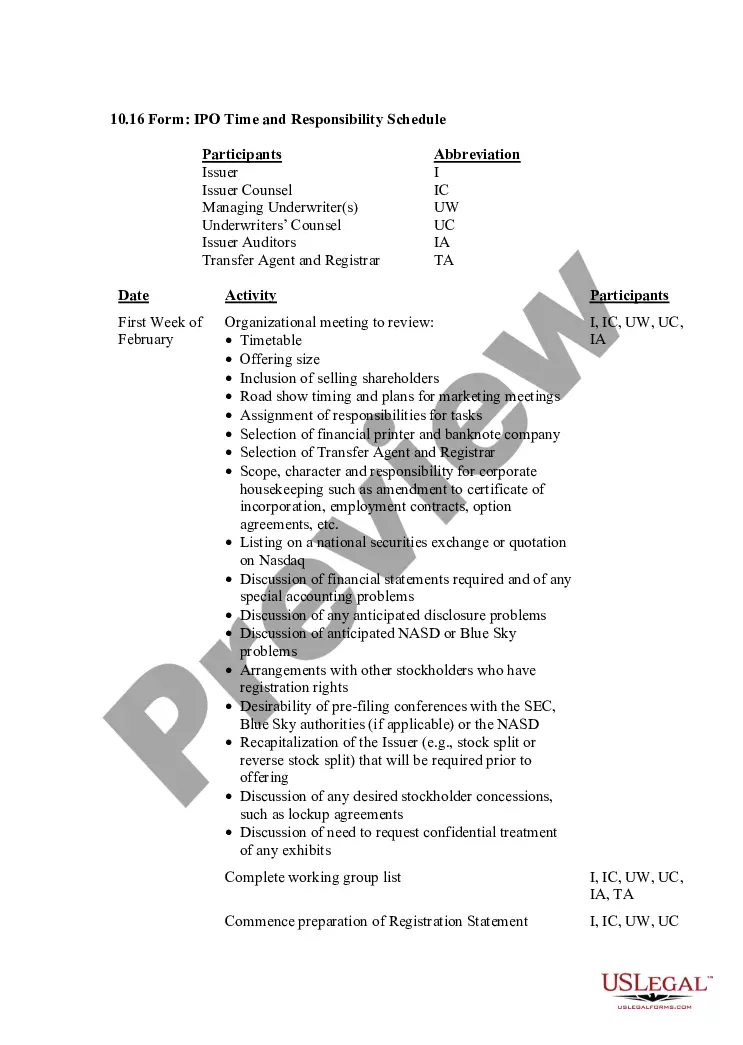
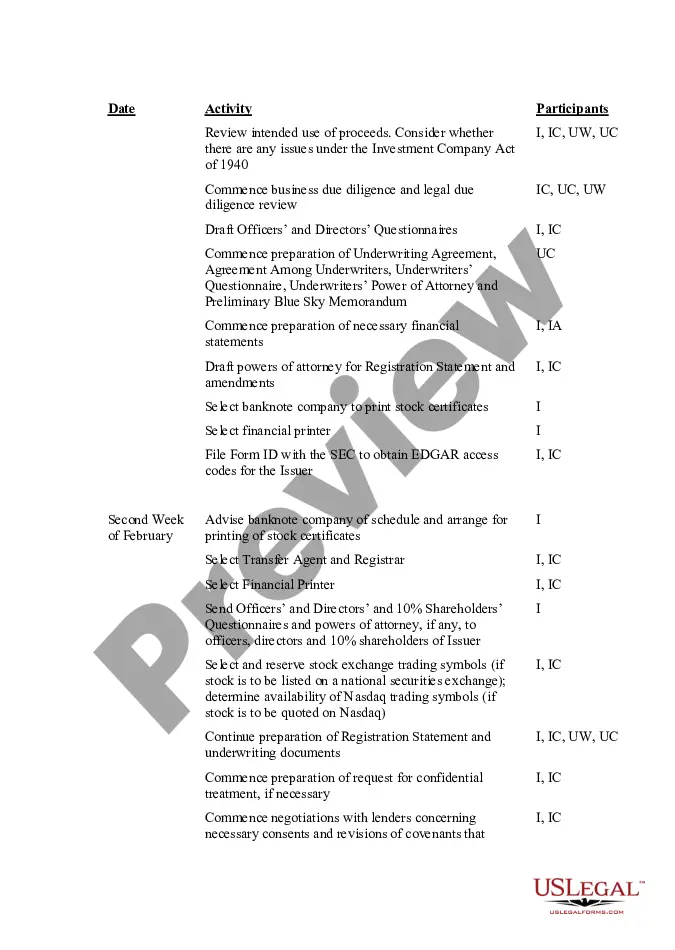
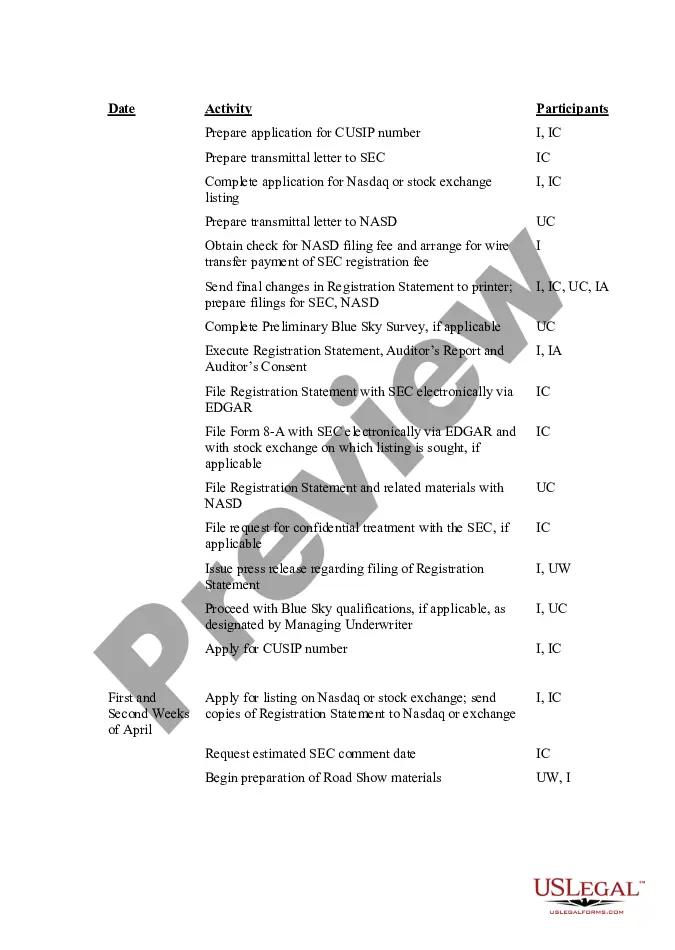
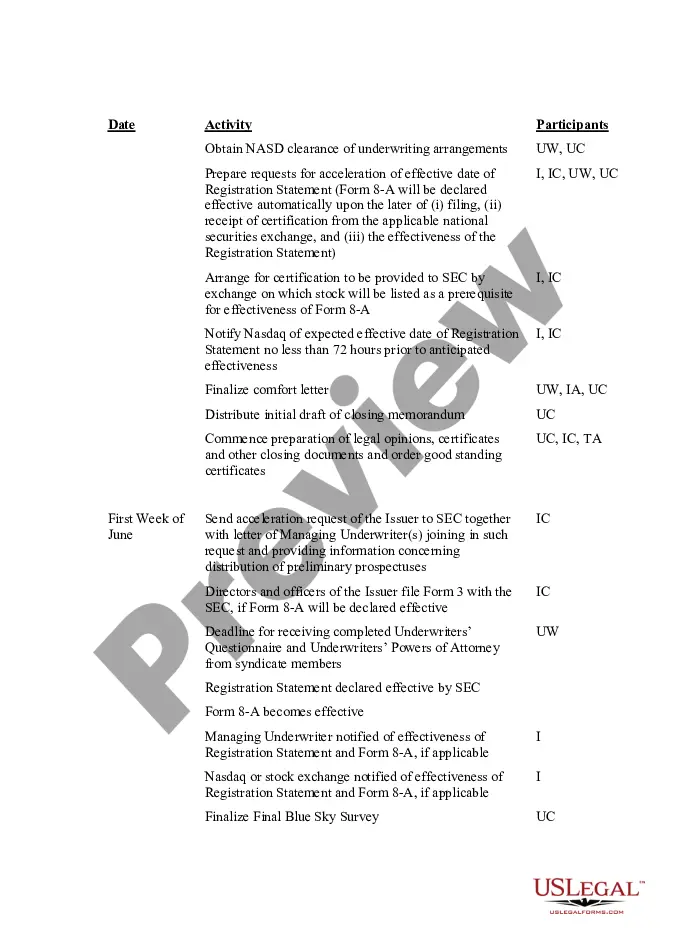
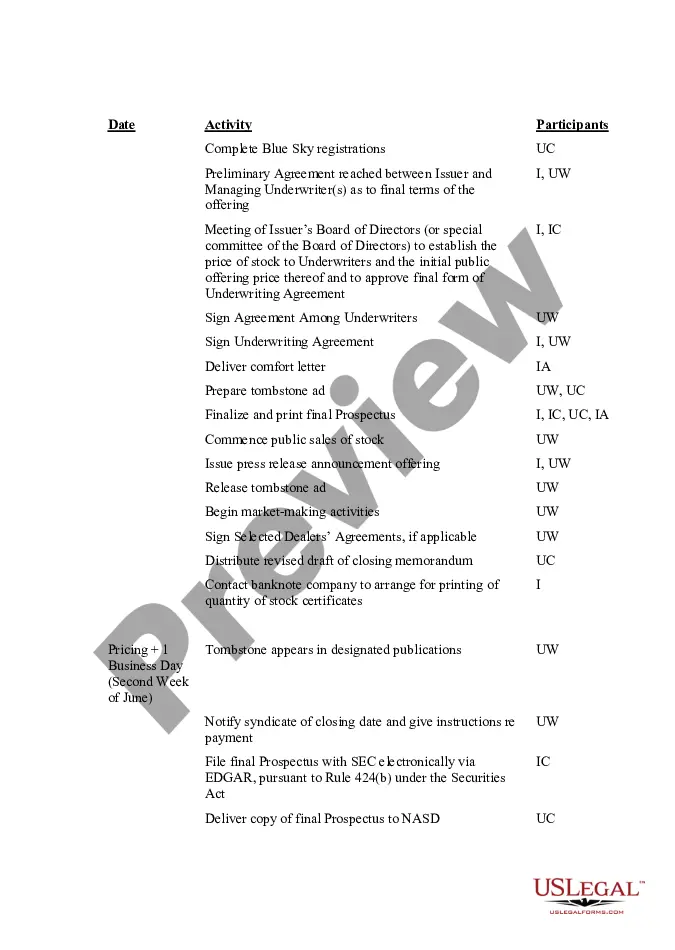
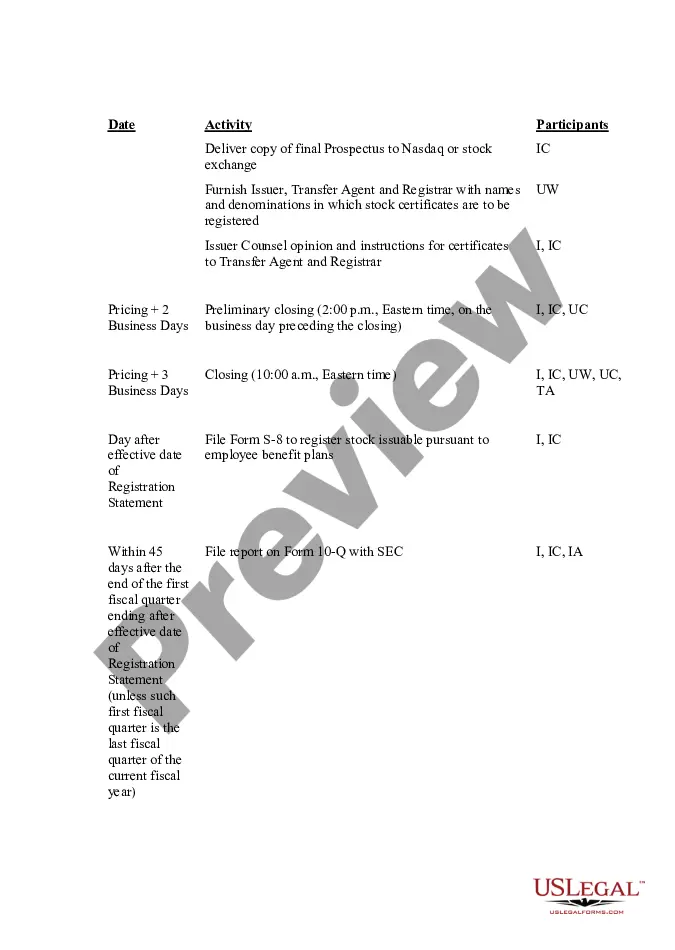
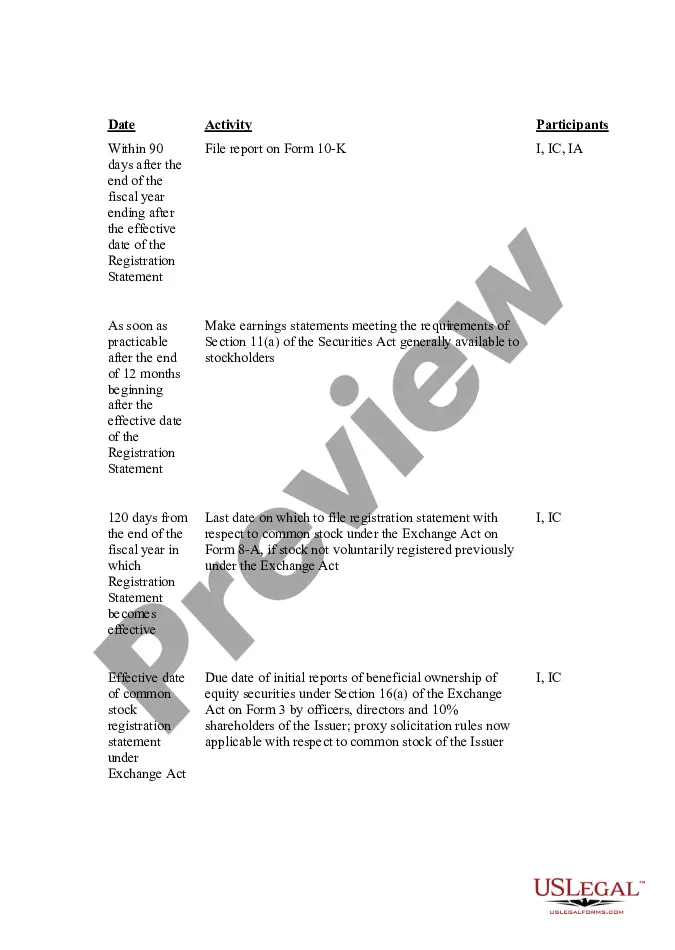
The IPO Time and Responsibility Schedule is a structured document outlining essential tasks and responsibilities for a company preparing for an initial public offering (IPO). This form serves as a comprehensive timeline, detailing who is responsible for each activity leading up to the IPO, ensuring all legal and logistical steps are clearly identified and assigned. It is crucial for managing the complex process of going public and differs from other forms in its specific focus on IPO-related tasks.
Main sections of this form
- Organizational meeting schedule with designated participants.
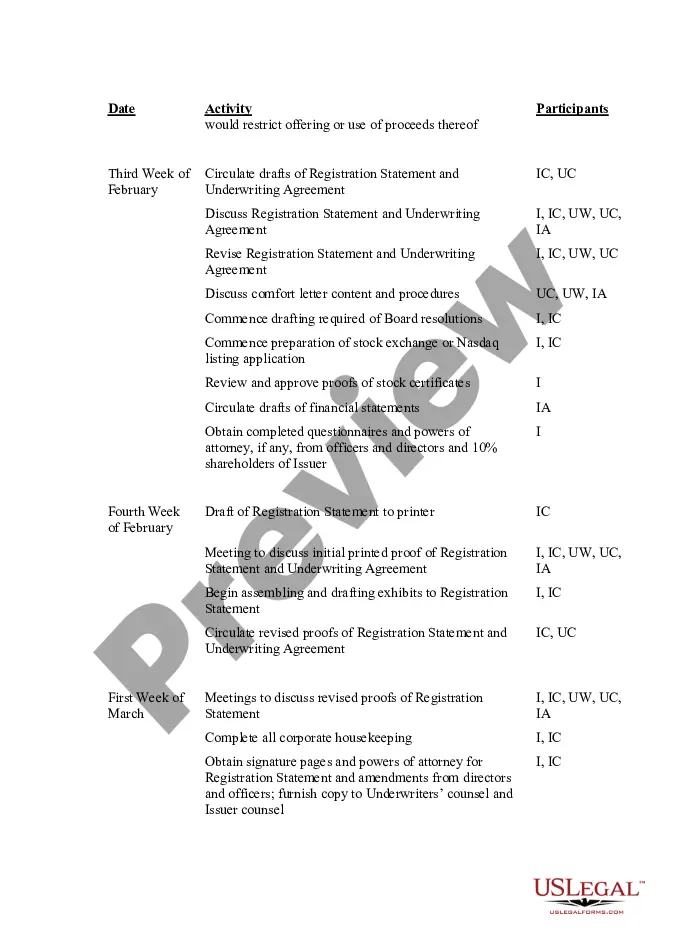
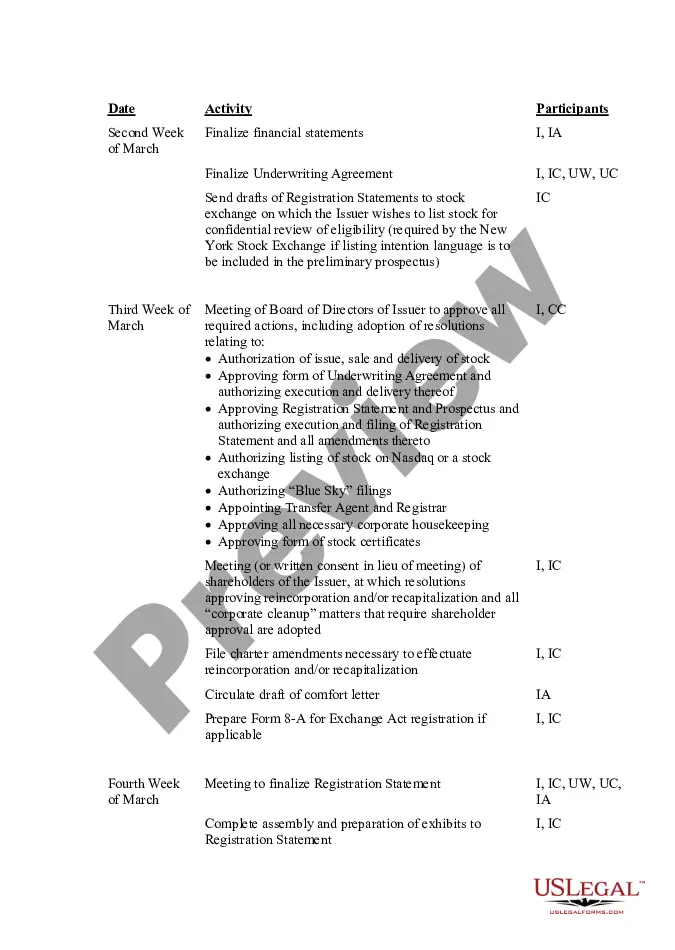
- Detailed timeline for each phase of the IPO preparation.
- Assignment of responsibilities among key participants, such as issuers and underwriters.
- Outline of necessary legal documentation, including Registration Statement and Underwriting Agreement.
- Schedule for meetings and approvals necessary for compliance and finalization of IPO.





When this form is needed
This form should be used when a company plans to go public through an IPO. It helps coordinate the various parties involved and ensures that all necessary tasks are assigned and completed in a timely manner. Ideal users include management teams, legal advisors, and financial consultants tasked with preparing for the IPO process.
Who needs this form
- Company executives and management teams preparing for an IPO.
- Legal counsel advising on compliance and regulatory matters related to IPOs.
- Financial underwriters and advisors involved in the initial public offering.
- Participants involved in corporate governance and compliance with securities law.
How to complete this form
- Identify the key participants in the IPO process and assign their responsibilities.
- Outline the timeline for each task leading up to the IPO.
- Ensure all meetings and approvals are scheduled, with designated participants noted.
- Detail the preparation of necessary legal documents like the Registration Statement.
- Review and revise the schedule as needed to accommodate changes in the IPO process.
Does this form need to be notarized?
Notarization is generally not required for this form. However, certain states or situations might demand it. You can complete notarization online through US Legal Forms, powered by Notarize, using a verified video call available anytime.
Get your form ready online
Our built-in tools help you complete, sign, share, and store your documents in one place.
Make edits, fill in missing information, and update formatting in US Legal Forms—just like you would in MS Word.
Download a copy, print it, send it by email, or mail it via USPS—whatever works best for your next step.
Sign and collect signatures with our SignNow integration. Send to multiple recipients, set reminders, and more. Go Premium to unlock E-Sign.
If this form requires notarization, complete it online through a secure video call—no need to meet a notary in person or wait for an appointment.
We protect your documents and personal data by following strict security and privacy standards.

Make edits, fill in missing information, and update formatting in US Legal Forms—just like you would in MS Word.

Download a copy, print it, send it by email, or mail it via USPS—whatever works best for your next step.

Sign and collect signatures with our SignNow integration. Send to multiple recipients, set reminders, and more. Go Premium to unlock E-Sign.

If this form requires notarization, complete it online through a secure video call—no need to meet a notary in person or wait for an appointment.

We protect your documents and personal data by following strict security and privacy standards.
Typical mistakes to avoid
- Failing to assign clear responsibilities to all participants.
- Overlooking critical deadlines in the IPO preparation schedule.
- Neglecting to confirm participation and readiness of all parties involved.
- Not revising the schedule as business conditions change.
Benefits of using this form online
- Convenient access to detailed IPO preparation schedules from anywhere.
- Editable templates allow for customization to meet specific company needs.
- Ensures reliability and compliance with current legal standards.
- Saves time by providing a structured framework for task delegation.
Legal use & context
- This schedule helps ensure compliance with SEC regulations during the IPO process.
- Utilizing this form aids in documentation that is vital for legal and financial audits.
- Failure to follow the outlined responsibilities may result in delays or legal challenges to the IPO process.
Summary of main points
- The IPO Time and Responsibility Schedule is essential for organizing tasks in preparation for a public offering.
- It ensures that all parties involved are aware of their roles and deadlines.
- Proper completion of this form can significantly reduce the risk of delays or failures in the IPO process.
Looking for another form?

Form popularity
FAQ
Technically, the quiet period is enforced through a period of 40 days beyond the IPO date.
Strong demand for the company will lead to a higher stock price. In addition to the demand for a company's shares, there are several other factors that determine an IPO valuation, including industry comparables, growth prospects, and the story of a company.
Pre-IPO Transformation Stage. The pre-IPO transformation stage is a restructuring phase when a private company sets the groundwork for becoming publicly-traded. IPO Transaction Stage. Post-IPO Transaction Stage.
Step 1: Choose an IPO Underwriter. The first step of the IPO process requires the company to select an investment bank. Step 2: Due Diligence. Step 3: The IPO Roadshow. Step 4: IPO Price. Step 5: Going Public. Step 6: IPO Stabilization. Step 7: Transition to Market Competition.
Step 1: Hire an investment bank. A company seeks guidance from a team of under-writers or investment banks to start the process of IPO. Step 2: Register with the SEC. Step 3: Draft the Red Herring document. Step 4: Go on a road show. 5: IPO is priced. Step 6: Available to the public. Step 7: Going through with the IPO.
Step 1: Select an investment bank. Step 2: Due diligence and regulatory filings. Step 3: Pricing. Step 4: Stabilization. Step 5: Transition to Market Competition.
It usually takes 3-6 months between the filing of the S-1 and the first opportunity by the company to have its initial public offering.
Step 1: Select an investment bank. The first step in the IPO process is for the issuing company to choose an investment bank. Step 2: Due diligence and regulatory filings. Step 3: Pricing. Step 4: Stabilization. Step 5: Transition to Market Competition.
As per Section 73 of the Companies Act, 1956, a company seeking listing of its securities on BSE is required to submit a Letter of Application to all the stock exchanges where it proposes to have its securities listed before filing the prospectus with the Registrar of Companies.