An Ordinance to Amend Zoning Ordinance Lighting Requirements and Restrictions
What is this form?
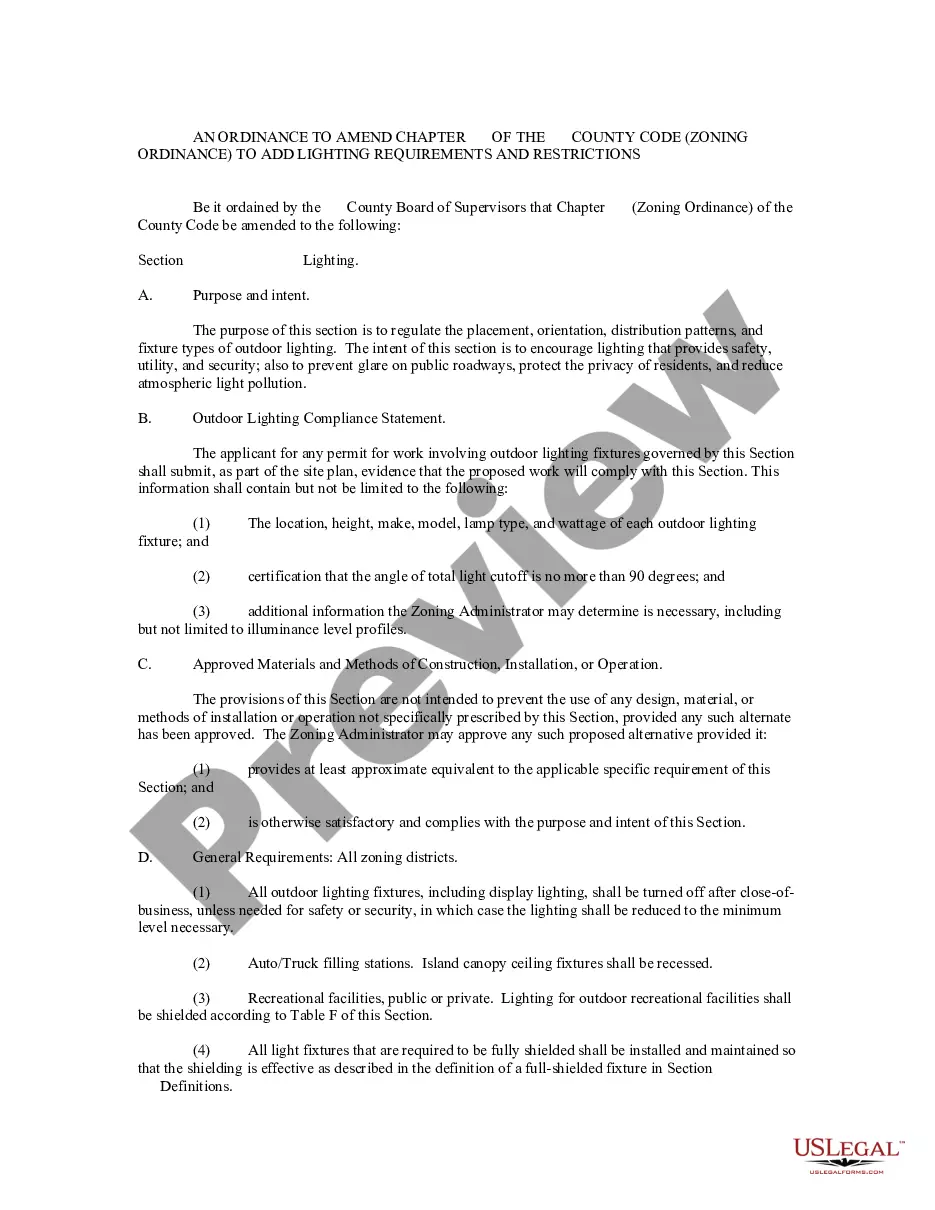
This form is an ordinance to amend zoning ordinance lighting requirements and restrictions. It regulates outdoor lighting to enhance safety, utility, and security while minimizing glare and light pollution. Unlike standard zoning forms, this ordinance specifically addresses outdoor lighting standards, making it essential for municipalities seeking to manage environmental impact and enhance community safety through effective lighting measures.
Form components explained
- Purpose and intent: Establishes the goals for regulating outdoor lighting.
- Outdoor lighting compliance statement: Requires applicants to provide detailed specifications for lighting fixtures.
- Approved materials and methods: Allows for alternative designs if they meet the ordinance's standards.
- General requirements: Outlines the conditions under which outdoor lighting must operate.
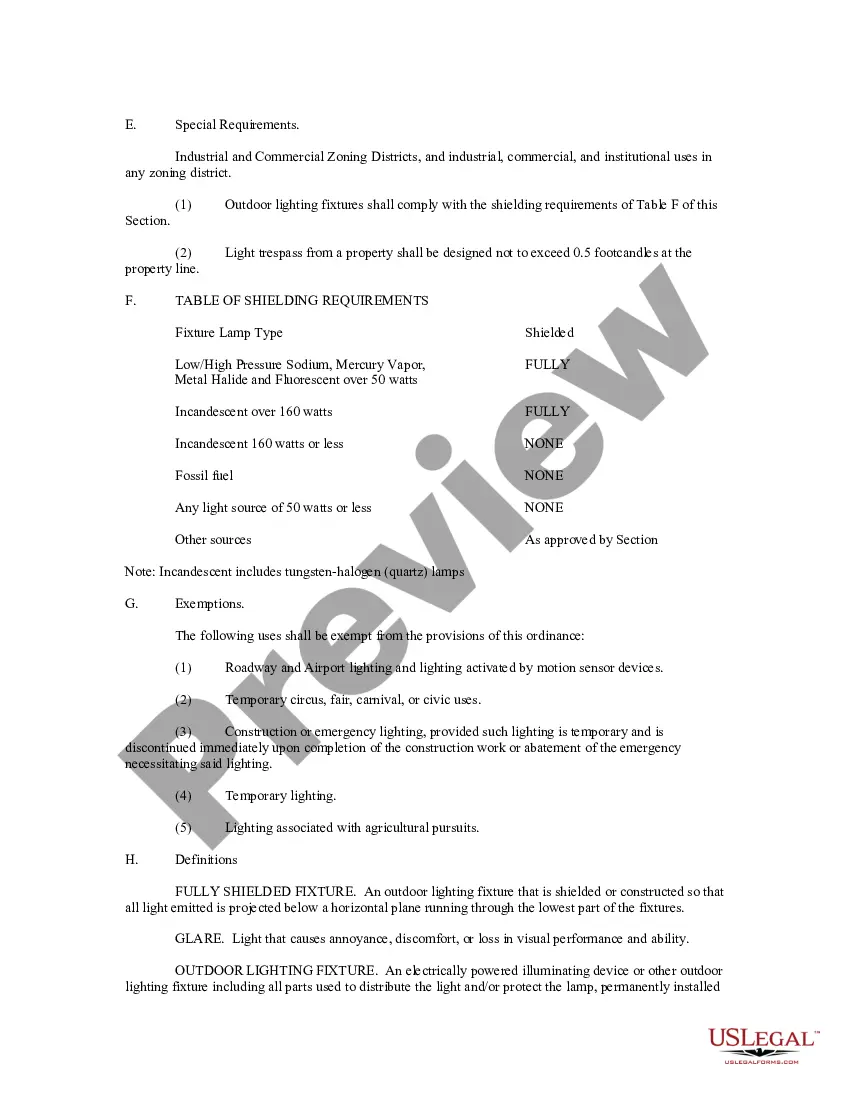
- Special requirements for industrial and commercial districts: Specifies shielding requirements and acceptable light levels.
- Exemptions: Lists specific lighting that does not fall under the ordinance's provisions.
When to use this document
This form should be used when a municipality aims to amend its existing zoning ordinance to include updated lighting requirements. It is suitable for local governments looking to enhance public safety, control glare, and safeguard against light pollution, particularly in areas experiencing growth or change in land use.
Intended users of this form
- Local government officials who oversee zoning regulations.
- Municipal attorneys drafting amendments to existing codes.
- Planning boards and committees involved in urban development.
- Citizens wishing to advocate for improved lighting regulations in their communities.
How to prepare this document
- Identify the specific chapter of the zoning ordinance to be amended.
- Define the purpose and intent behind the new lighting regulations.
- Specify compliance requirements for outdoor lighting fixtures in detail.
- Outline any exemptions applicable to the lighting requirements.
- Finalize the ordinance with necessary approvals from the governing board.
Notarization guidance
This form usually doesn’t need to be notarized. However, local laws or specific transactions may require it. Our online notarization service, powered by Notarize, lets you complete it remotely through a secure video session, available 24/7.
Get your form ready online
Our built-in tools help you complete, sign, share, and store your documents in one place.
Make edits, fill in missing information, and update formatting in US Legal Forms—just like you would in MS Word.
Download a copy, print it, send it by email, or mail it via USPS—whatever works best for your next step.
Sign and collect signatures with our SignNow integration. Send to multiple recipients, set reminders, and more. Go Premium to unlock E-Sign.
If this form requires notarization, complete it online through a secure video call—no need to meet a notary in person or wait for an appointment.
We protect your documents and personal data by following strict security and privacy standards.

Make edits, fill in missing information, and update formatting in US Legal Forms—just like you would in MS Word.

Download a copy, print it, send it by email, or mail it via USPS—whatever works best for your next step.

Sign and collect signatures with our SignNow integration. Send to multiple recipients, set reminders, and more. Go Premium to unlock E-Sign.

If this form requires notarization, complete it online through a secure video call—no need to meet a notary in person or wait for an appointment.

We protect your documents and personal data by following strict security and privacy standards.
Common mistakes to avoid
- Failing to define the exemption clauses clearly.
- Not providing adequate specifications for lighting compliance.
- Neglecting to align the ordinance with existing state laws.
- Overlooking the need for public discussion or hearings before passing the ordinance.
Advantages of online completion
- Convenience of immediate access and download from any location.
- Editability to tailor the form to specific municipal needs.
- Reliable templates drafted by licensed attorneys ensure legal compliance.
- Easy to store and share digitally with team members or stakeholders.
What to keep in mind
- This ordinance is essential to regulate outdoor lighting effectively.
- The form covers critical components to manage lighting in urban areas.
- Proper completion ensures compliance with regulations and enhances community safety.
- Available for municipal officials, attorneys, and community advocates.
Glossary of terms used in this form
- Fully shielded fixture: A lighting fixture that prevents light from being emitted above a horizontal plane.
- Light trespass: An unwanted spill of light onto neighboring properties.
- Auto/truck filling stations: Facilities where gas and diesel are dispensed to motor vehicles.
Looking for another form?
Form popularity
FAQ
Zoning Can: protect property from inconsistent or harmful use. protect individual property owners from harmful or undesirable uses of adjacent property. provide orderly and systematic transition in land use that benefit all land uses through public hearings and local decisions.
In practice, zoning is often used to preserve the character of a neighborhood and to ensure new development is compatible with existing uses and communities.Even a local CSA would be considered a commercial use not allowed by zoning law in most residential (and other) zones.
Why is zoning necessary? The purpose of zoning is to allow local and national authorities to regulate and control land and property markets to ensure complementary uses. Zoning can also provide the opportunity to stimulate or slow down development in specific areas.
Zoning can increase the cost of building new structures. Zoning can work against historic mixed use neighborhoods in older communities. To a certain extent, zoning limits the development potential of previously existing land uses and structures that do not conform with the zoning's standards.
Zoning ordinances are the written laws that provide the specifications for the use of real estate in different zones.These laws prohibit the construction of a commercial real estate in a residential zone. Zoning ensures that lands are prudently demarcated for a particular purpose.
Zoning requires that all involved property owners relinquish some of their individual property freedoms for the common good. Zoning can discourage some development in some locations. Zoning can increase the cost of building new structures. Zoning can work against historic mixed use neighborhoods in older communities.
Variance: A variance is granted to a landowner by a board and permits the owner to continue a use that is prohibited by a zoning ordinance. Amendments and Rezoning: A landowner may request the local municipal body to amend the zoning ordinance applying to their land.
Accordingly, zoning laws are created for the simple purpose of protecting the health, safety and general welfare of the people as relates to land use.Protecting the value and enjoyment of properties by allowing a property its most appropriate land use given its location and surrounding uses.