Form - Work for Hire Agreement - Musical Arrangement
Overview of this form
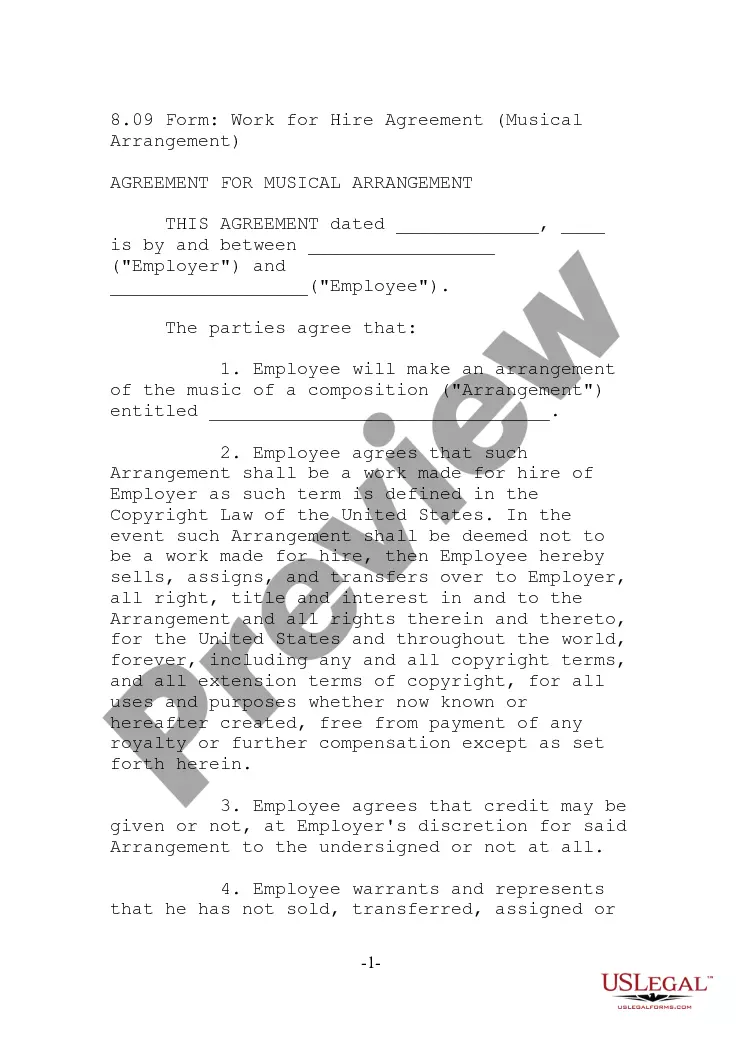
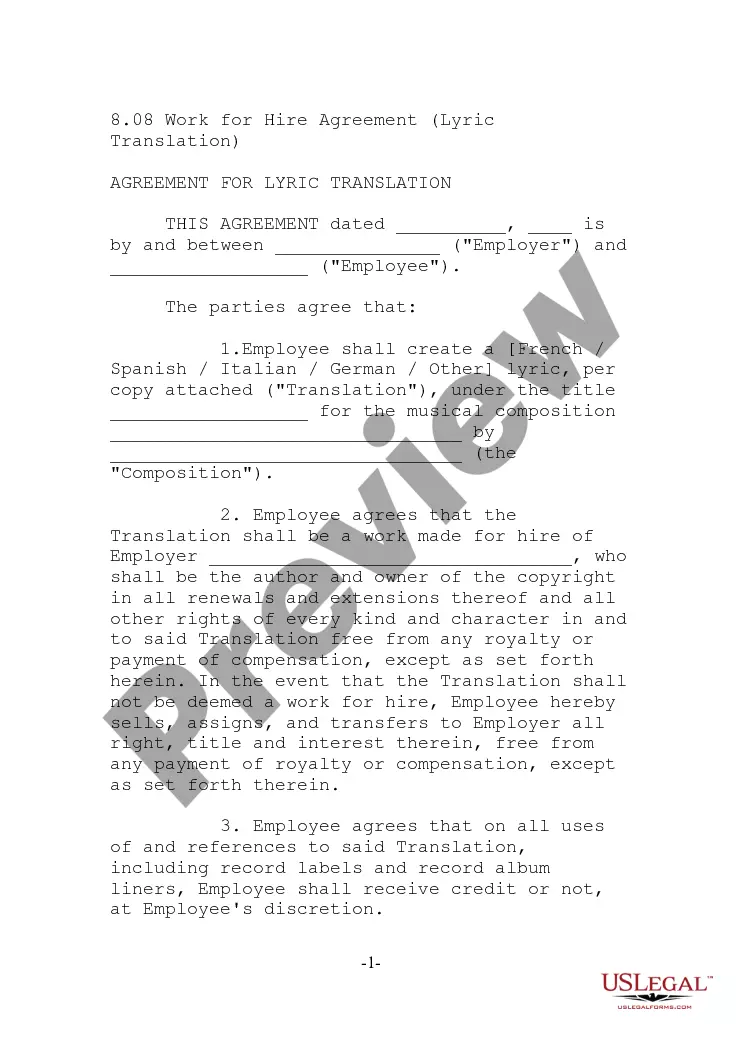
The Work for Hire Agreement - Musical Arrangement is a legal document used to establish the terms under which an employee creates a musical arrangement for an employer. This form specifies that the arrangement will be considered a "work made for hire," ensuring the employer retains ownership of the copyright. It is particularly relevant in the entertainment industry, making it distinct from other contracts that may not clearly outline ownership rights and compensation related to musical works.
Main sections of this form
- Agreement details: Identifies the parties involved (Employer and Employee) and the date of the agreement.
- Description of work: Specifies the title of the musical arrangement being created.
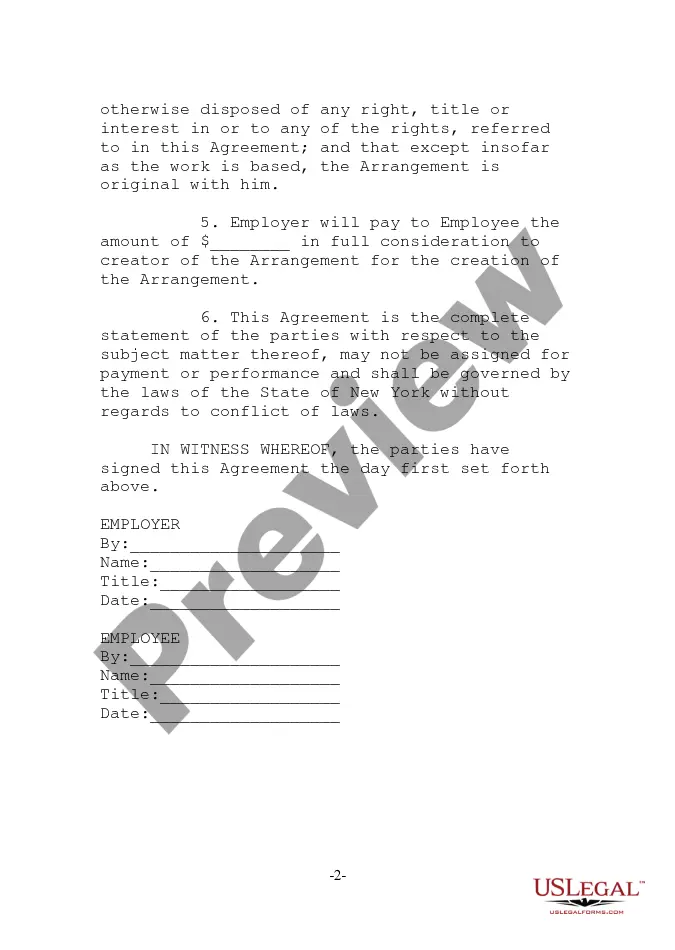
- Copyright ownership: Clarifies that the arrangement is a work for hire, transferring all rights to the employer.
- Compensation: States the payment terms for the creation of the arrangement.
- Credit: Addresses whether the Employee will receive credit for the arrangement at the Employer's discretion.
When this form is needed
This form should be used when an employer hires an individual to create a musical arrangement. It is essential in situations where copyright ownership needs to be clearly defined, such as when commissioning original arrangements for films, advertisements, or live performances. Using this agreement helps protect both parties by outlining the expectations regarding the arrangement and compensation.
Who should use this form
- Employers in the music or entertainment industry seeking to hire composers or arrangers.
- Musicians or arrangers creating original works for employers and wanting to formalize the terms of their work.
- Individuals or organizations producing multimedia content that involves original musical arrangements.
How to complete this form
- Identify the parties: Clearly state the names of the Employer and Employee.
- Enter the date: Specify the date of the agreement's execution.
- Provide the title of the musical arrangement: Fill in the title of the composition being arranged.
- State compensation: Enter the agreed payment amount for the arrangement.
- Sign and date: Both parties should sign and date the agreement to make it legally binding.
Does this form need to be notarized?
This form usually doesn’t need to be notarized. However, local laws or specific transactions may require it. Our online notarization service, powered by Notarize, lets you complete it remotely through a secure video session, available 24/7.
Get your form ready online
Our built-in tools help you complete, sign, share, and store your documents in one place.
Make edits, fill in missing information, and update formatting in US Legal Forms—just like you would in MS Word.
Download a copy, print it, send it by email, or mail it via USPS—whatever works best for your next step.
Sign and collect signatures with our SignNow integration. Send to multiple recipients, set reminders, and more. Go Premium to unlock E-Sign.
If this form requires notarization, complete it online through a secure video call—no need to meet a notary in person or wait for an appointment.
We protect your documents and personal data by following strict security and privacy standards.

Make edits, fill in missing information, and update formatting in US Legal Forms—just like you would in MS Word.

Download a copy, print it, send it by email, or mail it via USPS—whatever works best for your next step.

Sign and collect signatures with our SignNow integration. Send to multiple recipients, set reminders, and more. Go Premium to unlock E-Sign.

If this form requires notarization, complete it online through a secure video call—no need to meet a notary in person or wait for an appointment.

We protect your documents and personal data by following strict security and privacy standards.
Avoid these common issues
- Failing to specify the title of the musical arrangement.
- Omitting the compensation amount, leading to misunderstandings.
- Not signing the agreement, which may affect its enforceability.
- Using incorrect party names, leading to confusion about contract obligations.
Benefits of completing this form online
- Convenience: Easily download and customize the form to fit specific needs.
- Editability: Modify details as needed without hassle.
- Professional quality: Forms are created by licensed attorneys, ensuring legal soundness.
Main things to remember
- The Work for Hire Agreement - Musical Arrangement secures rights for employers over created arrangements.
- It's essential for employers and musicians to clearly outline terms, including payment and ownership rights.
- Compliance with New York law is crucial when using this form.
Looking for another form?



Form popularity
FAQ
If a work is made for hire, the employer or the party that specially ordered or commissioned that work is the initial owner of the copyright in the work unless the employer or the commissioning party has signed a written agreement to the contrary with the work's creator. Copyright Term.
In the copyright law of the United States, a work made for hire (work for hire or WFH) is a work subject to copyright that is created by an employee as part of his or her job, or some limited types of works for which all parties agree in writing to the WFH designation.
A work for hire agreement is when you give up all ownership and administration rights for the life of a work's copyright in exchange for a flat fee. It is an exception to the prevailing rule that the person who creates a work is its legally recognized author.
A . Work made for hire is a doctrine created by U.S. Copyright Law.However, under the work made for hire doctrine, your employer or the company that has commissioned your work, not you, is considered the author and automatic copyright owner of your work.
Works Made by Employees A work created by an employee within the scope of his or her employment is a work made for hire. The employer for whom the work is made is the "author" of the work for copyright purposes and is the owner of the work's copyright (unless the employee and employer have agreed otherwise).
Generally, the person who creates a work is considered its author and the automatic owner of copyright in that work. However, under the work made for hire doctrine, your employer or the company that has commissioned your work, not you, is considered the author and automatic copyright owner of your work.
Recording company details (name, contact info) Artist details (group name, names of each artist, contact info) Production details, e.g. studio address, recording session dates, control over song selections on the recording, and control over album title.
Only the author or those deriving rights from the author can rightfully claim copyright. There is, however, an exception to this principle: works made for hire. If a work is made for hire, an employer is considered the author even if an employee actually created the work.
But to qualify, a commissioned work must be specified as a work made for hire, either in a contract or other writing, and the work must fit within one of the following categories: (i) a contribution to a collective work, (ii) a part of a motion picture, (iii) a translation, (iv) a supplementary work, (v) a compilation,