Photograph License Agreement
Overview of this form
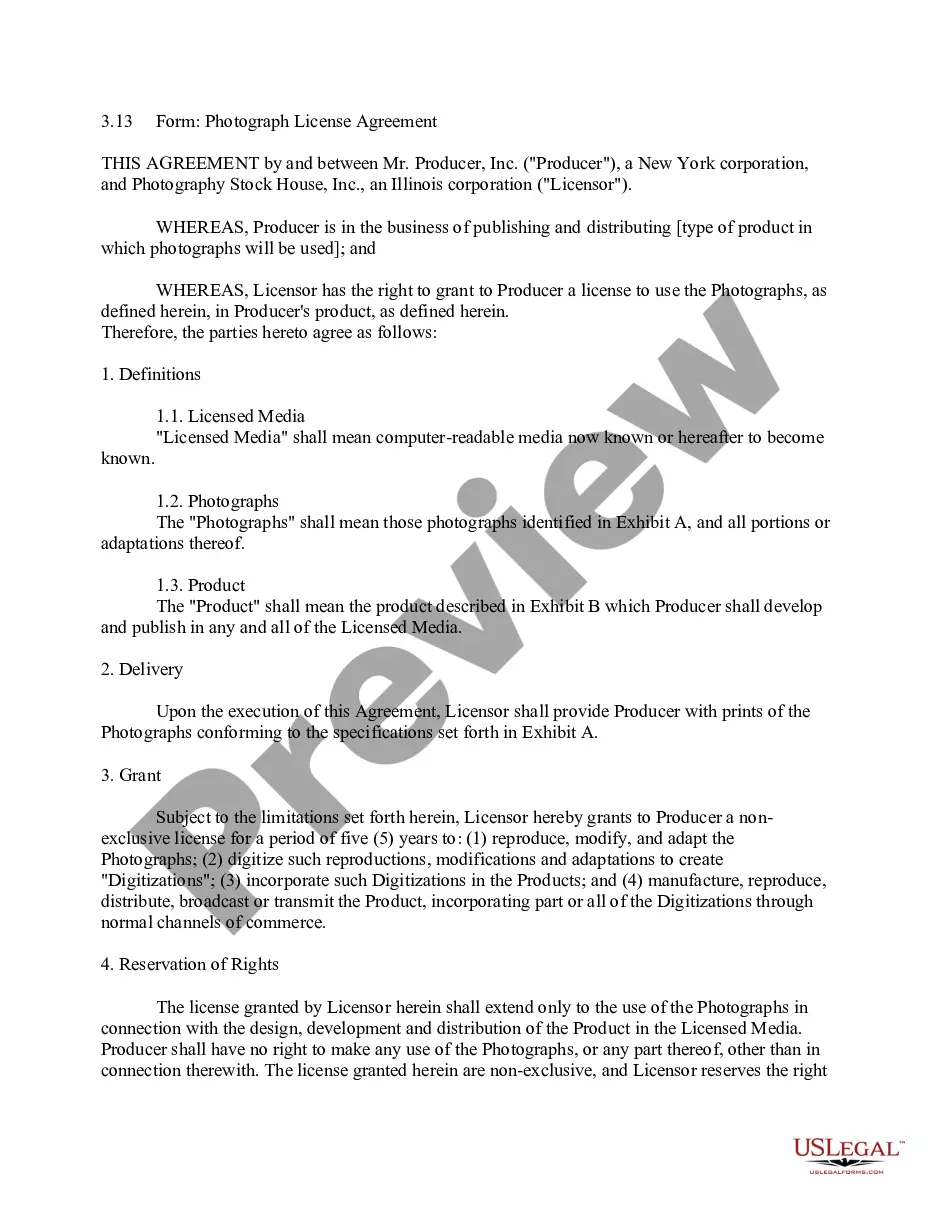
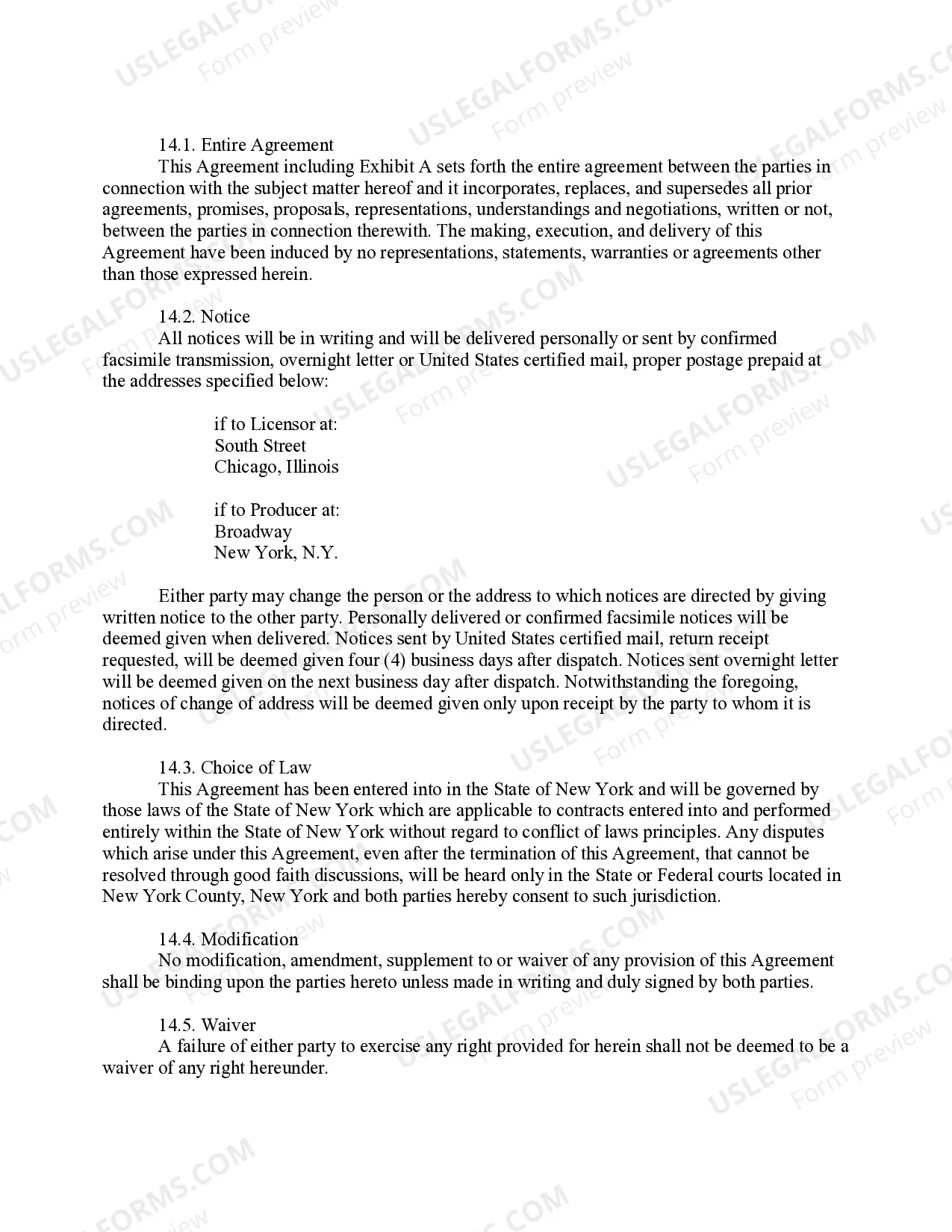
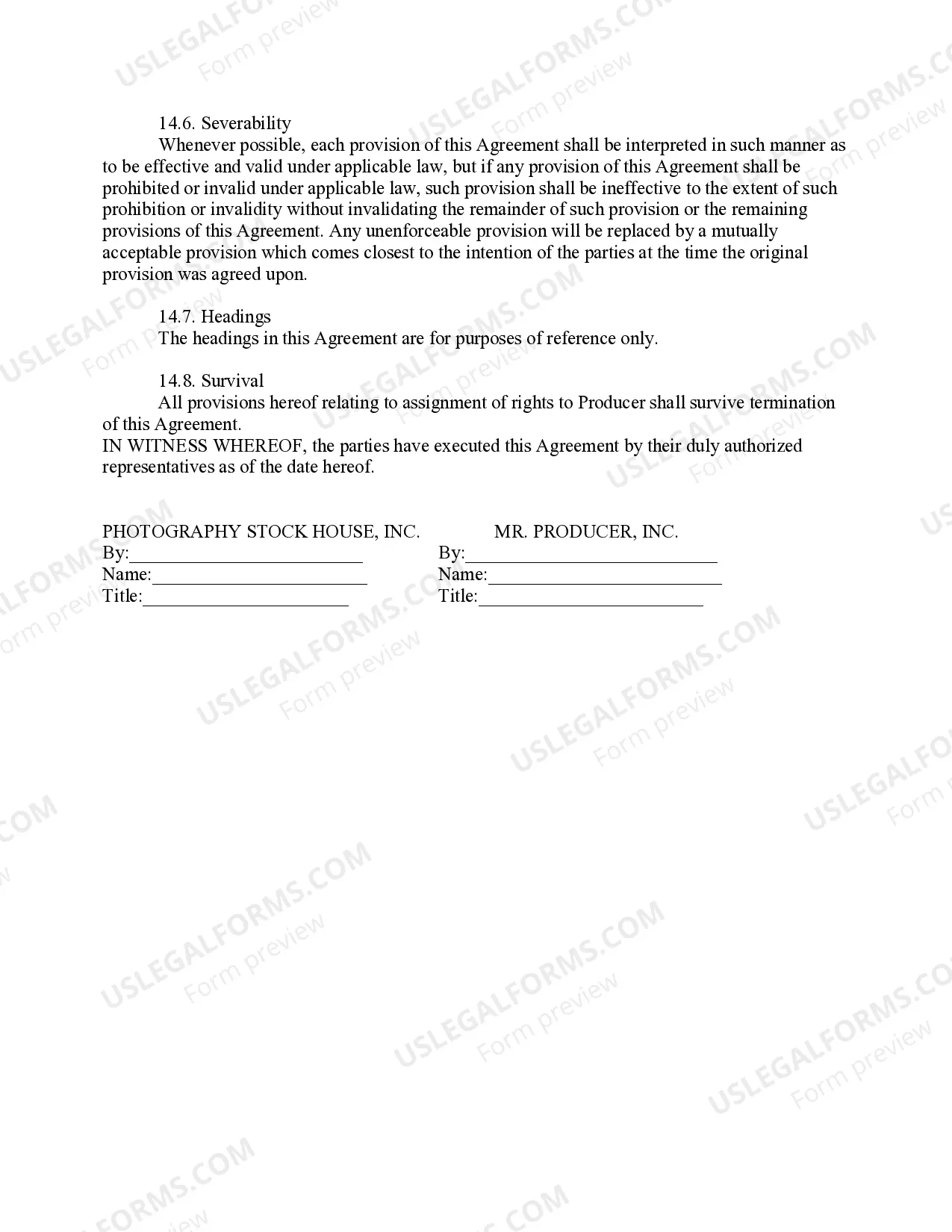
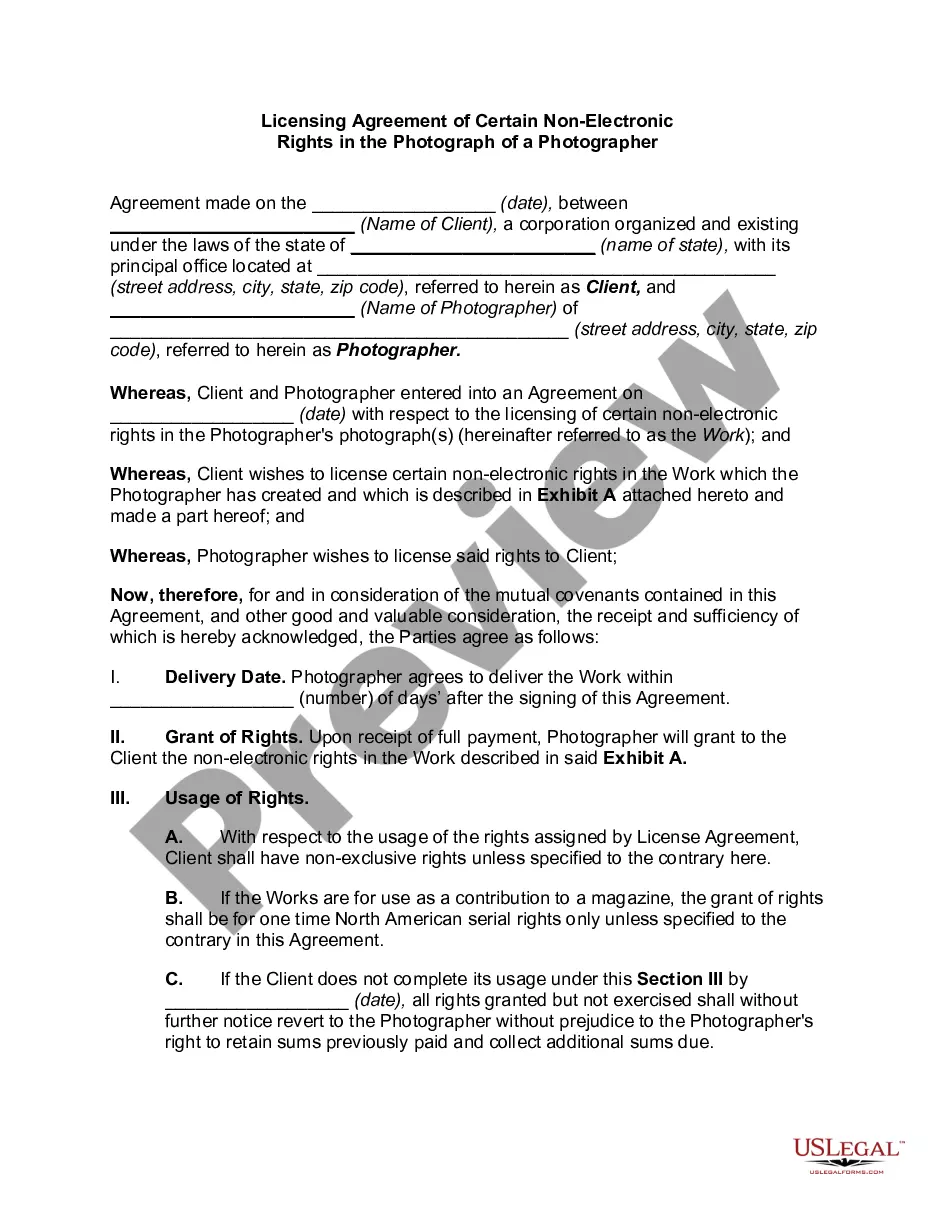
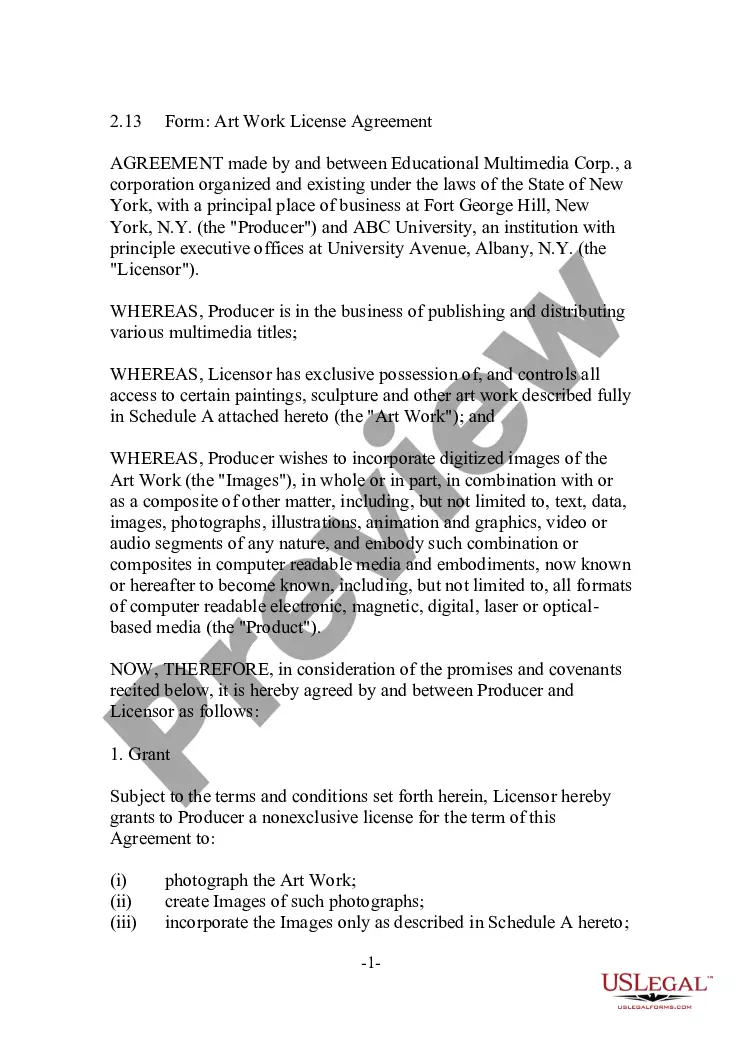
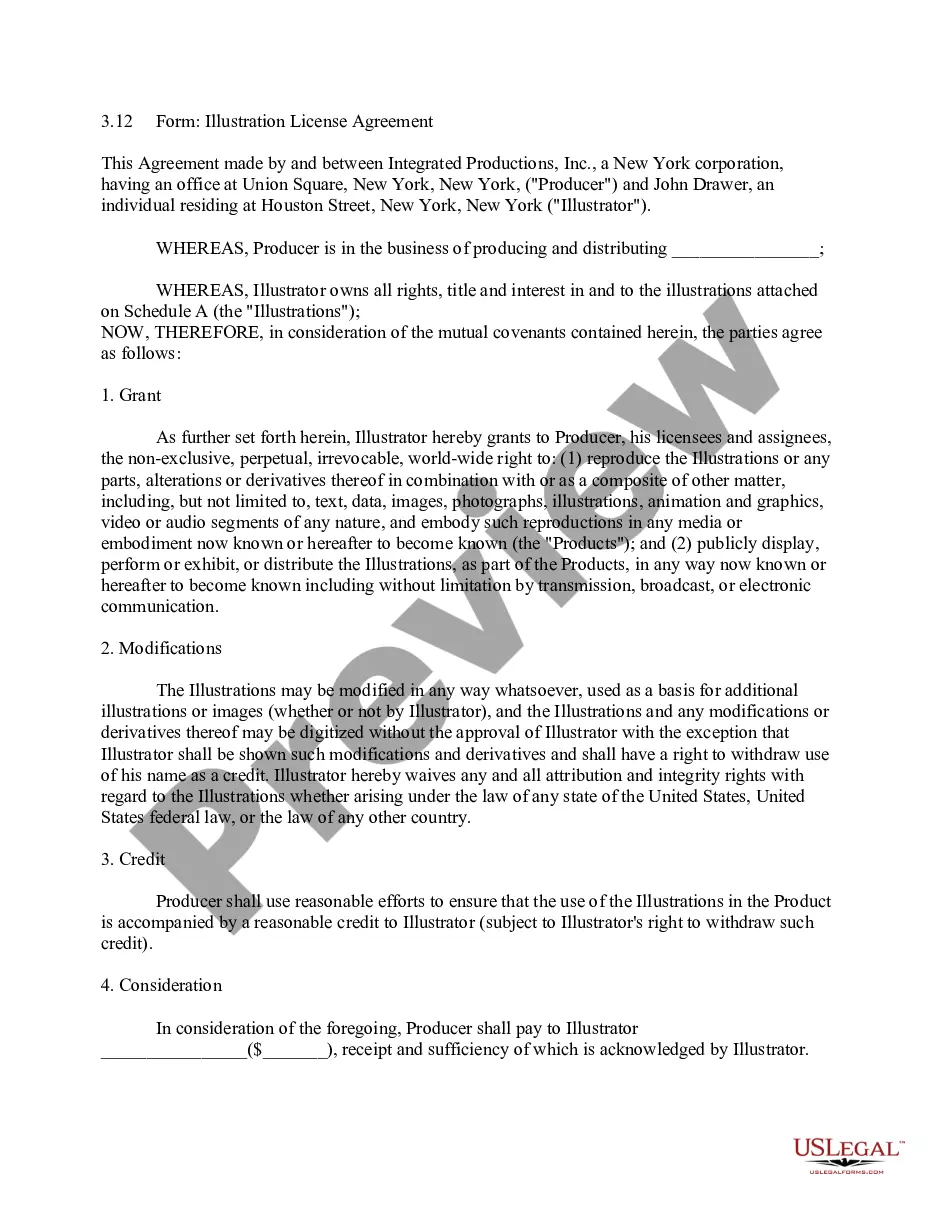
A Photograph License Agreement is a legal document that allows one party, known as the Producer, to use photographs owned by another party, the Licensor. This agreement outlines the specific rights granted, including reproduction, modification, and distribution of the photographs in various media. Unlike other license agreements, this form is specifically tailored for the licensing of photographic works and establishes clear terms for compensation, usage rights, and responsibilities of both parties involved.
What’s included in this form
- Definitions of key terms, including Licensed Media, Photographs, and Product.
- Delivery obligations for the Licensor to provide photographs following execution of the agreement.
- Grant of a non-exclusive license for the Producer, detailing permissible uses of the Photographs.
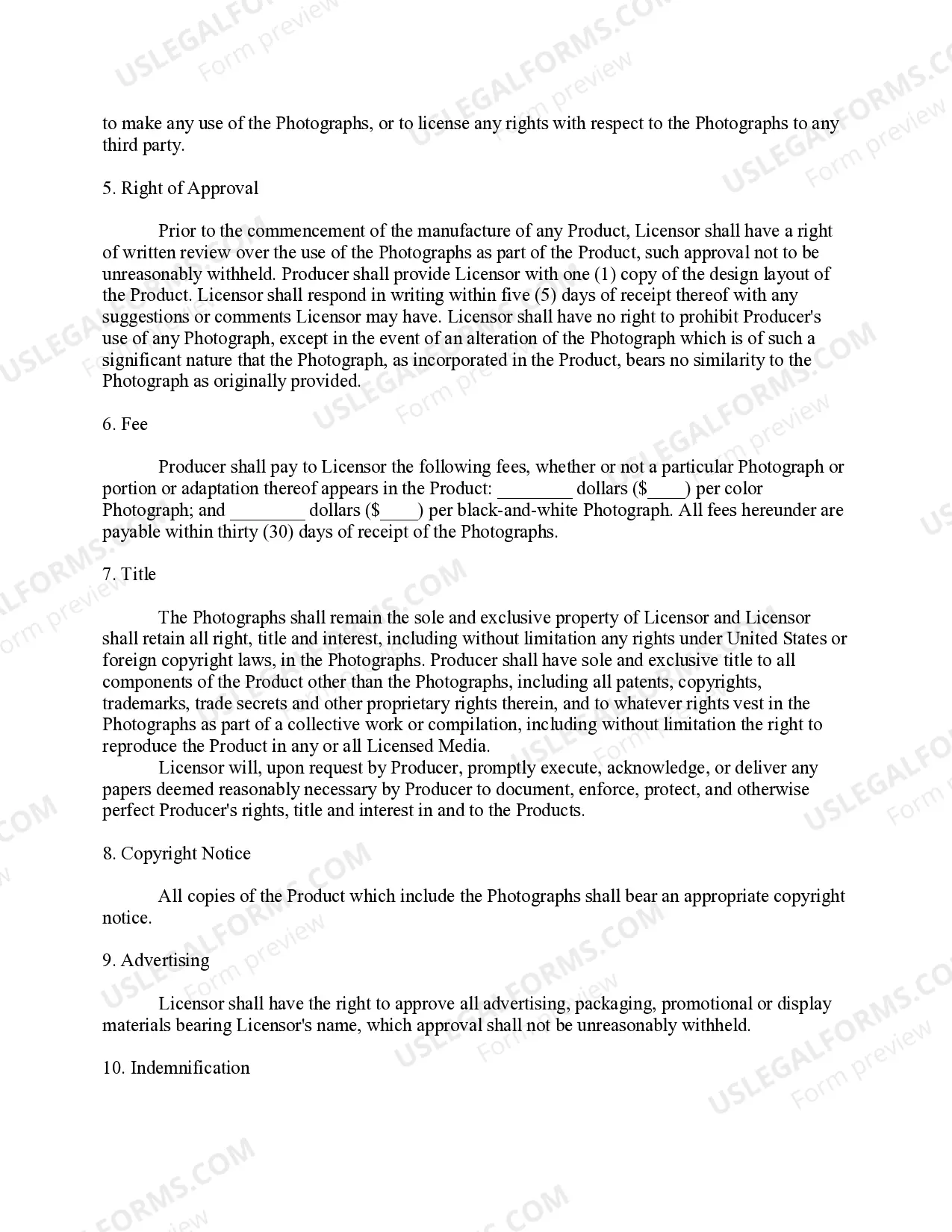
- Clauses regarding the reservation of rights and limitations on usage.
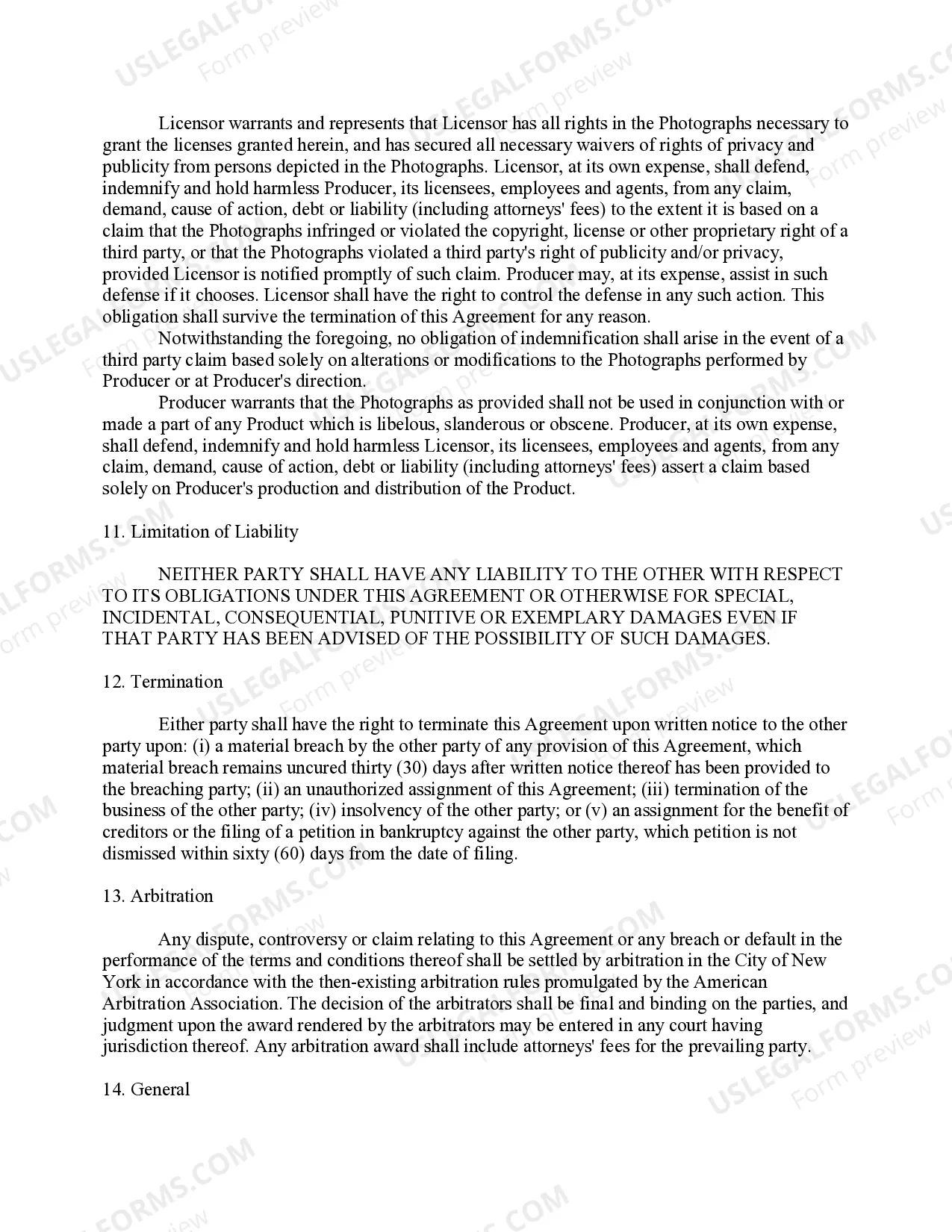
- Indemnification provisions protecting both parties from copyright claims.
- Termination conditions and dispute resolution through arbitration.
Common use cases
This form should be used when a Producer wishes to license photographs from a Licensor for use in a specific product, such as a book, magazine, or digital media. It is particularly relevant for photographers and stock photo agencies that need to formalize the terms under which their images will be utilized by others in a commercial context. Additionally, it is useful when parties want to ensure clarity and protection regarding the use of creative works.
Intended users of this form
- Photographers or photography agencies seeking to license their images to producers.
- Producers or publishers looking to acquire the rights to use specific photographs in their products.
- Legal professionals involved in drafting or reviewing licensing agreements for photography-related businesses.
- Individuals or companies that require a clear understanding of their rights concerning the photographs used in their projects.
Completing this form step by step
- Identify the parties involved by filling in the names and addresses of the Licensor and the Producer.
- Specify the photographs covered by the agreement by listing them in the designated exhibits.
- Define the product in which the photographs will be used, including any relevant details in the agreement.
- Enter the licensing fees to be paid for the use of the photographs as outlined in the agreement.
- Both parties should sign and date the agreement to ensure it is legally binding.
Notarization requirements for this form
This form does not typically require notarization unless specified by local law. However, it is advisable for both parties to keep signed copies for their records to ensure enforceability and clarity of terms.
Get your form ready online
Our built-in tools help you complete, sign, share, and store your documents in one place.
Make edits, fill in missing information, and update formatting in US Legal Forms—just like you would in MS Word.
Download a copy, print it, send it by email, or mail it via USPS—whatever works best for your next step.
Sign and collect signatures with our SignNow integration. Send to multiple recipients, set reminders, and more. Go Premium to unlock E-Sign.
If this form requires notarization, complete it online through a secure video call—no need to meet a notary in person or wait for an appointment.
We protect your documents and personal data by following strict security and privacy standards.

Make edits, fill in missing information, and update formatting in US Legal Forms—just like you would in MS Word.

Download a copy, print it, send it by email, or mail it via USPS—whatever works best for your next step.

Sign and collect signatures with our SignNow integration. Send to multiple recipients, set reminders, and more. Go Premium to unlock E-Sign.

If this form requires notarization, complete it online through a secure video call—no need to meet a notary in person or wait for an appointment.

We protect your documents and personal data by following strict security and privacy standards.
Avoid these common issues
- Failing to clearly specify the photographs being licensed, which can lead to disputes.
- Not including the duration of the license, leaving uncertainty about how long the rights are granted.
- Omitting indemnification clauses, exposing parties to legal risks.
- Neglecting to provide review and approval procedures for the use of the photographs in products.
Advantages of online completion
- Convenience of downloading the form instantly to begin the licensing process without delays.
- Editability allows customization to fit the specific needs of both parties involved.
- Reliable templates drafted by licensed attorneys ensure legal compliance and protection.
- Access to updated forms that reflect current laws and regulations.
Legal use & context
- The form legally binds both parties to the agreed terms concerning the use of photographs.
- Using this agreement helps to prevent copyright infringement and potential legal issues related to unauthorized use.
- Licensing agreements can be enforceable in court, provided they meet the legal requirements of the jurisdiction in which they are executed.
Quick recap
- The Photograph License Agreement is essential for defining how photographs can be used commercially.
- Both parties must agree on the terms, including usage rights and compensation.
- Ensure that all parties sign the document to avoid future legal complications.
Looking for another form?


Form popularity
FAQ
Since digital images on a disc can be printed by the client at many different sizes, an average price is often charged for each digital photo file, say $20 to $50 per image file.
The 3 P's of collegiate licensing are protection, promotion, and profit.
In order to license images and grant photo usage rights, you need to be either the author of the images, or otherwise authorized to license the images. For example, agencies are also authorized to license images if the author has contractually allowed them to be granted.
A license agreement is a business contract between two parties. The licensor (the seller of the license) owns the asset being licensed and the licensee (the buyer) pays for the right to use the license. The licensee pays royalties to the owner in exchange for the right to sell the product or use the technology.
An example of a licensing agreement is a contract between the copyright holders of software and another company, allowing the latter to use the computer software for their daily business operations.
Exclusive or non-exclusive. In an exclusive license, the intellectual property holder is licensing the work only to one person, for that particular use/territory. Territory. Use. Attribution. Derivative works. Confidentiality. Time frame. Termination.
In general, you can get anywhere between $20 to $50. To ensure you're not giving away your files for free or look as if you're not selling the license or rights, we're going to look into the right ways on how you can add value to your digital images, how to calculate rates, and different photo pricing models to use.
1) Ask the Budget. When in doubt, you can always ask the budget from the individual requesting the quote or estimate. 2) Ask Your Peers. 3) Look for similar estimates. 4) Use Licensing Generators. End Notes. Help Support www.ishootshows.com.
Download a template for a licensing agreement. Choose your role as the licensor or licensee. Define the license(s) in the agreement. Decide whether the license is exclusive or not. Settle the matter of fees and payment schedule. Add a renewal date and rules.