Nebraska Revocation of Declaration
About this form
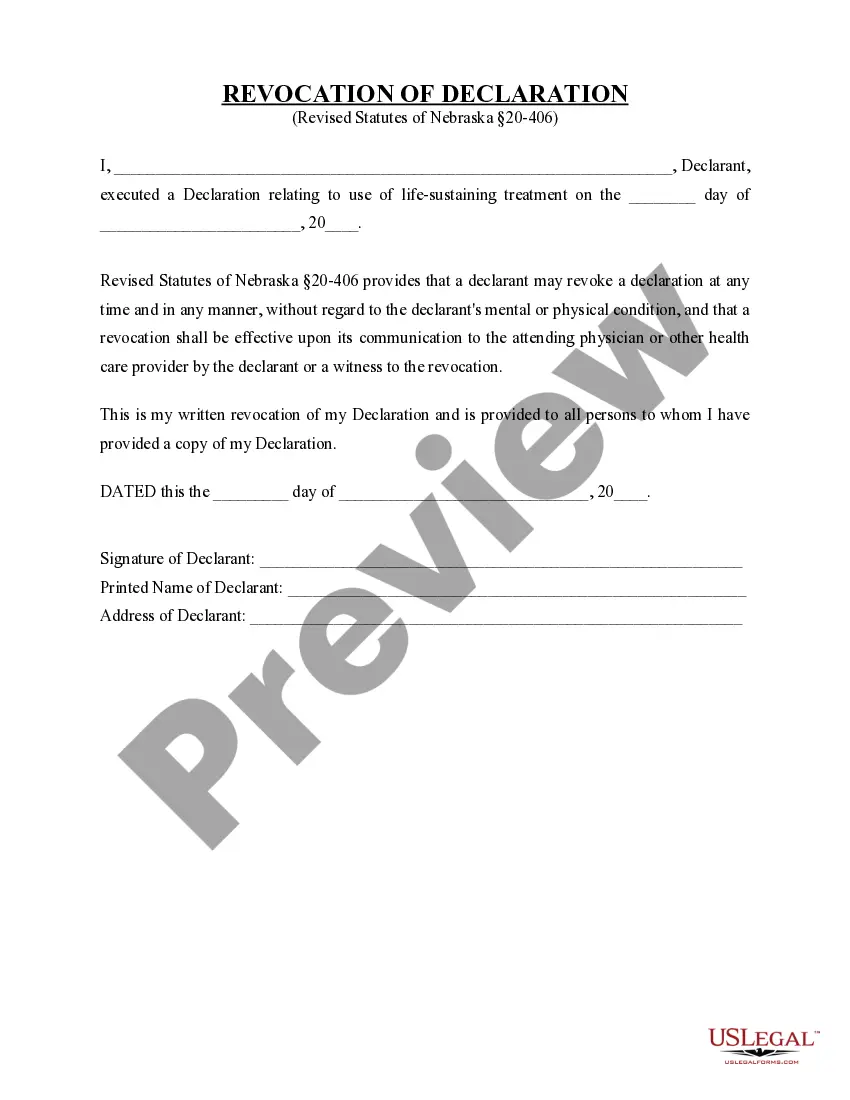
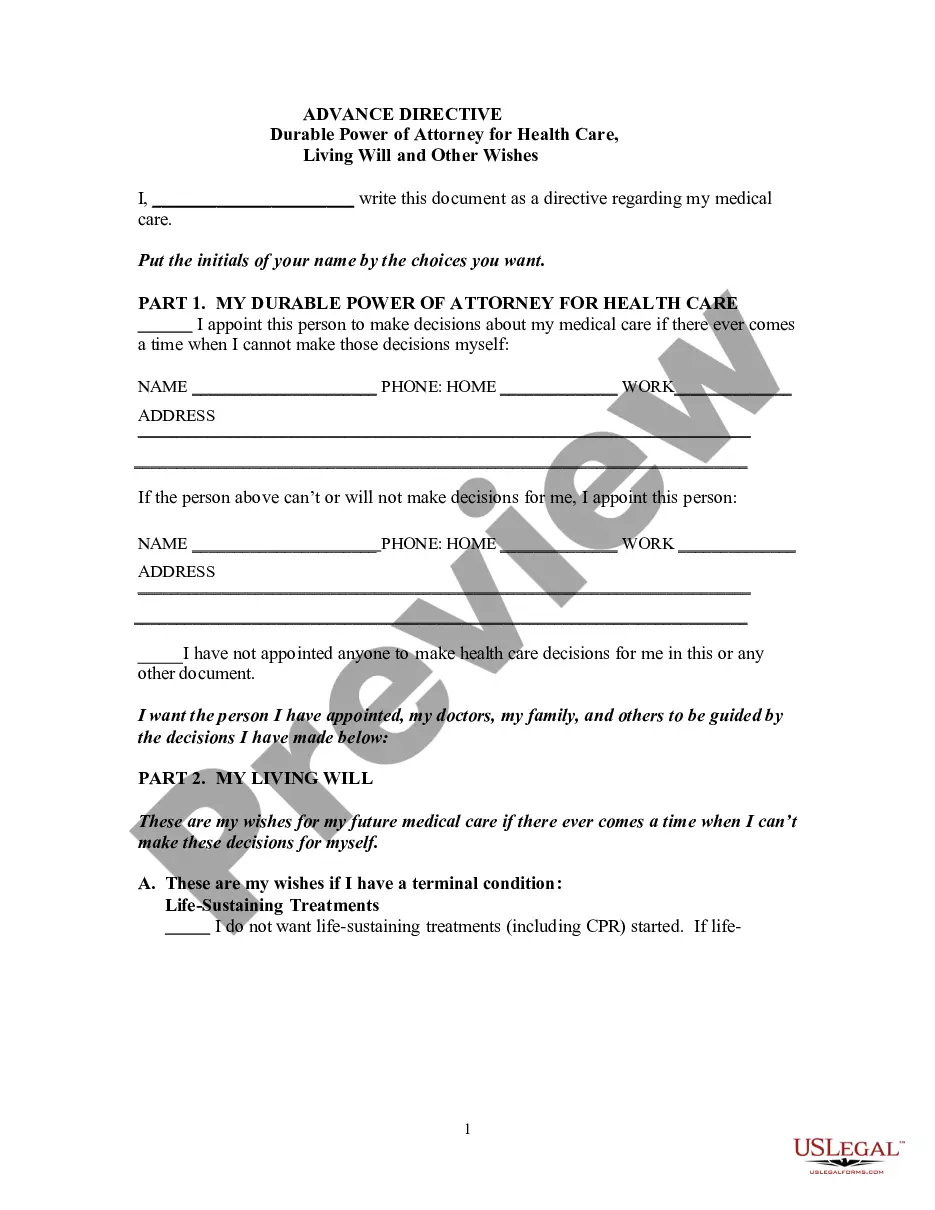
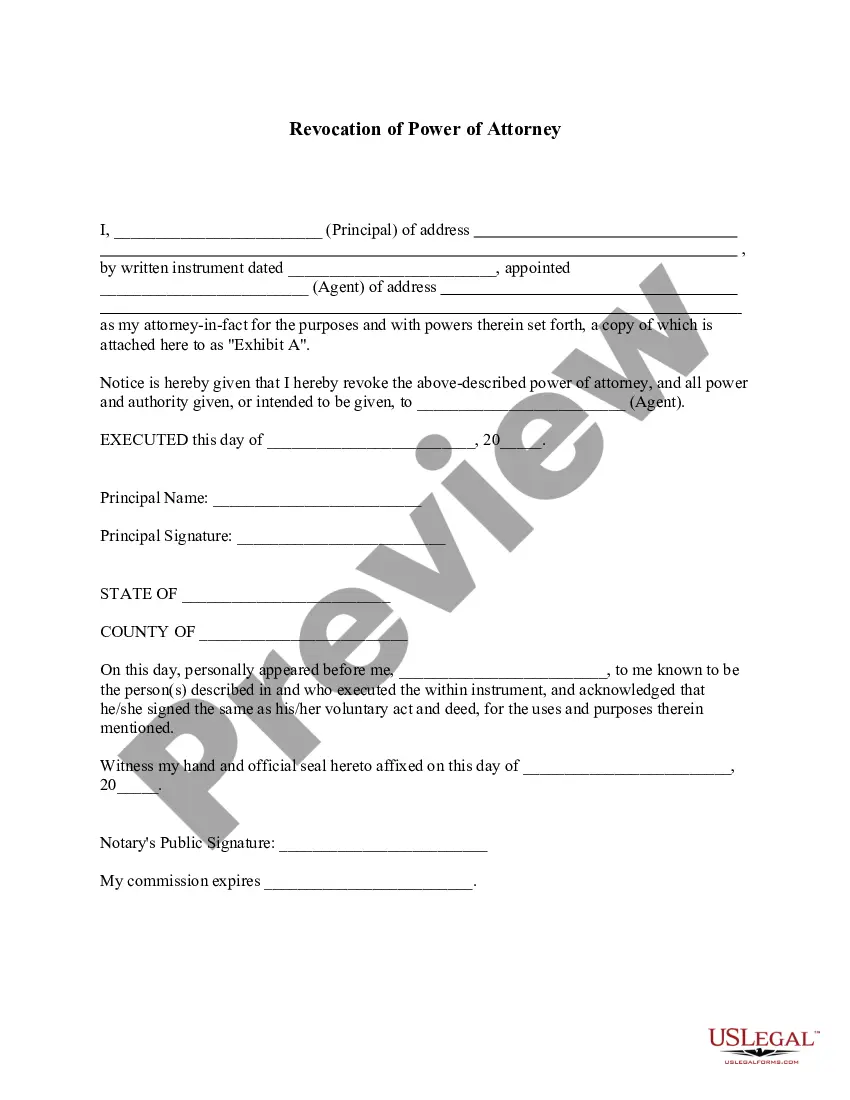
The Revocation of Declaration is a legal document that allows an individual to withdraw previously communicated wishes regarding life-sustaining treatments. Specifically, it revokes a prior Declaration concerning the use of artificial means to prolong life in accordance with Nebraska statutes. This form is crucial for ensuring that healthcare providers and family members are aware of the individualâs current wishes, especially when health conditions may affect decision-making abilities.
Key parts of this document
- Name and contact information of the declarant.
- Date of the original declaration being revoked.
- Statement that revocation is effective upon communication to healthcare providers.
- Date of revocation and signature of the declarant.
- Witness signature section, if required.
When to use this form
This form should be used when an individual has previously established a Declaration regarding life-sustaining treatment but has since decided to revoke it. Scenarios may include changes in health status, shifts in personal beliefs about medical treatment, or the desire to adjust end-of-life care preferences.
Who needs this form
- Individuals who have executed a Declaration concerning life-sustaining treatment.
- People experiencing changes in health or circumstances that necessitate updating their end-of-life preferences.
- Those seeking to ensure that their current wishes are accurately known by healthcare providers.
Completing this form step by step
- Clearly print the declarant's name in the designated field.
- Specify the date when the original Declaration was executed.
- Include the date on which the revocation is being made.
- Sign the revocation document, and print the name underneath the signature.
- Provide a current address to ensure proper identification.
Notarization guidance
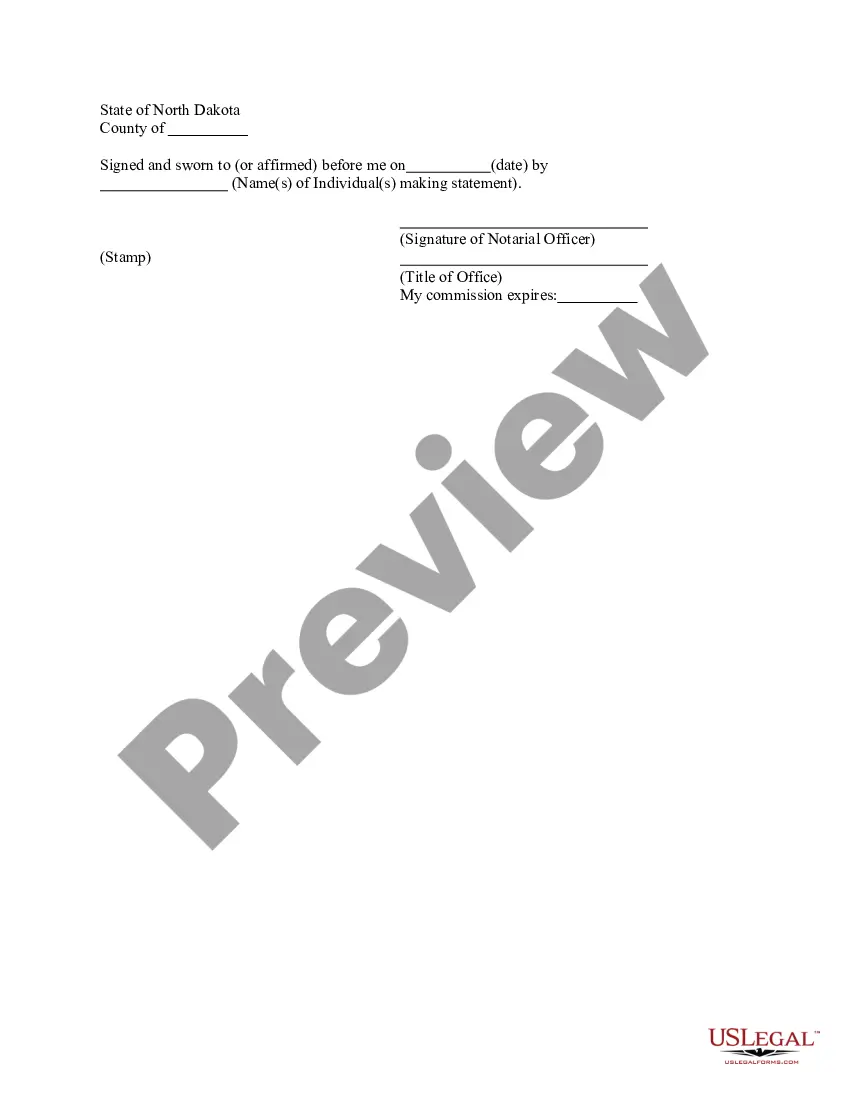
This form does not typically require notarization unless specified by local law. It is advisable to confirm any state-specific requirements regarding notarization or witnessing.
Get your form ready online
Our built-in tools help you complete, sign, share, and store your documents in one place.
Make edits, fill in missing information, and update formatting in US Legal Forms—just like you would in MS Word.
Download a copy, print it, send it by email, or mail it via USPS—whatever works best for your next step.
Sign and collect signatures with our SignNow integration. Send to multiple recipients, set reminders, and more. Go Premium to unlock E-Sign.
If this form requires notarization, complete it online through a secure video call—no need to meet a notary in person or wait for an appointment.
We protect your documents and personal data by following strict security and privacy standards.

Make edits, fill in missing information, and update formatting in US Legal Forms—just like you would in MS Word.

Download a copy, print it, send it by email, or mail it via USPS—whatever works best for your next step.

Sign and collect signatures with our SignNow integration. Send to multiple recipients, set reminders, and more. Go Premium to unlock E-Sign.

If this form requires notarization, complete it online through a secure video call—no need to meet a notary in person or wait for an appointment.

We protect your documents and personal data by following strict security and privacy standards.
Common mistakes to avoid
- Failing to date the revocation, which may lead to confusion about which Declaration is revoked.
- Not communicating the revocation to healthcare providers or family, which can result in the old Declaration being followed.
- Omitting a witness signature if required, which may invalidate the revocation.
Advantages of online completion
- Convenient download allows immediate access to important legal documents.
- Editability ensures that the document can be tailored to reflect updated wishes.
- Reliable templates drafted by licensed attorneys guarantee compliance with state laws.
The Revocation of Declaration is legally recognized under Nebraska law, providing declarants the authority to change their healthcare treatment preferences at any time. It is essential for the revocation to be communicated clearly to ensure that healthcare providers and family members are aware of the changes to avoid any confusion in critical situations.
Main things to remember
- The Revocation of Declaration form allows individuals to officially withdraw previous medical treatment decisions.
- It must be properly completed to ensure clarity and enforceability.
- The form is compliant with Nebraska laws regarding declarations of life-sustaining treatment.
Looking for another form?
Form popularity
FAQ
It is designed to safeguard against misunderstandings, disagreements, and people changing their minds, and as such it is not easily changed. That being said, circumstances do change, and if all parties who signed the original document give their consent then the Declaration of Trust can be amended or rewritten.
In some states, your trustee must submit a formal accounting of the trust's operation to all beneficiaries.Trustees can sometimes waive this requirement if all beneficiaries agree in writing. In either case, after the report is made, the trust's assets can be distributed and the trust can be dissolved.
The first step in dissolving a revocable trust is to remove all the assets that have been transferred into it.Such documents, often called a trust revocation declaration or revocation of living trust," can be downloaded from legal websites; local probate courts may also provide copies of them.
If you want to revoke your trust, you must formally take all of the trust assets out of the living trust and transfer title back to you. Basically, you must reverse the process you followed when you transferred ownership of the property to yourself as trustee.
EXAMPLE: Yvonne and Andre make a living trust together. Step 1: Transfer ownership of trust property from yourself as trustee back to yourself. Step 2: A revocation prints out with your trust document. Step 3: Complete the Revocation of Trust by filling in the date, and then sign it in front of a notary public.
One of the most common reasons for revoking a trust, for example, is a divorce, if the trust was created as a joint document with one's soon-to-be ex-spouse.A revocable trust may also be revoked if the grantor wants to appoint a new trustee or change the provisions of the trust completely.
Can a declaration of trust be overturned? Generally the point in the document is so you cannot change your minds. However, you can update the document with the consent of both parties. If it is a big change, you should write a new deed.
You have the right to revoke your deed of trust. It is the writing that evidences the agreement to allow the lender a security interest in your property.Even after you sign the deed of trust, you STILL hold legal title to the property.
The first step in dissolving a revocable trust is to remove all the assets that have been transferred into it. The second step is to fill out a formal revocation form, stating the grantor's desire to dissolve the trust.