Law Firm Opinion Letter
What this document covers
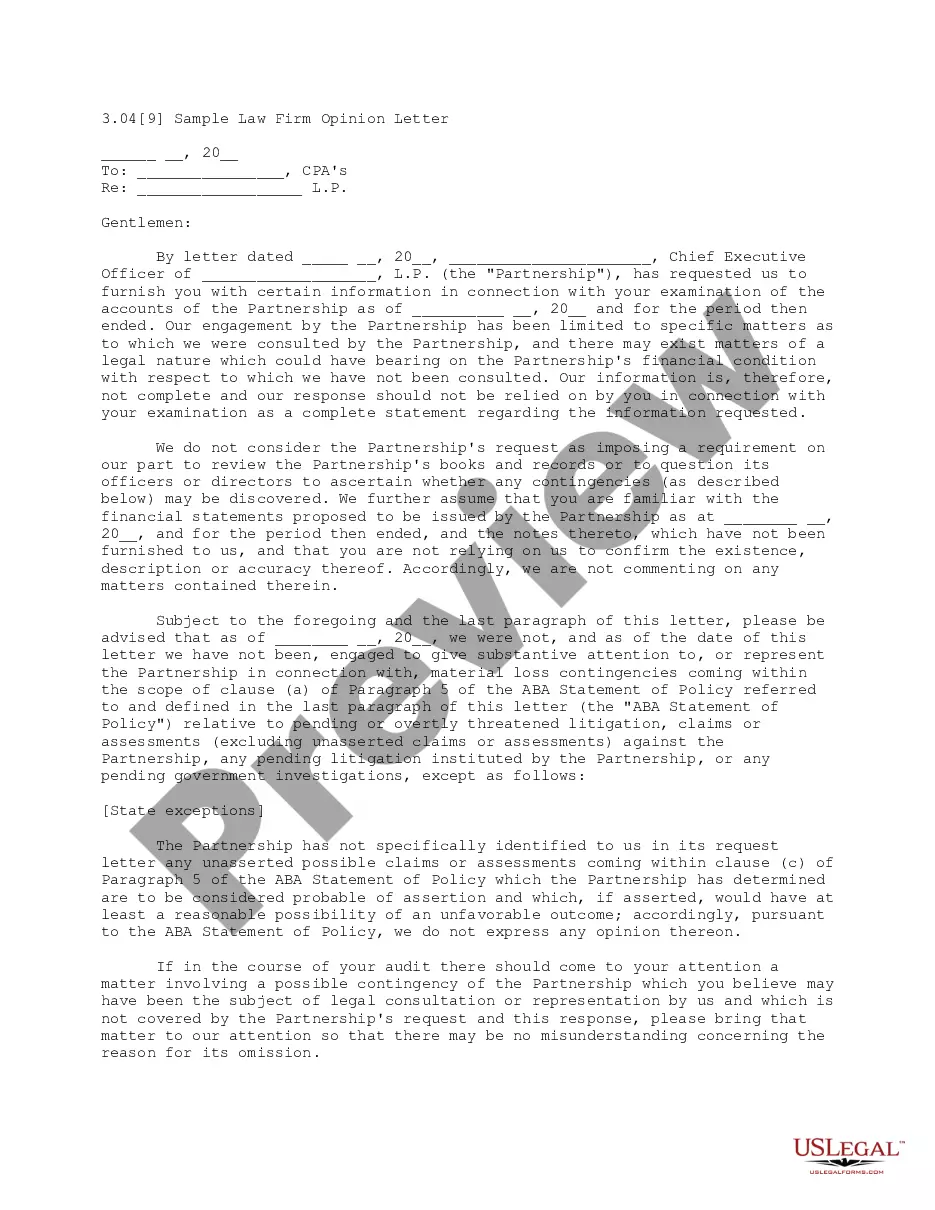
The Law Firm Opinion Letter is a formal document provided by a law firm at the request of a client, typically used to assist auditors in their examination of a partnershipâs financial condition. This letter is designed to meet the standards set by the American Bar Association (ABA) for responding to auditorsâ requests for information, ensuring that it adheres to specific legal guidelines.
Key parts of this document
- Date of the letter and the addressee (e.g., CPAs)
- Details of the partnership and the request made by its Chief Executive Officer
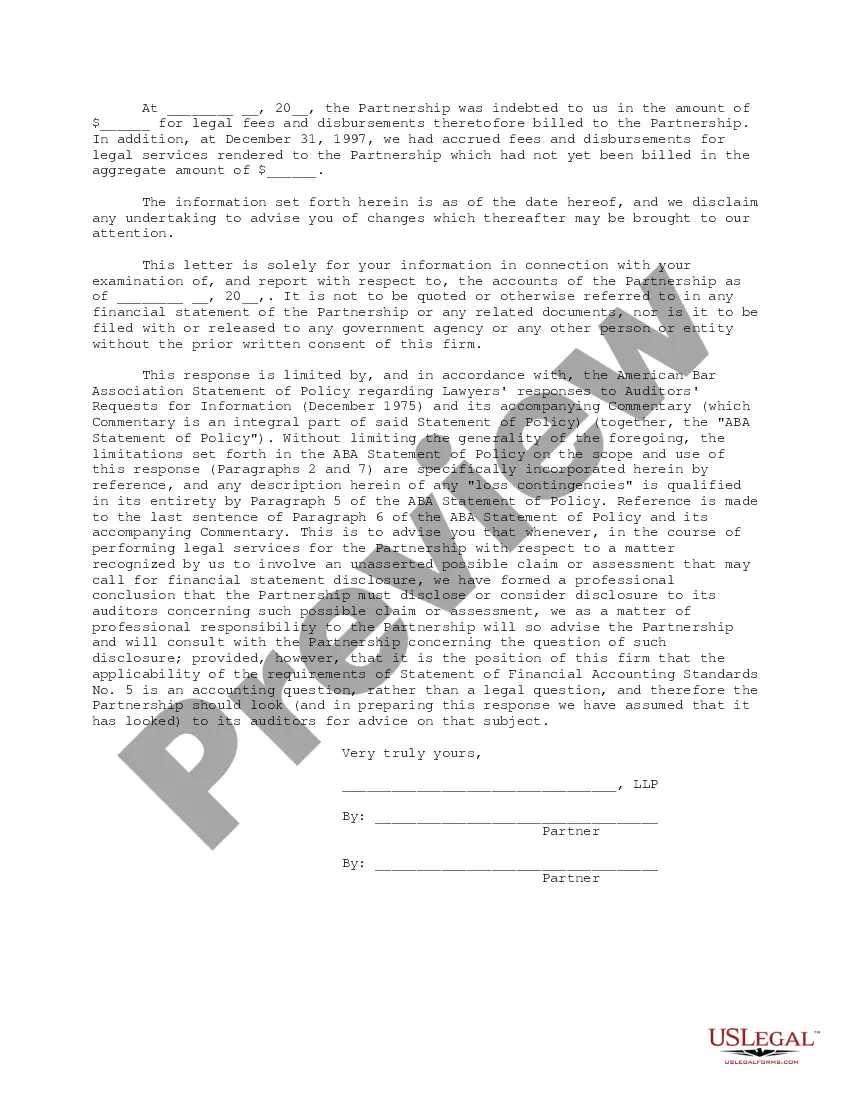
- Disclosure limits regarding legal matters and existing debts
- Assumptions regarding the completeness of the financial statements
- Limitations on use and sharing of the letter
- Signatures of the partners at the law firm

When this form is needed
This form should be used when a partnership or its representatives require a legal opinion regarding its financial condition for audit purposes. Specifically, it is essential when the auditors need verification about the partnershipâs legal standing and any potential liabilities that could affect its financial statements.
Who needs this form
This form is intended for:
- Partnerships seeking formal legal opinions to satisfy auditor requirements
- Legal professionals preparing opinion letters in compliance with ABA standards
- Accountants or auditors examining the financial statements of partnerships
How to complete this form
To complete this form, follow these steps:
- Identify the date of the letter and the corresponding CPA addressee.
- Provide the name of the partnership and its Chief Executive Officer who is making the request.
- Specify the relevant dates for the financial statements being audited.
- Detail any assumptions made regarding pending legal issues or debts.
- Collect signatures from the law firm's partners involved in providing the opinion.
Notarization guidance
This form does not typically require notarization unless specified by local law. However, it is good practice to consult with an attorney to ensure compliance with any state-specific requirements.
Get your form ready online
Our built-in tools help you complete, sign, share, and store your documents in one place.
Make edits, fill in missing information, and update formatting in US Legal Forms—just like you would in MS Word.
Download a copy, print it, send it by email, or mail it via USPS—whatever works best for your next step.
Sign and collect signatures with our SignNow integration. Send to multiple recipients, set reminders, and more. Go Premium to unlock E-Sign.
If this form requires notarization, complete it online through a secure video call—no need to meet a notary in person or wait for an appointment.
We protect your documents and personal data by following strict security and privacy standards.

Make edits, fill in missing information, and update formatting in US Legal Forms—just like you would in MS Word.

Download a copy, print it, send it by email, or mail it via USPS—whatever works best for your next step.

Sign and collect signatures with our SignNow integration. Send to multiple recipients, set reminders, and more. Go Premium to unlock E-Sign.

If this form requires notarization, complete it online through a secure video call—no need to meet a notary in person or wait for an appointment.

We protect your documents and personal data by following strict security and privacy standards.
Common mistakes to avoid
- Failing to provide complete information on the partnership's legal obligations or existing debts.
- Neglecting to specify the date of the letter or the relevant financial periods.
- Using the letter for purposes other than its intended use without prior consent.
- Providing incomplete answers to auditor questions regarding pending litigation or claims.
Advantages of online completion
- Convenience: Easily downloadable and customizable legal template.
- Editability: Users can fill in specific details relevant to their partnership.
- Reliability: Templates are drafted by licensed attorneys, ensuring compliance with legal standards.
Legal use & context
- This opinion letter serves as a formal communication between the law firm and auditors.
- It helps mitigate misunderstandings regarding legal contingencies related to financial statements.
- The letter must be used as intended and should not be relied upon in isolation.
Summary of main points
- This form is essential for partnerships undergoing audits to provide legal clarity.
- It outlines the scope and limitations of the law firm's engagement with the partnership.
- Understand the importance of correctly filling out all sections to avoid future legal complications.
Looking for another form?

Form popularity
FAQ
The California Supreme Court and Court of Appeal are state agencies authorized to request opinions. Requests should come from the chief justice or a presiding justice of the court or, as is usually the case, be submitted by the Administrative Office of the Courts.
A legal opinion letter is a formal letter by an attorney verifying the legal status of a person or entity.At Tsang & Associates, we can provide a legal opinion letter for persons or entities in the state of California.
The date it was written. a salutation or greeting (who the letter is to) an introduction explaining your topic and opinion. a body with reasons that support your opinion. a conclusion restating your opinion or telling why it is important. closing. your signature.
State the facts: The facts are the answers to the client's questions. Analysis: For an easy analysis, first set out the provision of the law and the law itself. Answer the query: To answer the query, you will rely on the fact and analysis sections.
Start with a summary. Present the problem and a range of potential solutions. Choose the best solution and provide step-by-step actions to take. Make it clear if you are making assumptions or need further information.
An opinion letter, also called a legal opinion, is a letter issued by a legal counsel that facilitates a lender's due diligence process in a transaction.Lenders often require an opinion letter to act as proof of legal counsel's advice and conclusions regarding the loan documents relevant to the transaction.
1Look carefully at the letter's contents.2Check to see who sent the letter.3Review the substance of the letter or email.4Review the situation and the facts.5Determine how best to proceed.6Consider whether you should notify your insurance company that you have received a legal threat.Responding to Correspondence Threatening Legal Action Digital\nwww.dmlp.org > legal-guide > responding-correspondence-threatening-leg...
1Maintain focus throughout the process. Both intended and unintended audiences can read legal letters.2Come up with coherent and consistent arguments.3Use short sentences and paragraphs in your letter.4Make sure your language has precision.