Joint Filing of Rule 13d-1(f)(1) Agreement
What is this form?
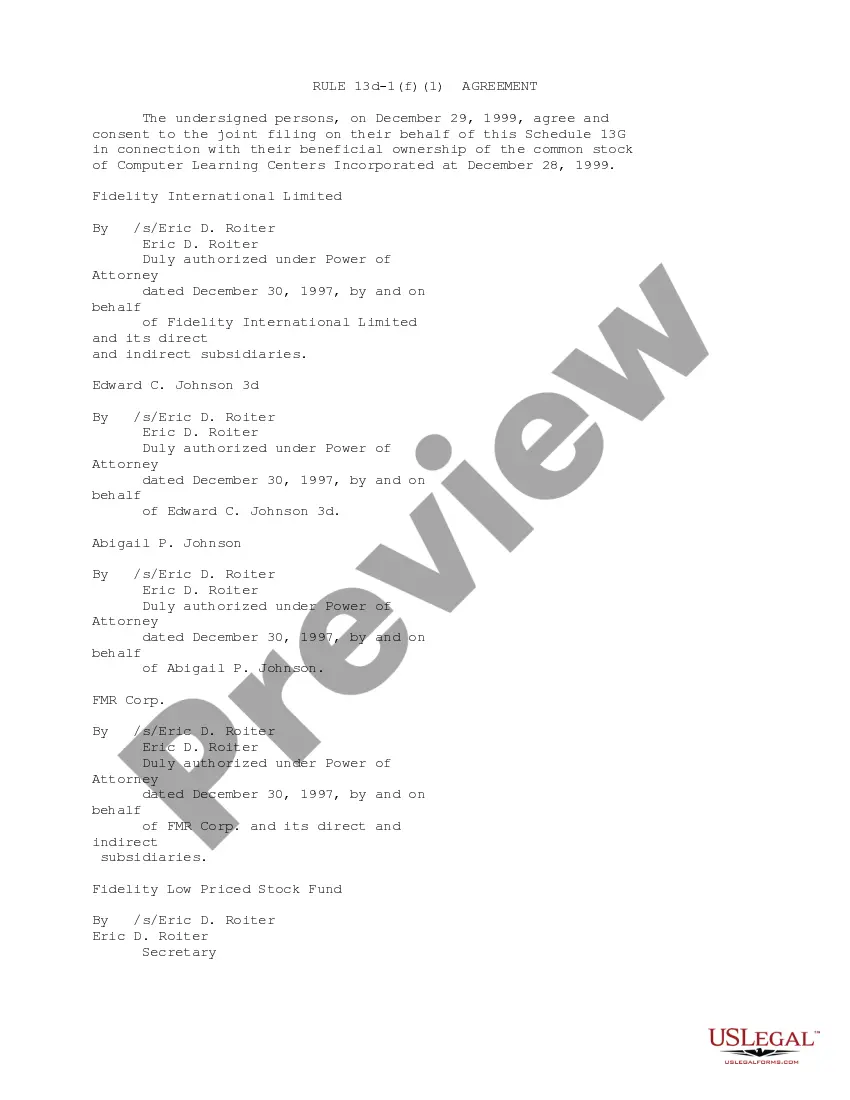
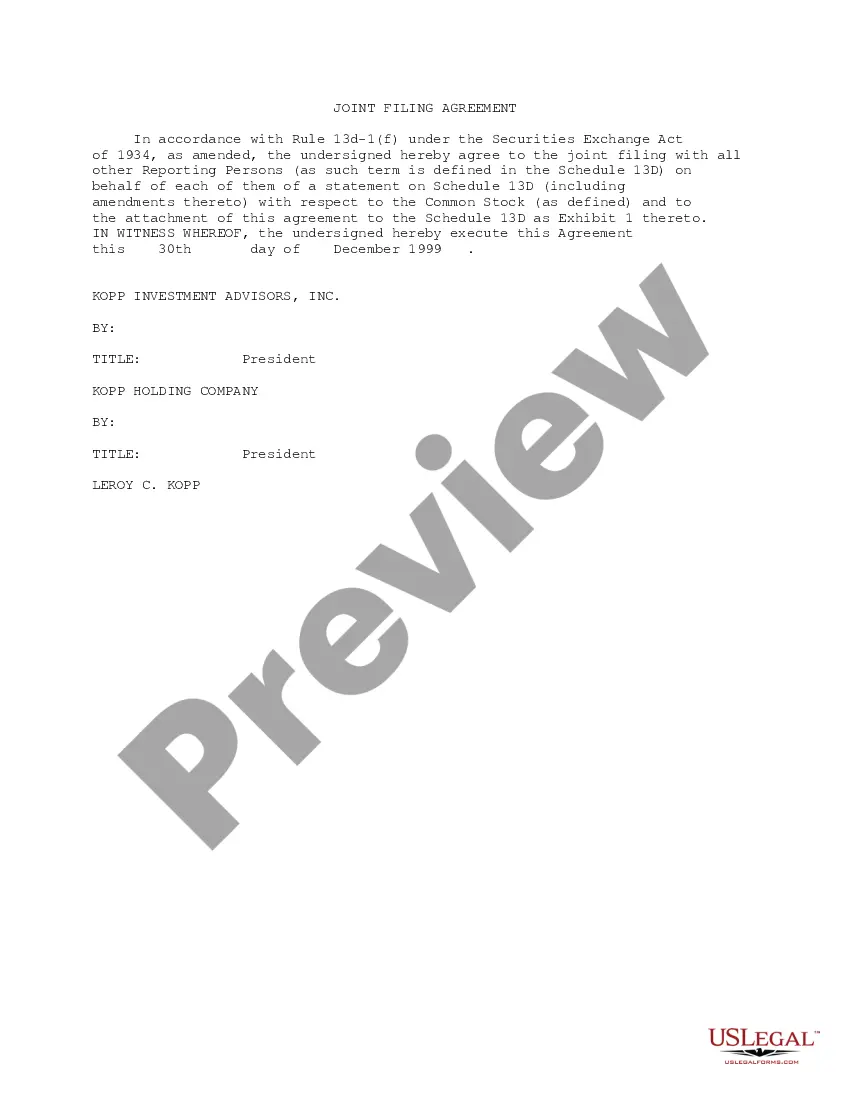
The Joint Filing of Rule 13d-1(f)(1) Agreement is a legal document used by multiple parties to collectively disclose their beneficial ownership of a company's common stock. This form distinguishes itself from other ownership forms by its requirement for coordinated filing, which is typically necessary for entities or individuals holding substantial shares in a public company. By submitting this agreement, the parties confirm their joint ownership and comply with SEC regulations for ownership disclosure.
What’s included in this form
- Identification of the parties involved in the joint filing.
- Details regarding the beneficial ownership of the stock, including the company name and relevant dates.
- Signature lines for each party, indicating their consent to the filing.
- Authorization details, including any Power of Attorney references.
Common use cases
This form should be used when multiple entities or individuals own shares in a company and need to file a joint ownership disclosure. It is particularly relevant for investors intending to declare their collective investment in a public company under SEC regulations, especially when their ownership surpasses the threshold for reporting.
Who this form is for
- Individuals or entities with joint ownership of stock in a public company.
- Investment funds or partnerships looking to disclose aggregated beneficial ownership.
- Shareholders required to file under the SEC's Schedule 13G rules.
How to prepare this document
- Identify all parties involved in the joint filing; include full names and descriptions.
- Specify the company name and the beneficial ownership details, including the stock quantity owned.
- Enter the relevant date of ownership information.
- Ensure each party signs the document, confirming their agreement to the joint filing.
- Include any required Power of Attorney documentation where applicable.
Notarization guidance
This form usually doesn’t need to be notarized. However, local laws or specific transactions may require it. Our online notarization service, powered by Notarize, lets you complete it remotely through a secure video session, available 24/7.
Get your form ready online
Our built-in tools help you complete, sign, share, and store your documents in one place.
Make edits, fill in missing information, and update formatting in US Legal Forms—just like you would in MS Word.
Download a copy, print it, send it by email, or mail it via USPS—whatever works best for your next step.
Sign and collect signatures with our SignNow integration. Send to multiple recipients, set reminders, and more. Go Premium to unlock E-Sign.
If this form requires notarization, complete it online through a secure video call—no need to meet a notary in person or wait for an appointment.
We protect your documents and personal data by following strict security and privacy standards.

Make edits, fill in missing information, and update formatting in US Legal Forms—just like you would in MS Word.

Download a copy, print it, send it by email, or mail it via USPS—whatever works best for your next step.

Sign and collect signatures with our SignNow integration. Send to multiple recipients, set reminders, and more. Go Premium to unlock E-Sign.

If this form requires notarization, complete it online through a secure video call—no need to meet a notary in person or wait for an appointment.

We protect your documents and personal data by following strict security and privacy standards.
Common mistakes
- Failing to include all parties' signatures, which can invalidate the filing.
- Omitting necessary dates or essential ownership details, leading to compliance issues.
- Not checking for updates to the SEC filing requirements or forms.
Why use this form online
- Easy accessibility allows for quick downloads and immediate use.
- Customizable templates ensure the form meets specific needs without legal jargon.
- Secure storage options protect your sensitive information and filings.
Legal use & context
- The form must comply with SEC regulations regarding beneficial ownership disclosures.
- Ensures transparency in ownership, which is critical for public companies and regulatory bodies.
- Avoids legal penalties associated with failing to disclose joint ownership properly.
Key takeaways
- The Joint Filing of Rule 13d-1(f)(1) Agreement is crucial for parties owning shares jointly.
- Ensure all parties are clearly identified and properly document signatures.
- Review local laws regarding ownership disclosures to ensure compliance.
Looking for another form?
Form popularity
FAQ
Schedule 13G is a shorter version of Schedule 13D with fewer reporting requirements. Schedule 13G can be filed in lieu of the SEC Schedule 13D form as long as the filer meets one of several exemptions.
A Schedule 13D is a document that must be filed with the Securities and Exchange Commission (SEC) within 10 days of the purchase of more than 5% of the shares of a public company by anyone investor or entity. It is sometimes referred to as a beneficial ownership report.
A Schedule 13D is a document that must be filed with the Securities and Exchange Commission (SEC) within 10 days of the purchase of more than 5% of the shares of a public company by anyone investor or entity. It is sometimes referred to as a beneficial ownership report.
Schedule 13D is an SEC filing that must be submitted to the US Securities and Exchange Commission within 10 days by anyone who acquires beneficial ownership of more than 5% of any class of publicly traded securities in a public company.
Schedule 13D is a form that must be filed with the U.S. Securities and Exchange Commission (SEC) when a person or group acquires more than 5% of any class of a company's equity shares.Schedule 13D is also known as a "beneficial ownership report."
Institutional investors must file a Schedule 13G within 45 days after the calendar year in which the investor holds more than 5% as of the year end or within 10 days after the end of the first month in which the person's beneficial ownership exceeds 10% of the class of equity securities computed as of the end of the
The filing must be made within 10 days of breaking the five percent threshold. The 13D is useful because it can give the average investor the ability to follow the so-called smart money. Maybe a billionaire investor known for spotting good opportunities on the cheap is acquiring shares of Company XYZ.