Due Diligence Groups
About this form
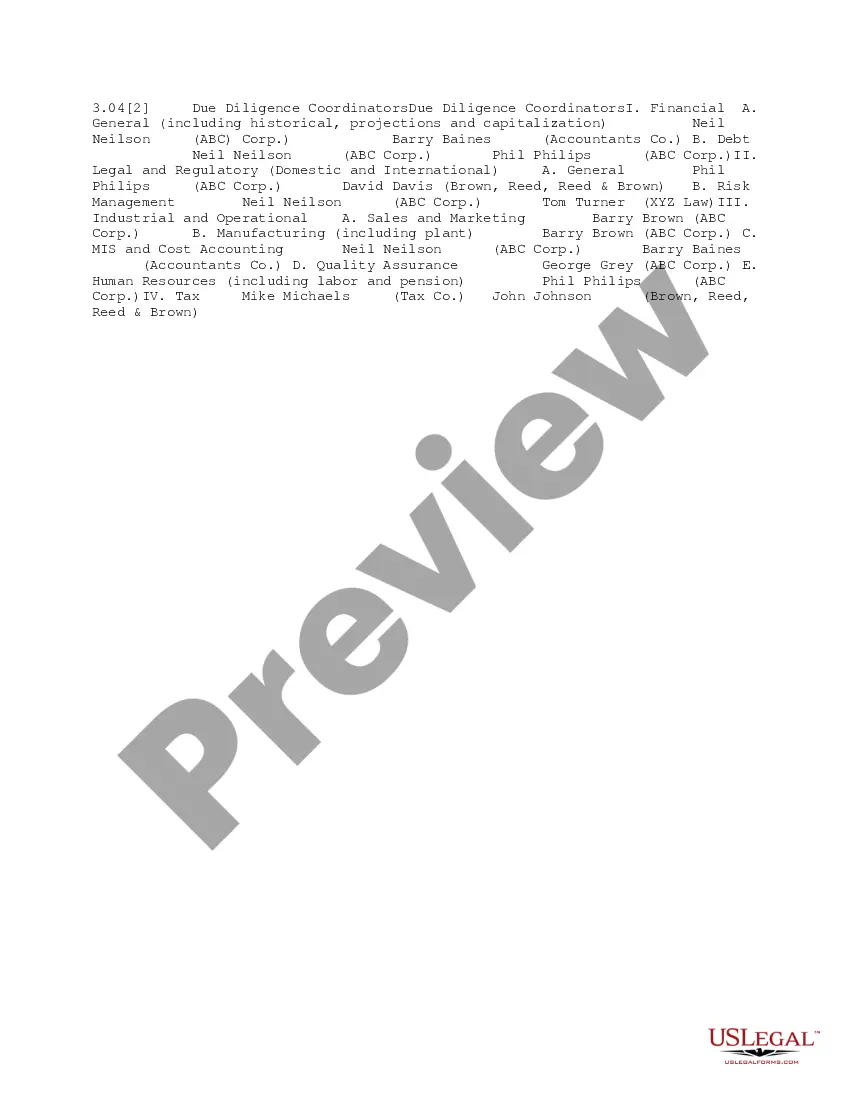
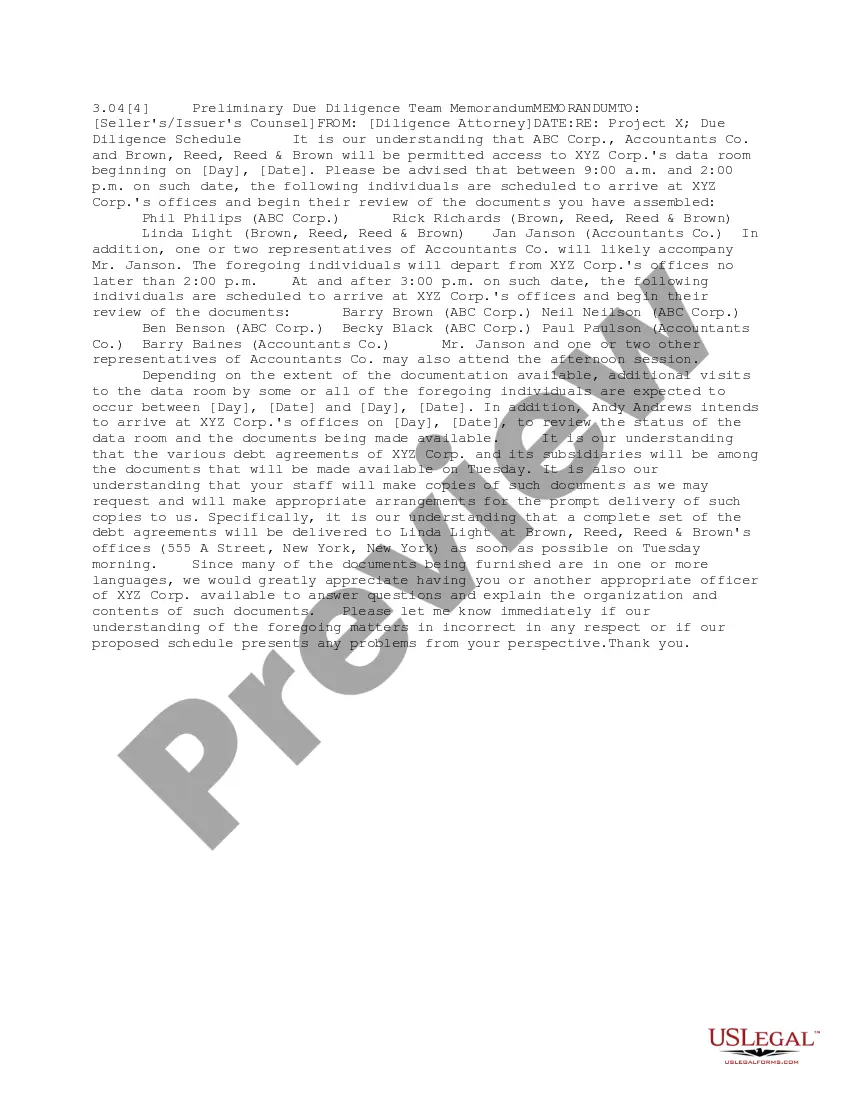
The Due Diligence Groups form outlines the members involved in various due diligence activities within a company. This form is essential for establishing clear accountability and roles across different departments during the assessment of financial, legal, regulatory, and operational aspects. Unlike other legal forms, this document specifically focuses on identifying group members essential for due diligence processes within a corporate framework.
Main sections of this form
- Financial assessment details, including historical data and projections.
- Legal and regulatory compliance sections for domestic and international considerations.
- Business industrial sectors such as sales, marketing, manufacturing, and human resources.
- Tax responsibilities covering domestic, international, and treaty-based issues.
- Roles of key personnel from various companies listed under each category.


Common use cases
This form should be utilized when a company is conducting due diligence, whether for mergers, acquisitions, partnerships, or regulatory compliance. It helps in organizing team members and defining their roles in the due diligence process, ensuring all critical aspects are covered comprehensively.
Intended users of this form
- Corporations engaging in mergers and acquisitions.
- Legal teams preparing for audits or compliance checks.
- Project managers coordinating due diligence processes.
- Finance teams conducting thorough assessments of financial health.
- Human resources departments involved in labor assessments during due diligence.
Instructions for completing this form
- Identify the companies involved, such as ABC Corp., First Corp., and others.
- List the members from each department responsible for due diligence.
- Specify the categories of due diligence, including financial, legal, and operational.
- Ensure accuracy in listing roles and responsibilities for each member.
- Review and adjust the form as needed to reflect the specific needs of your project.
Notarization requirements for this form
This form does not typically require notarization unless specified by local law.
Get your form ready online
Our built-in tools help you complete, sign, share, and store your documents in one place.
Make edits, fill in missing information, and update formatting in US Legal Forms—just like you would in MS Word.
Download a copy, print it, send it by email, or mail it via USPS—whatever works best for your next step.
Sign and collect signatures with our SignNow integration. Send to multiple recipients, set reminders, and more. Go Premium to unlock E-Sign.
If this form requires notarization, complete it online through a secure video call—no need to meet a notary in person or wait for an appointment.
We protect your documents and personal data by following strict security and privacy standards.

Make edits, fill in missing information, and update formatting in US Legal Forms—just like you would in MS Word.

Download a copy, print it, send it by email, or mail it via USPS—whatever works best for your next step.

Sign and collect signatures with our SignNow integration. Send to multiple recipients, set reminders, and more. Go Premium to unlock E-Sign.

If this form requires notarization, complete it online through a secure video call—no need to meet a notary in person or wait for an appointment.

We protect your documents and personal data by following strict security and privacy standards.
Mistakes to watch out for
- Failing to include all necessary team members.
- Not updating roles as staffing changes occur.
- Overlooking local regulations that may impact the due diligence process.
- Neglecting to review the form for accuracy before implementation.
Advantages of online completion
- Convenient access to templates that can be downloaded and filled out at your pace.
- Editability allows for easy updates and modifications as team members change.
- Reliable structure ensures all necessary components of due diligence are addressed.
- Access to legal expertise through templates drafted by licensed attorneys.
- The form is critical for legally documenting due diligence team members.
- It helps establish accountability and clear roles during the due diligence process.
- Using this form can enhance compliance with regulatory requirements and industry standards.
Key takeaways
- The Due Diligence Groups form is vital for defining roles in corporate assessments.
- Utilizing this form can help organize and streamline the due diligence process.
- Clear identification of team members helps ensure thoroughness and accountability.
- Customizable for different jurisdictions, making it versatile across states.
Looking for another form?



Form popularity
FAQ
A due diligence checklist is an organized way to analyze a company. The checklist will include all the areas to be analyzed, such as ownership and organization, assets and operations, the financial ratios, shareholder value, processes and policies, future growth potential, management, and human resources.
Step 1: Company Capitalization. Step 2: Revenue, Margin Trends. Step 3: Competitors & Industries. Step 4: Valuation Multiples. Step 5: Management and Ownership. Step 6: Balance Sheet Exam. Step 7: Stock Price History. Step 8: Stock Options & Dilution.
Due diligence refers to being able to prove that your business has done everything reasonably possible to comply with current legislation and regulations. In other words, it helps to prove that you applied all reasonable precautions to avoid committing an offence.
Due diligence is the process of examining the details of a transaction to make sure it's legal, and to fully apprise both the buyer and seller of as many facts in the deal as possible. When the deal satisfies both aspects of due diligence, the two parties can finalize and correctly price the transaction.
Look at past annual and quarterly financial information, including: Review sales and gross profits by product. Look up the rates of return by product. Look at the accounts receivable. Get a breakdown of the business's inventory. Make a breakdown of real estate and equipment.
A Statement describing the subject of research. Documents in support of the research such as corporate reports, legal documents, transaction copies, market research, etc. SWOT Analysis i.e. an overview of the strengths, weaknesses, opportunities, and threats linked with the proposal.
Due Diligence Examples Conducting thorough inspections on a property before buying it in order to make sure that it is a good investment. An underwriter auditing an issuer's business and operations prior to selling it.