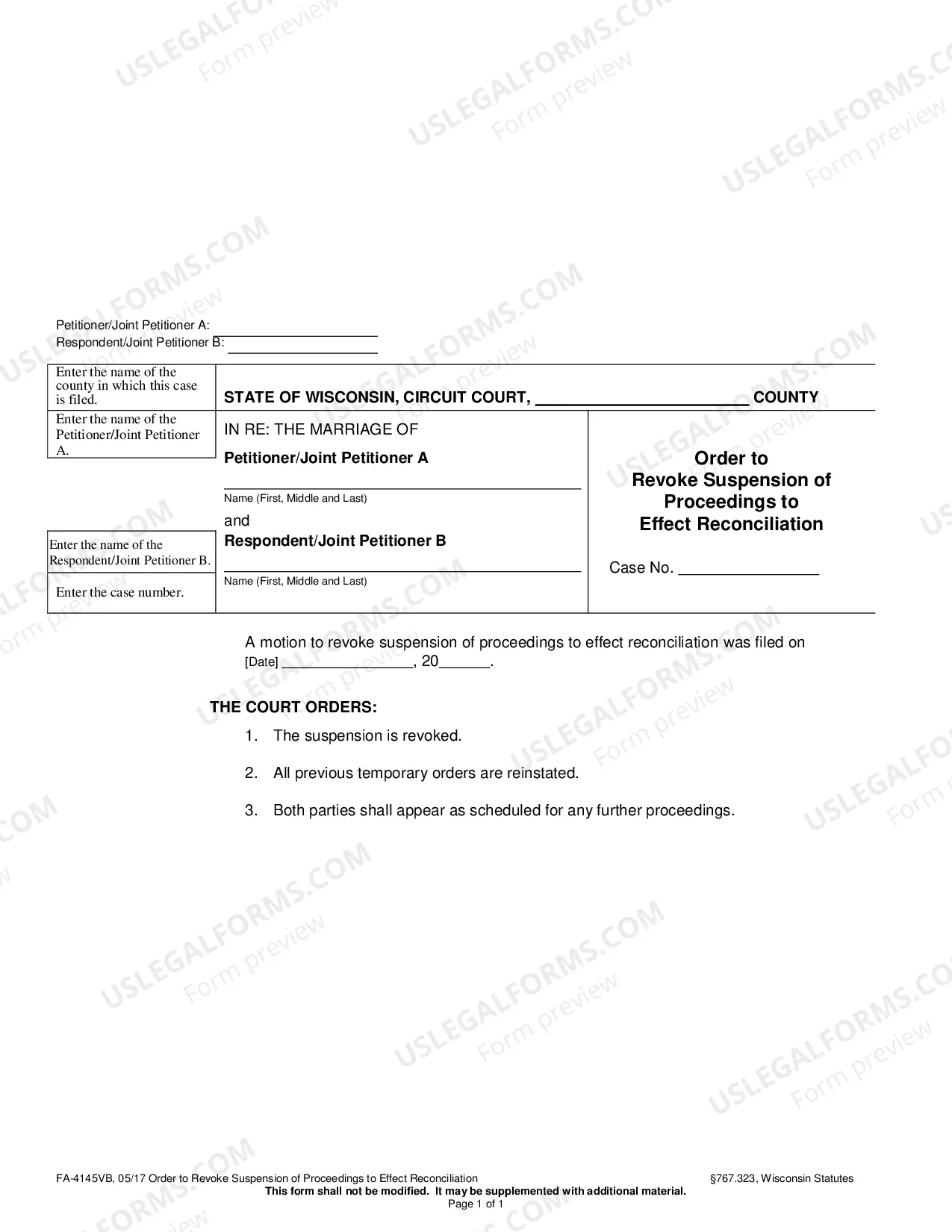
Import Compliance and Records Review Due Diligence
Understanding this form
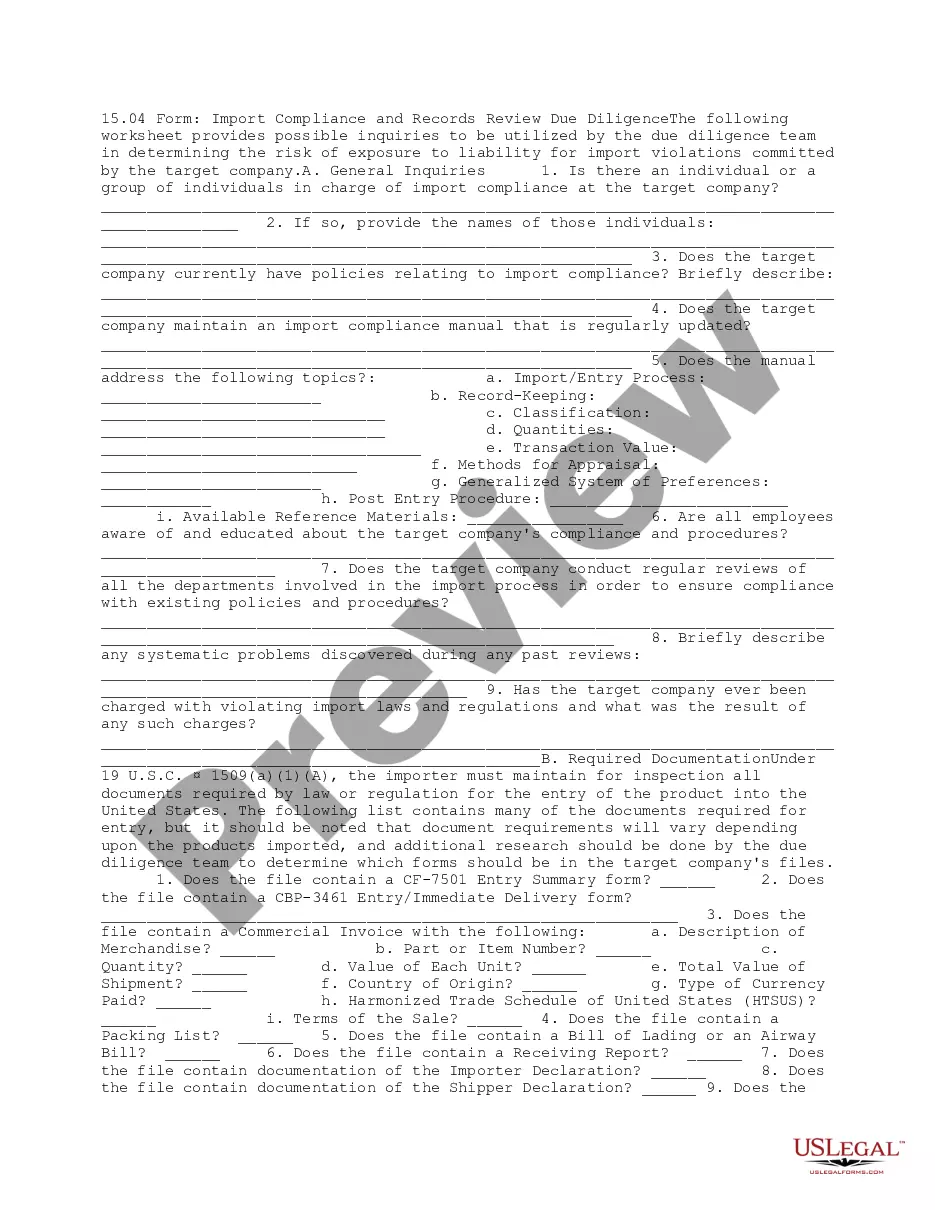
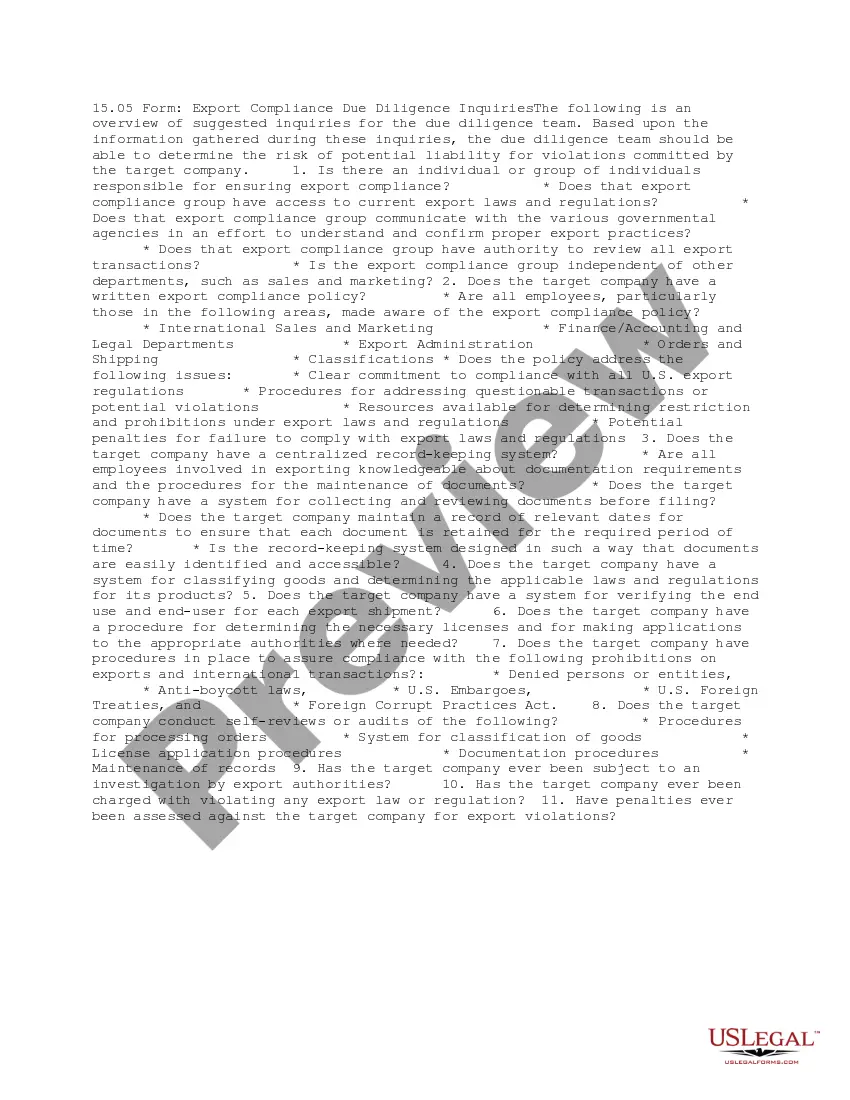
The Import Compliance and Records Review Due Diligence form is a comprehensive worksheet designed to assist due diligence teams in evaluating the risk associated with a company's compliance with import regulations. This form provides essential inquiries that help assess whether a target company may be exposing itself to liabilities due to import violations, distinguishing it from other forms focused solely on general compliance issues.
What’s included in this form
- General inquiries about the company's import compliance structure and procedures.
- Documentation requirements under U.S. import laws, including specific forms needed for compliance.
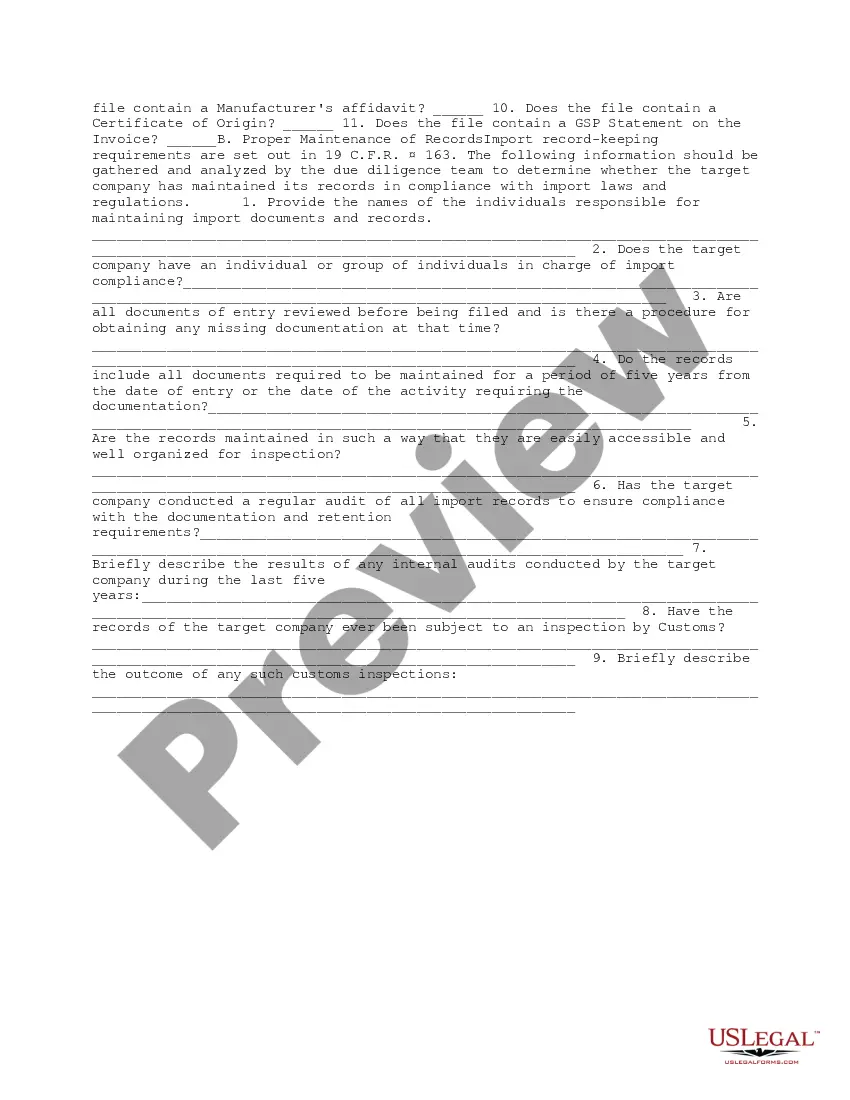
- Assessment of the maintenance and organization of import records.
- Details on previous import law violations and their outcomes.
- Evaluation of compliance education among employees.
When to use this form
This form should be used when conducting due diligence on a company involved in importing goods into the United States. It is especially important when assessing potential liabilities for regulatory infractions, during mergers and acquisitions, or when entering new business relationships with foreign entities. Utilizing this form helps ensure that all necessary compliance measures are met before finalizing any contracts or agreements.
Who can use this document
- Due diligence teams evaluating the import practices of target companies.
- Business owners considering partnerships or acquisitions with importing entities.
- Compliance officers tasked with ensuring adherence to import regulations.
- Legal professionals advising clients on import compliance issues.
Instructions for completing this form
- Identify the individuals or teams responsible for import compliance within the target company.
- Gather and evaluate the required documentation needed for U.S. import compliance.
- Document and analyze past import law violations and their resolutions.
- Review the organization and accessibility of all import-related records.
- Assess employee knowledge regarding compliance procedures.
Does this form need to be notarized?
Notarization is generally not required for this form. However, certain states or situations might demand it. You can complete notarization online through US Legal Forms, powered by Notarize, using a verified video call available anytime.
Get your form ready online
Our built-in tools help you complete, sign, share, and store your documents in one place.
Make edits, fill in missing information, and update formatting in US Legal Forms—just like you would in MS Word.
Download a copy, print it, send it by email, or mail it via USPS—whatever works best for your next step.
Sign and collect signatures with our SignNow integration. Send to multiple recipients, set reminders, and more. Go Premium to unlock E-Sign.
If this form requires notarization, complete it online through a secure video call—no need to meet a notary in person or wait for an appointment.
We protect your documents and personal data by following strict security and privacy standards.

Make edits, fill in missing information, and update formatting in US Legal Forms—just like you would in MS Word.

Download a copy, print it, send it by email, or mail it via USPS—whatever works best for your next step.

Sign and collect signatures with our SignNow integration. Send to multiple recipients, set reminders, and more. Go Premium to unlock E-Sign.

If this form requires notarization, complete it online through a secure video call—no need to meet a notary in person or wait for an appointment.

We protect your documents and personal data by following strict security and privacy standards.
Common mistakes to avoid
- Failing to accurately document all required compliance and import documentation.
- Not updating records in a timely manner which can lead to non-compliance.
- Overlooking the need for employee training regarding import compliance processes.
- Assuming that previous compliance issues have been fully resolved without properly reviewing documentation.
Benefits of using this form online
- Convenience of accessing the form from any location and device.
- Editability allows for customization to fit specific due diligence requirements.
- Reliable source of information drafted by licensed attorneys, ensuring legal soundness.
- Structured layout makes it easy to follow and complete, reducing the risk of errors.
Legal use & context
- This form aids in establishing due diligence which is crucial in legal contexts, particularly in mergers and acquisitions.
- Completing this form can help companies avoid potential fines and penalties associated with import violations.
- The information gathered can serve as a legal record in the event of disputes regarding compliance matters.
Main things to remember
- The Import Compliance and Records Review Due Diligence form is essential for assessing a company's adherence to import regulations.
- Utilizing this form helps to identify potential liabilities before significant business decisions.
- Complete and organized import records are critical for compliance and reducing legal risks.
Looking for another form?

Form popularity
FAQ
Due diligence refers to being able to prove that your business has done everything reasonably possible to comply with current legislation and regulations. In other words, it helps to prove that you applied all reasonable precautions to avoid committing an offence.
A Statement describing the subject of research. Documents in support of the research such as corporate reports, legal documents, transaction copies, market research, etc. SWOT Analysis i.e. an overview of the strengths, weaknesses, opportunities, and threats linked with the proposal.
A due diligence checklist is an organized way to analyze a company. The checklist will include all the areas to be analyzed, such as ownership and organization, assets and operations, the financial ratios, shareholder value, processes and policies, future growth potential, management, and human resources.
The objective of M&A compliance due diligence is to define the target company's compliance risk profile and uncover any red flags, including any problematic contractual arrangements, past or continuing violations of fraud and anti-bribery laws, antitrust regulation violations, data protection lapses, or conflict-of-
Statement of what is being studied, research or proposed. Background and supporting documentation on the proposal (corporate reports, financial statements, legal documents, copies of transaction history, market research)
A due diligence report is a comprehensive exploration and explanation of a property, a company's financial records, or a company's overall standing in the marketplace.Following a due diligence checklist can ensure your due diligence report: Conveys all the information necessary for educated business decisions.
Reviewing and auditing financial statements. Scrutinizing projections for future performance. Analyzing the consumer market. Seeking operating redundancies that can be eliminated. Reviewing potential or ongoing litigation. Reviewing antitrust considerations.
The most effective way to prove due diligence is through records of your food safety systems. In particular, records of your food safety practices and HACCP procedures will help to demonstrate compliance. These will show that you follow all the necessary safety standards and procedures to make food safe.
The report will include a list of key findings and valid recommendations, as well as a reasoned conclusion with a financial analysis explaining the feasibility of our recommendations, and its impact on the company.