Jury Instruction - Aiding And Abetting Filing False Return
What this document covers
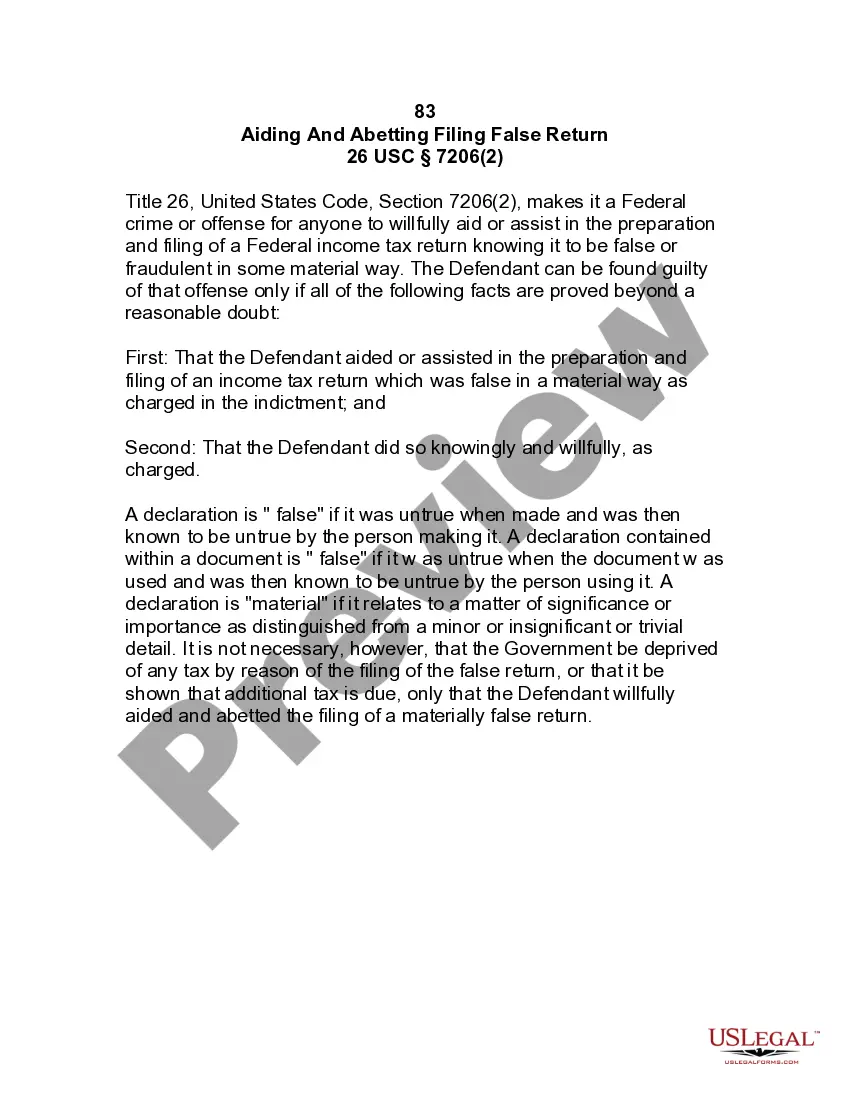
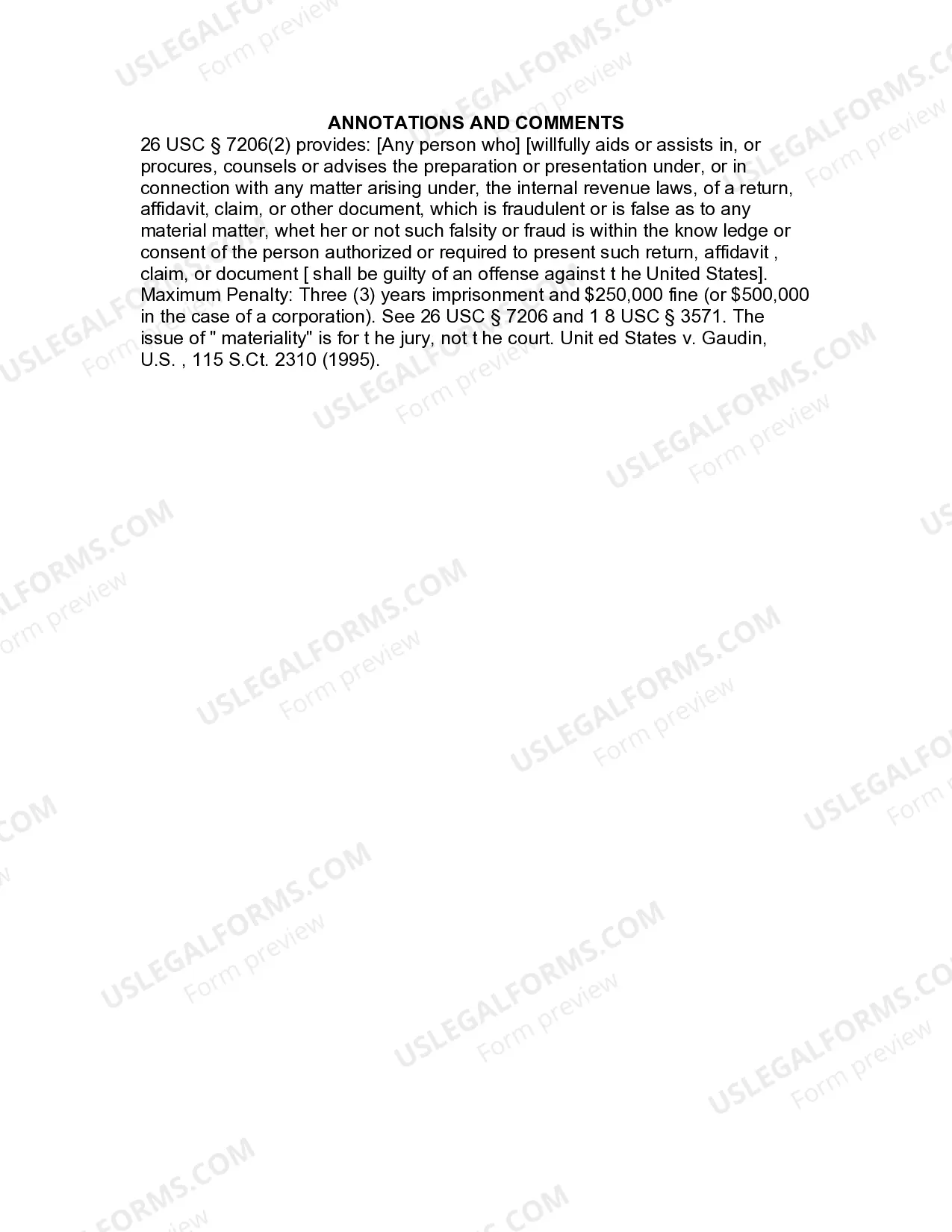
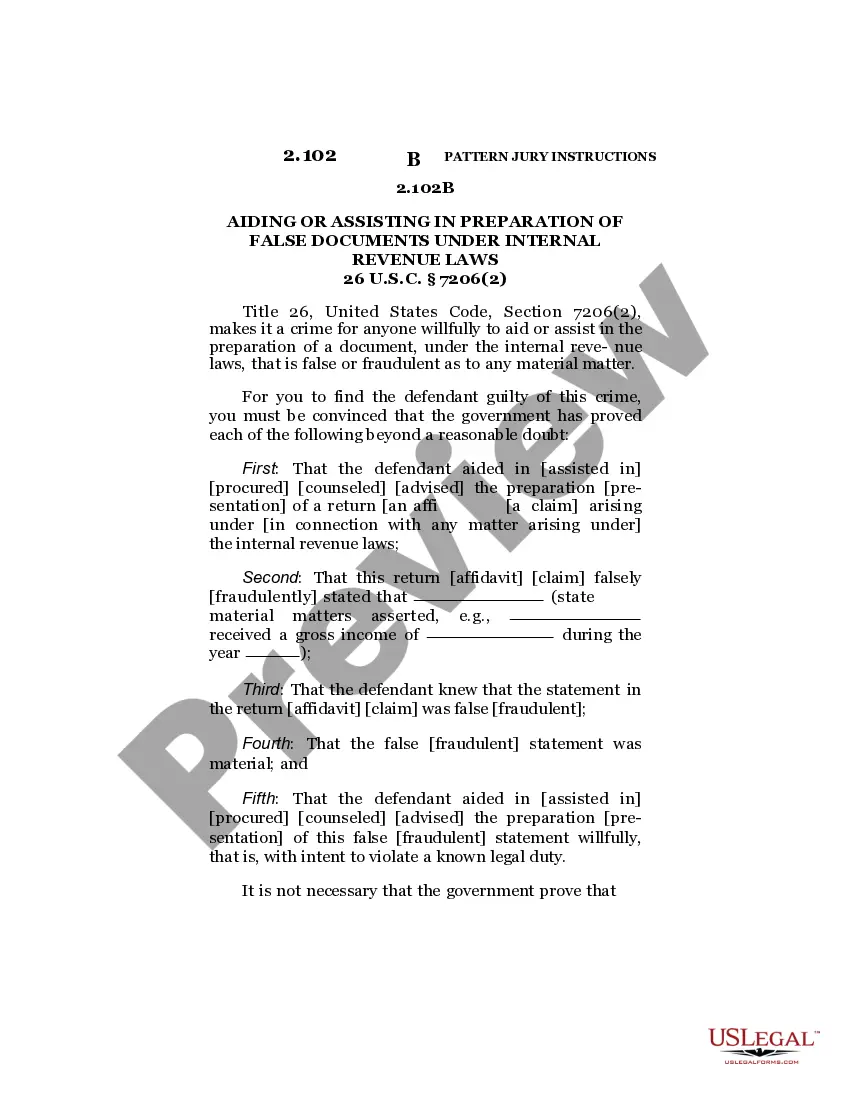
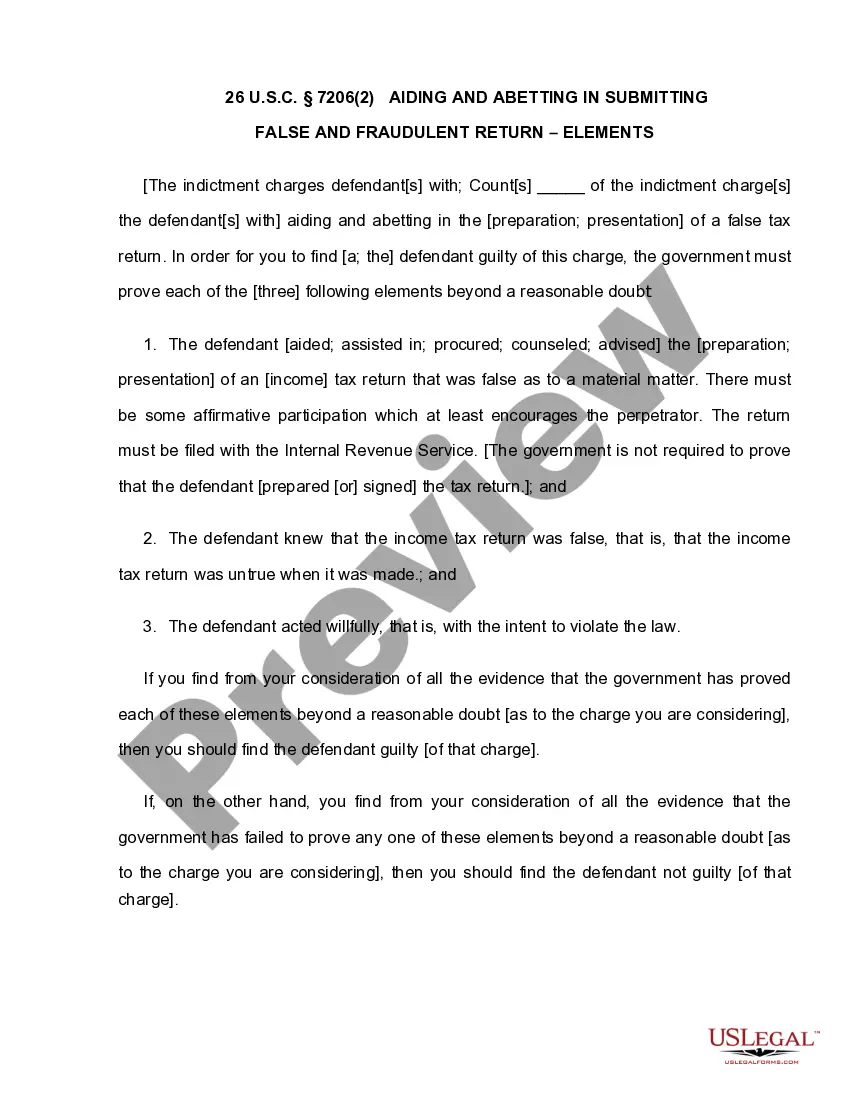
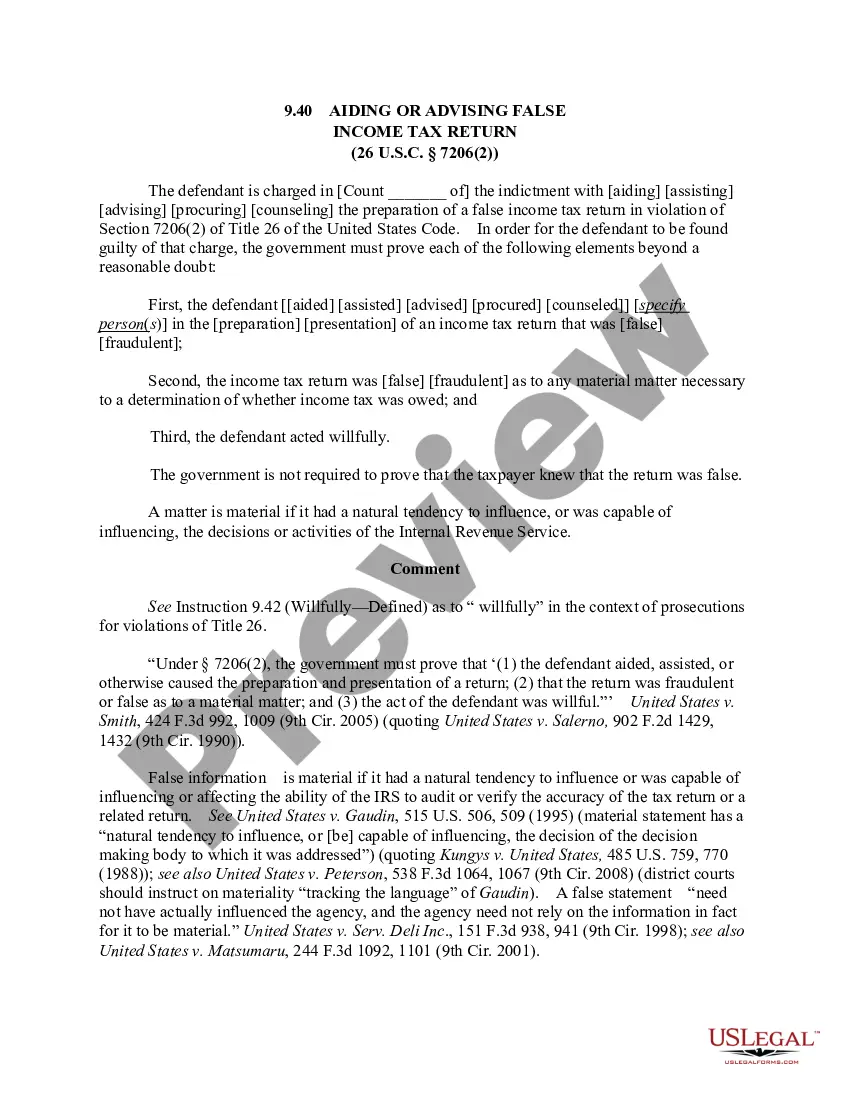
The Jury Instruction - Aiding and Abetting Filing False Return form provides standardized jury instructions used in federal cases concerning the crime of aiding or abetting the filing of a false tax return. This form serves as a model to guide juries in understanding the legal definitions and requirements for proving this particular charge, distinguishing it from other jury instructions related to tax fraud or other offenses.
Key components of this form
- The legal basis for the charge under Title 26, United States Code, Section 7206(2).
- The definition of "willfully" in the context of aiding or assisting in the preparation of a false return.
- A description of what constitutes a "false" declaration and what is considered "material" to the case.
- The necessity for the jury to assess the evidence beyond a reasonable doubt for conviction.
- Possible penalties, including imprisonment and monetary fines.
When this form is needed
This form is utilized in court cases where a defendant is accused of assisting in the preparation or filing of a false federal income tax return. Legal practitioners should use this form to instruct juries on the specific legal standards necessary to establish guilt for aiding and abetting tax fraud. It is particularly relevant in cases where fraud is suspected but not readily evident from the return itself.
Who should use this form
- Judges presiding over federal tax fraud cases.
- Defense attorneys representing individuals accused of aiding in tax fraud.
- Prosecutors seeking to establish legal definitions and standards during a trial.
How to prepare this document
- Identify the specific accusations against the defendant as noted in the indictment.
- Review the jury instructions carefully to ensure they reflect the case specifics.
- Modify the sample language to accurately represent the facts and evidence presented.
- Clarify definitions and legal standards for the jury based on the case context.
- Ensure all modifications are compliant with federal and local court requirements.
Is notarization required?
In most cases, this form does not require notarization. However, some jurisdictions or signing circumstances might. US Legal Forms offers online notarization powered by Notarize, accessible 24/7 for a quick, remote process.
Get your form ready online
Our built-in tools help you complete, sign, share, and store your documents in one place.
Make edits, fill in missing information, and update formatting in US Legal Forms—just like you would in MS Word.
Download a copy, print it, send it by email, or mail it via USPS—whatever works best for your next step.
Sign and collect signatures with our SignNow integration. Send to multiple recipients, set reminders, and more. Go Premium to unlock E-Sign.
If this form requires notarization, complete it online through a secure video call—no need to meet a notary in person or wait for an appointment.
We protect your documents and personal data by following strict security and privacy standards.

Make edits, fill in missing information, and update formatting in US Legal Forms—just like you would in MS Word.

Download a copy, print it, send it by email, or mail it via USPS—whatever works best for your next step.

Sign and collect signatures with our SignNow integration. Send to multiple recipients, set reminders, and more. Go Premium to unlock E-Sign.

If this form requires notarization, complete it online through a secure video call—no need to meet a notary in person or wait for an appointment.

We protect your documents and personal data by following strict security and privacy standards.
Common mistakes
- Failing to modify the sample instructions to fit the specific case details.
- Not adequately explaining the legal definitions of "false" and "material" to the jury.
- Neglecting to emphasize the requirement of proof beyond a reasonable doubt.
Advantages of online completion
- Convenience of immediate access to standardized legal instructions.
- Editable templates that allow for adjustments based on individual case needs.
- Drafted by licensed attorneys, ensuring legal compliance and reliability.
Legal use & context
- This form is utilized in federal courts due to its adherence to national tax law statutes.
- Understanding the legal definitions and what constitutes aiding and abetting is crucial for fair trials.
- Misinterpretation of the form could lead to unjust outcomes in jury decisions.
What to keep in mind
- The form provides essential jury instructions relevant to cases of tax fraud.
- It is crucial to customize the form for each case to ensure accuracy in legal representation.
- Using standardized legal language enhances clarity and understanding for juries.
Looking for another form?
Form popularity
FAQ
An accessory to a crime can face a fine of up to $5,000 and/or up to one year in a county jail.Consult with an experienced criminal defense attorney if you are facing criminal charges for being an accomplice of or accessory to a crime. The prosecution must prove you assisted or encouraged the commission of the crime.
To aid someone in the commission of a crime is a more straightforward concept than to abet the commission of a crime. As the term implies, aiding involves assisting in the commission of the crime, such as a getaway driver. It should be noted that the assistance in the commission of the crime must be intentional.
Aiding and abetting is a legal doctrine related to the guilt of someone who aids or abets (encourages, incites) another person in the commission of a crime (or in another's suicide).
"Aiding" and "Abetting" "Aid" is often defined as conduct that assists or helps the principal in the offence. "Abet" refers to "encouraging", "instigating", "promoting" or "procuring" the commission of the offence. It also includes "encouraging" or "supporting" the principal party.
To prove you guilty on a theory of aiding and abetting, a prosecutor must demonstrate three things: That you knew of someone's unlawful purpose; you acted with the intent or purpose of committing or encouraging the commission of a crime; and that your actions did, in fact, aid or promote in the commission of the
Aiding and abetting is a legal doctrine related to the guilt of someone who aids or abets (encourages, incites) another person in the commission of a crime (or in another's suicide).
Aiding and abetting a crime is a crime, itself. People who aid and abet a crime can face the same punishment as the person who committed it.