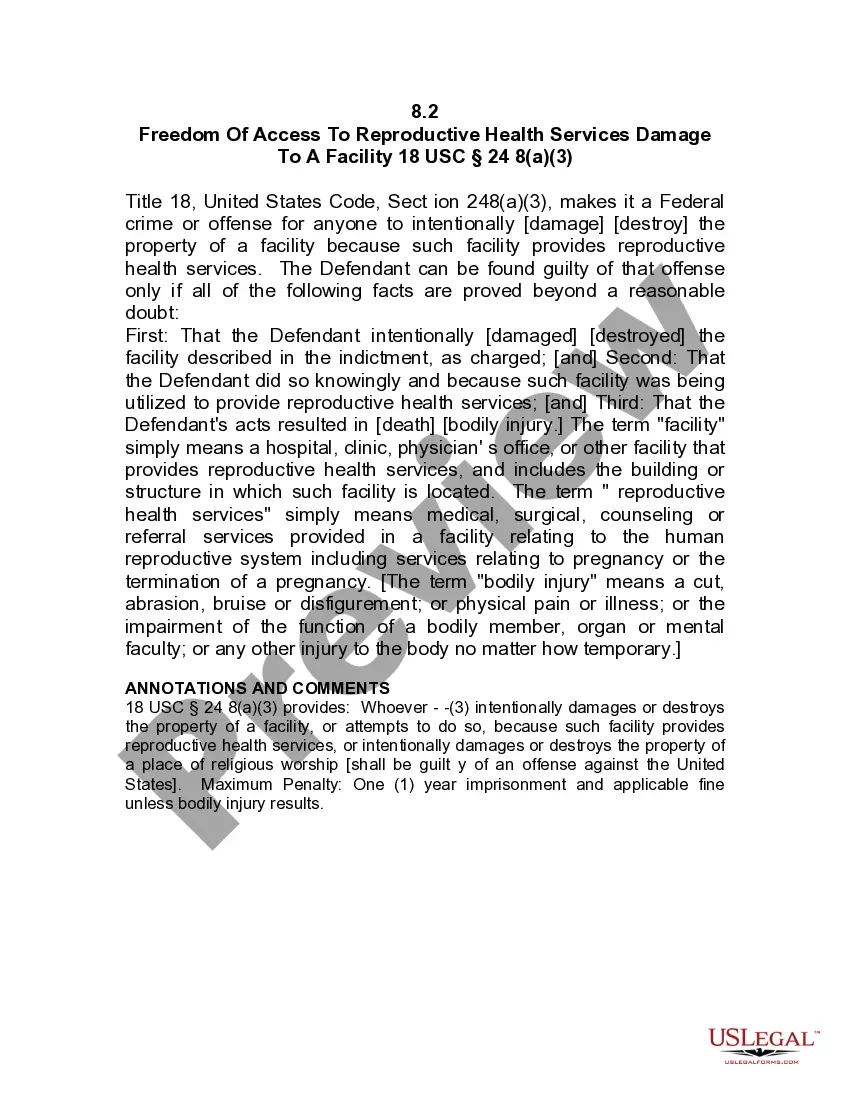
Jury Instruction - Freedom Of Access To Reproductive Health Services - Damage To A Facility
Overview of this form
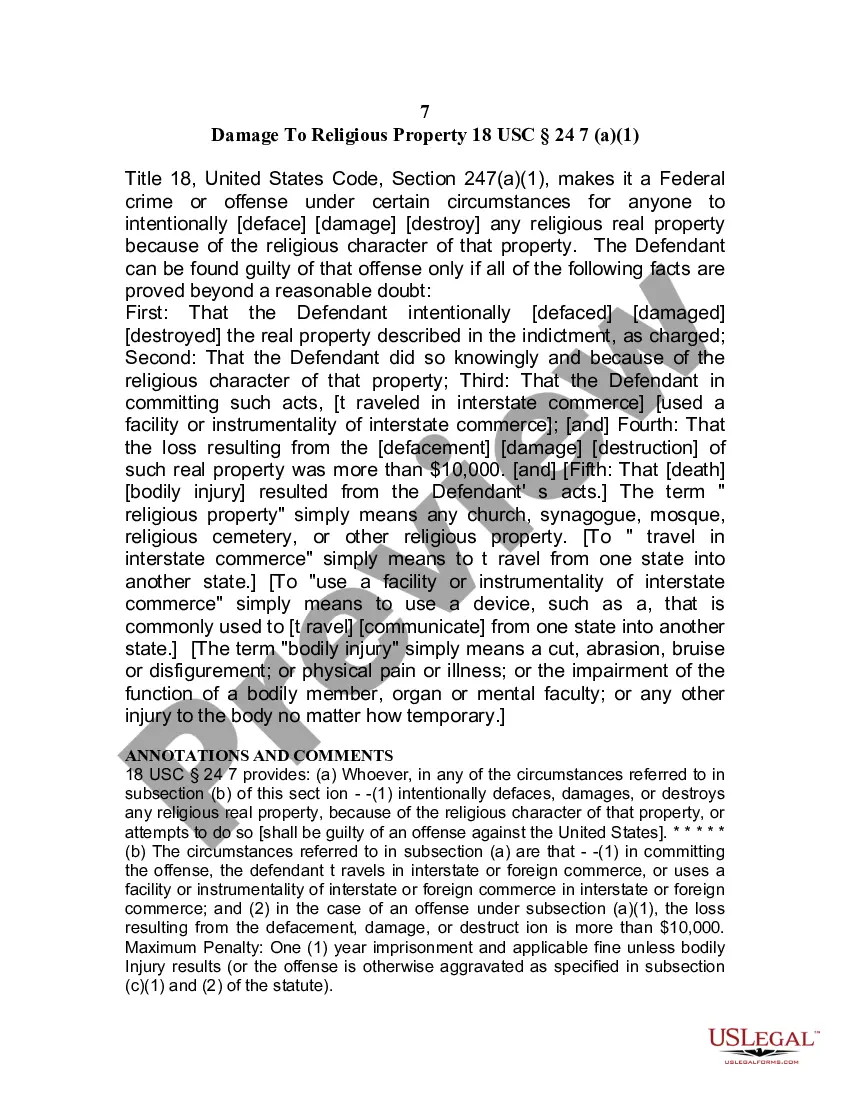
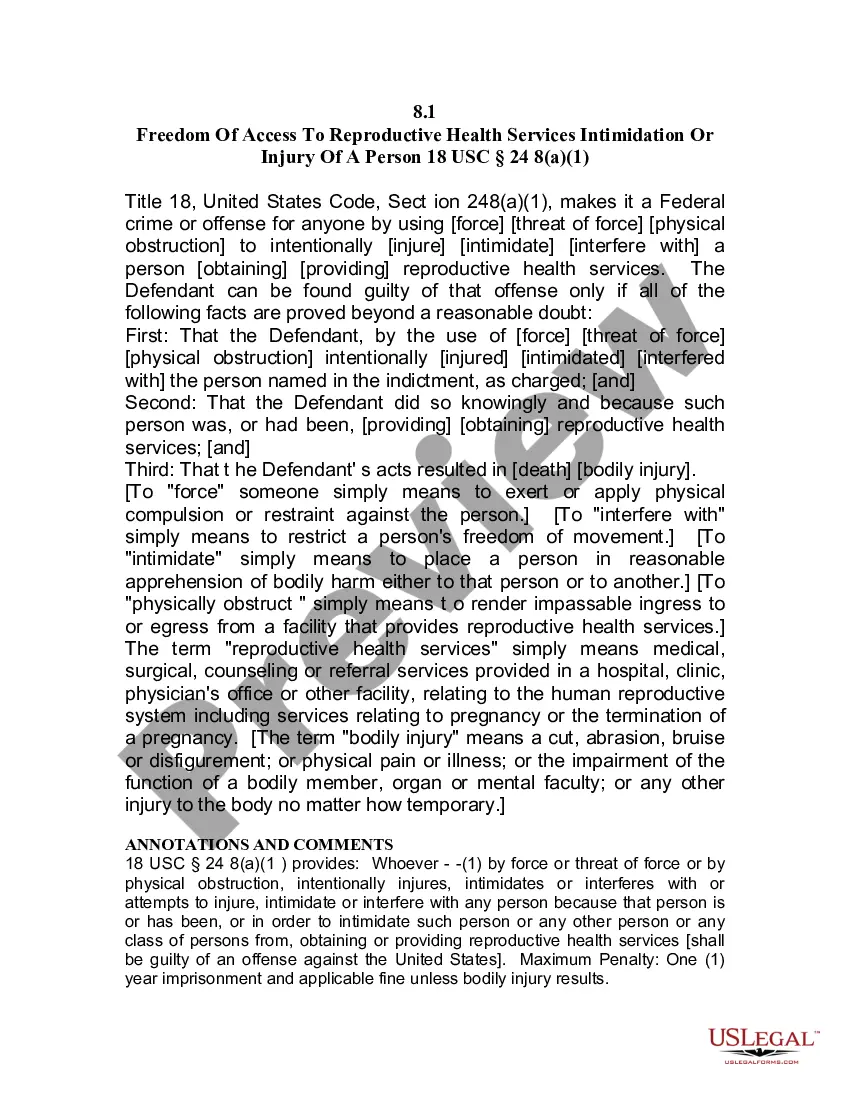
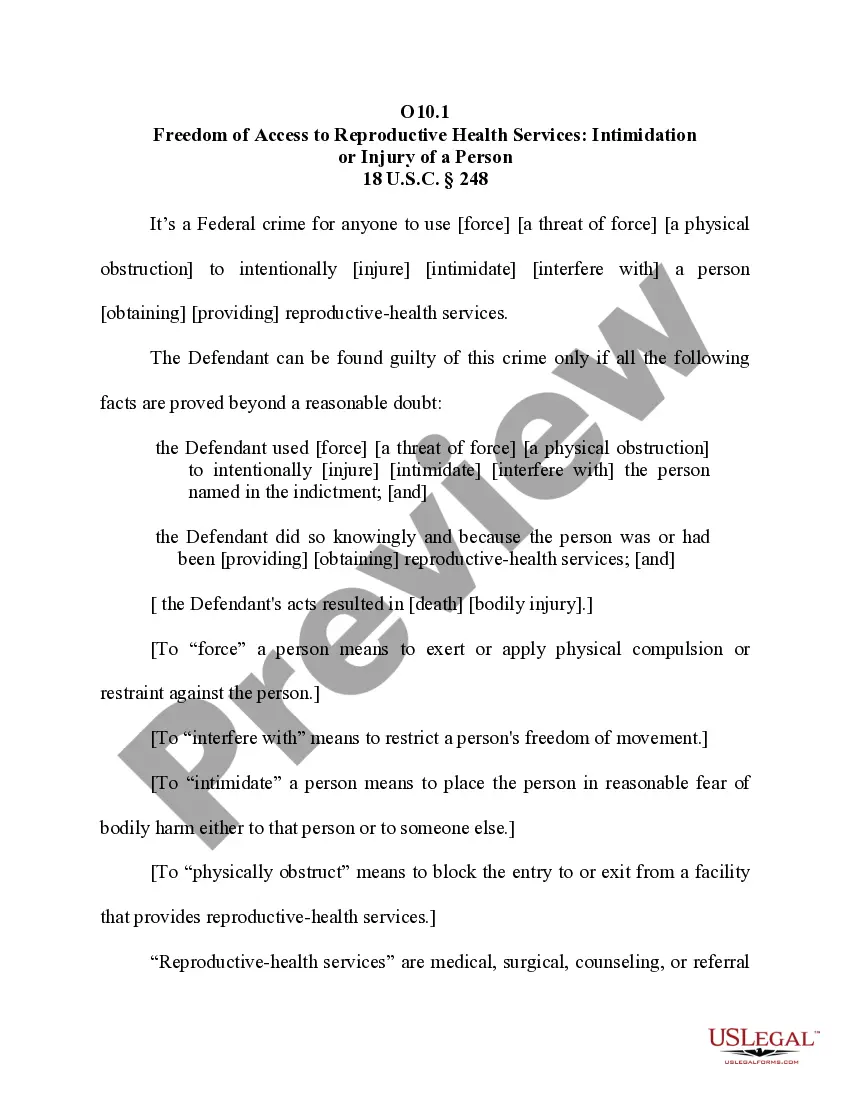
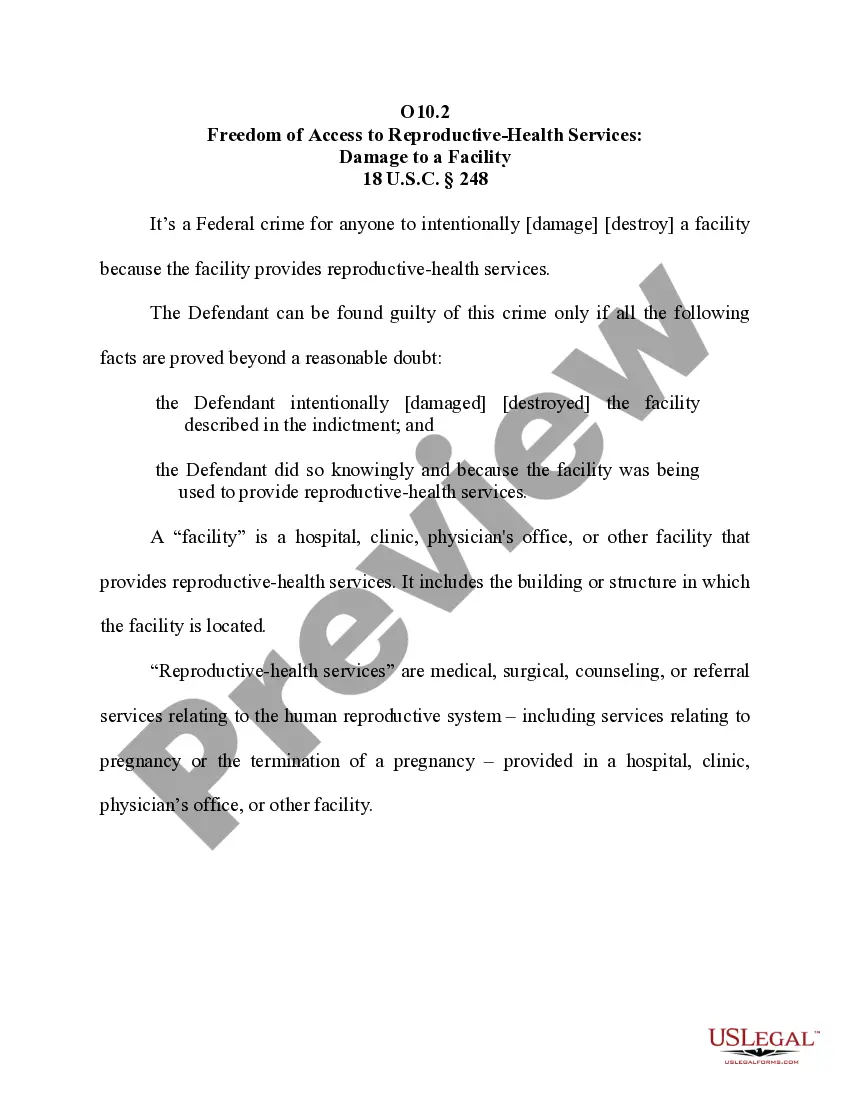
The Jury Instruction for Freedom of Access to Reproductive Health Services concerning Damage to a Facility is a legal document that provides standardized guidelines for jury members in cases involving intentional damage to facilities offering reproductive health services. This instruction outlines the essential facts that must be proven for a defendant to be found guilty, distinguishing it from general jury instructions by its specific legal focus on reproductive health services and the offenses related to their protection.
Key parts of this document
- Definition of key terms: Clarifies what constitutes a "facility" and "reproductive health services."
- Elements of the offense: Details the criteria that must be proven beyond a reasonable doubt for a guilty verdict.
- Legal repercussions: Outlines the potential penalties, including imprisonment and fines.
- Annotations: Provides comments and references to supporting statutes, enhancing the understanding of the legal framework.
When this form is needed
This form is utilized in legal proceedings where an individual is accused of intentionally damaging a facility due to its association with reproductive health services. It serves as a guideline for jurors to understand the legal implications and guidelines necessary for deliberation in such cases. Common scenarios include prosecutions under federal law where facilities are damaged in connection with reproductive rights advocacy or opposition.
Intended users of this form
The following individuals or entities should consider using this form:
- Jurors involved in trials related to damage against reproductive health service facilities.
- Attorneys representing clients in cases concerning reproductive health service protections.
- Legal scholars studying reproductive rights and related legal instructions.
Instructions for completing this form
To complete this jury instruction effectively, follow these steps:
- Identify the parties involved in the case, including the defendant and the prosecuting attorney.
- Review the elements of the offense outlined in the form to ensure understanding of what must be proven.
- Consider any annotations or comments provided for further clarification on legal terms and statutes.
- Ensure that all criteria for guilt are clearly laid out and understood by all jurors.
- Discuss any questions or clarifications with the presiding judge as needed during deliberations.
Notarization guidance
This form does not typically require notarization unless specified by local law.
Get your form ready online
Our built-in tools help you complete, sign, share, and store your documents in one place.
Make edits, fill in missing information, and update formatting in US Legal Forms—just like you would in MS Word.
Download a copy, print it, send it by email, or mail it via USPS—whatever works best for your next step.
Sign and collect signatures with our SignNow integration. Send to multiple recipients, set reminders, and more. Go Premium to unlock E-Sign.
If this form requires notarization, complete it online through a secure video call—no need to meet a notary in person or wait for an appointment.
We protect your documents and personal data by following strict security and privacy standards.

Make edits, fill in missing information, and update formatting in US Legal Forms—just like you would in MS Word.

Download a copy, print it, send it by email, or mail it via USPS—whatever works best for your next step.

Sign and collect signatures with our SignNow integration. Send to multiple recipients, set reminders, and more. Go Premium to unlock E-Sign.

If this form requires notarization, complete it online through a secure video call—no need to meet a notary in person or wait for an appointment.

We protect your documents and personal data by following strict security and privacy standards.
Common mistakes
- Failing to understand the definitions of key terms, which can affect the interpretation of the instructions.
- Not recognizing the legal requirements for proving each element of the offense can lead to improper verdicts.
- Confusing this instruction with general jury instructions due to its specific focus.
Advantages of online completion
- The form is downloadable and can be accessed anytime, making it convenient to prepare for a trial.
- It is drafted by licensed attorneys, ensuring that it aligns with current legal standards and requirements.
- The form is editable, allowing legal professionals to tailor it to specific cases as needed.
- The jury instruction adheres to federal laws under Title 18, United States Code, providing clear guidelines for jurors.
- It is enforceable in a court of law when properly applied during jury deliberations.
- Understanding this form's legal context is crucial for effective application in related court cases.
Key takeaways
- This form provides crucial legal instructions for jurors in cases of facility damage related to reproductive health services.
- It outlines specific legal definitions and elements that must be proven for a guilty verdict.
- Common mistakes should be avoided to ensure proper adherence to legal standards in jury deliberations.
Looking for another form?



Form popularity
FAQ
Jury instructions, directions to the jury, or judge's charge are legal rules that jurors should follow when deciding a case.
Jury Instructions. instructions that are given by the trial judge that specifically state what the defendant can be found guilty of and what the prosecution or plaintiff has to prove in order for a guilty verdict.
Instructions to the Jury The judge instructs the jury about the relevant laws that should guide its deliberations. (In some jurisdictions, the court may instruct the jury at any time after the close of evidence. This sometimes occurs before closing arguments.) The judge reads the instructions to the jury.
They will review the evidence and arguments made by both sides, and frame the legal principles on which the jury has to make its decision. These remarks from the judge are known as jury directions. Jury directions have become more and more frequent as the criminal process has developed over the generations.
A jury instruction is given by the judge to the jury to explain what is happening in the court, to explain the points of law relevant to the case, to explain certain aspects of the evidence presented and to assist the jurors in understanding their duties in reaching a verdict.
Step 7 (Execution of judgment) Step 6 (Judgment) Step 6 (Verdict) Step 5 (Instructions to the Jury) Step 4 (Closing Arguments) Step 3 (Introduction Of Evidence) Step 2 (Opening statemant. Step 1 ( Selecting Jury)
A curative instruction is given to a jury by the judge in a case to negate the prejudicial effect of an erroneous instruction or tainted evidence.