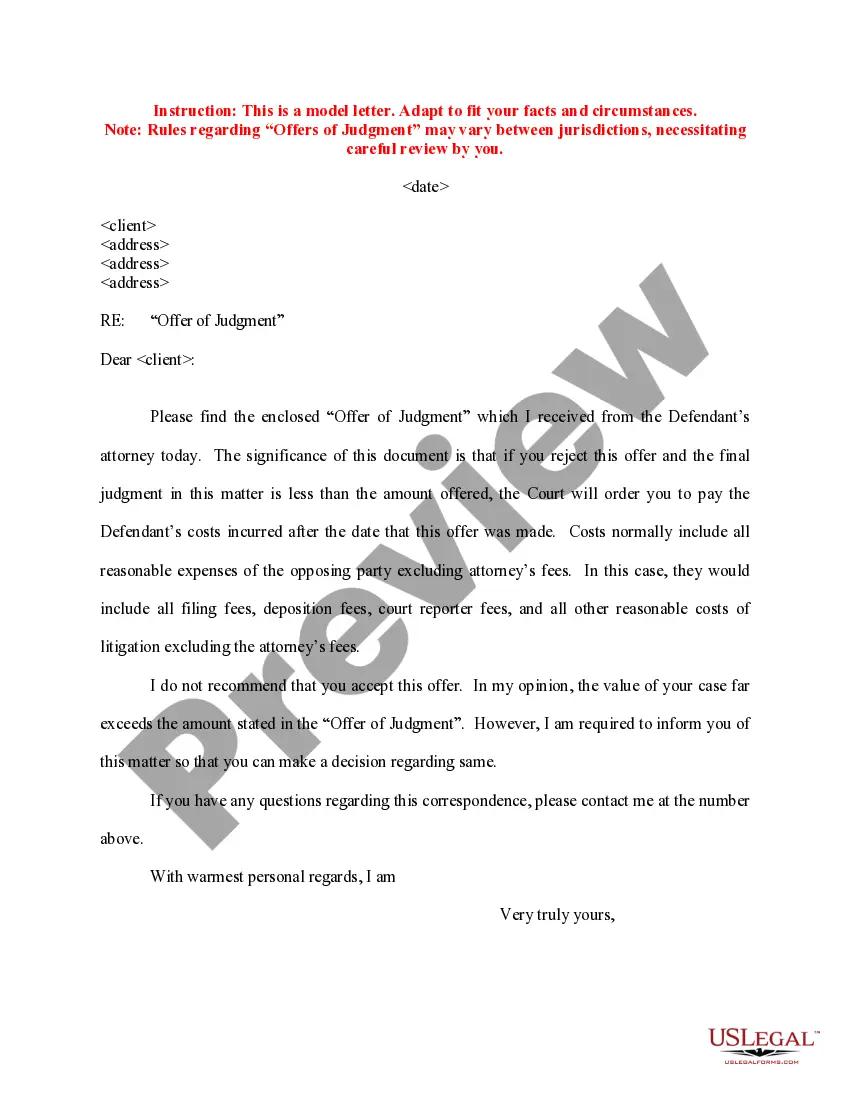
Sample Letter to Client regarding Defendant's Offer of Judgment
What this document covers
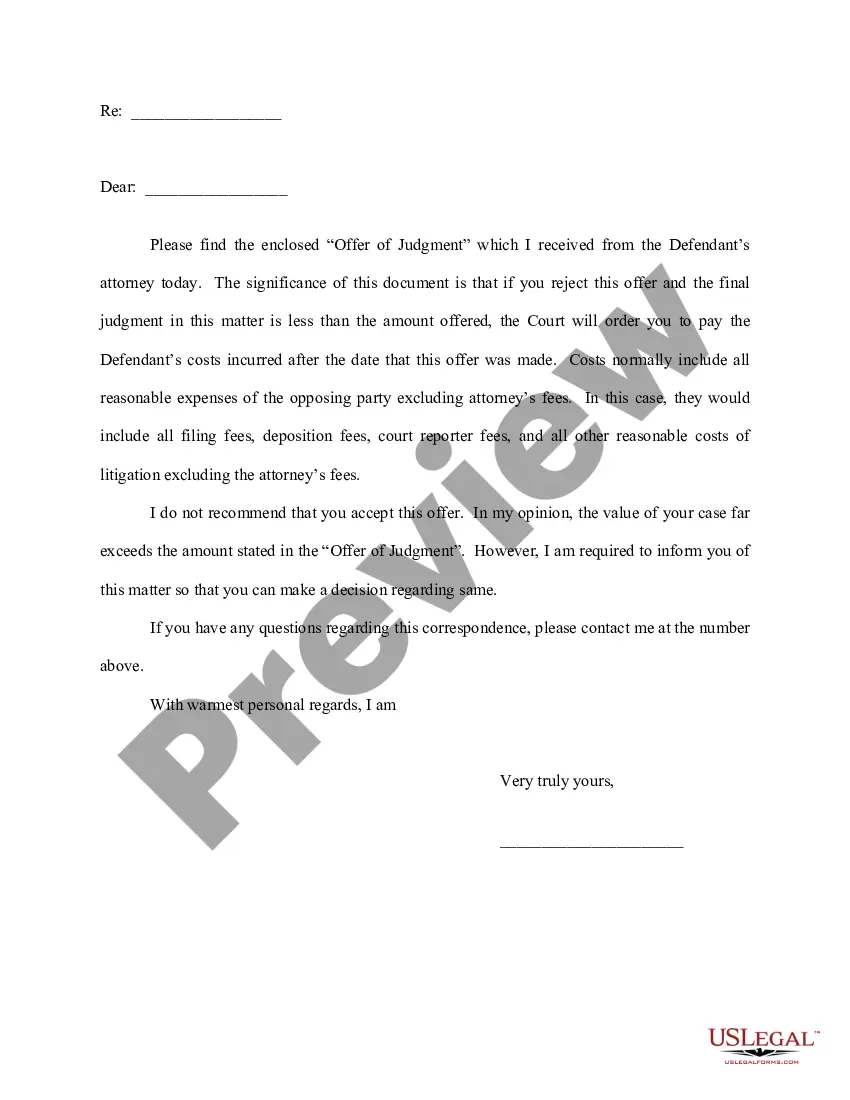
This Sample Letter to Client regarding Defendant's Offer of Judgment is a formal communication template designed to inform a client about an offer made by the defendant in a legal matter. The purpose of this letter is to convey the importance of the offer and outline potential consequences if the client decides to reject it. This form differs from other legal correspondence by specifically addressing the implications of an Offer of Judgment, making it crucial for clients in litigation to understand their options.
Form components explained
- Recipient's information: Includes the client's name and address.
- Date: Captures the date the letter is sent.
- Subject line: Clearly states the purpose as "Offer of Judgment."
- Explanation of the offer: Describes the nature of the Offer of Judgment and its significance.
- Recommendation: The attorney's opinion on whether to accept or reject the offer.
- Contact information: Provides the attorney's telephone number for questions.

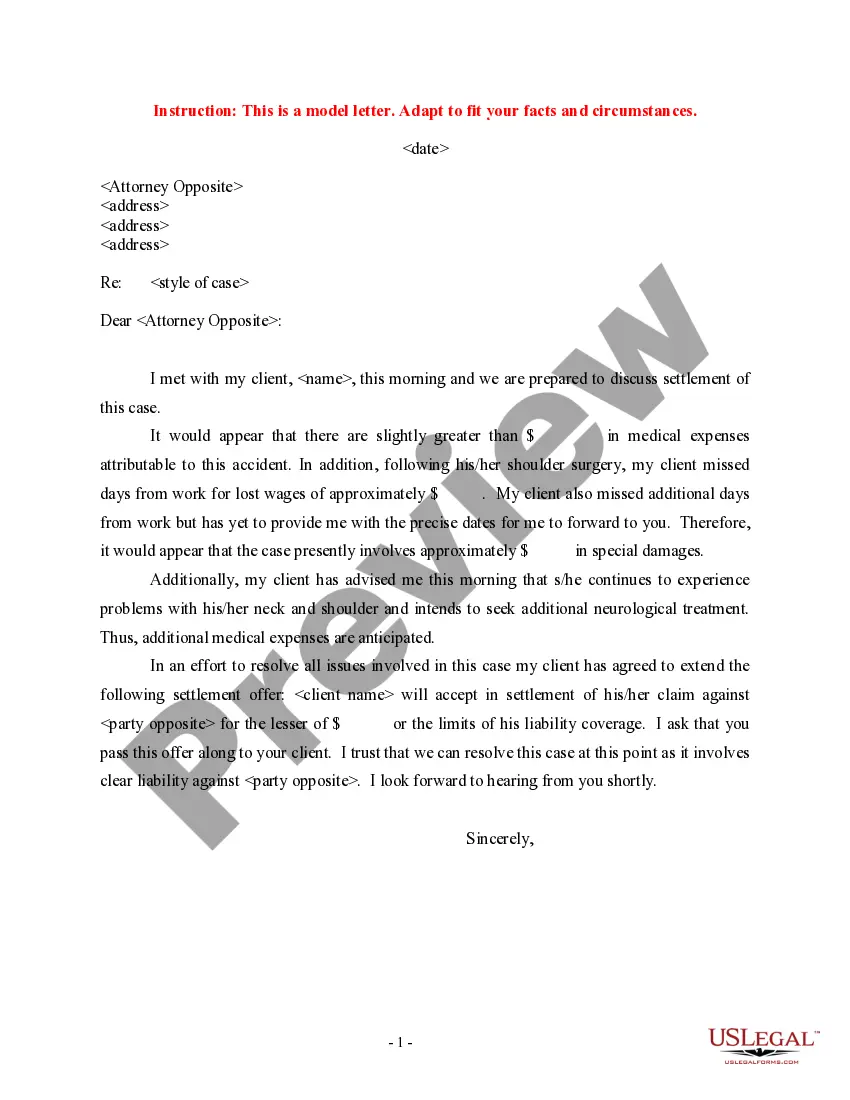
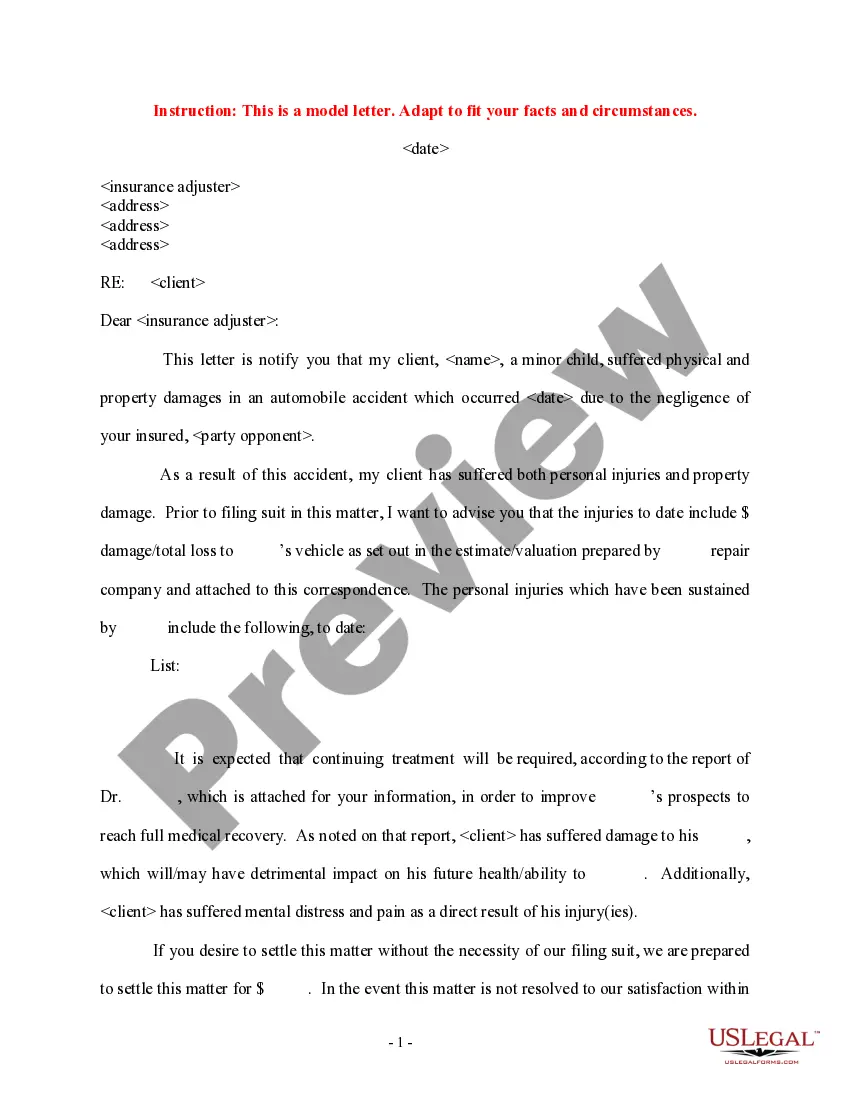
Situations where this form applies
This form should be used when an attorney receives an Offer of Judgment from the defendant's counsel and needs to formally communicate the details to the client. It is particularly relevant in litigation cases, where clients must make informed decisions about settlement offers that could impact their financial responsibilities if rejected. Clients should refer to this letter to understand the implications of accepting or rejecting the offer.
Intended users of this form
- Attorneys representing clients in litigation who receive an Offer of Judgment from defendants.
- Clients involved in legal proceedings who need to understand their options regarding settlement offers.
- Legal offices seeking a standardized method to communicate important offers to clients.
How to complete this form
- Enter the date at the top of the letter.
- Fill in the client's name and address in the appropriate fields.
- Clearly state the subject of the letter as "Offer of Judgment."
- Outline the details of the Offer of Judgment and its implications for the client.
- Provide your professional recommendation regarding the acceptance or rejection of the offer.
- Include your contact information at the end of the letter for any client questions.
Notarization guidance
This form does not typically require notarization unless specified by local law.
Get your form ready online
Our built-in tools help you complete, sign, share, and store your documents in one place.
Make edits, fill in missing information, and update formatting in US Legal Forms—just like you would in MS Word.
Download a copy, print it, send it by email, or mail it via USPS—whatever works best for your next step.
Sign and collect signatures with our SignNow integration. Send to multiple recipients, set reminders, and more. Go Premium to unlock E-Sign.
If this form requires notarization, complete it online through a secure video call—no need to meet a notary in person or wait for an appointment.
We protect your documents and personal data by following strict security and privacy standards.

Make edits, fill in missing information, and update formatting in US Legal Forms—just like you would in MS Word.

Download a copy, print it, send it by email, or mail it via USPS—whatever works best for your next step.

Sign and collect signatures with our SignNow integration. Send to multiple recipients, set reminders, and more. Go Premium to unlock E-Sign.

If this form requires notarization, complete it online through a secure video call—no need to meet a notary in person or wait for an appointment.

We protect your documents and personal data by following strict security and privacy standards.
Avoid these common issues
- Failing to personalize the letter with the client's correct information.
- Not clearly explaining the consequences of rejecting the Offer of Judgment.
- Overlooking state-specific laws that may impact the validity of the offer.
- Including unnecessary legal jargon that may confuse the client.
Why complete this form online
- Convenient access to a professionally drafted template.
- Easy to customize for individual client situations and local jurisdiction requirements.
- Reliability in ensuring the letter meets legal standards and expectations.
Main things to remember
- This form facilitates clear communication between attorneys and clients regarding critical legal offers.
- Understanding Offers of Judgment is crucial to avoiding potential costs in litigation.
- Clients should carefully consider the attorney's recommendation in the context of their case value.
Looking for another form?




Form popularity
FAQ
Making an Offer of Judgment by itself is not an admission of liability. If the Offer is accepted, then the Judgment is entered by the Court.
When making a Rule 68 offer of judgment, it is essential that the offeror clearly state whether attorney fees and costs are included in the final offer. This principle was highlighted in Louie Medina v.
Both parties may file proposals for settlement, so long as the proposal is filed and served to the opposing side no earlier than 90 days following the initiation of the lawsuit and no later than 45 days before trial. Further, should you wish to accept the proposed offer, you must do so in writing within 30 days.
It is like an option that you have for ten days based upon a valuable consideration. If you have paid for any option, you are entitled to it, and it cannot be withdrawn. The fact that the offer is made under these rules takes out of it the element of gratuity, and gives to it an enforceable legal effect.
An offer of judgment is a written offer made to the opposing party to resolve the plaintiff's claim on specified terms, with the costs then accrued. For instance, a defendant might offer to pay the plaintiff $50,000.00, plus the costs accrued by the plaintiff to that point in the litigation to fully and finally