Jury Instruction - Involuntary Servitude And Peonage
What this document covers
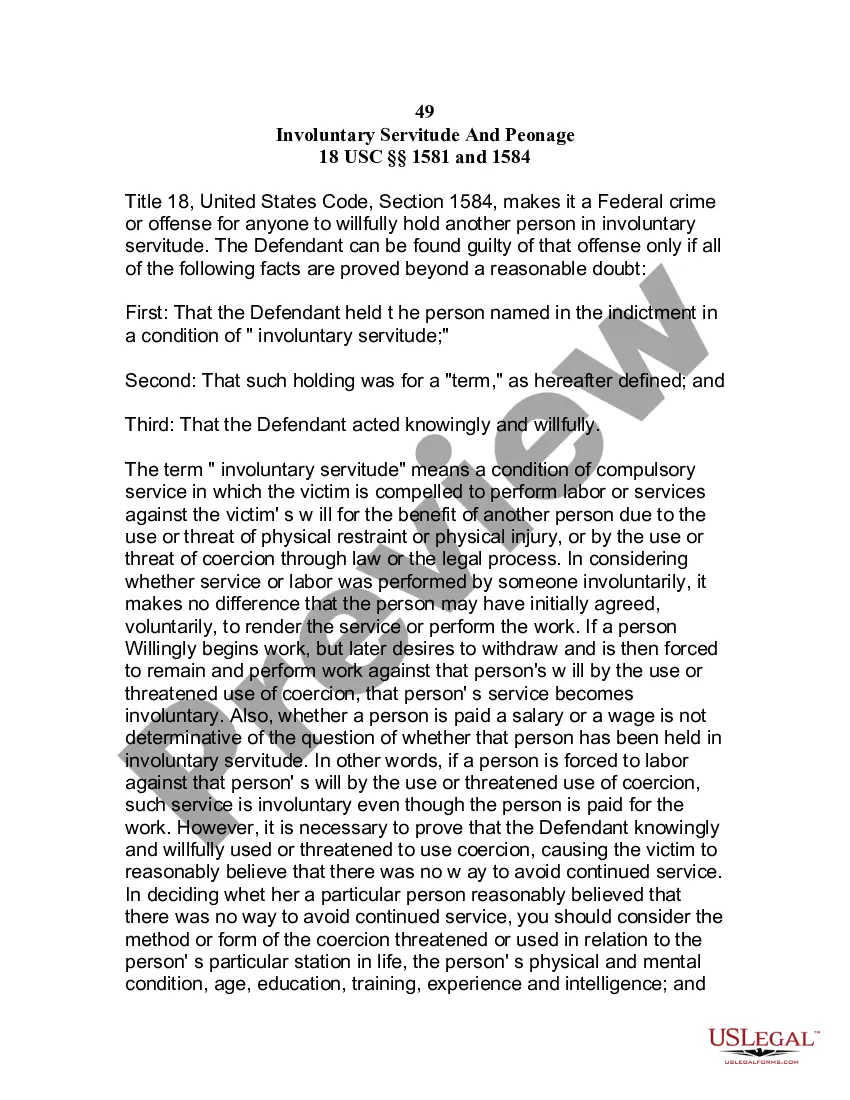
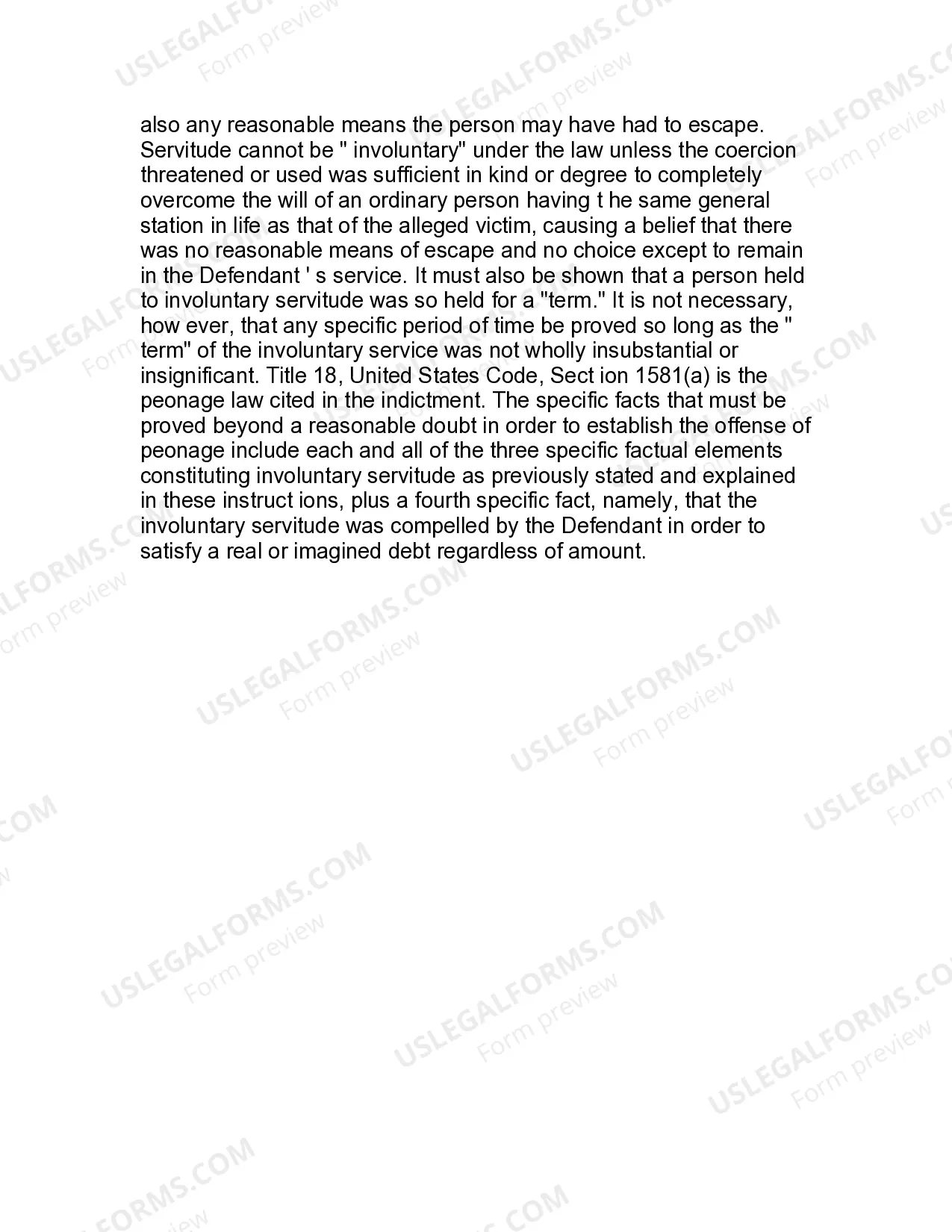
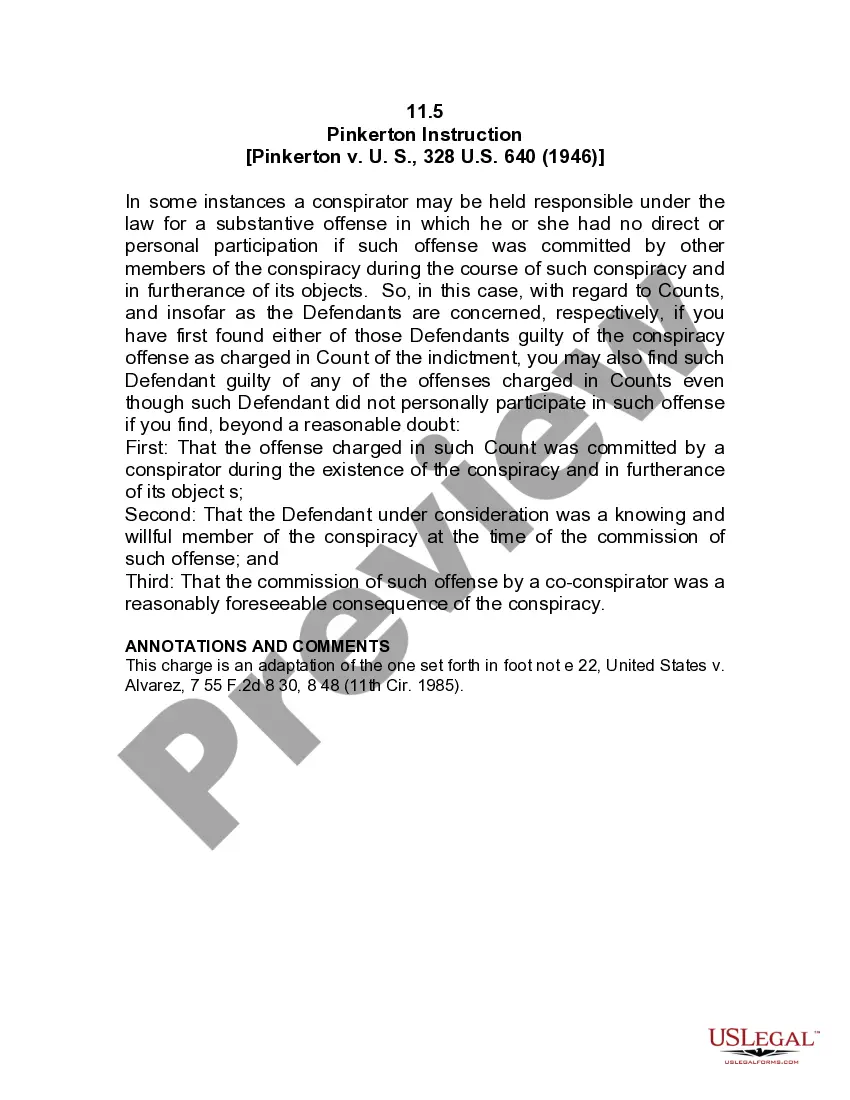
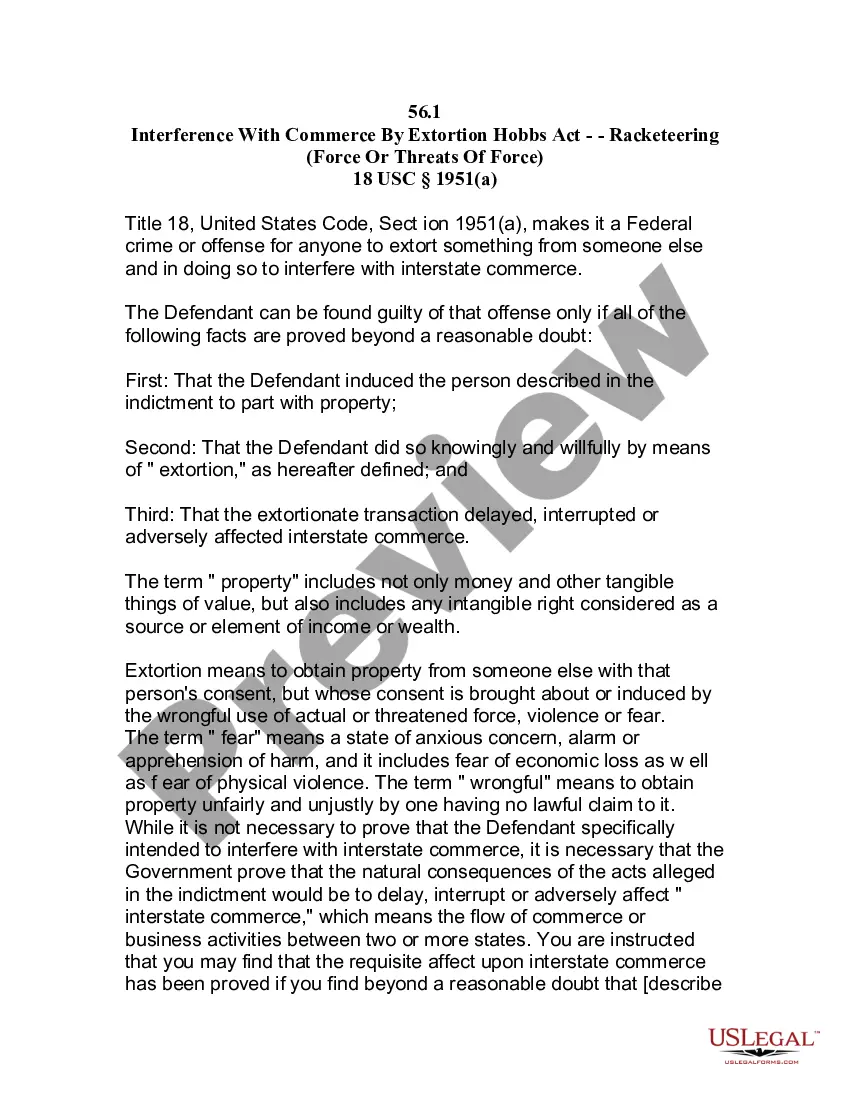
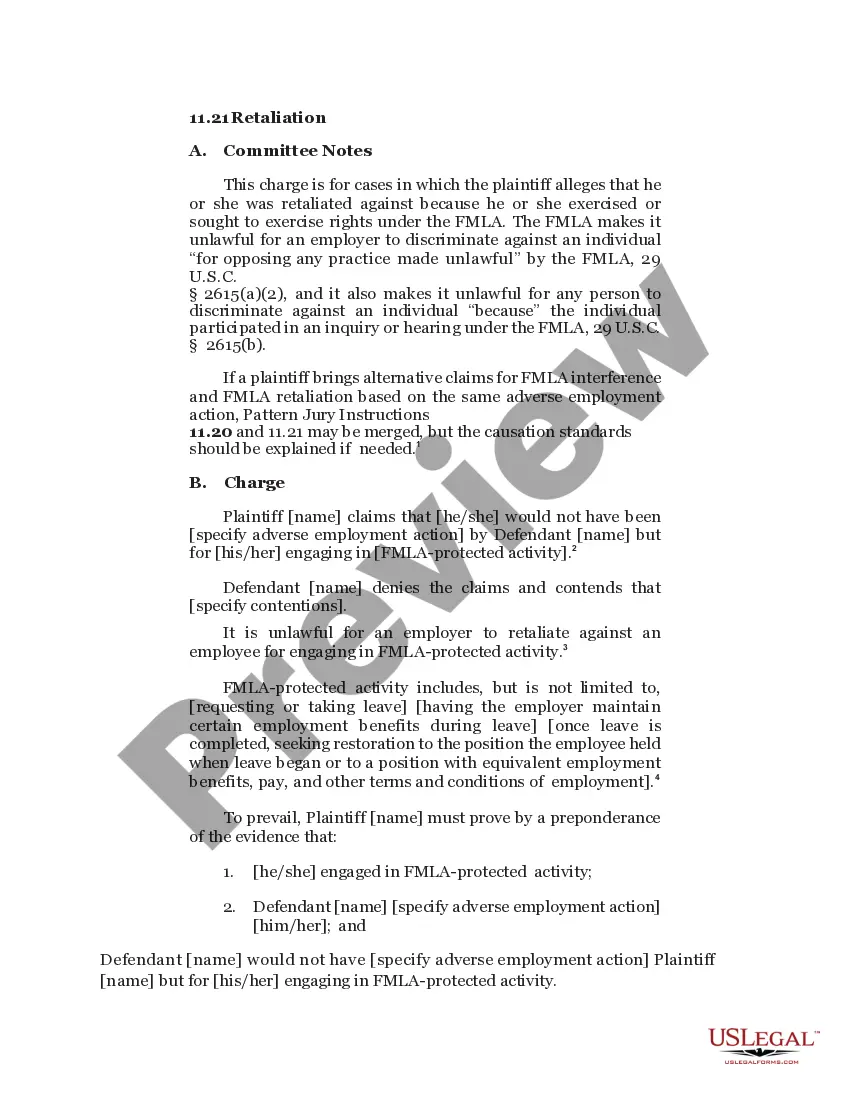
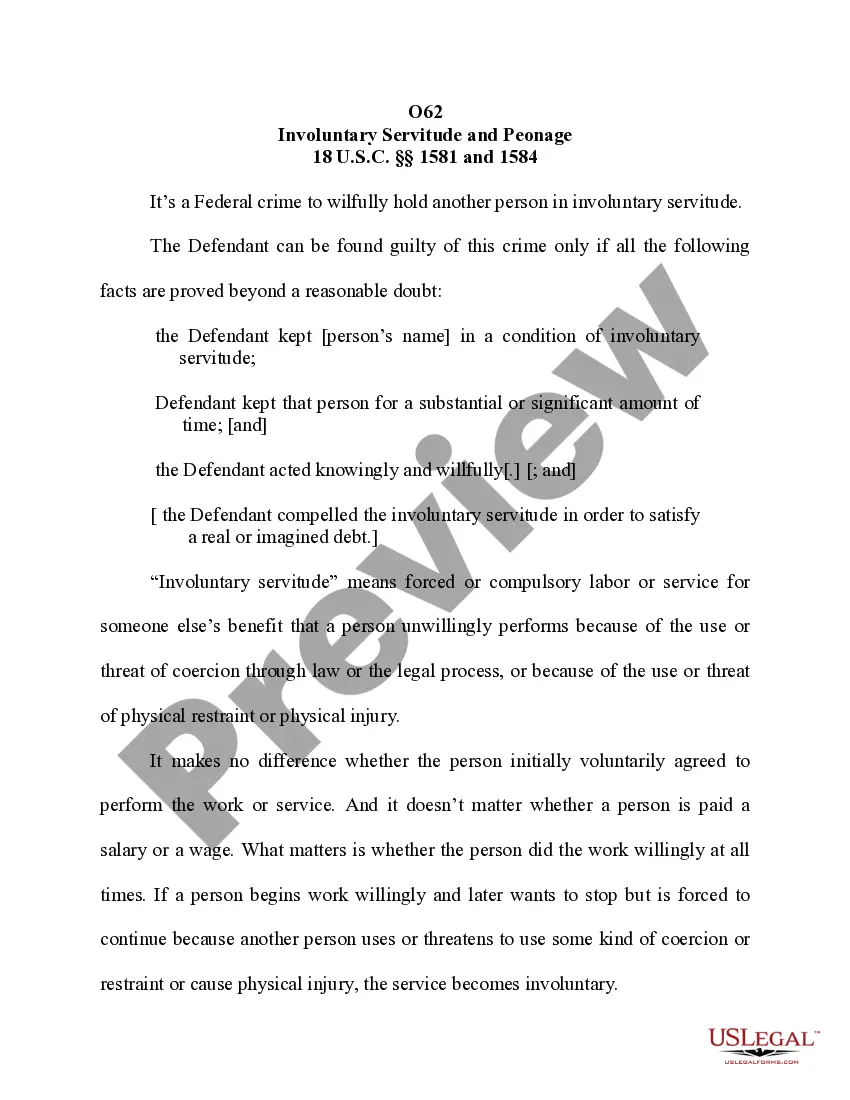
This Jury Instruction - Involuntary Servitude and Peonage provides sample jury instructions related to federal offenses concerning involuntary servitude and peonage. This form is specifically designed for use in court settings to help jurors understand the legal definitions and requirements necessary to prove these serious violations under Title 18 of the United States Code. Unlike other forms, it focuses solely on instructions for jury deliberation regarding cases of involuntary servitude and peonage, ensuring clarity in legal proceedings.
Form components explained
- Definition of involuntary servitude and peonage as specified in federal law.
- Criteria that must be proven to establish a case of involuntary servitude, including the requirement of willfulness.
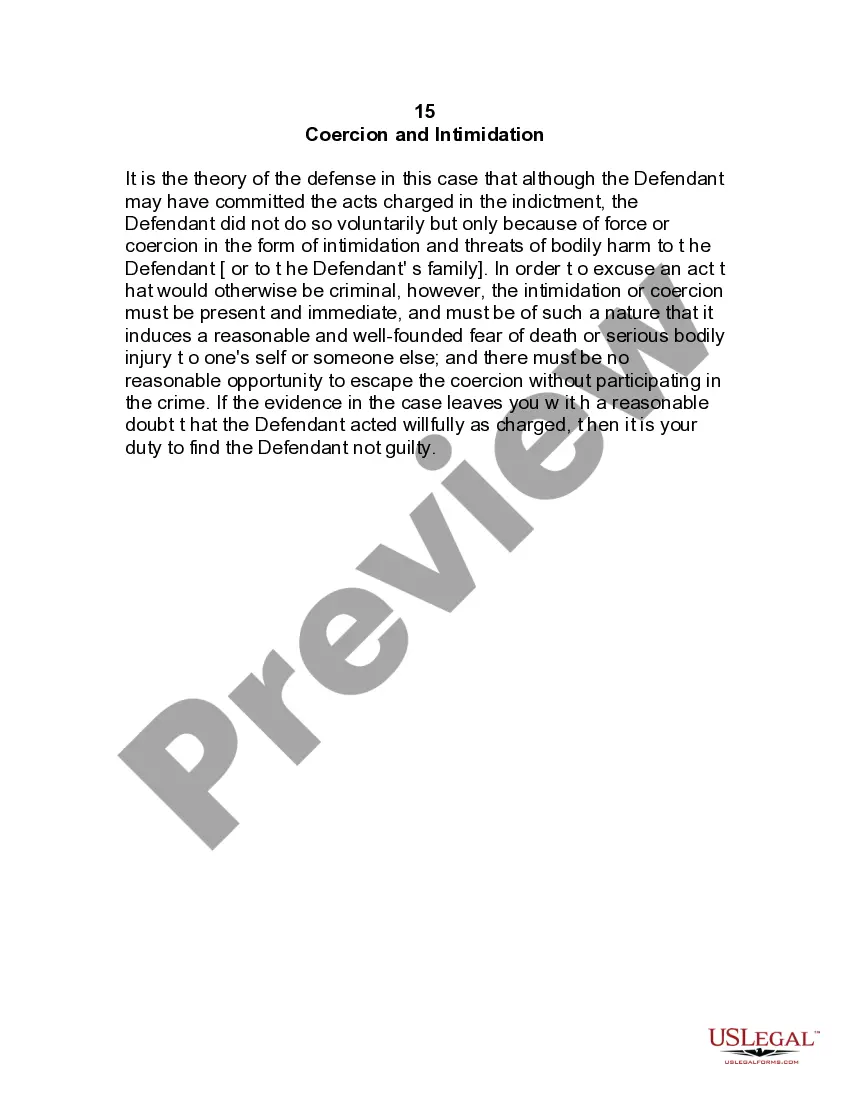
- Understanding of coercion and its impact on the victim's freedom to choose.
- Specific factual elements required to prove the offense beyond a reasonable doubt.
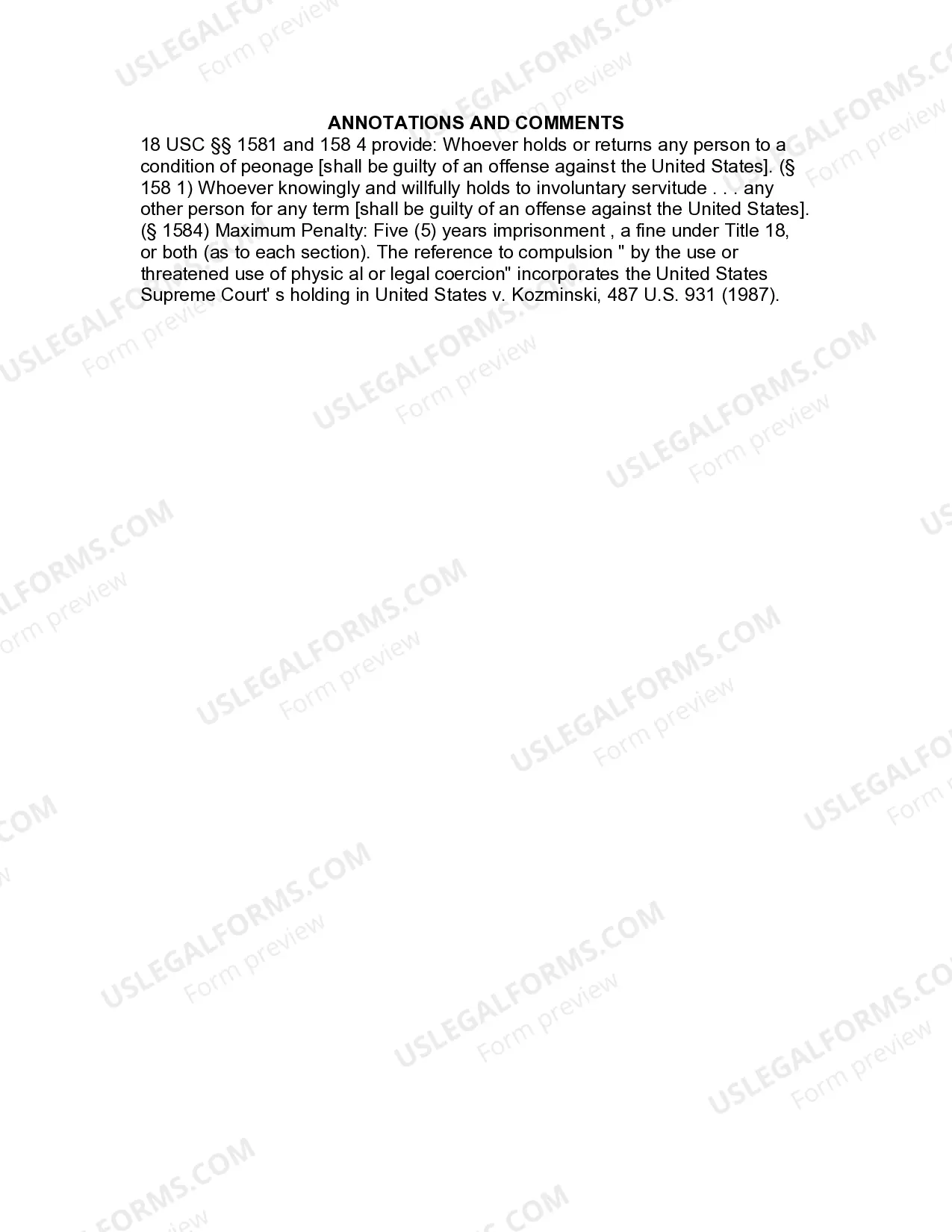
- Legal consequences for violating the laws against involuntary servitude and peonage.
When to use this document
This form should be utilized in court proceedings where a jury is required to make determinations about charges relating to involuntary servitude or peonage. It provides guidance on how jurors should interpret the law based on the evidence presented. This form is crucial in trials where defendants are accused of holding individuals in conditions of forced labor, against their will, under various forms of coercion.
Who should use this form
- Judges overseeing criminal cases related to involuntary servitude or peonage.
- Jurors selected to deliberate cases involving charges under 18 USC 1581 and 1584.
- Attorneys representing defendants or plaintiffs in cases of involuntary servitude.
- Legal educators or students learning about federal criminal law.
Completing this form step by step
- Gather the details of the case, including charges and relevant facts.
- Review the definitions of involuntary servitude and peonage outlined in the form.
- Ensure all criteria necessary for proving the offenses are clearly stated.
- Modify the example jury instructions as needed to fit the specifics of the case.
- Present the completed jury instructions to the court for approval and usage during deliberations.
Notarization guidance
This form usually doesn’t need to be notarized. However, local laws or specific transactions may require it. Our online notarization service, powered by Notarize, lets you complete it remotely through a secure video session, available 24/7.
Get your form ready online
Our built-in tools help you complete, sign, share, and store your documents in one place.
Make edits, fill in missing information, and update formatting in US Legal Forms—just like you would in MS Word.
Download a copy, print it, send it by email, or mail it via USPS—whatever works best for your next step.
Sign and collect signatures with our SignNow integration. Send to multiple recipients, set reminders, and more. Go Premium to unlock E-Sign.
If this form requires notarization, complete it online through a secure video call—no need to meet a notary in person or wait for an appointment.
We protect your documents and personal data by following strict security and privacy standards.

Make edits, fill in missing information, and update formatting in US Legal Forms—just like you would in MS Word.

Download a copy, print it, send it by email, or mail it via USPS—whatever works best for your next step.

Sign and collect signatures with our SignNow integration. Send to multiple recipients, set reminders, and more. Go Premium to unlock E-Sign.

If this form requires notarization, complete it online through a secure video call—no need to meet a notary in person or wait for an appointment.

We protect your documents and personal data by following strict security and privacy standards.
Typical mistakes to avoid
- Failing to clearly define coercion and its implications on the victim's consent.
- Not providing sufficient evidence to support all elements required for involuntary servitude or peonage.
- Overlooking the importance of distinguishing between voluntary work and coerced labor.
Advantages of online completion
- Immediate access to ready-to-use jury instructions that can be tailored to specific cases.
- Ability to edit and customize the form according to the unique details of a case.
- Reliability, as the form is drafted by licensed attorneys ensuring its legal soundness.
Legal use & context
- This form outlines the federal law regarding involuntary servitude and peonage, ensuring compliance with the Title 18 regulations.
- It serves as an educational tool for jurors, promoting accurate deliberation based on legal standards.
- Jurors must understand the gravity of the offenses defined under this form to reach a fair verdict.
Main things to remember
- The form provides essential jury instructions in cases of involuntary servitude and peonage.
- Familiarity with the legal definitions and requirements is critical for jurors to make informed decisions.
- Each component of the instructive format is tailored for clarity and effectiveness in court settings.
Looking for another form?
Form popularity
FAQ
In the United States, the 13th Amendment to the United States Constitution prohibits slavery and involuntary servitude except as a punishment for a crime of which one has been convicted.
In Steirer v. Bethlehem Area School District , the U.S. Court of Appeals for the Third Circuit rules that a high school community service requirement does not constitute involuntary servitude prohibited by the 13th Amendment.
An 1865 amendment to the US Constitution that forbids slavery and forced labor except, as regards the latter, as punishment for crime. Related Terms: Eleventh (11th) Amendment, Fourteenth Amendment.
"Involuntary servitude involves a condition of having some of the incidents of slavery. "It may include situations in which persons are forced to return to employment by law. "It may also include persons who are physically restrained by guards from leaving employment.
Amdt13. Thirteenth Amendment, Section 1: Neither slavery nor involuntary servitude, except as a punishment for crime whereof the party shall have been duly convicted, shall exist within the United States, or any place subject to their jurisdiction.
Actually, the US Constitution says that slavery is ok when it is the punishment for a crime.If you volunteer to work at a charity event you are not a slave, and the many slaves who were given money or other compensation throughout the ages were not less enslaved on account of it.
Despite its significance in American history, the Thirteenth Amendment is not one of the more frequently invoked parts of our Constitution today. Now that slavery is a part of our past, the Amendment's current relevance is subject to debate.
(f) Involuntary Servitude refers to a condition of enforced and compulsory service induced by means of any scheme, plan or pattern, intended to cause a person to believe that if he or she did not enter into or continue in such condition, he or she or another person would suffer serious harm or other forms of abuse