Borrowed Servant
Understanding this form
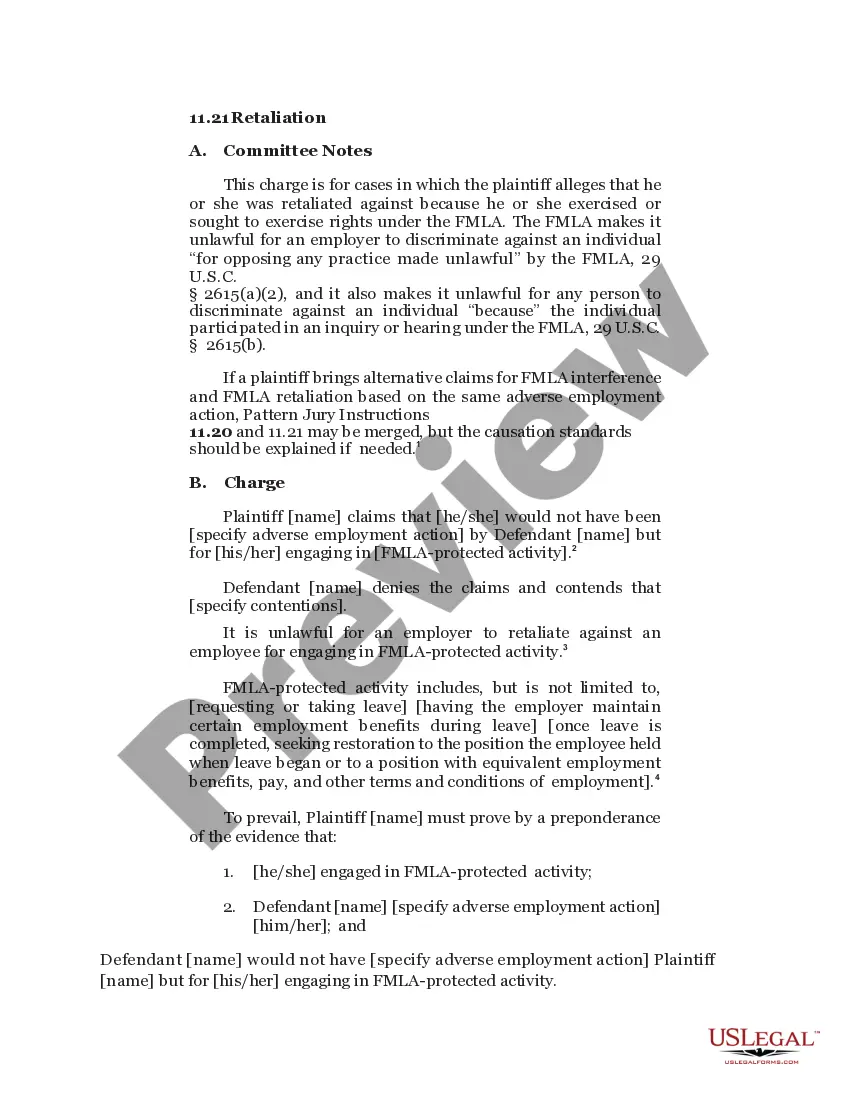
The Borrowed Servant form is a legal document used in cases where an employee claims retaliation for exercising rights protected under the Family and Medical Leave Act (FMLA). This form allows a plaintiff to outline their allegations against an employer for being discriminated against due to their FMLA-protected activities, such as requesting leave or seeking job reinstatement. Unlike other employment forms, this document specifically addresses issues of retaliation in the context of FMLA rights.
Form components explained
- Plaintiff's claim of retaliation against an employer.
- Specification of adverse employment actions taken by the employer.
- Definition of FMLA-protected activities.
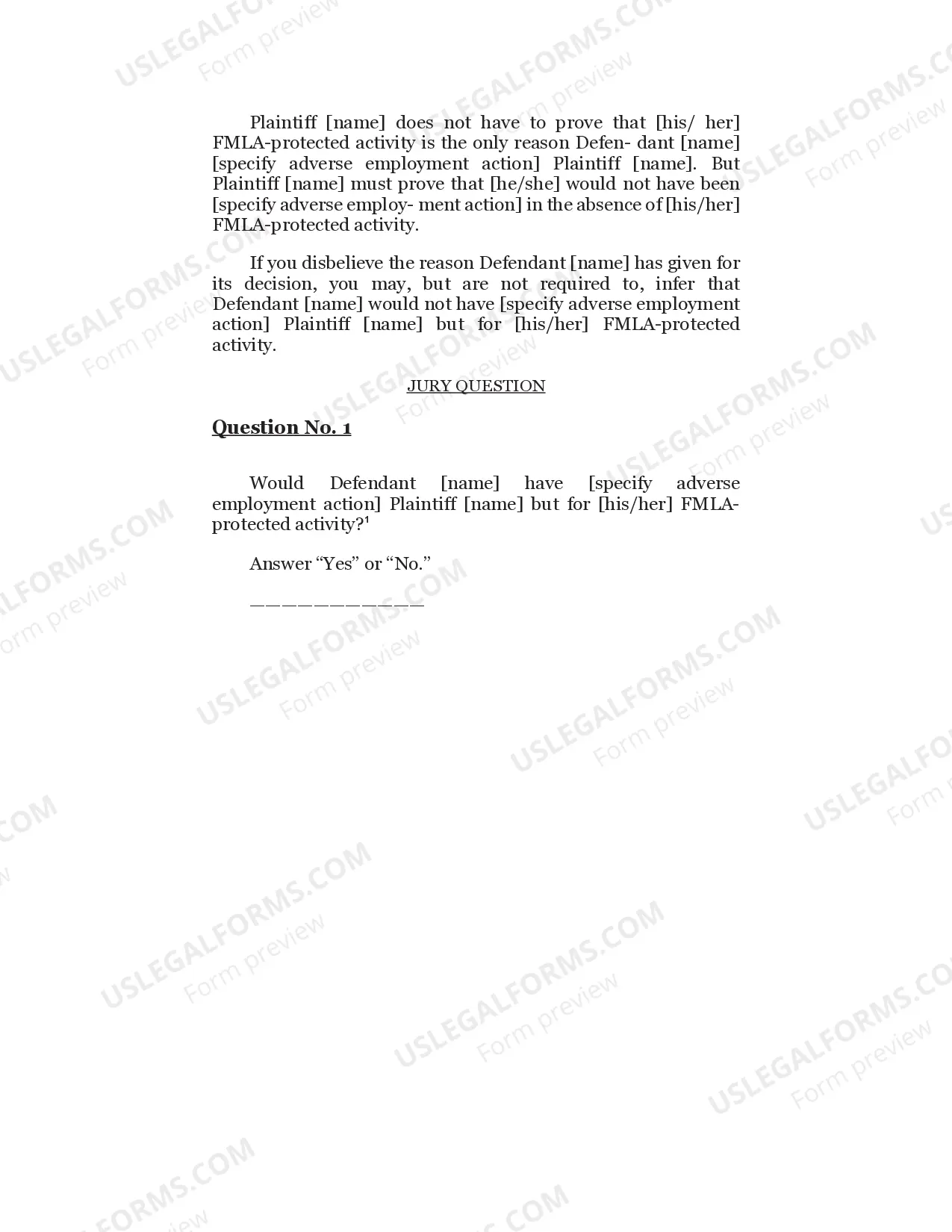
- Causation standard requiring proof that retaliation occurred due to FMLA activities.
- Questions for the jury regarding causation.
Common use cases
This form should be used in situations where an employee believes they have faced negative employment actions, such as termination, demotion, or discrimination, after participating in FMLA-protected activities. It is applicable in disputes regarding workplace rights and protections under the FMLA, especially in cases involving allegations of employer retaliation.
Who can use this document
- Employees who believe they have been retaliated against for exercising their rights under the FMLA.
- Individuals pursuing legal claims related to FMLA retaliation.
- Legal representatives assisting clients in cases of FMLA violations.
How to prepare this document
- Identify the plaintiff and the defendant, including full names.
- Specify the adverse employment action taken by the defendant.
- List the FMLA-protected activity that triggered the retaliation claim.
- Detail the reasons the defendant provides for the employment actions taken.
- Provide evidence supporting the claim that the adverse action was due to FMLA-protected activity.
Does this document require notarization?
This form does not typically require notarization unless specified by local law.
Get your form ready online
Our built-in tools help you complete, sign, share, and store your documents in one place.
Make edits, fill in missing information, and update formatting in US Legal Forms—just like you would in MS Word.
Download a copy, print it, send it by email, or mail it via USPS—whatever works best for your next step.
Sign and collect signatures with our SignNow integration. Send to multiple recipients, set reminders, and more. Go Premium to unlock E-Sign.
If this form requires notarization, complete it online through a secure video call—no need to meet a notary in person or wait for an appointment.
We protect your documents and personal data by following strict security and privacy standards.

Make edits, fill in missing information, and update formatting in US Legal Forms—just like you would in MS Word.

Download a copy, print it, send it by email, or mail it via USPS—whatever works best for your next step.

Sign and collect signatures with our SignNow integration. Send to multiple recipients, set reminders, and more. Go Premium to unlock E-Sign.

If this form requires notarization, complete it online through a secure video call—no need to meet a notary in person or wait for an appointment.

We protect your documents and personal data by following strict security and privacy standards.
Common mistakes to avoid
- Failing to clearly define the FMLA-protected activity.
- Not providing sufficient evidence to link the adverse action to the FMLA activity.
- Overlooking state-specific nuances in employment law.
Why use this form online
- Convenient access to legal documents anytime, ensuring timely filing.
- Editability allows for customization to fit specific circumstances.
- Reliability of forms drafted by licensed attorneys, ensuring legal compliance.
Legal use & context
- The Borrowed Servant form is designed specifically for claims under the FMLA.
- It helps establish a legal precedent for cases of retaliation against employees.
- Essential for employees to understand their rights under federal law.
Summary of main points
- The Borrowed Servant form is essential for documenting FMLA retaliation claims.
- Understanding the legal requirements and procedures is crucial for potential plaintiffs.
- Correctly completing the form increases the chances of a favorable legal outcome.
Looking for another form?
Form popularity
FAQ
Under the Borrowed Servant Doctrine, a doctor is usually only responsible for what a hospital employee does in his presence. The Captain of the Ship Doctrine holds the doctor responsible, whether he was present or not, if he had the power to control the actions of the person who committed the malpractice.
Called also loaned employee. 2. : a doctrine under which a loaned servant is considered an employee of the borrowing employer who is thus liable for negligence or workers' compensation.
The borrowed servant rule is a legal doctrine stipulating that if an employer (usually referred as the special employer) borrows a worker from another employer (usually referred as the general employer), the special employer can be held liable for the borrowed employee's actions, even though a permanent relationship
A ?borrowed servant? is a person who, although employed by one company, is temporarily lent to another company for a limited purpose. For example, when a contractor rents a crane for use on a construction project, the rental company typically requires the use of its employee to operate the crane.
Alternate Employer Endorsement is designed to extend Workers' Compensation protection to the special employer's "borrowed servants." Attached to the general employer's policy, the endorsement specifically names the special employer, thus extending the required Workers' Compensation protection without the need of the
A ?borrowed servant? is a person who, although employed by one company, is temporarily lent to another company for a limited purpose. For example, when a contractor rents a crane for use on a construction project, the rental company typically requires the use of its employee to operate the crane.
A borrowed employee agreement is a legal contract in which an employee is assigned by their employer to work for another employer for a period of time. This may occur when a company has a surplus of employees and not enough work to go around.