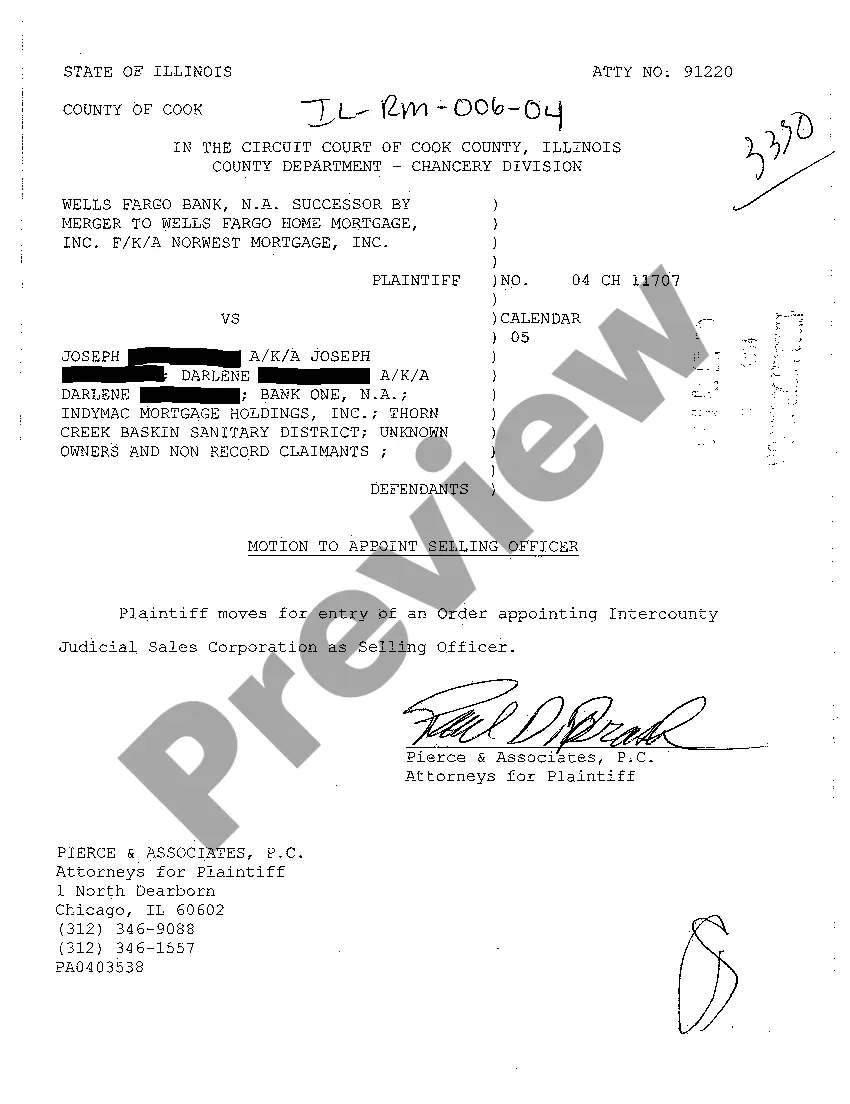
Jury Instruction - 6.1 Raiding Key Employees
The Jury Instruction - 6.1 Raiding Key Employees form provides sample jury instructions related to claims of tortious interference with business relationships, specifically involving the enticement of key employees. This legal form aids judges and juries in evaluating claims where a business alleges that another party has wrongfully induced its employees to leave, thereby harming the business. This form is distinct because it offers a structured guide for courts to follow when assessing the legality of such actions under U.S. law, ensuring a fair examination of both parties' claims.
- Introduction to tortious interference claims and relevant legal standards.
- Criteria that the plaintiff must prove, including wrongful intent and resulting damages.
- Guidelines on lawful competition versus unlawful inducement of employees.
- Special interrogatories to the jury regarding the defendant's actions and intent.
- Considerations for compensatory and punitive damages if the plaintiff prevails.
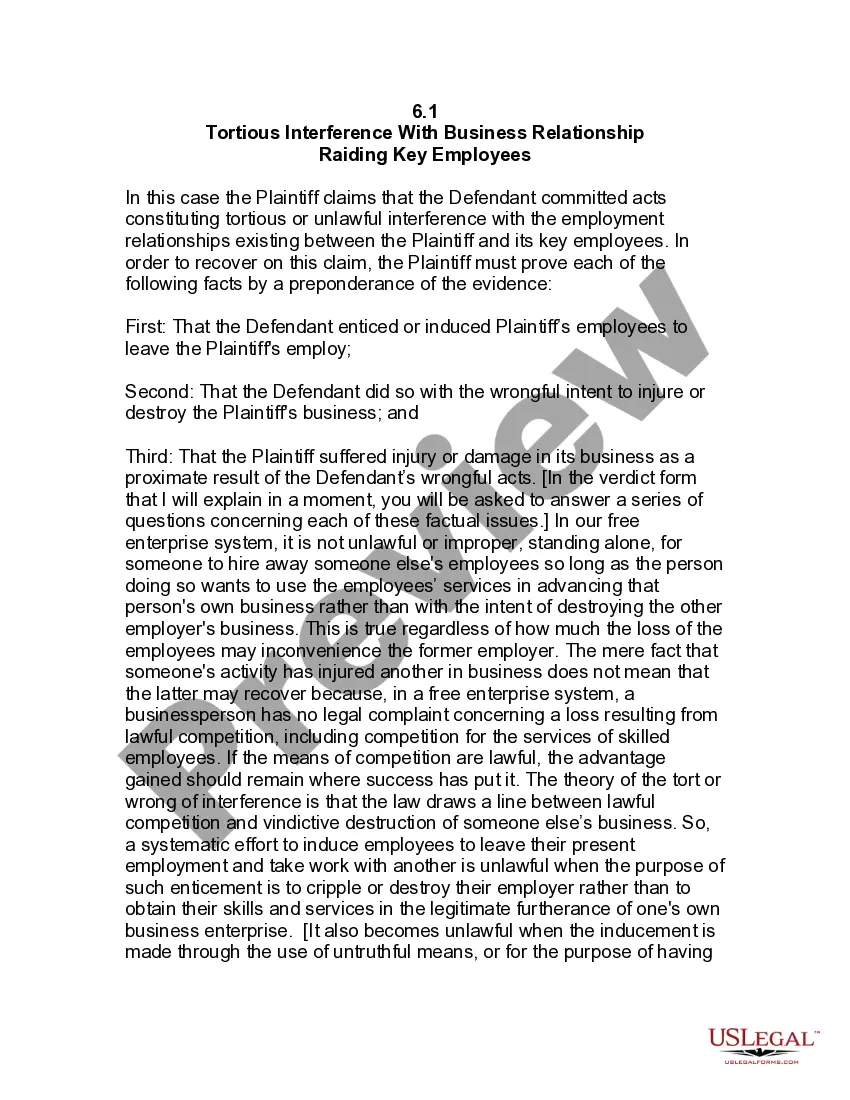
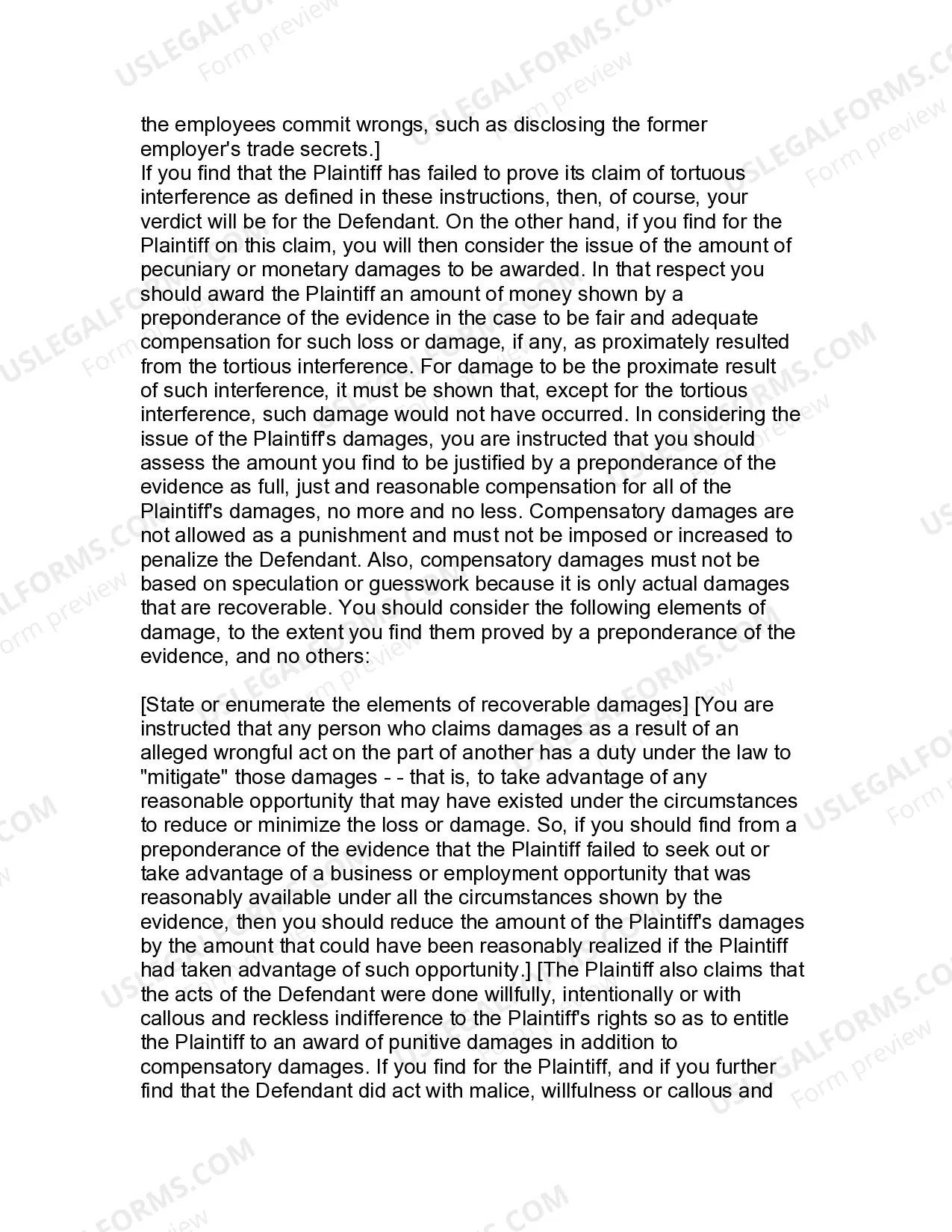
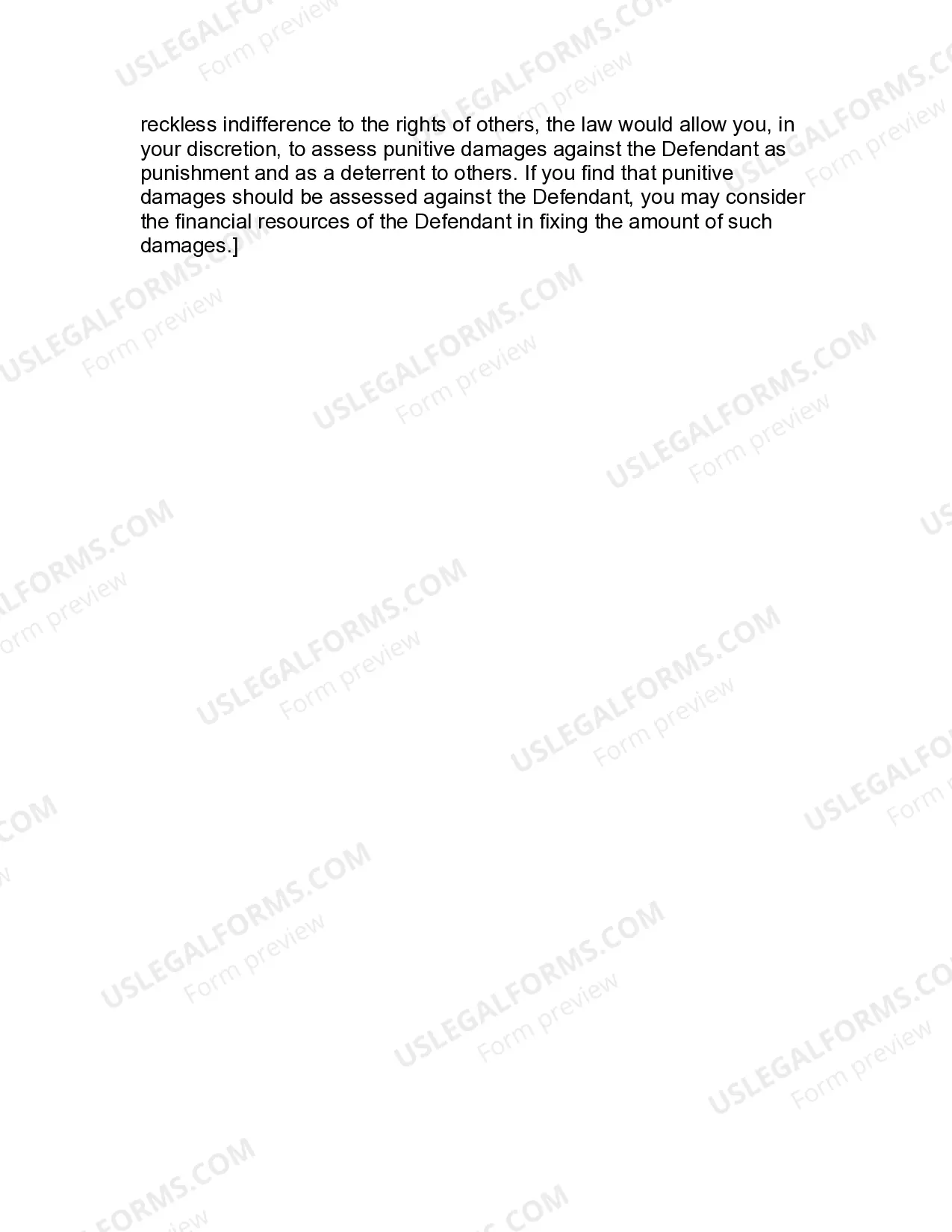
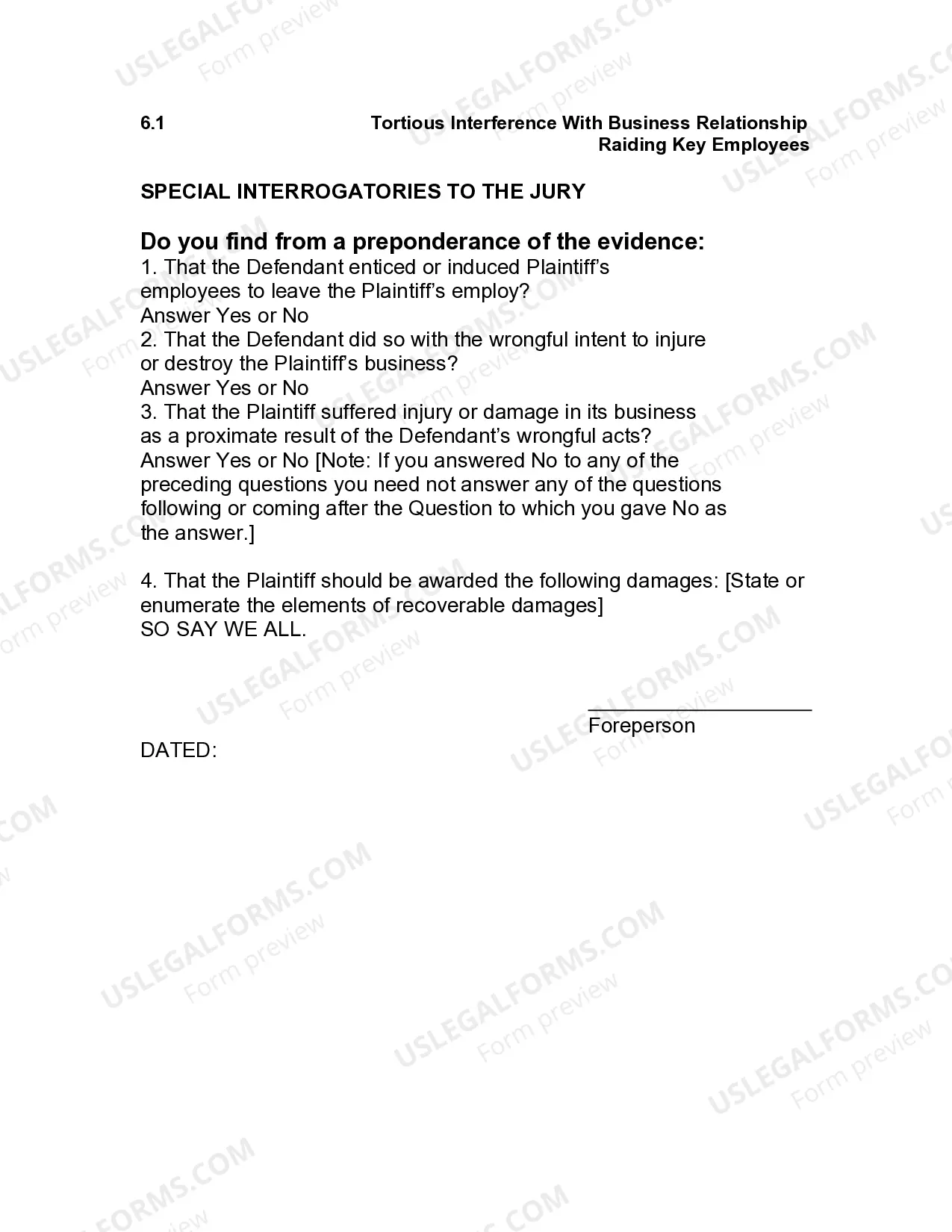
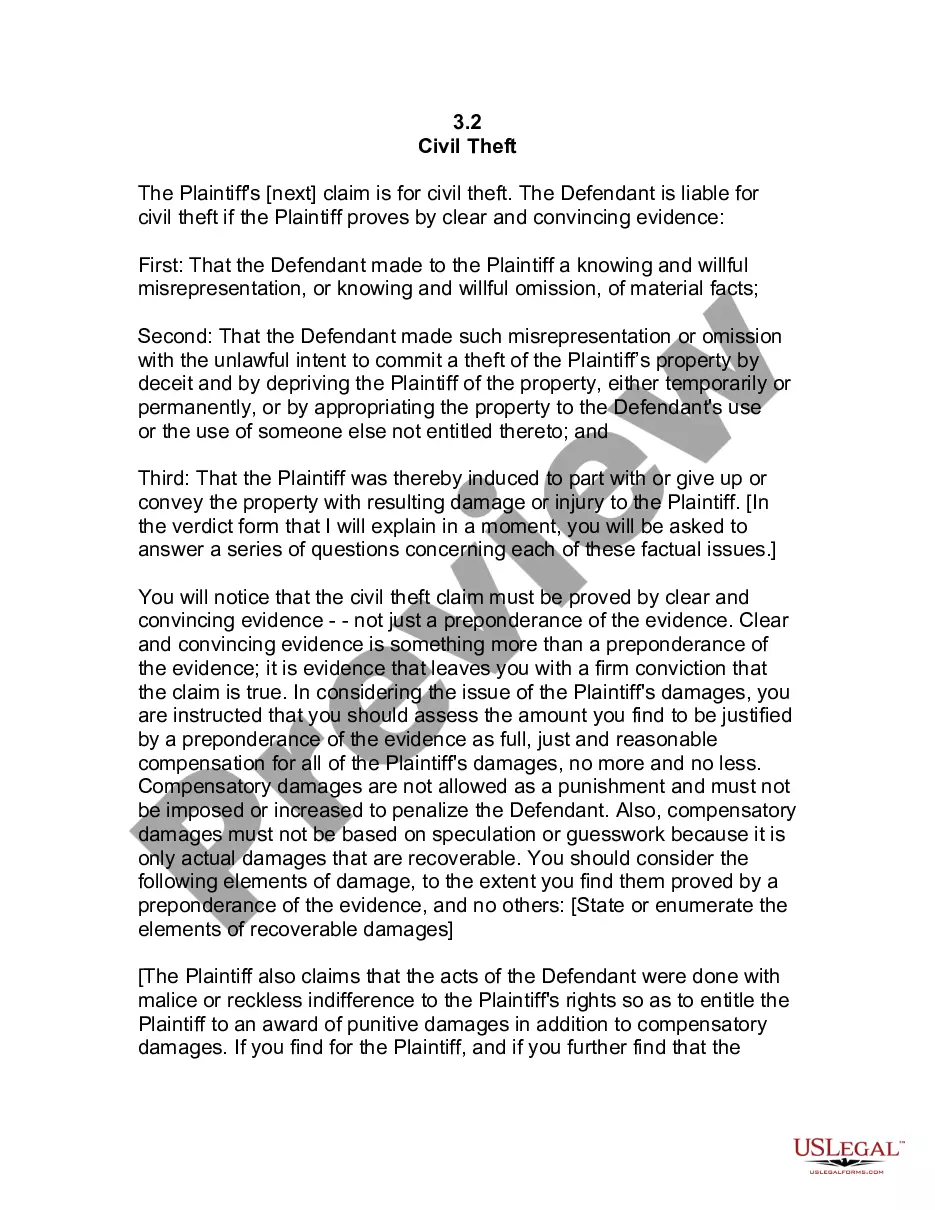
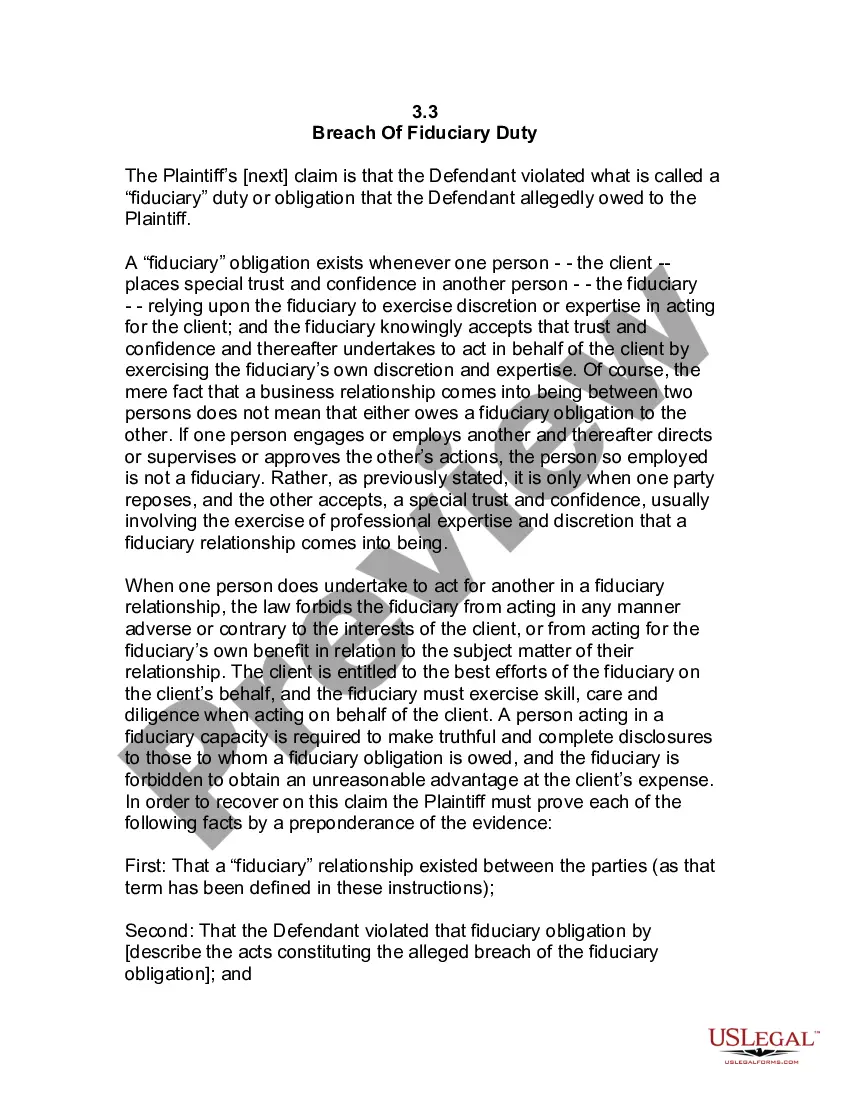
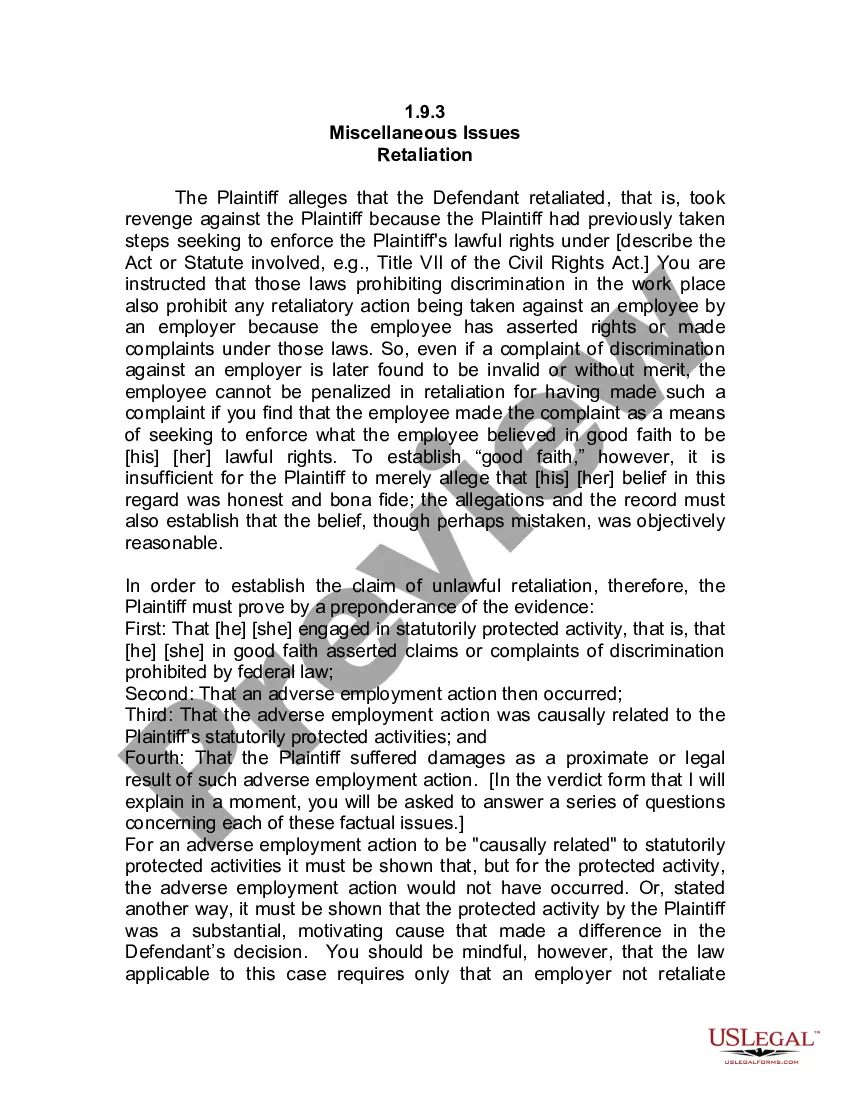
This form should be used in cases involving allegations of tortious interference where one business claims that another has intentionally disrupted its employment relationships by enticing key employees to leave. It is appropriate in civil cases where such actions are presented as unlawful competition, particularly where damages need to be quantified and addressed in court proceedings.
This form is intended for use by:
- Judges overseeing civil litigation cases involving tortious interference.
- Jury members tasked with evaluating evidence and making determinations on business disputes.
- Lawyers representing businesses making or defending against claims of employee raiding.
- Parties involved in disputes over employment relationships and business competition.
To effectively use this jury instruction form, follow these steps:
- Review the criteria set forth for proving tortious interference claims.
- Identify the facts specific to the case at hand, ensuring they align with the required proof.
- Instruct jurors on the importance of distinguishing between lawful competition and wrongful inducement.
- Utilize the special interrogatories to ascertain jurors' verdicts on each element of the claim.
- Prepare to discuss potential compensatory and punitive damages based on the juryâs findings.
Notarization guidance
This form usually doesn’t need to be notarized. However, local laws or specific transactions may require it. Our online notarization service, powered by Notarize, lets you complete it remotely through a secure video session, available 24/7.
Get your form ready online
Our built-in tools help you complete, sign, share, and store your documents in one place.
Make edits, fill in missing information, and update formatting in US Legal Forms—just like you would in MS Word.
Download a copy, print it, send it by email, or mail it via USPS—whatever works best for your next step.
Sign and collect signatures with our SignNow integration. Send to multiple recipients, set reminders, and more. Go Premium to unlock E-Sign.
If this form requires notarization, complete it online through a secure video call—no need to meet a notary in person or wait for an appointment.
We protect your documents and personal data by following strict security and privacy standards.

Make edits, fill in missing information, and update formatting in US Legal Forms—just like you would in MS Word.

Download a copy, print it, send it by email, or mail it via USPS—whatever works best for your next step.

Sign and collect signatures with our SignNow integration. Send to multiple recipients, set reminders, and more. Go Premium to unlock E-Sign.

If this form requires notarization, complete it online through a secure video call—no need to meet a notary in person or wait for an appointment.

We protect your documents and personal data by following strict security and privacy standards.
- Failing to clearly establish the definition of wrongful intent in the context of the case.
- Not providing enough evidence to prove the plaintiff's damages directly result from the defendant's actions.
- Overlooking the importance of lawful competition as a defense against tortious interference claims.
- Inadequately addressing the necessity for jurors to assess the credibility of evidence presented.
- Convenience of having readily available jury instructions for quick access during trials.
- Increased reliability due to templates drafted by licensed attorneys familiar with the applicable law.
- Editable formats that allow customization to fit specific cases or jurisdictional requirements.
- Minimized risk of error by following structured legal guidance embedded in the form.
- This form provides a legally recognized framework for jury instructions in tortious interference cases.
- It helps ensure that jurors understand the difference between permissible competition and targeted harm.
- Compliance with established legal protocols enhances the enforceability of the verdicts reached.
Looking for another form?

Form popularity
FAQ
Business law is the law that governs what happens with commercial matters, and there are two main types: regulation of commercial entities and regulation of commercial transactions.
The Constitution. supreme body of laws that govern our country. Statutory law. written or codified law such as legislative acts, declaring, commanding, or prohibiting something. Common or Case Law. Civil Law (Private law) Criminal Law. Equity Law. Administrative Law.
In the United States, the law is derived from five sources: constitutional law, statutory law, treaties, administrative regulations, and the common law (which includes case law).
Business Law is an intellectually challenging study of the constantly changing legal puzzles that face businesses of all sizes and types. The Program of Study in Business Law prepares law students for a variety of practice areas, including business transactions, commercial litigation, tax, nonprofit law, and more.
Administrative law. Regulations from government agencies. Common law. Law established by past court decisions. Statutory law. Law written by Congress. Constitutional law. From interpretation and application of the Constitution. Criminal law. Laws that protect public welfare. Civil law.
Criminal law. The Criminal law is enforced by the police. Civil law. The Civil law is law that looks at actions that are not the crime. Common law. Statutory law.
Business lawyers can work in many industries, such as real estate, entertainment, or environmental, with various specialties, from intellectual property to taxes and labor and employment law. They can open their own private practice, work for an organization, or work at large or small corporate firms.
The Constitution. supreme body of laws that govern our country. Statutory law. written or codified law such as legislative acts, declaring, commanding, or prohibiting something. Common or Case Law. Civil Law (Private law) Criminal Law. Equity Law. Administrative Law.
Complex Litigation. This is an area of law that demands a lot of patience and incredible attention to detail. Corporate Law. Tax Law. Intellectual Property. Blockchain. Healthcare. Environmental. Criminal.