Sample Letter for Note and Deed of Trust
Overview of this form
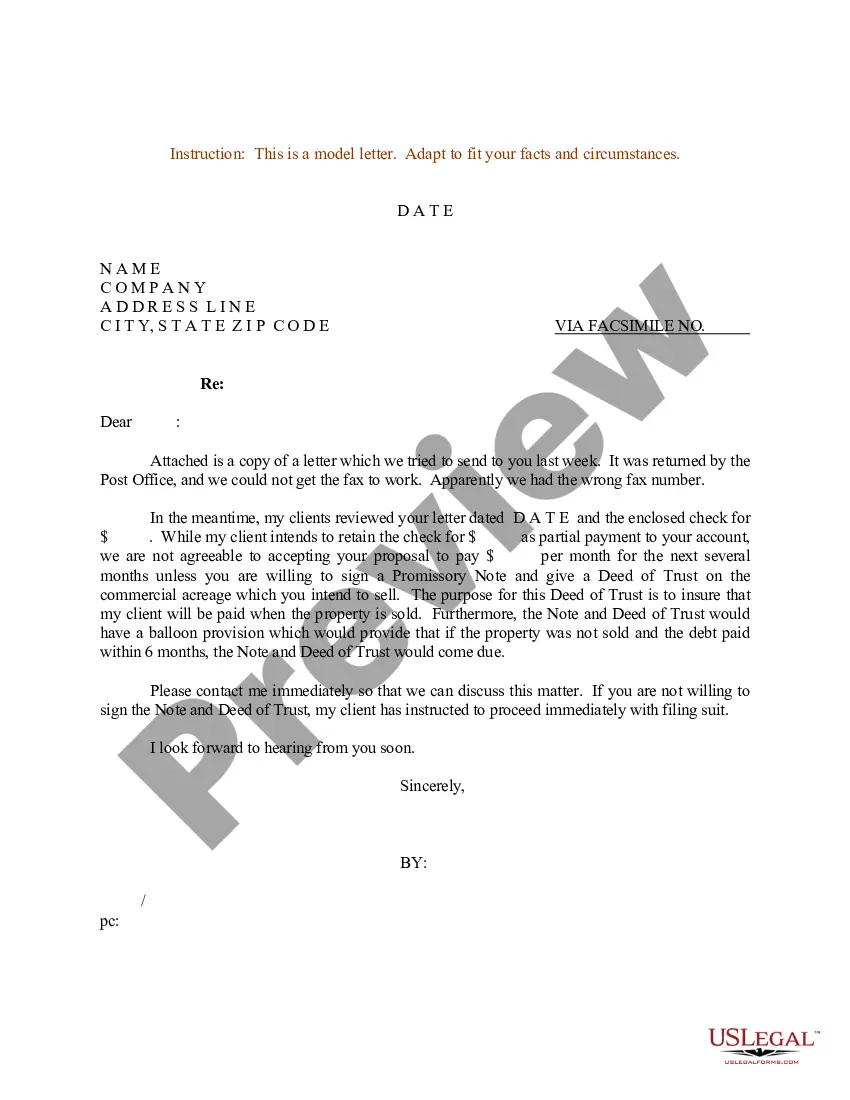
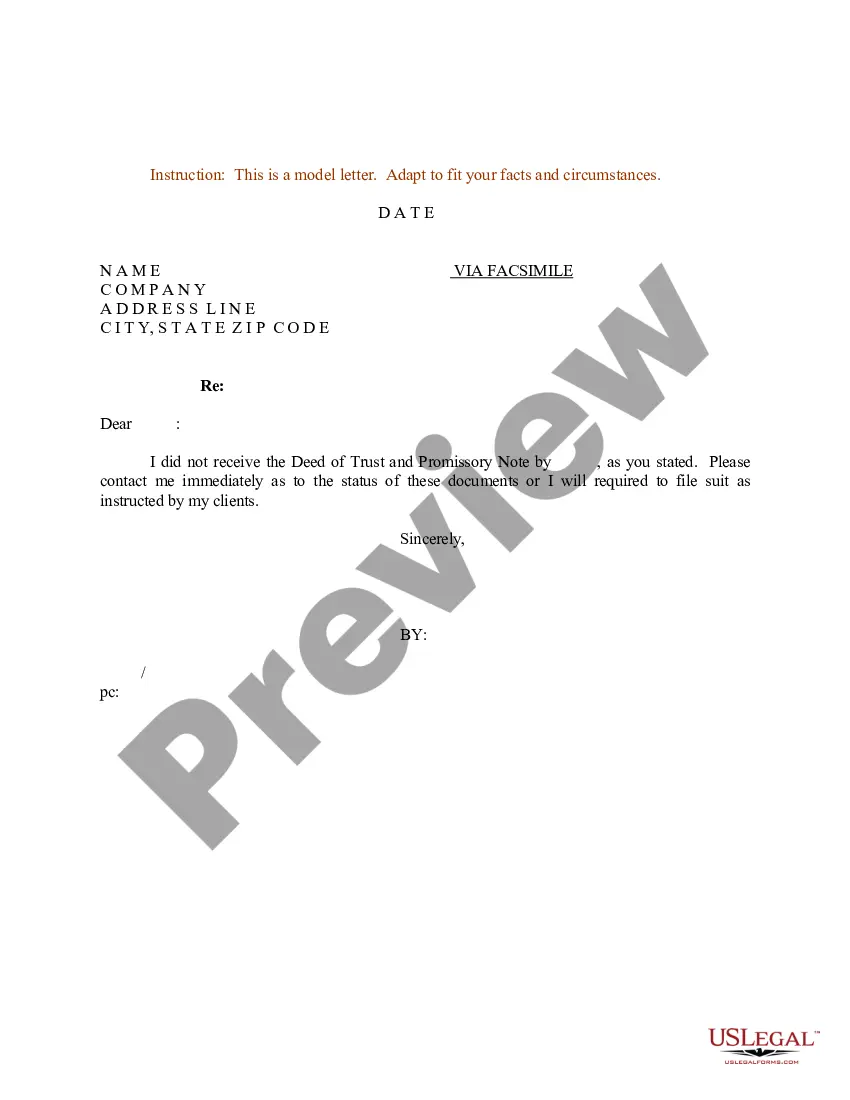
The Sample Letter for Note and Deed of Trust is a template letter intended to facilitate communication regarding the signing of a Note and Deed of Trust. This form outlines a request for prompt action and clearly states the consequences of inaction. Unlike other legal documents, this sample letter serves the specific purpose of initiating discussions or negotiations related to a trust agreement.
Key components of this form
- Date of the letter
- Sender's name and address
- Recipient's name and address
- Request for immediate contact and discussion
- Notice of potential legal action if the Note and Deed of Trust is not signed
- Closing statement expressing anticipation for a reply
When this form is needed
This form is useful when you need to formally notify a party of your intent to pursue legal actions if they do not comply with signing a Note and Deed of Trust. It is typically used in scenarios where a borrower has been unresponsive or reluctant to finalize the trust documentation necessary to secure a loan or property transaction.
Who should use this form
This letter is intended for:
- Individuals or entities involved in a financial transaction requiring a Note and Deed of Trust
- Attorneys representing clients in real estate or financing matters
- Lenders looking to expedite the process of securing a trust agreement
Instructions for completing this form
- Enter the date at the top of the letter.
- Fill in your name and address as the sender.
- Provide the recipient's name and address.
- State clearly that you wish to discuss the Note and Deed of Trust.
- Include any notice regarding the potential filing of a lawsuit.
- Sign the letter to conclude your message professionally.
Notarization requirements for this form
This form needs to be notarized to ensure legal validity. US Legal Forms provides secure online notarization powered by Notarize, allowing you to complete the process through a verified video call, available anytime.
Get your form ready online
Our built-in tools help you complete, sign, share, and store your documents in one place.
Make edits, fill in missing information, and update formatting in US Legal Forms—just like you would in MS Word.
Download a copy, print it, send it by email, or mail it via USPS—whatever works best for your next step.
Sign and collect signatures with our SignNow integration. Send to multiple recipients, set reminders, and more. Go Premium to unlock E-Sign.
If this form requires notarization, complete it online through a secure video call—no need to meet a notary in person or wait for an appointment.
We protect your documents and personal data by following strict security and privacy standards.

Make edits, fill in missing information, and update formatting in US Legal Forms—just like you would in MS Word.

Download a copy, print it, send it by email, or mail it via USPS—whatever works best for your next step.

Sign and collect signatures with our SignNow integration. Send to multiple recipients, set reminders, and more. Go Premium to unlock E-Sign.

If this form requires notarization, complete it online through a secure video call—no need to meet a notary in person or wait for an appointment.

We protect your documents and personal data by following strict security and privacy standards.
Common mistakes
- Failing to include the date of the letter.
- Not addressing the letter to the correct recipient.
- Using vague language instead of being specific about the request.
- Neglecting to clearly state the consequences of inaction.
Why complete this form online
- Convenience of immediate access and downloading the form in Word format.
- Editability allows users to customize the letter to fit their specific needs.
- Reliability with templates drafted by licensed attorneys to ensure legal soundness.
Legal use & context
- This letter serves as formal documentation of your intent, which can be used if legal action becomes necessary.
- It is important for initiating a dialogue about obligations under the Note and Deed of Trust.
- Ensuring clarity in communication can help avoid potential disputes in the future.
Key takeaways
- The Sample Letter for Note and Deed of Trust is essential for initiating discussions around trust agreements.
- Clear communication is crucial to encourage timely responses from the other party.
- Proper completion of the form can aid in avoiding legal disputes later on.
Looking for another form?
Form popularity
FAQ
How much each person contributes to the deposit, and how much will be repaid to them. What percentage of the property each person will own, and how the money will be split if the property is sold. How much each person will pay towards the mortgage, and how the mortgage will ultimately be paid off.
Yes. The deed is a fully legally binding document which can be produced in a court of law as long as it has been signed and executed correctly.
1. What is the Difference Between the Note and Deed of Trust? A note, usually known as a promissory note, which is a written promise to repay a loan. Whereas, a trust deed is a document used to protect paying back of a loan that is being documented as a lien counter to the borrowers real estate.
Co-signers, often parents or other relatives with excellent credit and income, help under-qualified borrowers obtain mortgages. They act as guarantors and do not live in the home or hold an ownership interest. Lenders require co-signers to sign the note, but not the deed, at closing.
A deed of trust includes most of the same information as a mortgage, including:A legal description of the property that's used as security or collateral for the mortgage. The names of parties: trustee, trustor, and beneficiary. The inception and maturity dates of the loan.
What Is a Trust Deed? A trust deedalso known as a deed of trustis a document sometimes used in real estate transactions in the U.S. It is a document that comes into play when one party has taken out a loan from another party to purchase a property.
Some owners are put off using solicitors duke to the deed of trust cost. Individuals can write out their own, and use someone else as a witness. However, this may have errors or not be a legally binding document. The investment of getting a deed of trust when buying a property is often worth it in the long term.
A Deed of Trust is essentially an agreement between a lender and a borrower to give the property to a neutral third party who will serve as a trustee. The trustee holds the property until the borrower pays off the debt.
Party information: names and addresses of the trustor(s), trustee(s), beneficiary(ies), and guarantor(s) (if applicable) Property details: full address of the property and its legal description (which can be obtained from the County Recorder's Office)