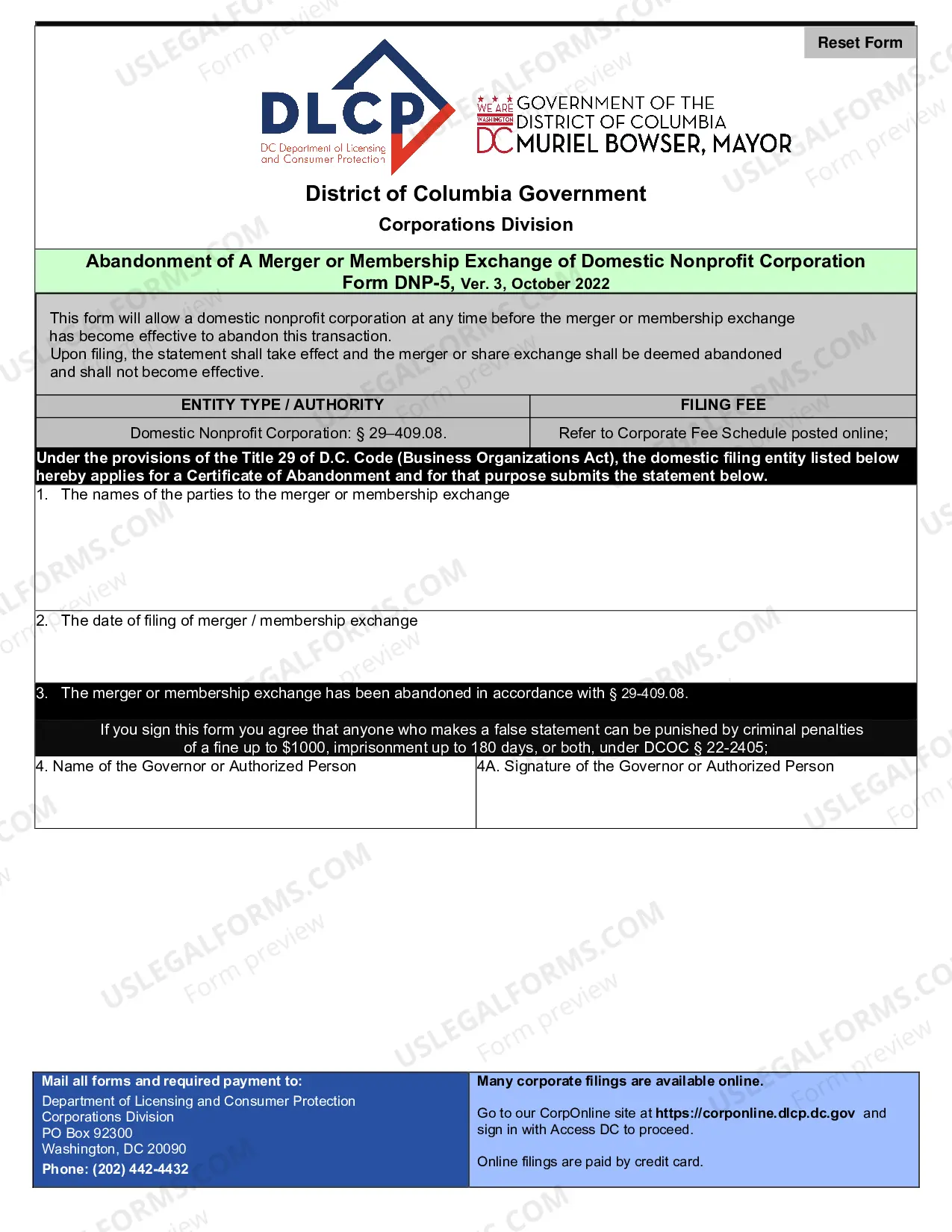
Enrollment and Salary Deferral Agreement
About this form
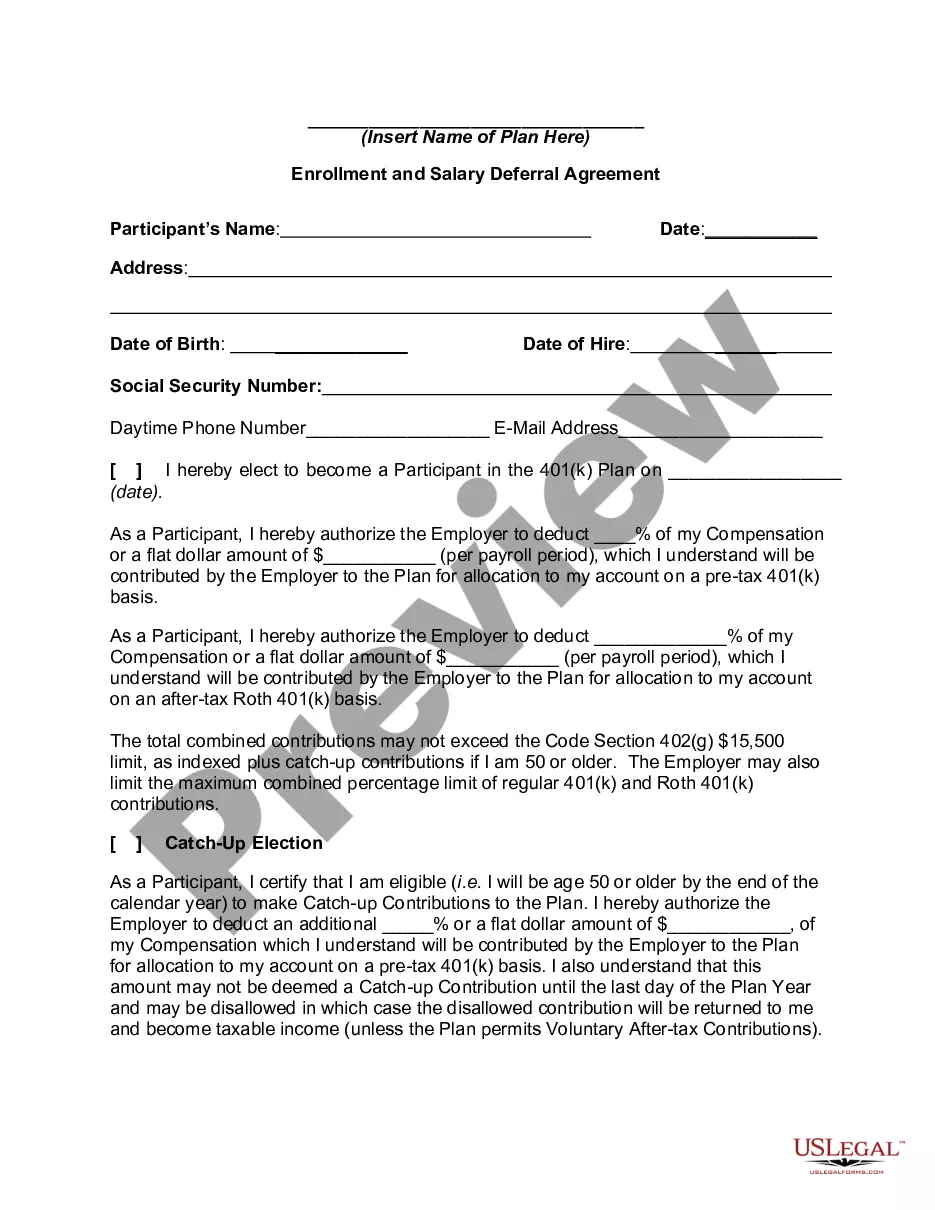
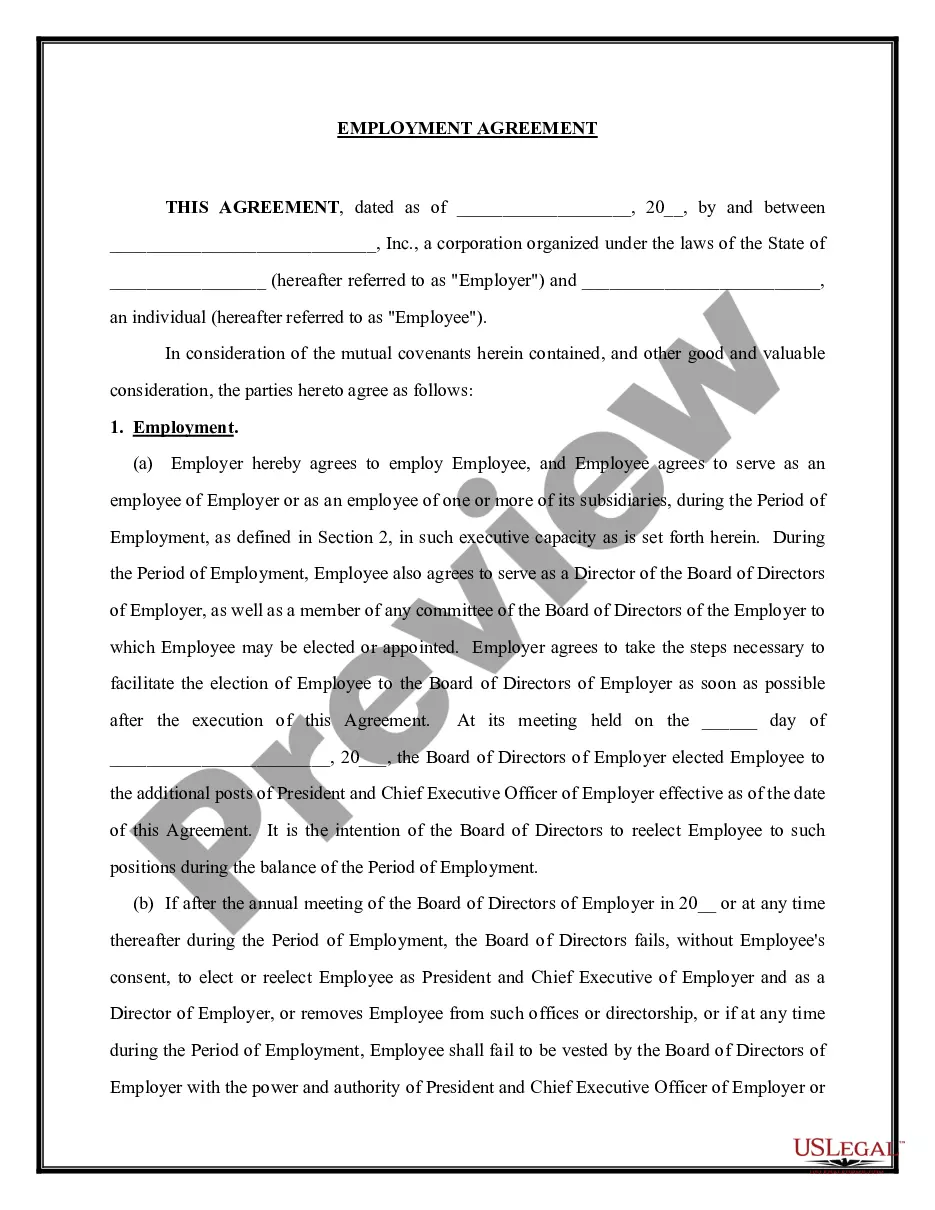
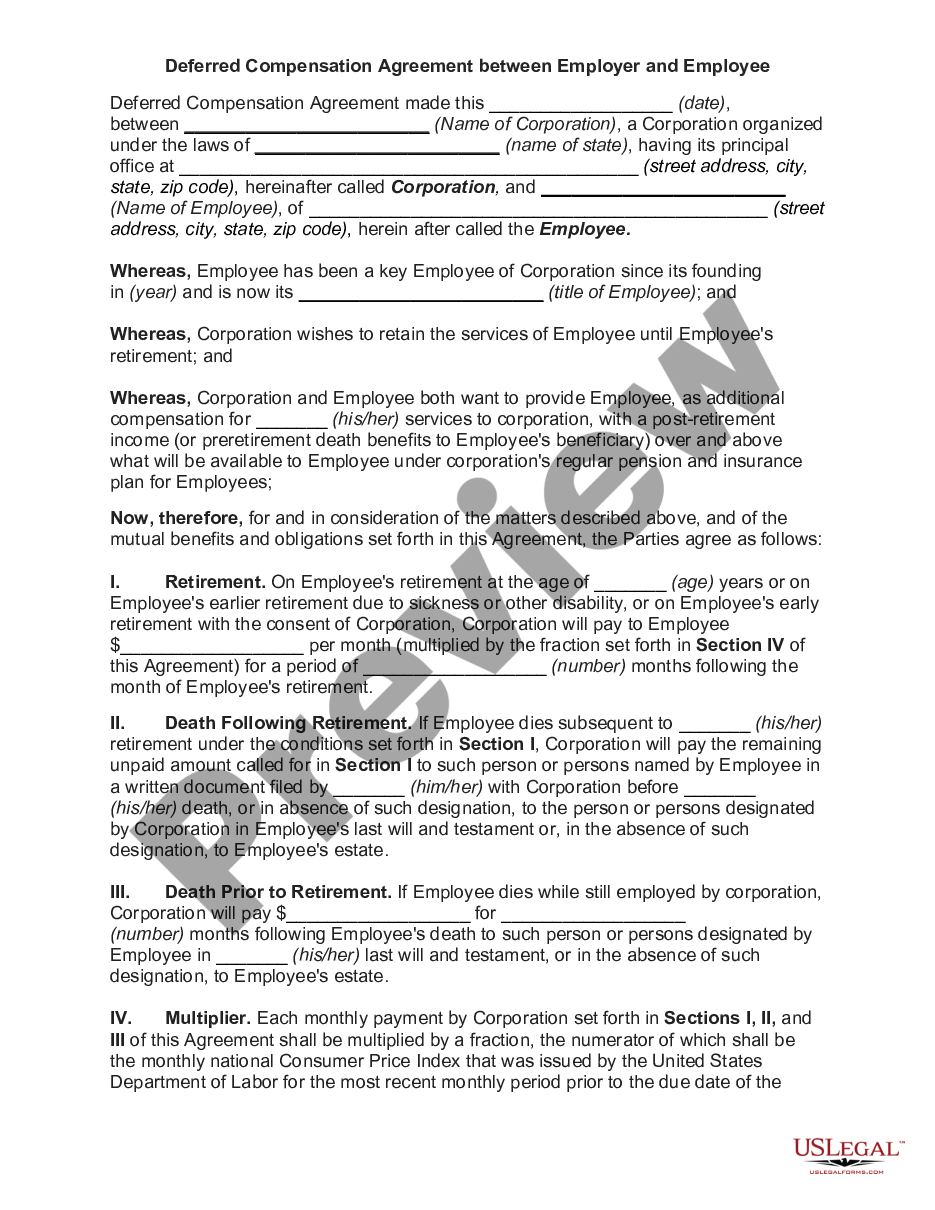
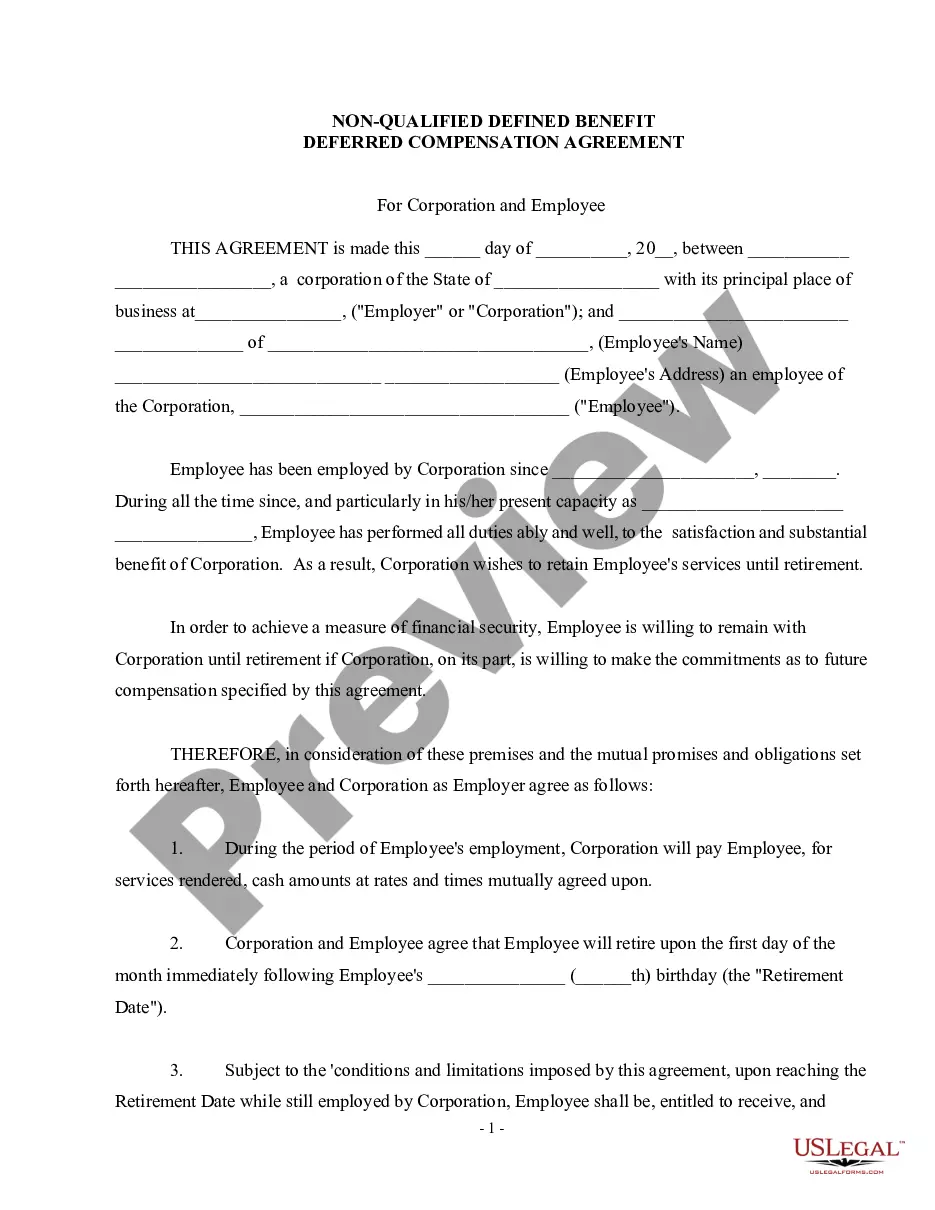
The Enrollment and Salary Deferral Agreement is a legal document that allows employees to participate in their employerâs 401(k) retirement plan. This form is important for facilitating employees' decisions regarding their retirement savings, including the amount they wish to contribute on a pre-tax or after-tax basis. This form specifically outlines the employee's contribution choices and facilitates the necessary payroll deductions, making it distinct from other retirement plan enrollment forms that may not have as detailed a focus on salary deferrals.
Form components explained
- Participantâs personal information, including name, address, and Social Security number.
- The election to participate in the 401(k) plan, including the date of enrollment.
- Authorization for payroll deductions for both pre-tax and after-tax (Roth) contributions.
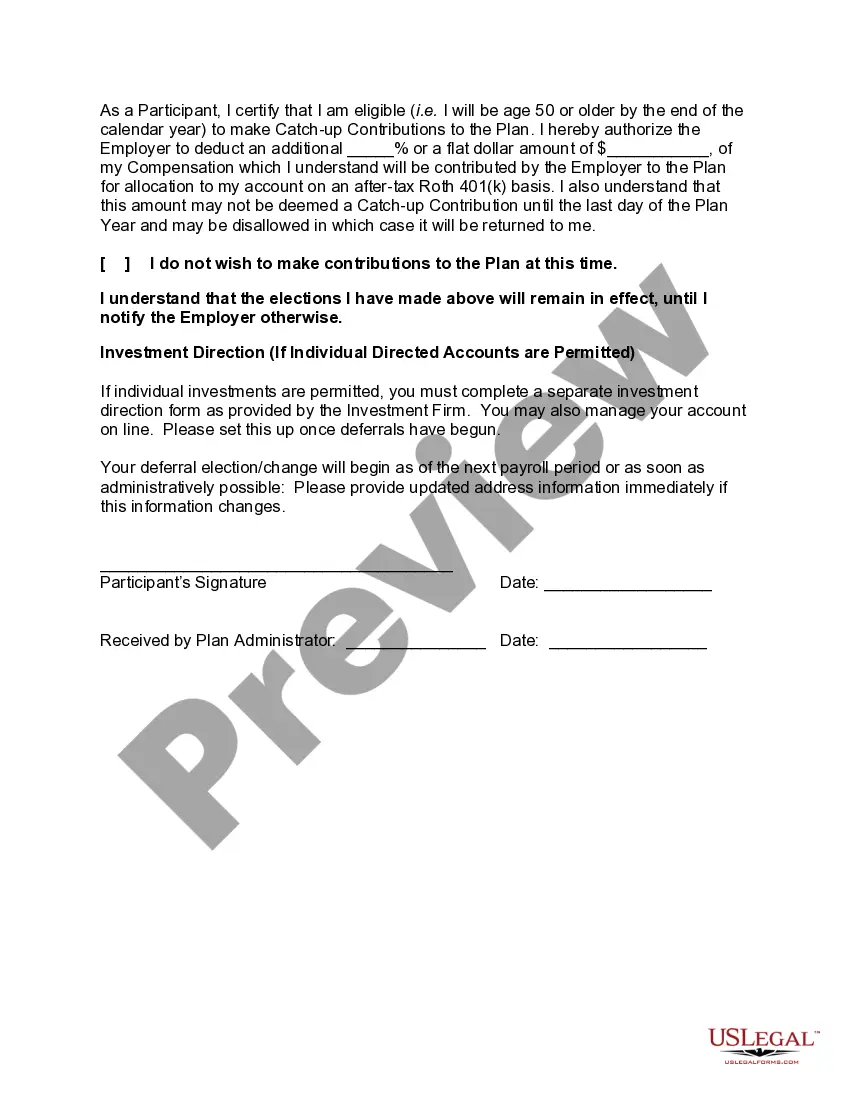
- Catch-up contribution options for participants aged 50 and over.
- Investment direction procedures, if applicable.
- Signature section to confirm the participantâs choices.

Common use cases
This form is typically used when an employee is starting a new job and wishes to enroll in the companyâs 401(k) plan. It is also relevant for current employees who want to adjust their salary deferral amounts or opt into catch-up contributions. Additionally, it is necessary for those who want to establish how their contributions will be allocated, particularly if they wish to utilize a Roth option.
Who this form is for
- Employees seeking to enroll in a 401(k) retirement plan offered by their employer.
- Individuals who wish to modify their salary deferral amounts for retirement contributions.
- Employees aged 50 or over who are eligible to make additional catch-up contributions.
Completing this form step by step
- Enter your personal information, including your name, address, date of birth, and Social Security number.
- Select the date you wish to enroll in the 401(k) plan.
- Specify the amount of your compensation you wish to contribute on a pre-tax basis and, if applicable, on a Roth basis.
- If eligible, indicate your desire to make catch-up contributions and provide the respective amounts.
- Review and sign the form to confirm your choices, then submit it to your employer.
Notarization requirements for this form
This form does not typically require notarization unless specified by local law. It is advisable to check with your employer or legal counsel for any specific requirements.
Get your form ready online
Our built-in tools help you complete, sign, share, and store your documents in one place.
Make edits, fill in missing information, and update formatting in US Legal Forms—just like you would in MS Word.
Download a copy, print it, send it by email, or mail it via USPS—whatever works best for your next step.
Sign and collect signatures with our SignNow integration. Send to multiple recipients, set reminders, and more. Go Premium to unlock E-Sign.
If this form requires notarization, complete it online through a secure video call—no need to meet a notary in person or wait for an appointment.
We protect your documents and personal data by following strict security and privacy standards.

Make edits, fill in missing information, and update formatting in US Legal Forms—just like you would in MS Word.

Download a copy, print it, send it by email, or mail it via USPS—whatever works best for your next step.

Sign and collect signatures with our SignNow integration. Send to multiple recipients, set reminders, and more. Go Premium to unlock E-Sign.

If this form requires notarization, complete it online through a secure video call—no need to meet a notary in person or wait for an appointment.

We protect your documents and personal data by following strict security and privacy standards.
Common mistakes
- Failing to enter correct personal information, which can delay processing.
- Not double-checking the contribution amounts, leading to incorrect deductions.
- Overlooking the catch-up contribution section if aged 50 or older.
- Not signing and dating the form, which can render it invalid.
Benefits of completing this form online
- Convenience of filling out the form anytime and anywhere.
- Ability to securely save and edit the form before final submission.
- Access to up-to-date legal templates drafted by licensed attorneys.
Looking for another form?




Form popularity
FAQ
Deferred compensation is a portion of an employee's compensation that is set aside to be paid at a later date. In most cases, taxes on this income are deferred until it is paid out. Forms of deferred compensation include retirement plans, pension plans, and stock-option plans.
The maximum salary deferral amount that you can contribute in 2019 to a 401(k) is the lesser of 100% of pay or $19,000. However, some 401(k) plans may limit your contributions to a lesser amount, and in such cases, IRS rules may limit the contribution for highly compensated employees.
Under a salary deferral plan, a key executive agrees to defer a portion of his/her compensation and the employer agrees to return the deferred amounts, with interest, at a future point in time.
Small business owners have the most opportunities to defer taxable income. Read more here.If you are not a small business owner, you can defer taxable income by prepaying expenses that give rise to higher itemized deductions, making installment sales of property, and arranging for like-kind exchanges of real estate.
An employer will offer the opportunity for you to defer a portion of your compensation for a number of years, and doing so defers taxes on any earnings until you take a withdrawal. Examples include pensions, retirement plans, and stock options.
Elective deferral limit The amount you can defer (including pre-tax and Roth contributions) to all your plans (not including 457(b) plans) is $19,500 in 2020 and in 2021 ($19,000 in 2019).
Under a salary deferral plan, a key executive agrees to defer a portion of his/her compensation and the employer agrees to return the deferred amounts, with interest, at a future point in time.
Employers and employees may enter into deferred remuneration arrangements that is, conditional arrangements to defer awards of remuneration for commercial reasons.The award of deferred remuneration must pass seven tests and the relevant step must pass three tests.