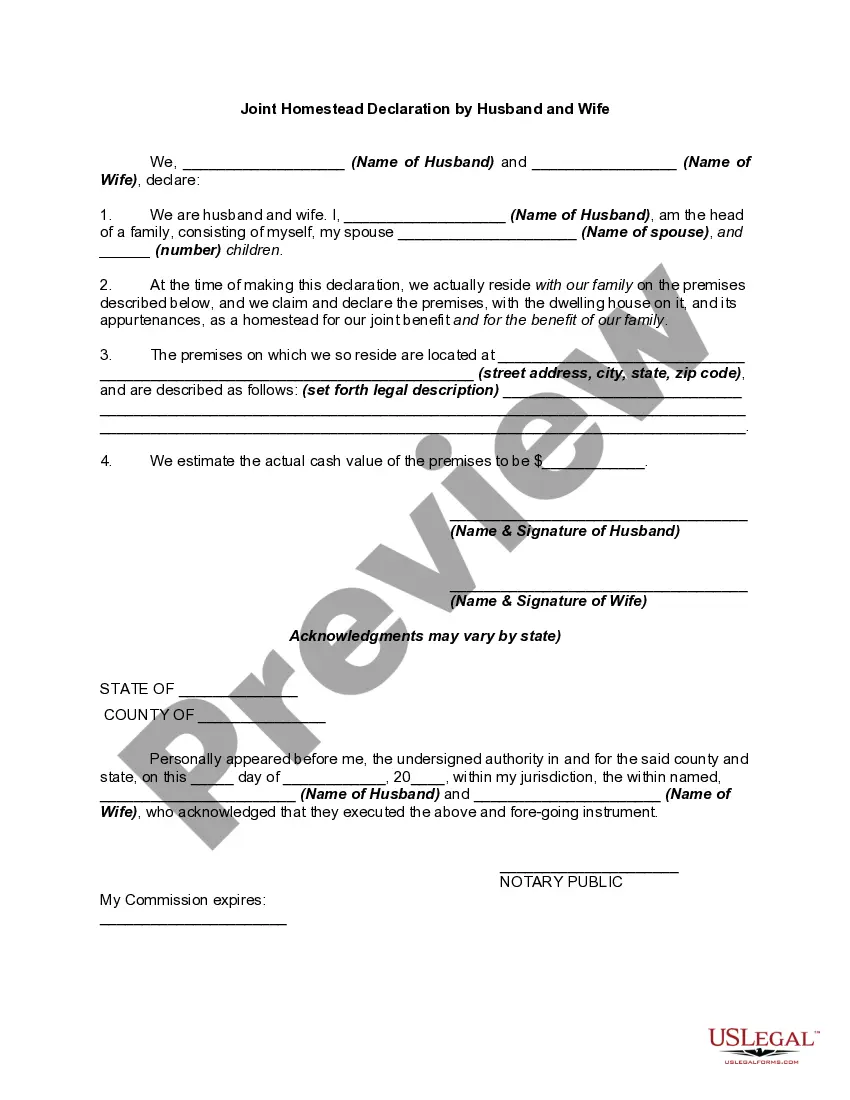
Joint Homestead Declaration by Husband and Wife
About this form
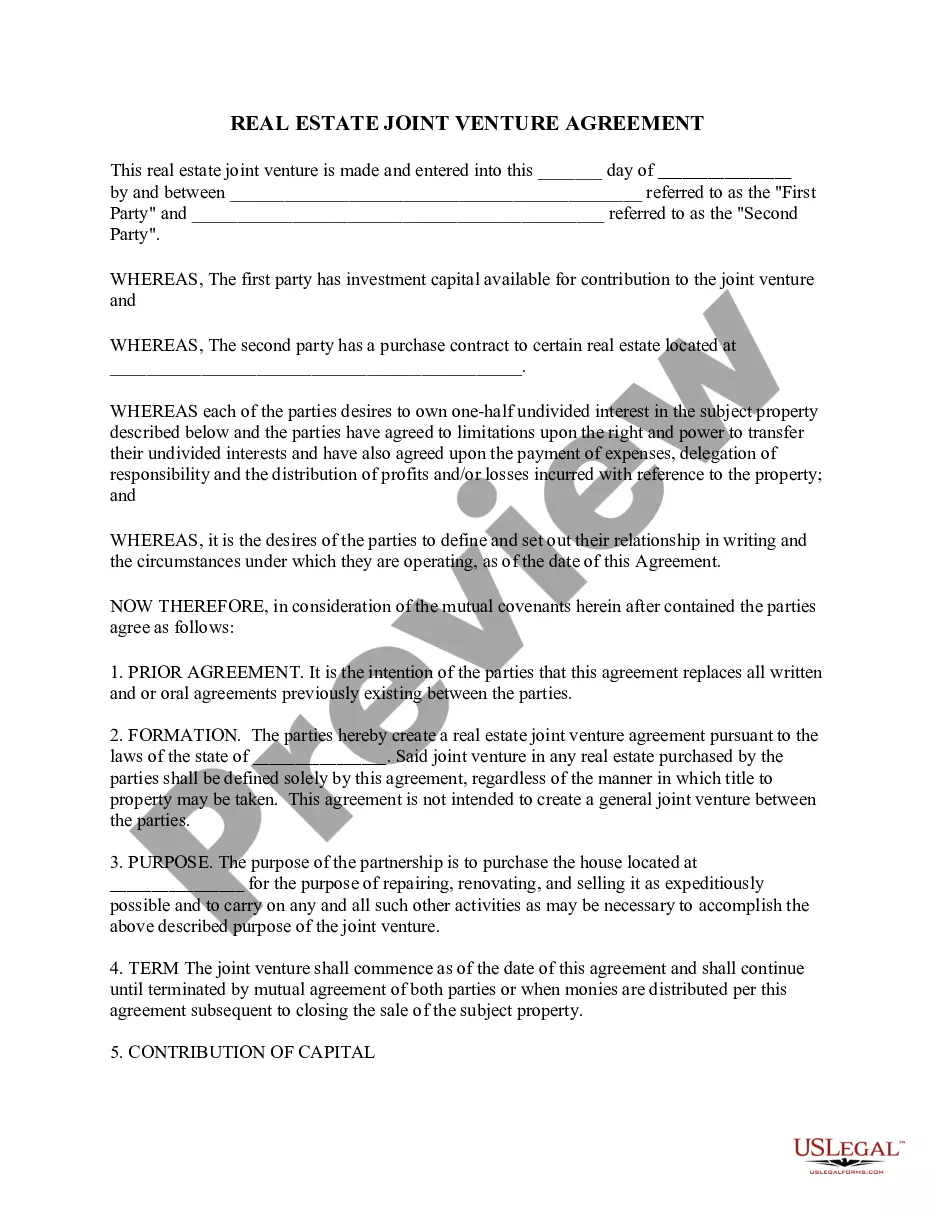
The Joint Homestead Declaration by Husband and Wife is a legal document that allows a married couple to declare their shared residence as a homestead. This designation can help protect their home from creditors and may offer tax benefits based on state laws. Unlike individual declarations, this form ensures that both spouses are jointly recognized in the declaration, which can enhance protection against potential claims on the property.
Key parts of this document
- Names of both husband and wife who are declaring the homestead.
- Declaration of marital status and family composition.
- Confirmation of residence at the specified property.
- Details about the property, including its address and legal description.
- Estimated cash value of the property.
- Signatures of both spouses and acknowledgment section for notarization.


Common use cases
This form is used when a married couple wants to officially declare their residence as a homestead. It is particularly beneficial when the couple intends to protect the property from creditors' claims or to take advantage of tax exemptions available under state homestead laws. Common scenarios include purchasing a new home, optimizing asset protection in the event of financial difficulties, or planning estate matters.
Who can use this document
This form is suitable for:
- Married couples who own a home together.
- Couples looking to protect their home equity from creditors.
- Spouses wanting to ensure their residence qualifies for homestead exemptions.
- Individuals seeking to clarify ownership in estate planning.
Steps to complete this form
- Identify the names of both husband and wife, ensuring correct spelling.
- Specify the number of children, if applicable.
- Provide the full address and legal description of the property being declared as a homestead.
- Estimate and enter the actual cash value of the property.
- Both spouses must sign the form in the designated areas.
- Complete the acknowledgment section for notarization, if required by your state.
Notarization requirements for this form
This document requires notarization to meet legal standards. US Legal Forms provides secure online notarization powered by Notarize, allowing you to complete the process through a verified video call, available 24/7.
Get your form ready online
Our built-in tools help you complete, sign, share, and store your documents in one place.
Make edits, fill in missing information, and update formatting in US Legal Forms—just like you would in MS Word.
Download a copy, print it, send it by email, or mail it via USPS—whatever works best for your next step.
Sign and collect signatures with our SignNow integration. Send to multiple recipients, set reminders, and more. Go Premium to unlock E-Sign.
If this form requires notarization, complete it online through a secure video call—no need to meet a notary in person or wait for an appointment.
We protect your documents and personal data by following strict security and privacy standards.

Make edits, fill in missing information, and update formatting in US Legal Forms—just like you would in MS Word.

Download a copy, print it, send it by email, or mail it via USPS—whatever works best for your next step.

Sign and collect signatures with our SignNow integration. Send to multiple recipients, set reminders, and more. Go Premium to unlock E-Sign.

If this form requires notarization, complete it online through a secure video call—no need to meet a notary in person or wait for an appointment.

We protect your documents and personal data by following strict security and privacy standards.
Typical mistakes to avoid
- Failing to accurately enter the legal description of the property.
- Not providing an estimated cash value for the property.
- Leaving out one spouse's signature or name.
- Neglecting to have the declaration notarized if required.
Advantages of online completion
- Convenience of accessing and completing the form from home.
- Editability allows you to easily make changes and tailor the document to your needs.
- Reliability of receiving a professionally drafted form created by licensed attorneys.
- Quick download ensures immediate availability for filing.
Legal use & context
- The Joint Homestead Declaration offers legal protection against creditors in many states.
- State laws determine the extent of protection and benefits of declaring a homestead.
- Understanding local laws is crucial to ensuring that the declaration meets all requirements.
Summary of main points
- This form allows married couples to declare their residence as a homestead for legal protection.
- Completion includes names, property details, cash value, and spousal signatures.
- Notarization is typically required for the declaration to be considered valid.
Looking for another form?
Form popularity
FAQ
The Joint Homestead Declaration by Husband and Wife is a single legal document that lets a married couple declare their shared residence as a homestead. It can help protect the home from creditors and may qualify for state tax benefits. It names both spouses, identifies the property, and requires signatures from both spouses plus notarization to be valid.
This form is designed to declare a single residence as homestead for both spouses. The key parts include the property’s address and legal description, and signatures of both spouses with an acknowledgment for notarization. The form’s purpose is to jointly recognize the home as a homestead and potentially shield equity.
Declaring a homestead on a single shared residence is the intended use of this form. Declaring homestead in two different states would typically require separate declarations in each jurisdiction; this form does not cover dual-state declarations. For multiple properties, prepare separate documents and follow local rules.
Additional homestead exemptions depend on state law. This form helps establish a joint homestead for the couple’s shared residence, which may support exemptions where allowed. For obtaining any extra exemptions, contact the local assessor or tax authority and follow their application process.
Whether a married couple can claim more than one exemption depends on state rules. This form creates a single joint declaration for one property, which may influence exemptions to the extent allowed by law. Always check local eligibility criteria with the relevant assessor or tax official.
Because it names both spouses, it jointly declares one residence as the homestead with a single property description, and requires signatures from both spouses plus a notarization acknowledgment. Two separate declarations would treat each person or property separately, potentially duplicating claims and lacking the joint recognition this form provides.