Investment Letter for a Private Sale of Securities
What is this form?
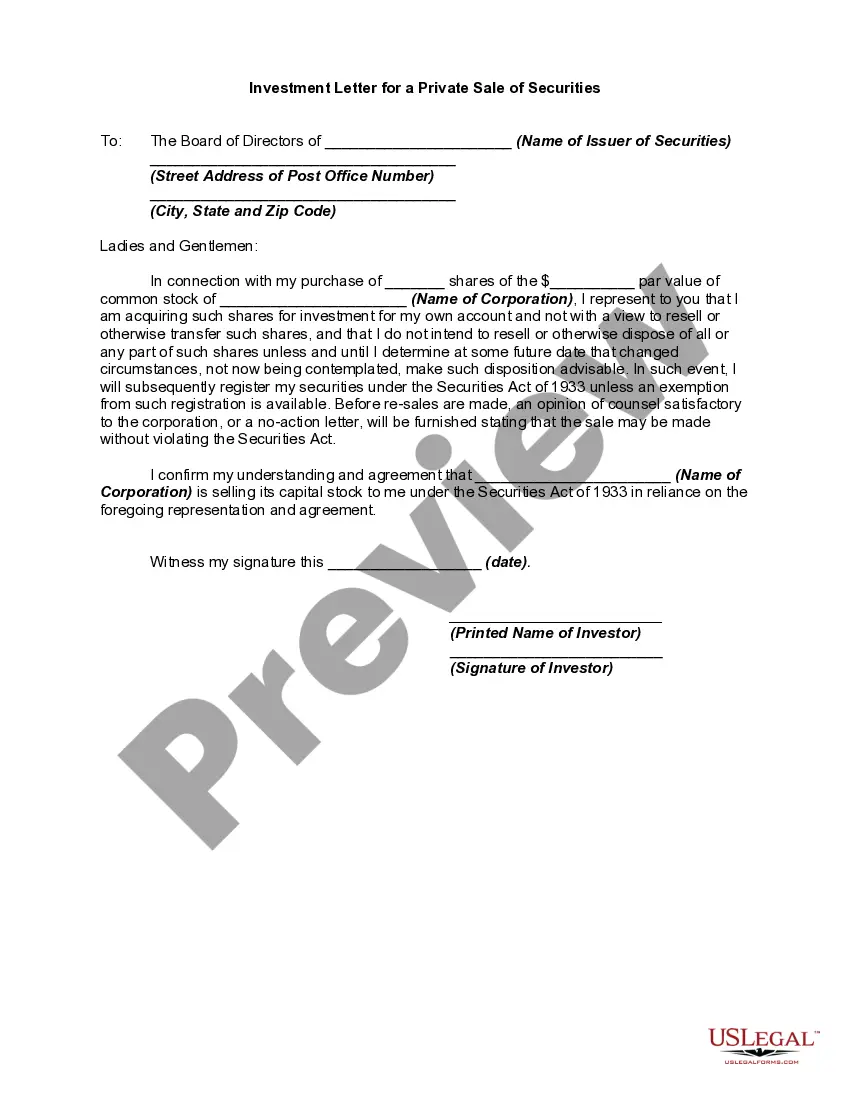
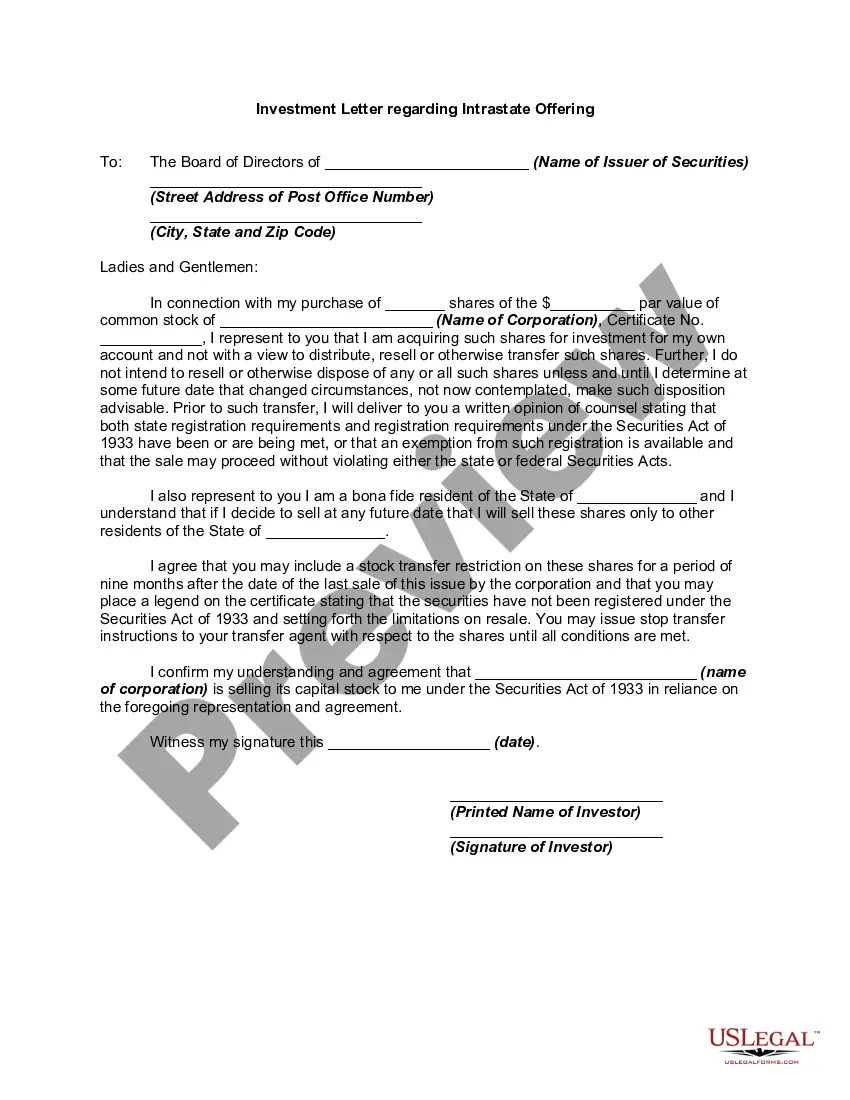
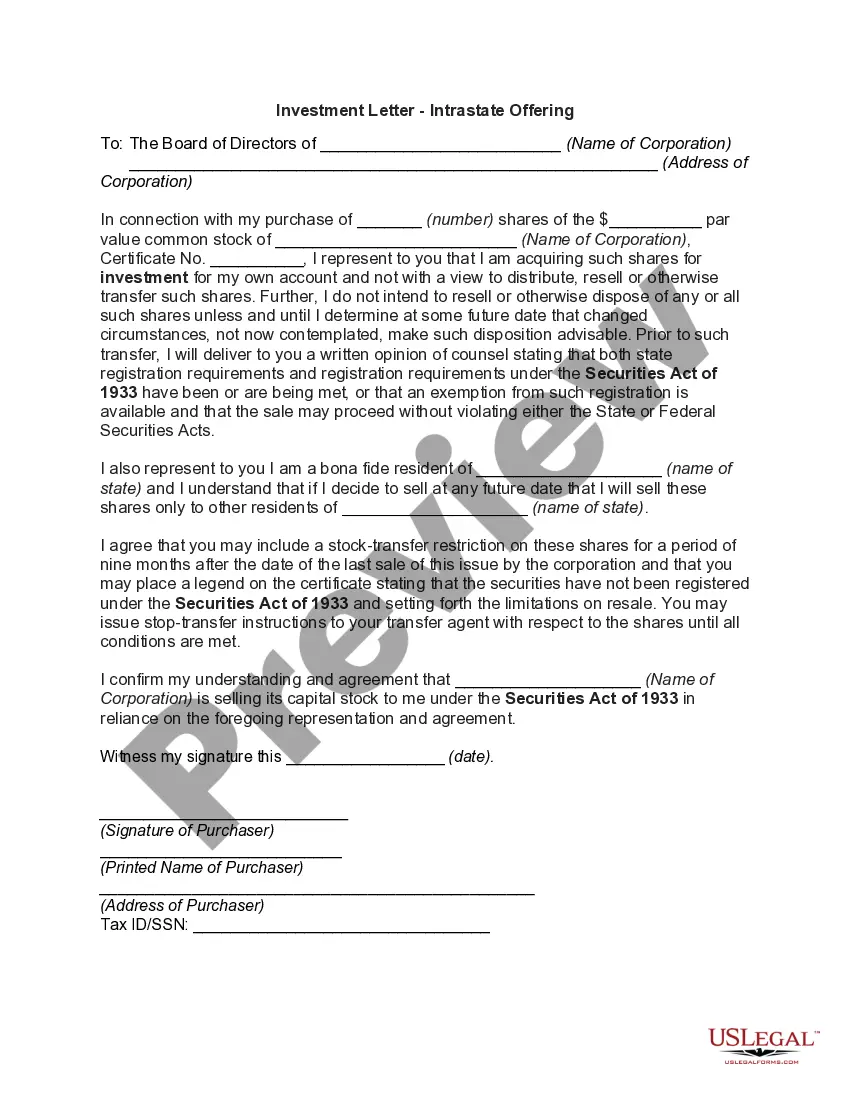
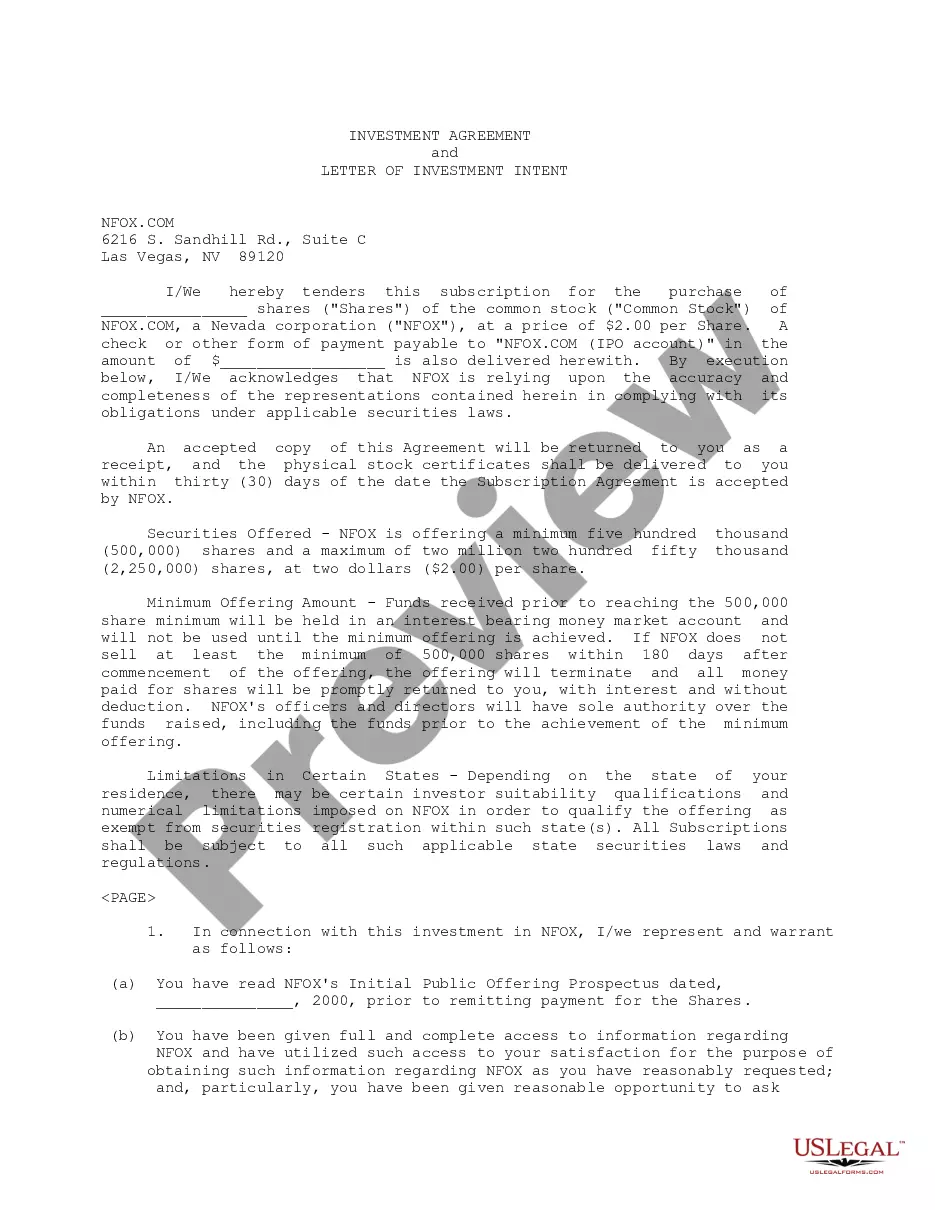
The Investment Letter for a Private Sale of Securities is a legal document designed to confirm that an investor purchases shares not for public resale but for their own investment. This form aligns with Section 4(2) of the Securities Act of 1933, which provides certain exemptions for private offerings, distinguishing it from other securities purchase agreements by specifically addressing the intention behind the purchase.
Key parts of this document
- Identification of the issuer of the securities.
- Statement of the investor's intent to purchase shares for investment purposes only.
- Assurances that the investor will not resell the shares without proper registration or an exemption.
- Signature fields for both the investor and the date of signing.
Common use cases
This form should be used when an individual or entity intends to purchase restricted securities in a private sale. It is essential when the issuance of shares is conducted under the private offering exemption, ensuring compliance with federal securities regulations. Common scenarios include investments in startups, private equity, or family-held businesses.
Who needs this form
This form is suitable for:
- Individual investors acquiring shares for their personal portfolios.
- Institutional investors participating in private equity placements.
- Business owners issuing shares to a limited number of buyers.
Instructions for completing this form
- Identify the name and address of the issuer of the securities.
- Specify the number of shares being purchased and the associated par value.
- Clearly state that the shares are being acquired for investment, not for resale.
- Provide signatures and printed names of both the investor and the date of signing.
Is notarization required?
This form does not typically require notarization unless specified by local law. It is advisable to check state regulations to ensure compliance.
Get your form ready online
Our built-in tools help you complete, sign, share, and store your documents in one place.
Make edits, fill in missing information, and update formatting in US Legal Forms—just like you would in MS Word.
Download a copy, print it, send it by email, or mail it via USPS—whatever works best for your next step.
Sign and collect signatures with our SignNow integration. Send to multiple recipients, set reminders, and more. Go Premium to unlock E-Sign.
If this form requires notarization, complete it online through a secure video call—no need to meet a notary in person or wait for an appointment.
We protect your documents and personal data by following strict security and privacy standards.

Make edits, fill in missing information, and update formatting in US Legal Forms—just like you would in MS Word.

Download a copy, print it, send it by email, or mail it via USPS—whatever works best for your next step.

Sign and collect signatures with our SignNow integration. Send to multiple recipients, set reminders, and more. Go Premium to unlock E-Sign.

If this form requires notarization, complete it online through a secure video call—no need to meet a notary in person or wait for an appointment.

We protect your documents and personal data by following strict security and privacy standards.
Common mistakes
- Failing to accurately state the intent of the purchase.
- Not signing the form or providing the date.
- Neglecting to provide correct issuer information.
Benefits of using this form online
- Convenience of immediate access and download.
- Editability to customize according to specific transaction details.
- Reliable templates drafted by licensed attorneys to ensure legal compliance.
Legal use & context
- This form helps affirm the investorâs declaration of intent, which is crucial for complying with securities regulations.
- Using this form correctly can protect both parties during a private transaction.
- The form does not substitute for legal advice from a qualified attorney regarding specific situations or concerns.
Quick recap
- The Investment Letter is essential for private sales of securities to comply with federal laws.
- Accurate completion of the form can help avoid legal pitfalls in securities transactions.
- Consulting with a legal professional is recommended for important transactions.
Looking for another form?
Form popularity
FAQ
Form 144, required under Rule 144, is filed by a person who intends to sell either restricted securities or control securities (i.e., securities held by affiliates.The securities may be sold within the 90-day period after Form 144 is filed.
You can redeem your mutual fund shares or transfer securities to another financial institution using a letter of instruction. This letter gives your financial institution the authority to sell or transfer shares on your behalf.
This Form must be filed with the SEC by an affiliate of the issuer as a notice of the proposed sale of securities in reliance on Rule 144 , when the amount to be sold under Rule 144 by the affiliate during any three-month period exceeds 5,000 shares or units or has an aggregate sales price in excess of $50,000.
You can sell shares by speaking to a broker or through a DIY investing platform. The cost of trading shares varies depending on the platform or broker you are using and whether you are selling your shares online, or in the case of paper certificates, on the phone or by post.
Identify your letter as a letter of intent to sell shares. Define the company and who is meant by "seller" and "buyer." Include contact information for all the parties. Include the postal and registered address of the company, if they're different. Name every shareholder involved in the sale.
Employees or investors can sell the public company shares through a broker. To sell private company stockbecause it represents a stake in a company that is not listed on any exchangethe shareholder must find a willing buyer. In addition, the company must approve the sale.
Rule 144 does not apply to private transactions, including sales, gifts, estate distributions and pledges, but does apply to the purchaser, donee, beneficiary and pledgee, when they sell the stock into the public market.
Sell the shares back to the company. Sell the shares to another investor. Sell the shares on a private-securities market. Get your company to do an IPO.
Rule 144 provides an exemption and permits the public resale of restricted or control securities if a number of conditions are met, including how long the securities are held, the way in which they are sold, and the amount that can be sold at any one time.