Disclaimer by Beneficiary of all Rights in Trust
Overview of this form
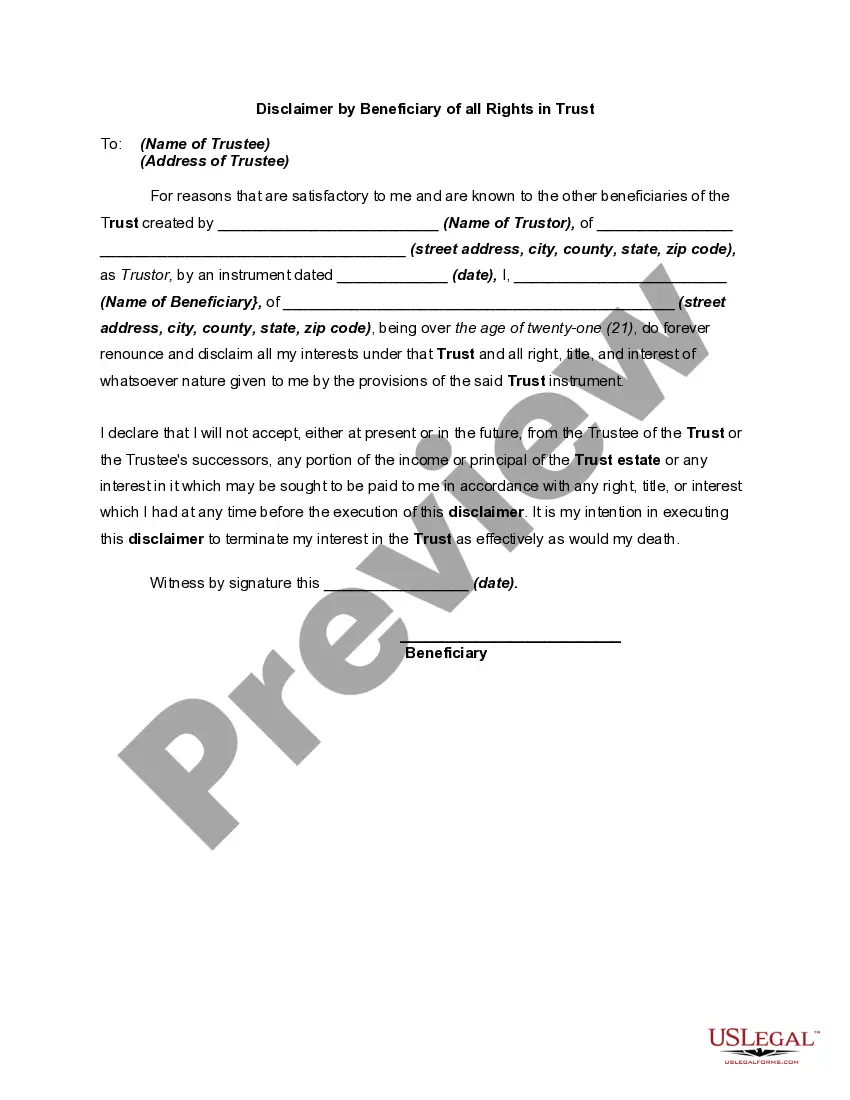
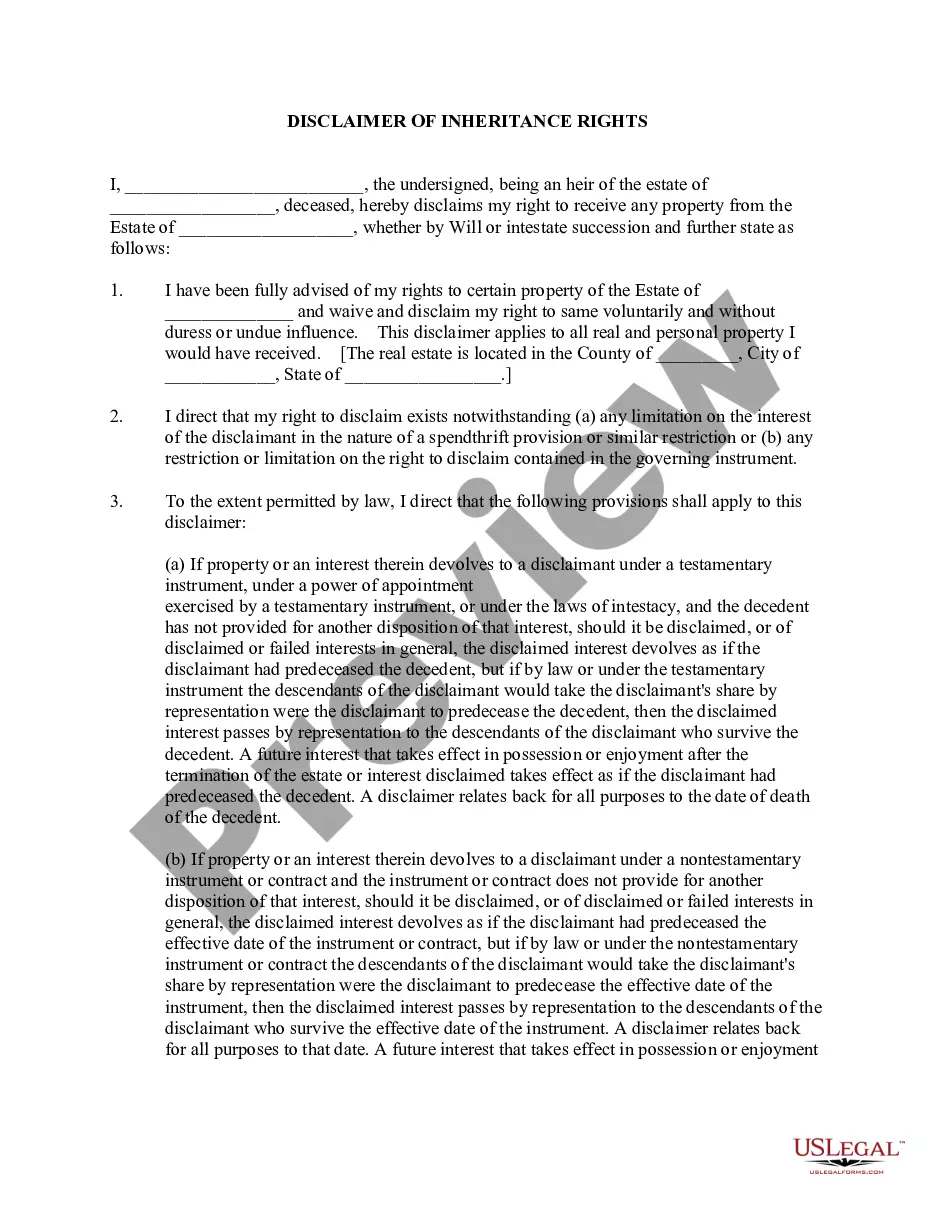
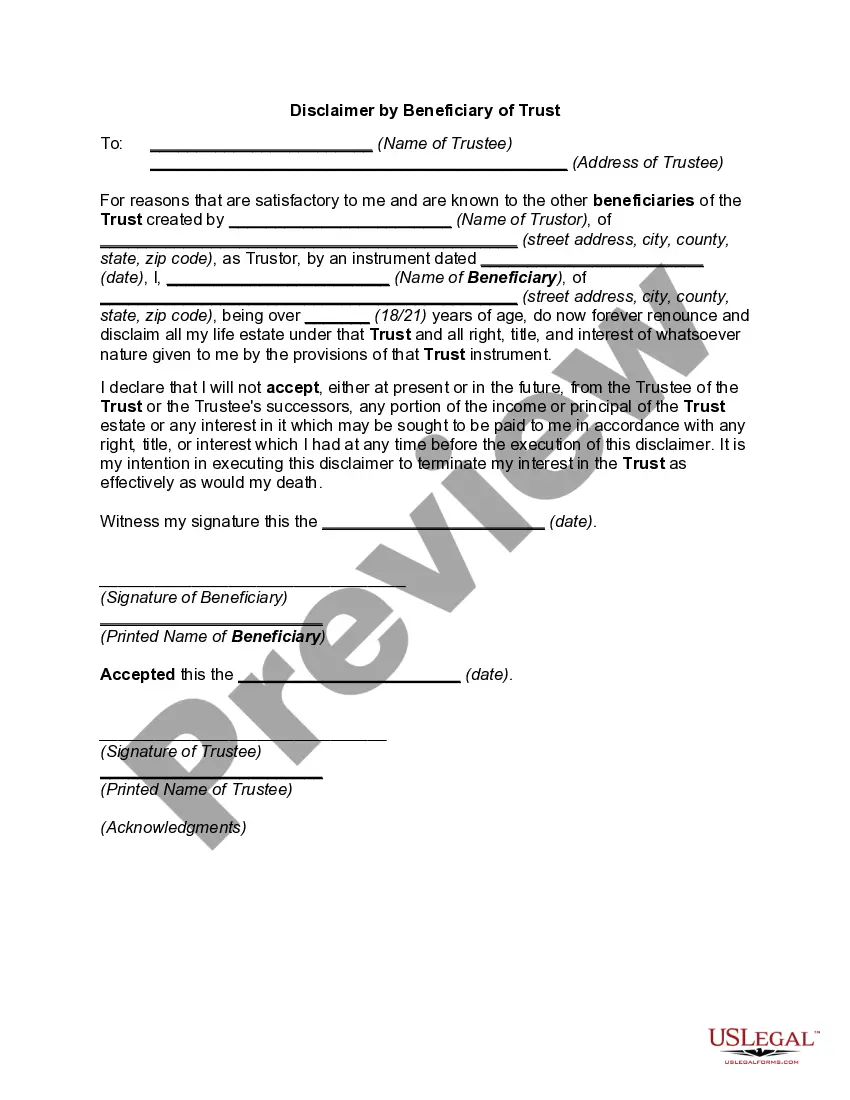
The Disclaimer by Beneficiary of all Rights in Trust is a legal document allowing a beneficiary to renounce their rights and interests in a trust. This form is particularly important when a beneficiary no longer wishes to accept assets conveyed by a trust, whether due to personal reasons or tax considerations. It serves to legally disassociate the beneficiary from any claims to the trust, distinguishing it from other legal documents that may be used to manage or distribute trust assets.
Form components explained
- Name and address of the Trustee, ensuring correct identification.
- Name of the Trust and Trustor, which provide context for the disclaimer.
- Date of the trust instrument, establishing a reference point for the disclaimer claim.
- Name and address of the Beneficiary renouncing their interest in the Trust.
- Clear declaration of the Beneficiary's intent to renounce all interests, specifying that this action is final.
- Signature of the Beneficiary and the date of signing, which are necessary for validation.
Situations where this form applies
This form is appropriate when a beneficiary decides to renounce their inheritance or rights to a trust. Situations may include financial planning purposes, avoidance of tax liabilities, or personal reasons related to family dynamics. Individuals may also use this document if they choose to pass their interest to another beneficiary or charitable organization.
Who this form is for
- Beneficiaries of a trust wanting to disclaim their rights and interests.
- Individuals seeking to clarify their intent not to accept benefits from a trust.
- Those involved in estate planning who wish to redistribute trust assets among other beneficiaries.
- Anyone looking to simplify their estate and trust arrangement for future clarity.
Instructions for completing this form
- Enter the name and address of the Trustee at the top of the form.
- Specify the name of the Trustor and the complete address of the trust.
- Fill in the date of the trust instrument as stated in the original trust document.
- Write your name and address as the Beneficiary intending to disclaim your rights.
- Add the date of signing and provide your signature at the end of the document.
Notarization requirements for this form
Notarization is not commonly needed for this form. However, certain documents or local rules may make it necessary. Our notarization service, powered by Notarize, allows you to finalize it securely online anytime, day or night.
Get your form ready online
Our built-in tools help you complete, sign, share, and store your documents in one place.
Make edits, fill in missing information, and update formatting in US Legal Forms—just like you would in MS Word.
Download a copy, print it, send it by email, or mail it via USPS—whatever works best for your next step.
Sign and collect signatures with our SignNow integration. Send to multiple recipients, set reminders, and more. Go Premium to unlock E-Sign.
If this form requires notarization, complete it online through a secure video call—no need to meet a notary in person or wait for an appointment.
We protect your documents and personal data by following strict security and privacy standards.

Make edits, fill in missing information, and update formatting in US Legal Forms—just like you would in MS Word.

Download a copy, print it, send it by email, or mail it via USPS—whatever works best for your next step.

Sign and collect signatures with our SignNow integration. Send to multiple recipients, set reminders, and more. Go Premium to unlock E-Sign.

If this form requires notarization, complete it online through a secure video call—no need to meet a notary in person or wait for an appointment.

We protect your documents and personal data by following strict security and privacy standards.
Common mistakes to avoid
- Failing to include all required parties' names and addresses, leading to potential legal issues.
- Not keeping a copy of the completed disclaimer for personal records.
- Assuming verbal disclaimers are sufficient; legal formalities must be properly followed.
- Neglecting to verify local laws regarding disclaimers before submission.
Why complete this form online
- Immediate access to a standardized template drafted by licensed attorneys.
- Convenience of downloading and completing the form from anywhere at any time.
- Editability allows for customization based on individual circumstances.
- Reliability ensured by the legal expertise that informs the form's structure and language.
Legal use & context
- The disclaimer serves to legally sever any claims by the beneficiary on the trust's assets, similar to the effects of death.
- It is important for tax implications, as accepting trust assets may have tax consequences.
- This form can also prevent disputes between beneficiaries regarding the distribution of trust estate assets.
What to keep in mind
- The Disclaimer by Beneficiary of all Rights in Trust allows a beneficiary to relinquish their interest in a trust.
- Proper completion requires clear identification of all parties and precise declarations of intent.
- Consult local laws to ensure that the disclaimer adheres to specific state requirements.
- This form can simplify estate matters and prevent future disputes between beneficiaries.
Looking for another form?
Form popularity
FAQ
This form allows a beneficiary to renounce their rights and interests in a trust, effectively disassociating from the trust’s assets. It is used when a beneficiary does not wish to accept assets conveyed by the trust, for planning, tax, or personal reasons. The document requires identifying the trustee, the trust and trustor, the renouncing beneficiary, a final declaration, and the signature with date.
A beneficiary disclaimer is the act of renouncing all rights or interests in a trust. This form requires the beneficiary to make a final declaration renouncing all interests and disassociating from claims to the trust, which supports estate planning goals and could enable redistribution of assets among other beneficiaries.
Disclaimer statements are final, unambiguous declarations renouncing all rights in the trust. In this form, the statement must clearly express the beneficiary’s intent to renounce all interests and state that the action is final. Such language establishes the scope and finality of the renunciation.
Fill in the trustee’s name and address, the trust’s name and trustor, the date of the trust instrument, the beneficiary’s name and address, a clear final declaration renouncing all interests, and the beneficiary’s signature and date.
This form is completed by the Beneficiary who fills the required fields, then signs and dates to finalize the disclaimer of all rights in the trust. The signature and date validate the document, and it may need to be delivered or filed per the trust terms.
This form requires a clear, final renunciation of all interests in the trust and collects full identifying details (trust, trustee, trustor, beneficiary) plus the signature and date. A partial disclaimer would renounce only certain rights, not all.