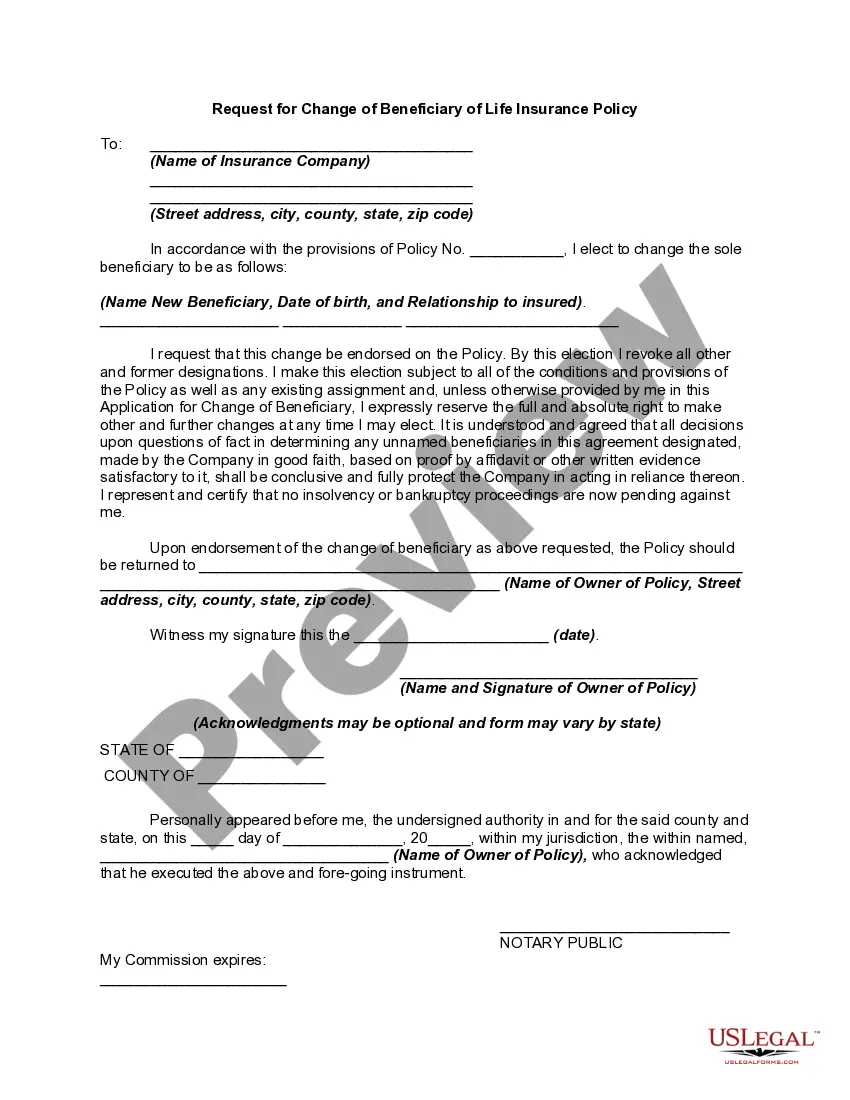
Request for Change of Beneficiary of Life Insurance Policy
What is this form?
The Request for Change of Beneficiary of Life Insurance Policy is a legal document that allows policyholders to designate a new beneficiary for their life insurance policy. This form differs from similar forms by specifically addressing the procedure for changing beneficiaries, which may include obtaining consent if the beneficiary has vested rights. It ensures that the policyholder's wishes are clearly documented and legally recognized by the insurance company.
Key parts of this document
- Name and address of the insurance company.
- Policy number for identification purposes.
- Details of the new beneficiary, including name, date of birth, and relationship to the insured.
- Revocation of all previous beneficiary designations.
- Signature of the policy owner with the date of completion.
- Notary acknowledgment to validate the request, if required.

When to use this document
This form should be used when a policyholder wishes to change the designated beneficiary of their life insurance policy. Scenarios may include a change in marital status, the birth of a child, or simply updating the beneficiaries due to changes in personal circumstances or preferences. It is crucial to ensure the insurance company is notified of these changes to reflect the policyholder's current intentions.
Who should use this form
- Individuals with a life insurance policy who wish to change their beneficiary.
- Policyholders who have experienced significant life events, such as marriage or divorce.
- Those who want to ensure their insurance benefits are directed to the intended recipient.
- Anyone designated as the owner of the policy looking to make official changes.
Instructions for completing this form
- Identify the insurance company by entering its name and address at the top of the form.
- Provide the policy number to ensure the correct document is updated.
- Fill in the new beneficiary's details, including their full name, date of birth, and relationship to the insured.
- Sign and date the form to validate your request for a change of beneficiary.
- If required, arrange for the form to be notarized to meet legal standards.
Does this document require notarization?
Notarization is required for this form to take effect. Our online notarization service, powered by Notarize, lets you verify and sign documents remotely through an encrypted video session, available 24/7.
Get your form ready online
Our built-in tools help you complete, sign, share, and store your documents in one place.
Make edits, fill in missing information, and update formatting in US Legal Forms—just like you would in MS Word.
Download a copy, print it, send it by email, or mail it via USPS—whatever works best for your next step.
Sign and collect signatures with our SignNow integration. Send to multiple recipients, set reminders, and more. Go Premium to unlock E-Sign.
If this form requires notarization, complete it online through a secure video call—no need to meet a notary in person or wait for an appointment.
We protect your documents and personal data by following strict security and privacy standards.

Make edits, fill in missing information, and update formatting in US Legal Forms—just like you would in MS Word.

Download a copy, print it, send it by email, or mail it via USPS—whatever works best for your next step.

Sign and collect signatures with our SignNow integration. Send to multiple recipients, set reminders, and more. Go Premium to unlock E-Sign.

If this form requires notarization, complete it online through a secure video call—no need to meet a notary in person or wait for an appointment.

We protect your documents and personal data by following strict security and privacy standards.
Common mistakes
- Failing to obtain consent from an existing beneficiary when required.
- Not providing complete information about the new beneficiary.
- Neglecting to sign and date the form.
- Overlooking state-specific requirements or instructions set by the insurance company.
Why use this form online
- Convenience of completing the form at your own pace from anywhere.
- Editable templates that allow for easy updates as needed.
- Access to legal accuracy, as templates are drafted by licensed attorneys.
Looking for another form?




Form popularity
FAQ
The Request for Change of Beneficiary of Life Insurance Policy is a legal form that lets a policy owner designate a new beneficiary for their policy. It requires the insurer's name and address, the policy number, the new beneficiary's details, revocation of prior designations, and the policy owner's signature and date, with a notary acknowledgment if required. Use it after life events or changes in wishes.
Yes. The form simplifies the change by collecting essential details: insurer's name and address, policy number, the new beneficiary's name, date of birth, and relationship to the insured, plus revocation of prior designations, the policy owner's signature and date, and a notary acknowledgment if required. Some policies may require consent from vested beneficiaries.
Changing a beneficiary with this form does not affect SSDI benefits. The form only changes who receives life insurance proceeds and does not determine Social Security disability benefits. For SSDI questions, consult a benefits professional or the Social Security Administration. Payout timing and amounts are governed by the policy terms and contract.
Having life insurance while on SSDI is generally possible and is separate from this form. This form focuses on beneficiary changes and does not address SSDI eligibility or coverage terms. For policy-specific guidance, speak with a licensed insurance professional.
To complete the form, provide the insurer's name and address, the policy number, and the new beneficiary's details (name, date of birth, relationship). Then revoke previous designations, sign and date the form, and obtain a notary acknowledgment if required. Submit the document to the insurer to process the change.
This form stands out because it specifically addresses the procedure for changing beneficiaries, including possible consent if a beneficiary has vested rights. It also requires revoking all prior beneficiary designations and includes the policy owner's signature, date, and a notary acknowledgment if required, ensuring the change is clearly documented and recognized by the insurer.