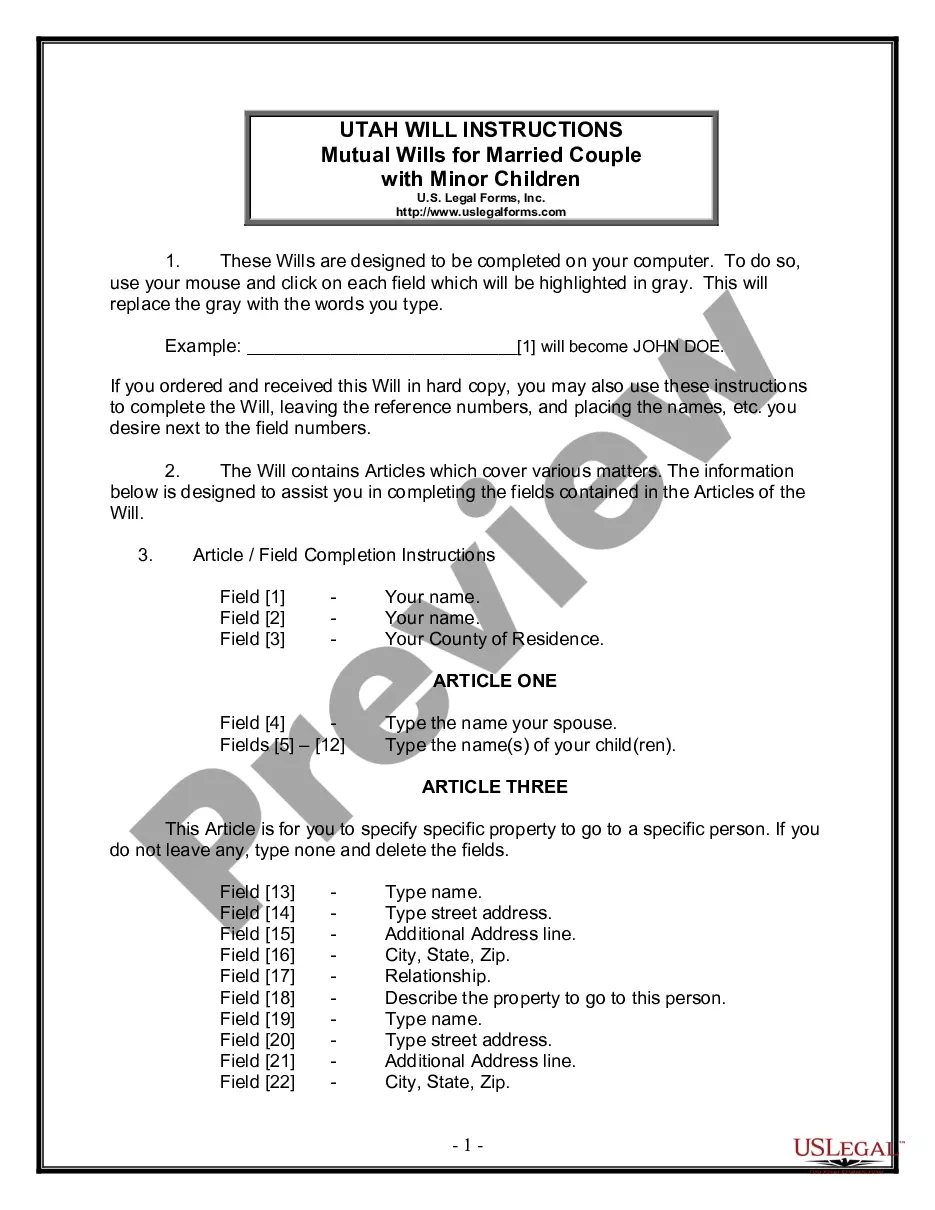
Motion to Invoke the Rule Prior to Voir Dire and To Enjoin the District Attorney From Advising Witnesses of Previous Testimony
Overview of this form
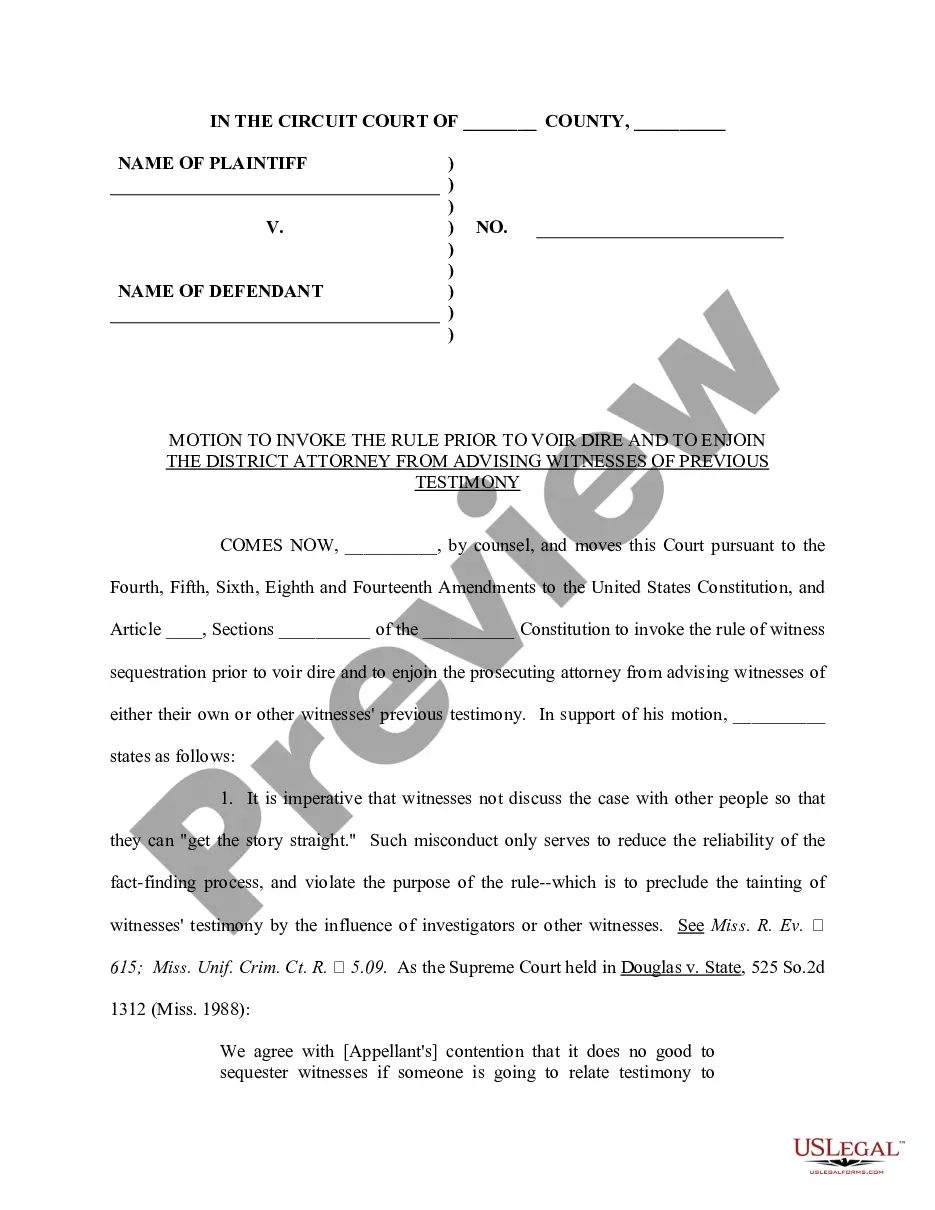
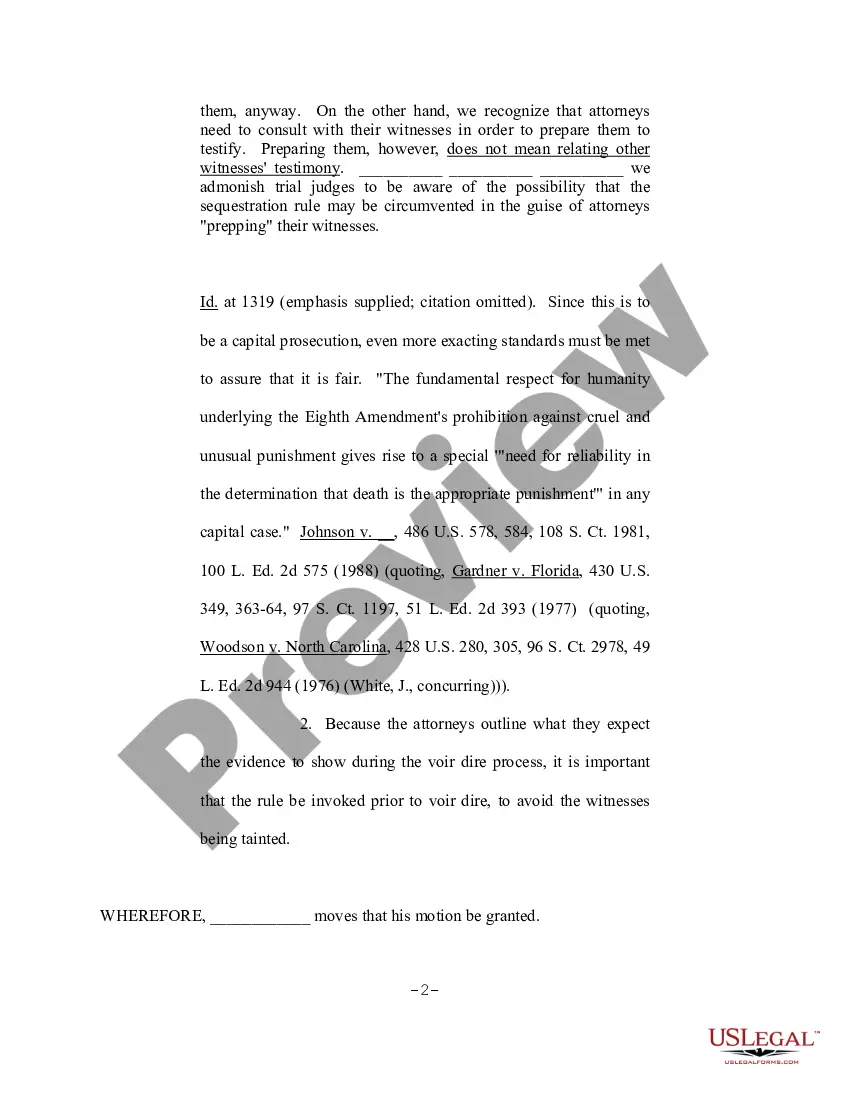
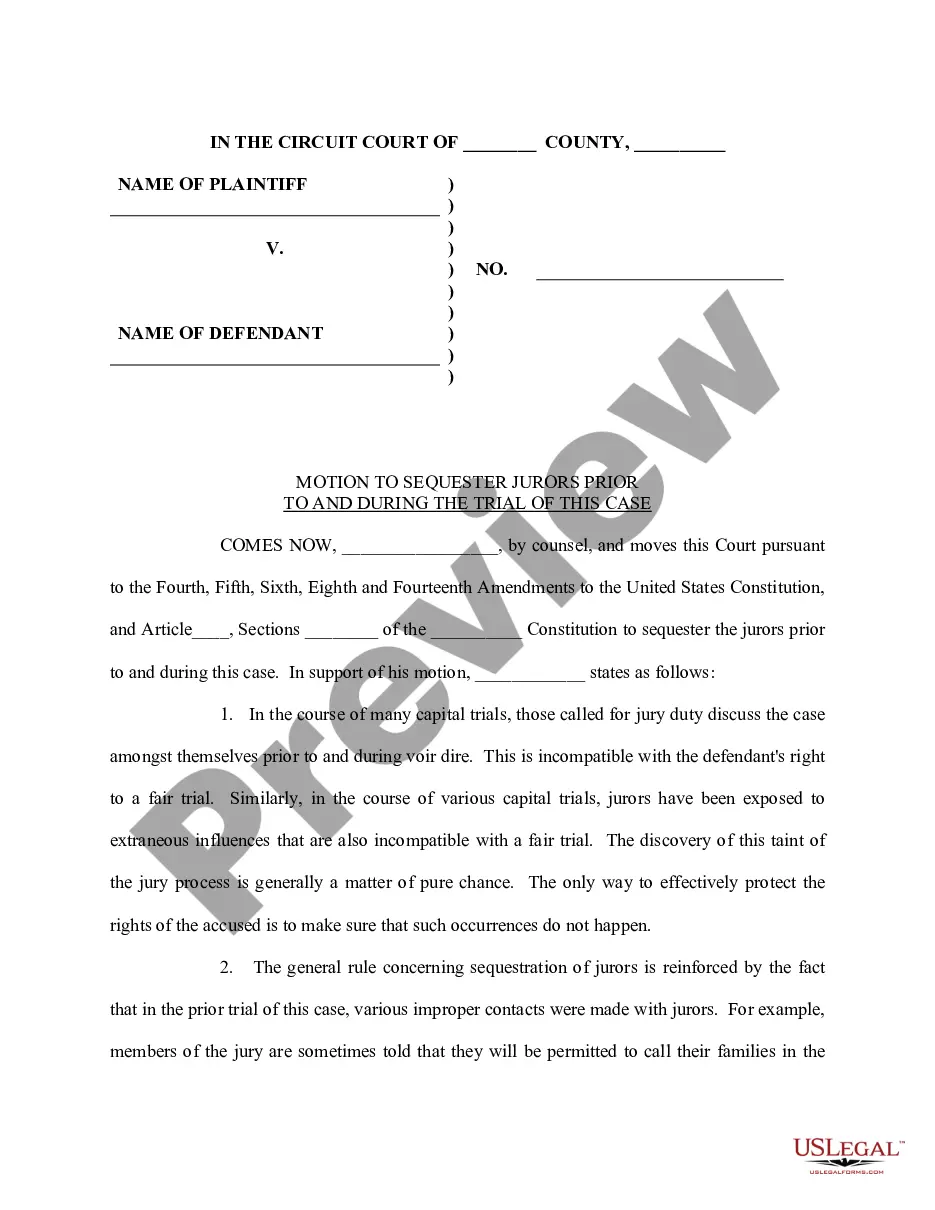
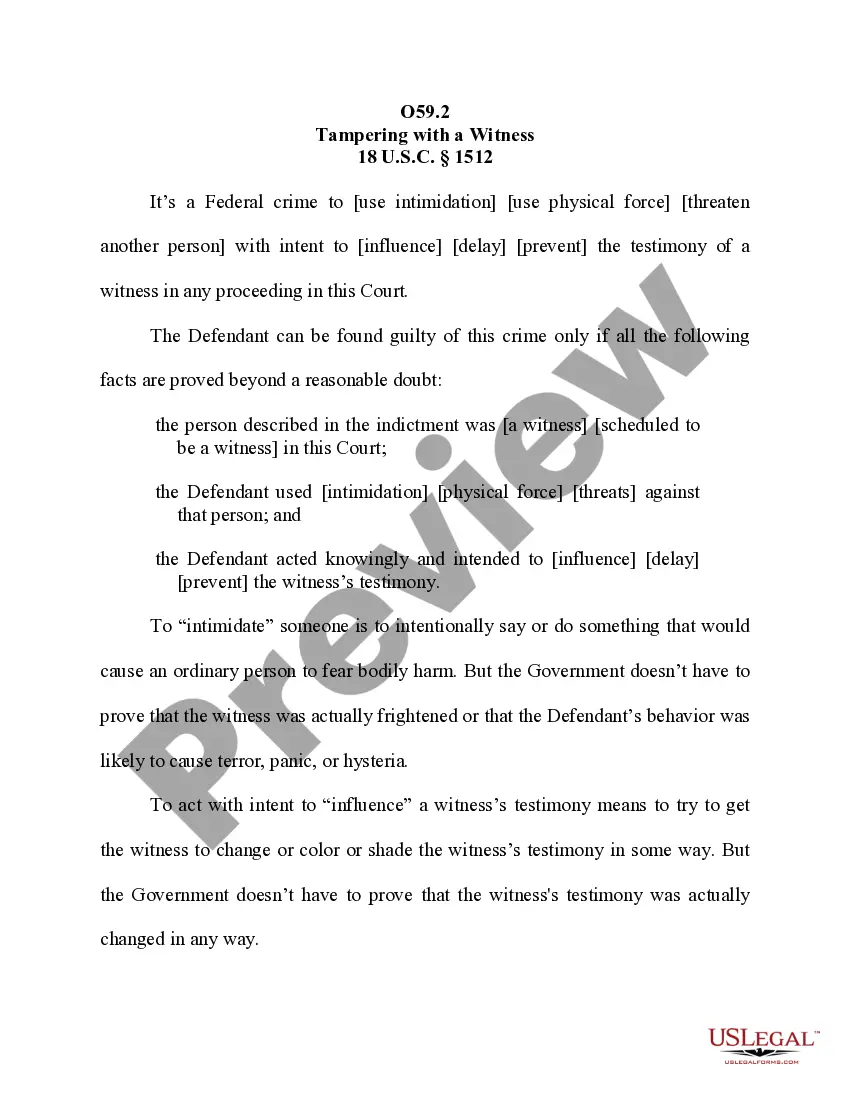
This legal form is a Motion to Invoke the Rule Prior to Voir Dire and to Enjoin the District Attorney from Advising Witnesses of Previous Testimony. It serves the purpose of requesting the court to limit witness interaction and advising before the jury selection process, ensuring fair trial standards. This motion is particularly relevant in capital cases where the stakes are high and the need for fairness is paramount, distinguishing it from other motion forms that do not specifically concern witness sequestration.
What’s included in this form
- Introduction detailing the party making the motion and legal grounds.
- Declaration for invoking witness sequestration prior to voir dire.
- Request to prevent the prosecuting attorney from advising witnesses.
- Arguments supporting the need for the motion, especially in capital cases.
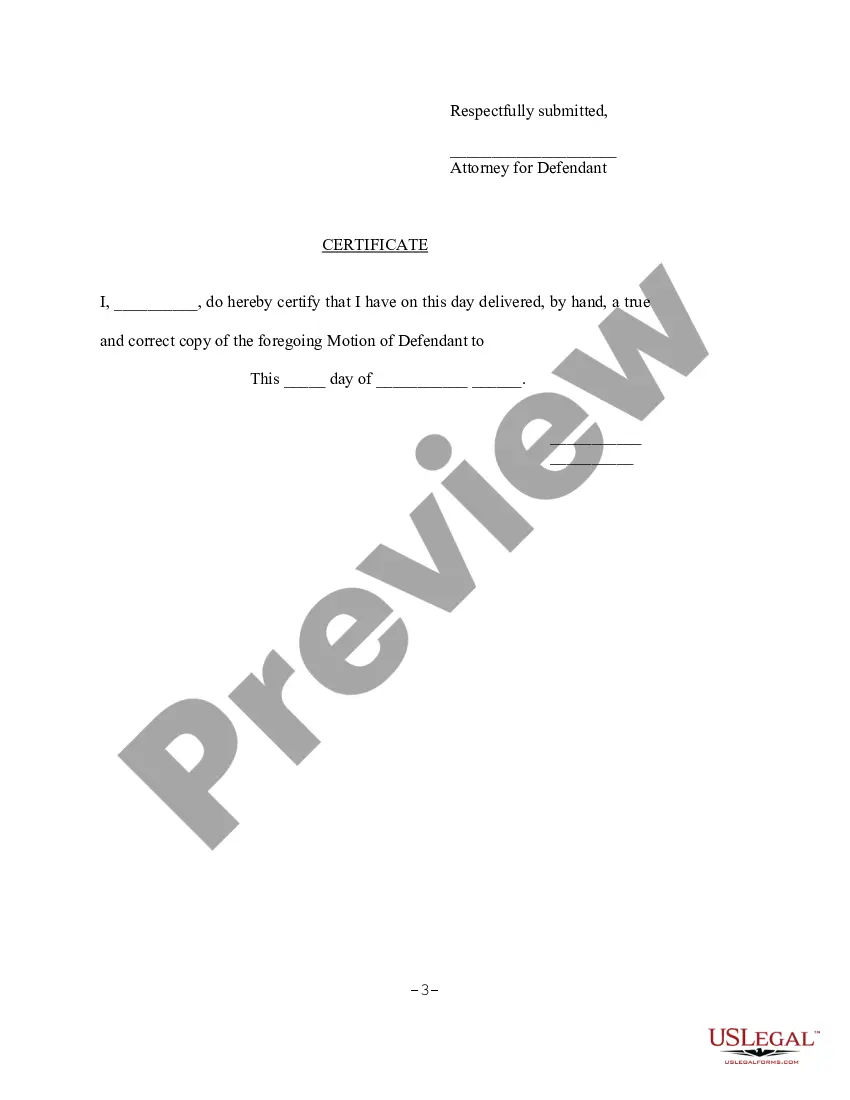
- Signature block for the attorney representing the defendant.
- Certificate of service to confirm delivery of the motion to relevant parties.
Situations where this form applies
This form is used in situations where a defendant wishes to safeguard the integrity of witness testimony during the voir dire process. It is applicable in criminal cases, particularly when facing serious charges, such as capital offenses, where ensuring a fair trial is essential for the accused's rights. If a defendant believes that witnesses may be influenced or tainted by previous testimonies, this motion is crucial to maintain the fairness of the trial.
Who should use this form
- Defendants in criminal cases, especially capital prosecutions.
- Attorneys representing defendants seeking to ensure a fair trial.
- Legal counsel in jurisdictions where witness sequestration is required before voir dire.
How to complete this form
- Identify the parties involved, including the defendant and the court.
- Provide the legal grounds for the motion based on constitutional amendments.
- Clearly state the request for witness sequestration and the reasons for this request.
- Have the attorney sign the motion, confirming their representation of the defendant.
- Complete the certificate of service to indicate delivery of the motion to parties involved.
Notarization requirements for this form
Notarization is not commonly needed for this form. However, certain documents or local rules may make it necessary. Our notarization service, powered by Notarize, allows you to finalize it securely online anytime, day or night.
Get your form ready online
Our built-in tools help you complete, sign, share, and store your documents in one place.
Make edits, fill in missing information, and update formatting in US Legal Forms—just like you would in MS Word.
Download a copy, print it, send it by email, or mail it via USPS—whatever works best for your next step.
Sign and collect signatures with our SignNow integration. Send to multiple recipients, set reminders, and more. Go Premium to unlock E-Sign.
If this form requires notarization, complete it online through a secure video call—no need to meet a notary in person or wait for an appointment.
We protect your documents and personal data by following strict security and privacy standards.

Make edits, fill in missing information, and update formatting in US Legal Forms—just like you would in MS Word.

Download a copy, print it, send it by email, or mail it via USPS—whatever works best for your next step.

Sign and collect signatures with our SignNow integration. Send to multiple recipients, set reminders, and more. Go Premium to unlock E-Sign.

If this form requires notarization, complete it online through a secure video call—no need to meet a notary in person or wait for an appointment.

We protect your documents and personal data by following strict security and privacy standards.
Avoid these common issues
- Failing to provide a clear legal basis for the motion.
- Not identifying or including all relevant parties in the motion.
- Omitting the certificate of service or failing to complete it correctly.
- Not adjusting the form for state-specific requirements where necessary.
Benefits of completing this form online
- Convenient access to legally drafted templates that save time.
- Editability allows users to personalize the form as per their case specifics.
- Reliability, knowing that the form is created by licensed attorneys.
- Streamlined process with easy downloading and saving for future reference.
Legal use & context
- The motion serves to enforce the rights of the defendant in a criminal trial.
- It is rooted in constitutional protections to ensure a fair trial, especially in capital cases.
- Judicial approval of the motion supports efforts to maintain impartiality during witness testimonies.
Main things to remember
- The Motion to Invoke the Rule Prior to Voir Dire is crucial for maintaining fair trial procedures.
- Ensuring witness sequestration prevents the contamination of testimonies.
- This form is applicable in multiple states and pertinent in serious criminal cases.
Looking for another form?
Form popularity
FAQ
A voir dire is a separate hearing in which the trier of law determines whether evidence is admissible and can potentially be entered into evidence in the trial. A voir dire can also be convened to determine the competence of a witness or to determine whether an expert witness is qualified to give evidence.
Relevant Life Experiences. In selecting (or de-selecting) a potential juror, one important element to consider is the person's previous life experience as it relates to the case at hand. Social Pressure. Online Activity. Legal Opinions. Ability to Be Impartial.
The judge instructs the jury about the relevant laws that should guide its deliberations. (In some jurisdictions, the court may instruct the jury at any time after the close of evidence.The judge reads the instructions to the jury. This is commonly referred to as the judge's charge to the jury.
When the plaintiff picks jurors, they're looking for those who are very sympathetic, who are willing to view the prosecution as the victim in the case. Very often, union employees make for good prosecution jurors as they are used to fighting injustice.
Voir dire is the process used by the parties to select a fair and impartial jury. During voir dire, the jury panel is questioned by both parties' lawyers. The questions are intended to help the lawyers in the jury selection process.
French for "to speak the truth." The process through which potential jurors from the venire are questioned by either the judge or a lawyer to determine their suitability for jury service. Also the preliminary questioning of witnesses (especially experts) to determine their competence to testify. See, e.g. Peretz v.
Voir dire (/02c8vw025102d0r d026a0259r/; often /v0254026ar da026a0259r/; from an Anglo-Norman phrase meaning "speak the truth") is a legal phrase for a variety of procedures connected with jury trials.
Adopt the proper orientation. Set the stage for jurors. Get them talking. Ask open-ended questions. Avoid the Socially Desirable Response Bias. Focus on difficulty vs. Use alternative route to uncover bias. Design questions using bad answers.
Lawyers and judges select juries by a process known as voir dire, which is Latin for to speak the truth. In voir dire, the judge and attorneys for both sides ask potential jurors questions to determine if they are competent and suitable to serve in the case.