Special Cemetery Gift Trust Fund
Overview of this form
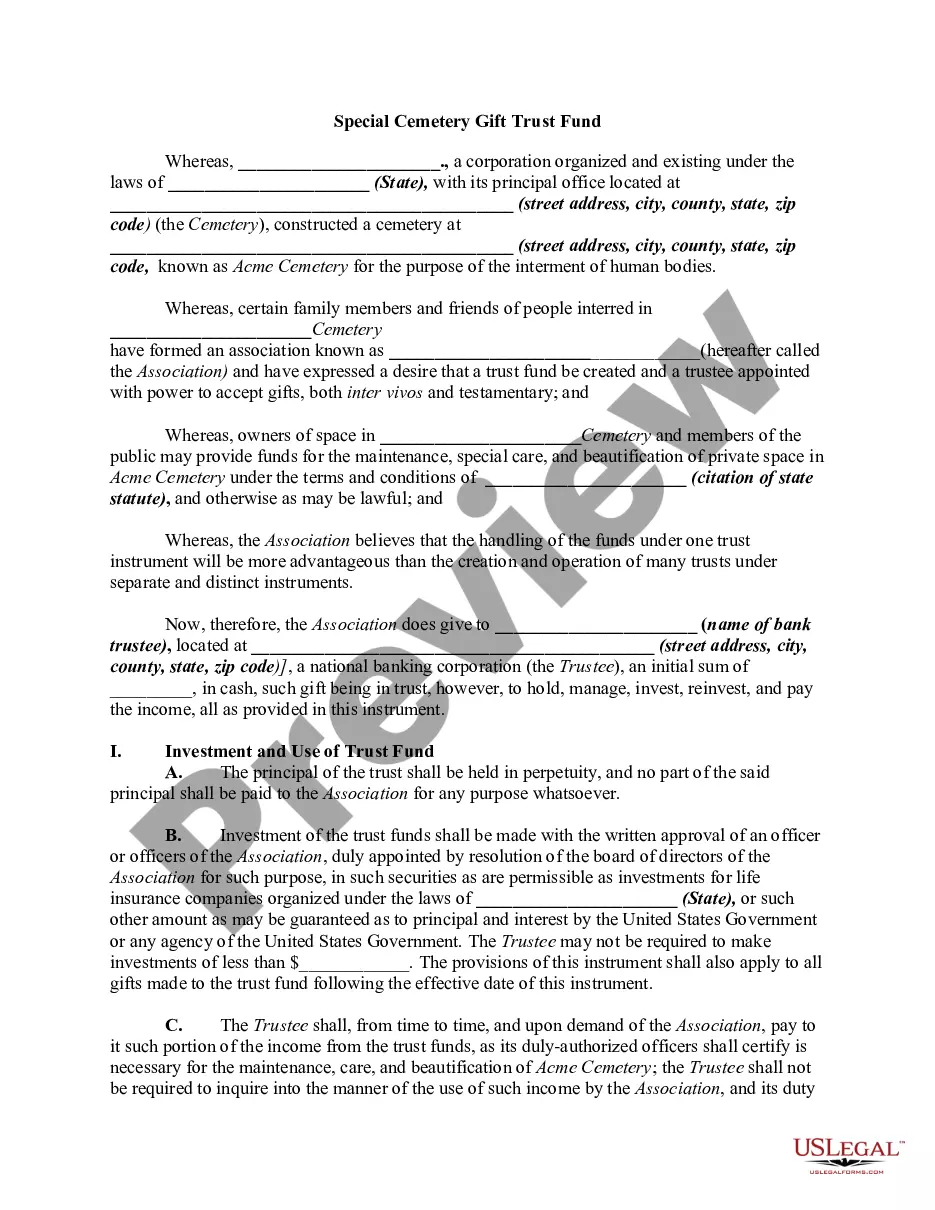
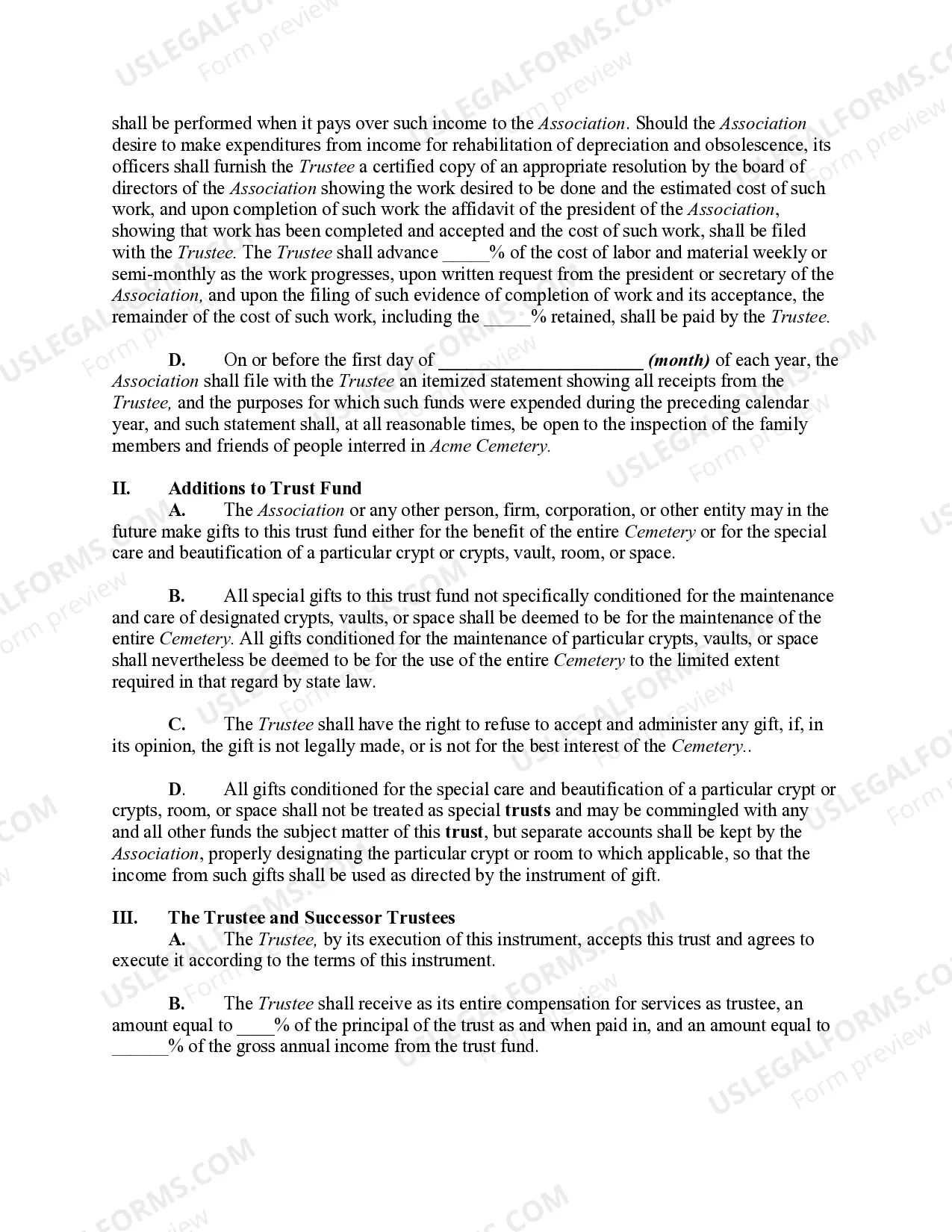
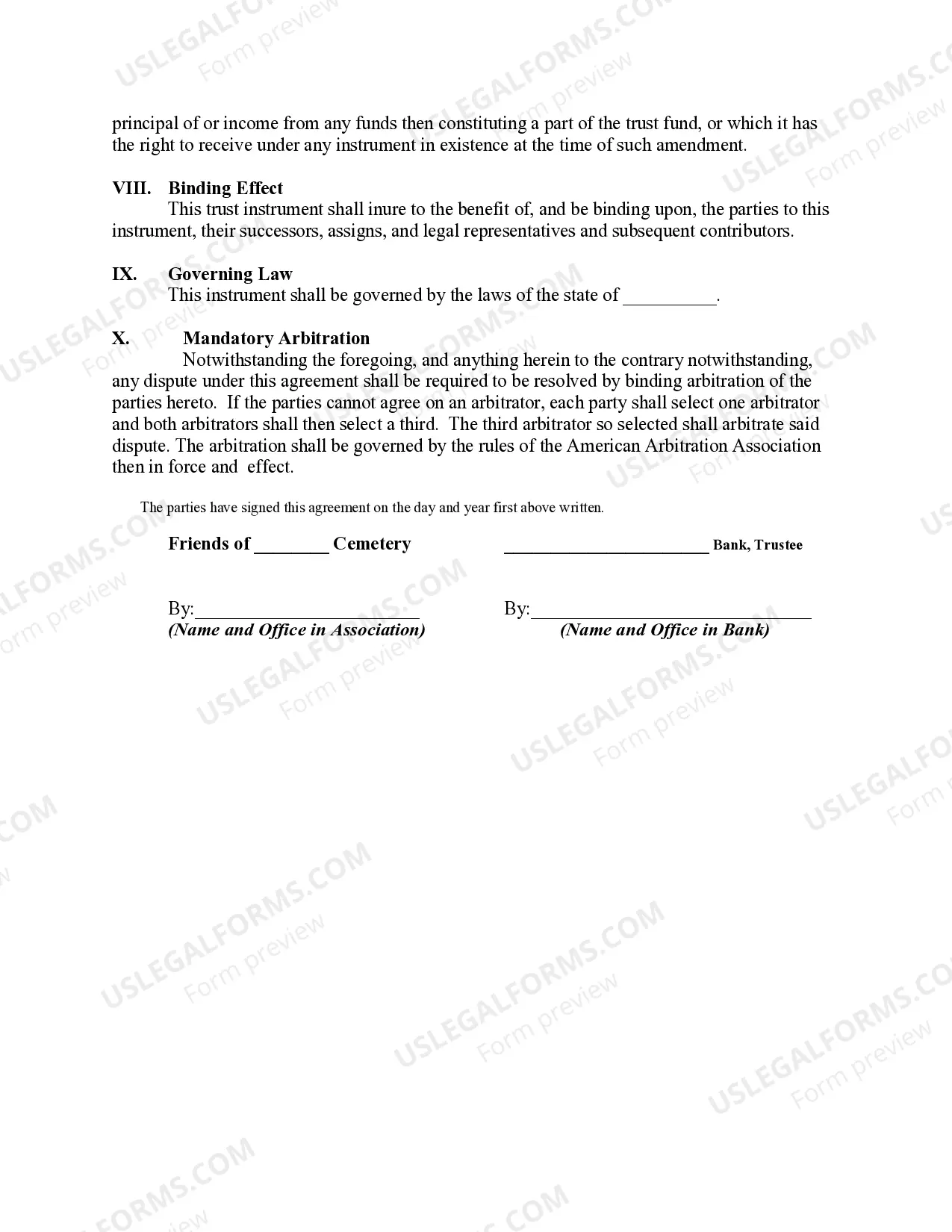
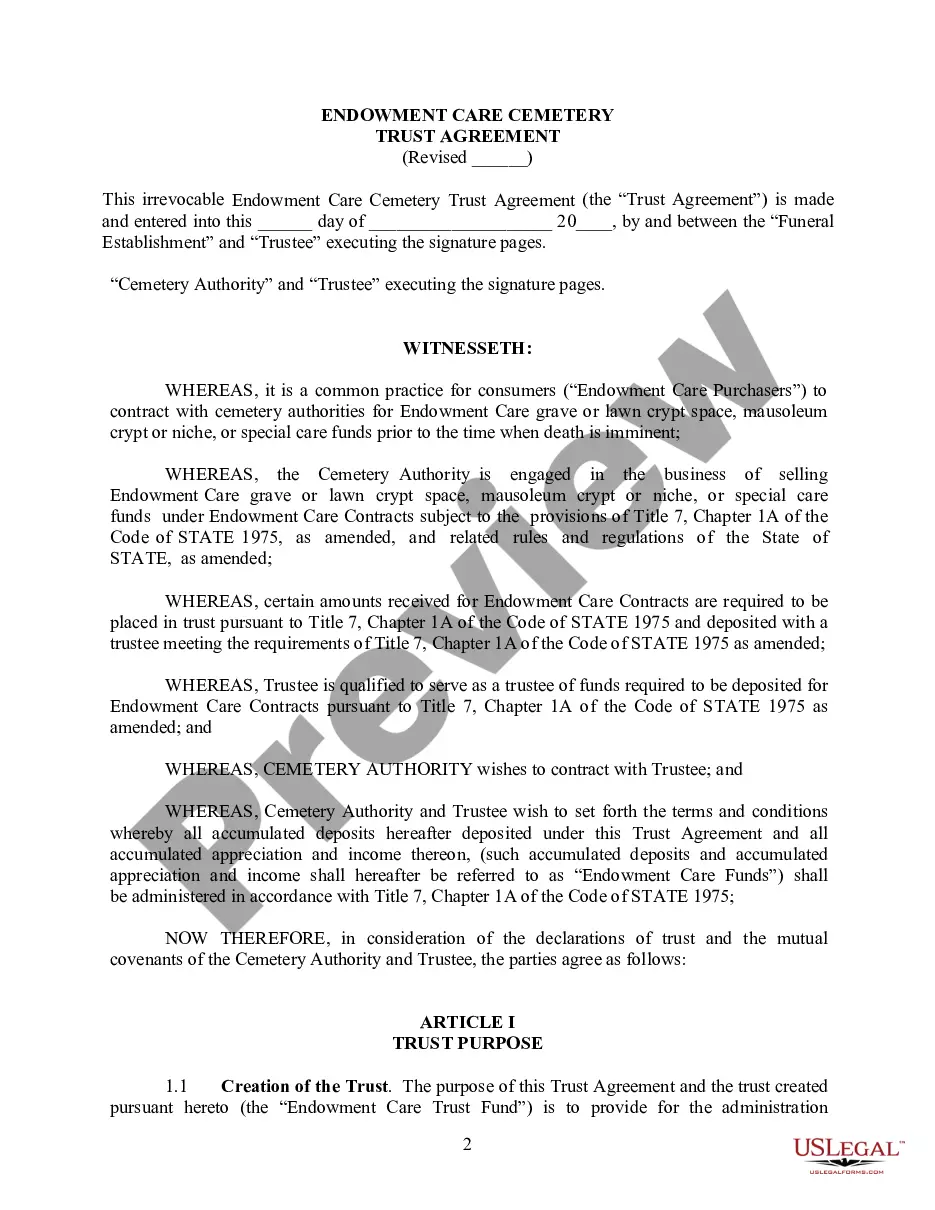
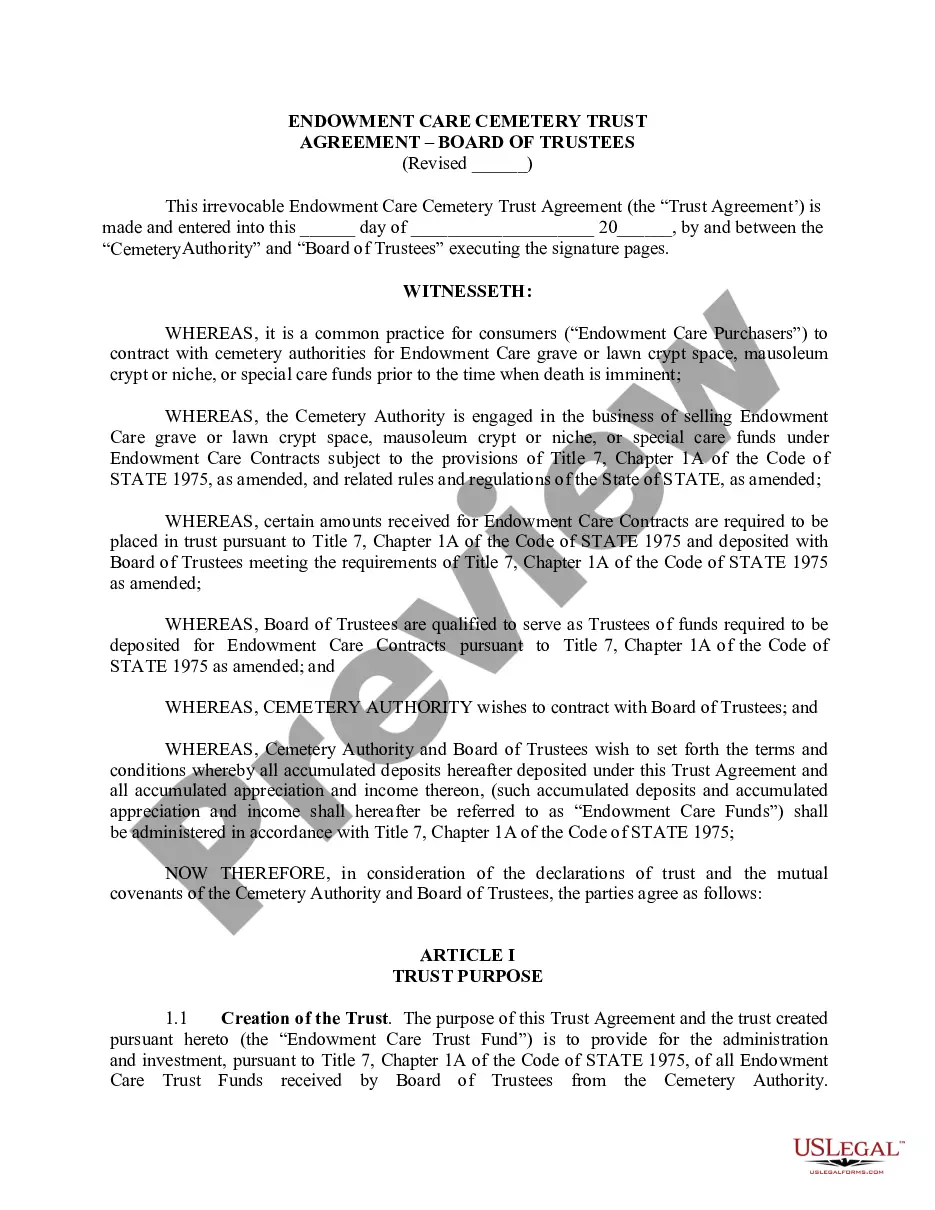
The Special Cemetery Gift Trust Fund form is a legal document that establishes a trust fund created by family members and friends of individuals interred in a cemetery. This trust fund is intended to provide financial support for the maintenance and restoration of the cemetery. Unlike other trusts, this specific fund combines contributions to facilitate better management of resources, ensuring that funds are exclusively designated for the care and beautification of the cemetery.
Main sections of this form
- Trust establishment: Specifies the formation of the trust fund by an association formed by family members and friends.
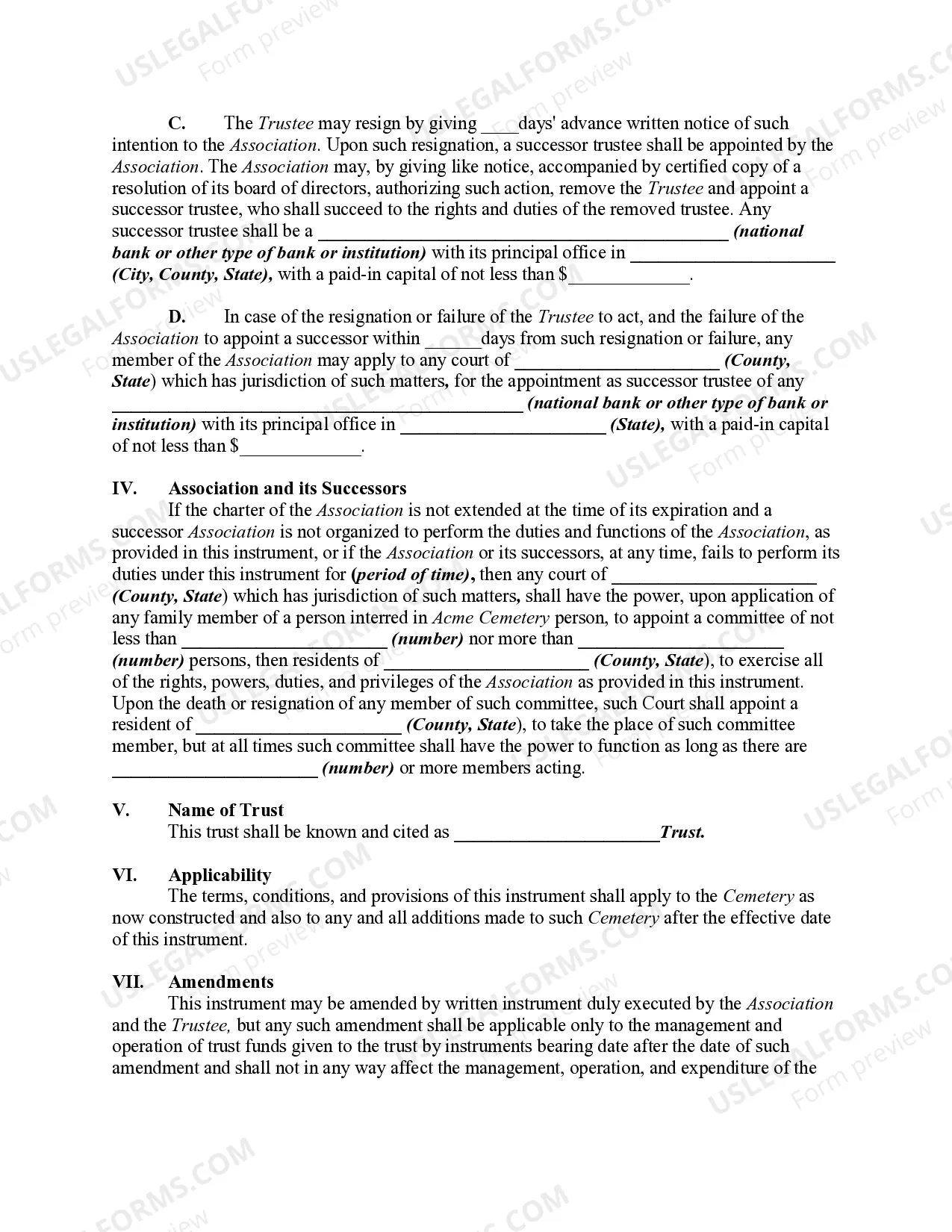
- Trustee appointment: Details the authority and responsibilities of the appointed trustee managing the funds.
- Investment guidelines: Outlines permissible investments for the trust's principal to ensure its growth.
- Use of funds: Describes how the income generated from the trust may be used for the cemetery's maintenance.
- Reporting requirements: Specifies annual reporting obligations for the Association regarding fund usage.
- Amendment procedures: Provides guidelines for how changes to the trust agreement can be made.

Situations where this form applies
This form should be used when family members or friends of individuals buried in a cemetery wish to create a collective trust fund. It is particularly useful when there is a desire to ensure long-term maintenance and improvements of the burial site. Additionally, it can be employed when contributions are being solicited from various donors for specific care projects within the cemetery.
Intended users of this form
- Families and friends of individuals interred in a cemetery.
- Cemetery associations seeking to establish a trust fund for maintenance and care.
- Trustees or bank representatives responsible for managing cemetery trust funds.
Instructions for completing this form
- Identify the cemetery by entering its name and address.
- Complete the details of the trust fund, including the initial cash contribution.
- Designate the trustee's name and the financial institution involved.
- Specify the investment parameters, ensuring compliance with state laws.
- Include the terms for the distribution of income to the Association for cemetery maintenance.
- Sign and date the form to validate the trust creation.
Does this form need to be notarized?
This form does not typically require notarization unless specified by local law. However, having a notarized document can provide additional legal validation and assurance for all parties involved.
Get your form ready online
Our built-in tools help you complete, sign, share, and store your documents in one place.
Make edits, fill in missing information, and update formatting in US Legal Forms—just like you would in MS Word.
Download a copy, print it, send it by email, or mail it via USPS—whatever works best for your next step.
Sign and collect signatures with our SignNow integration. Send to multiple recipients, set reminders, and more. Go Premium to unlock E-Sign.
If this form requires notarization, complete it online through a secure video call—no need to meet a notary in person or wait for an appointment.
We protect your documents and personal data by following strict security and privacy standards.

Make edits, fill in missing information, and update formatting in US Legal Forms—just like you would in MS Word.

Download a copy, print it, send it by email, or mail it via USPS—whatever works best for your next step.

Sign and collect signatures with our SignNow integration. Send to multiple recipients, set reminders, and more. Go Premium to unlock E-Sign.

If this form requires notarization, complete it online through a secure video call—no need to meet a notary in person or wait for an appointment.

We protect your documents and personal data by following strict security and privacy standards.
Common mistakes
- Failing to specify the trustee correctly, which may lead to mismanagement of funds.
- Not adhering to state-specific laws regarding trust fund management.
- Insufficient details about the contributions, which may create ambiguity in the trust agreement.
- Skipping the required signatures, making the document invalid.
Advantages of online completion
- Convenience of accessing and filling out the form from any location.
- Easy editing options to customize the trust terms according to specific requirements.
- Reliability ensured through professionally drafted templates by licensed attorneys.
Looking for another form?
Form popularity
FAQ
A trust fund is a legal entity that holds property or assets on behalf of another person, group or organization. It is an estate planning tool that keeps your assets in a trust managed by a neutral third party, or trustee. A trust fund can include money, property, stock, a business or a combination of these.
A Giftrust is an irrevocable trust that was set up (by a grantor) to be a one-time gift to another person (the beneficiary). The trust has a maturity date, which is when control of the money will transfer to the beneficiary.
The Donor is the person who creates the trust and makes gifts to the trust. The Trustee is the person who agrees to run the trust for the benefit of the trust's beneficiaries and is named in the trust document. This type of trust is an irrevocable trust.
Beneficiaries of a trust typically pay taxes on the distributions they receive from the trust's income, rather than the trust itself paying the tax. However, such beneficiaries are not subject to taxes on distributions from the trust's principal.
The IRS does not levy gift taxes on trusts, nor does it consider payments from the trust to a beneficiary as a gift (it may be taxable income to the beneficiary, however).The IRS does not consider a "future interest" to be subject to gift tax.
The IRS does not levy gift taxes on trusts, nor does it consider payments from the trust to a beneficiary as a gift (it may be taxable income to the beneficiary, however).The IRS does not consider a "future interest" to be subject to gift tax.
Each year, a person can make transfers of $14,000 to the trust without any gift tax consequences.
A gift in trust is a special legal and fiduciary arrangement that allows for an indirect bequest of assets to a beneficiary. The purpose of a gift in trust is to avoid the tax on gifts that exceed the annual gift tax exclusion limit. This type of trust is commonly used to transfer wealth to the next generation.