Contract of Employment between Church and Organist
What this document covers
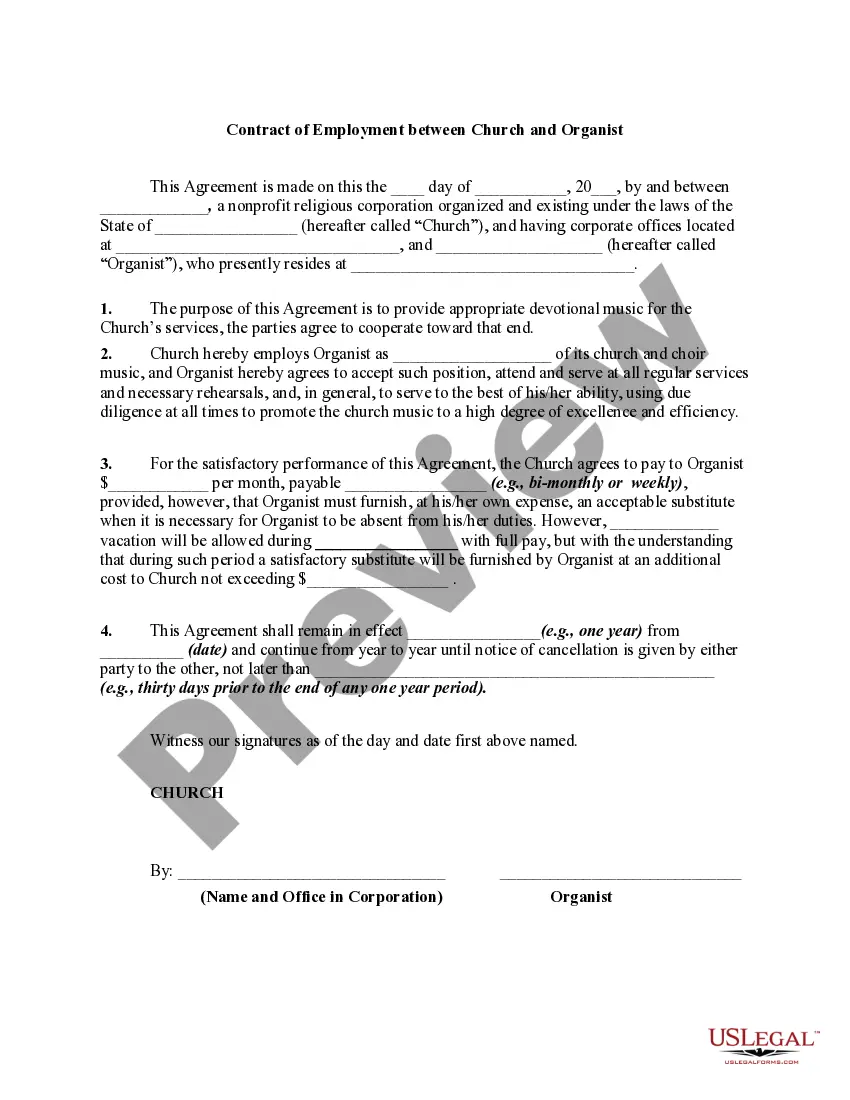
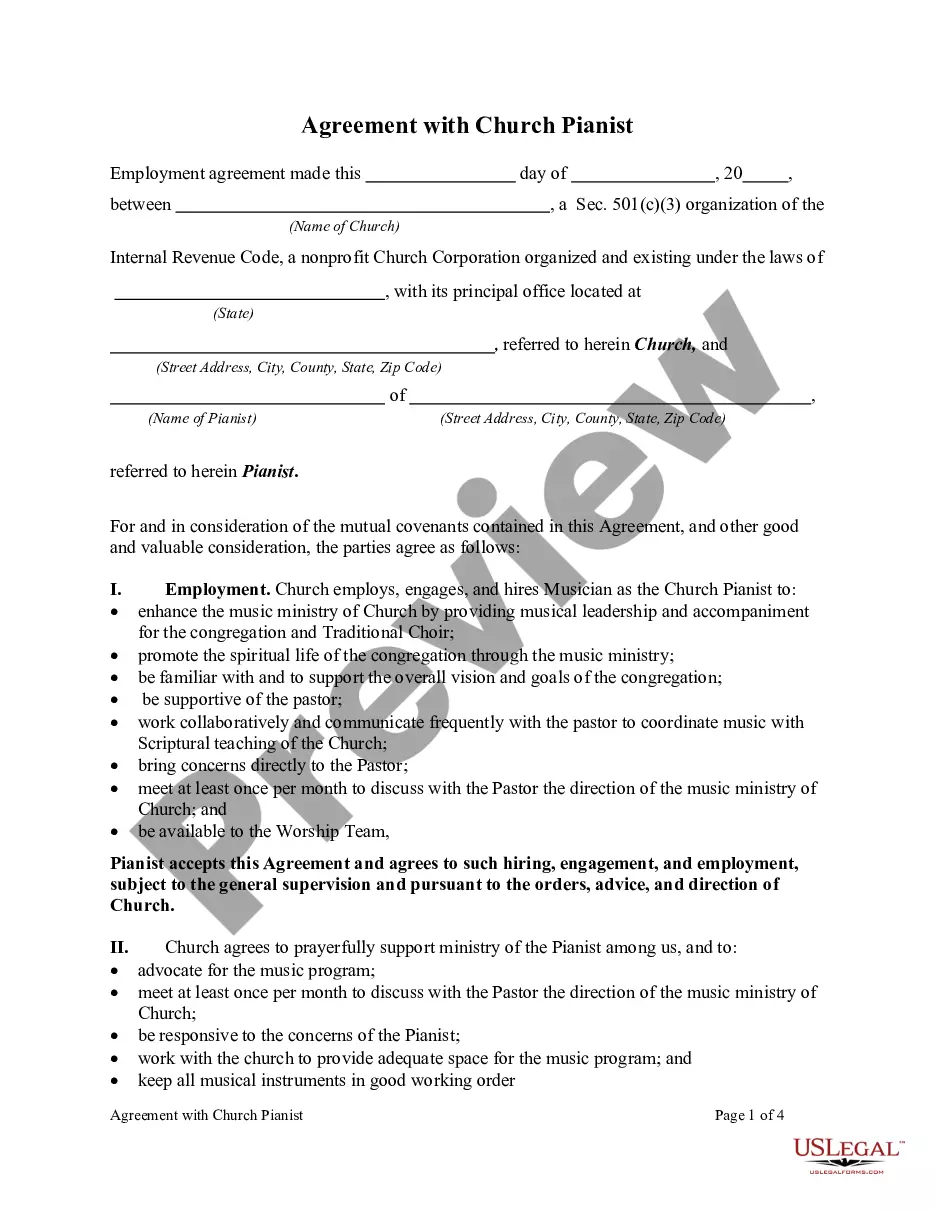
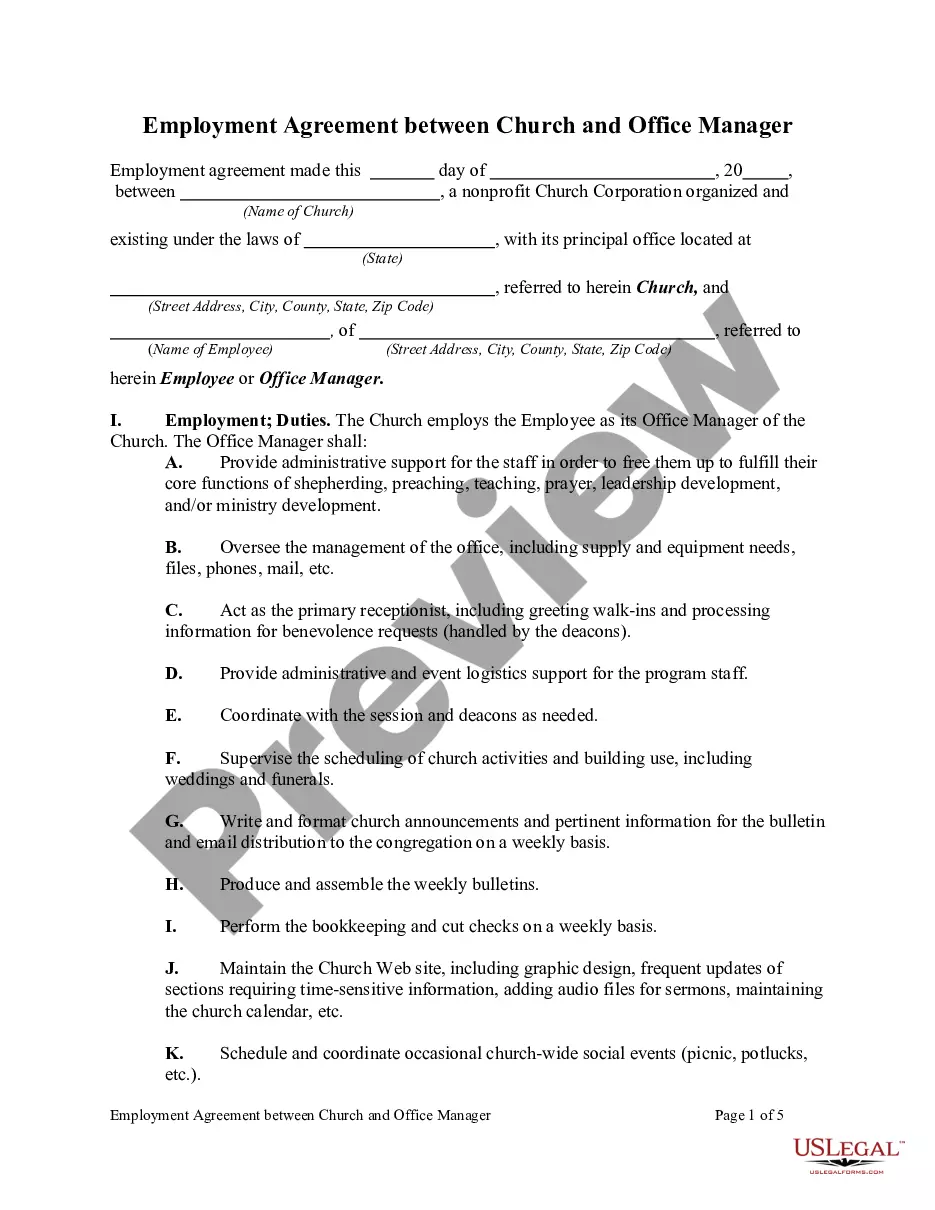
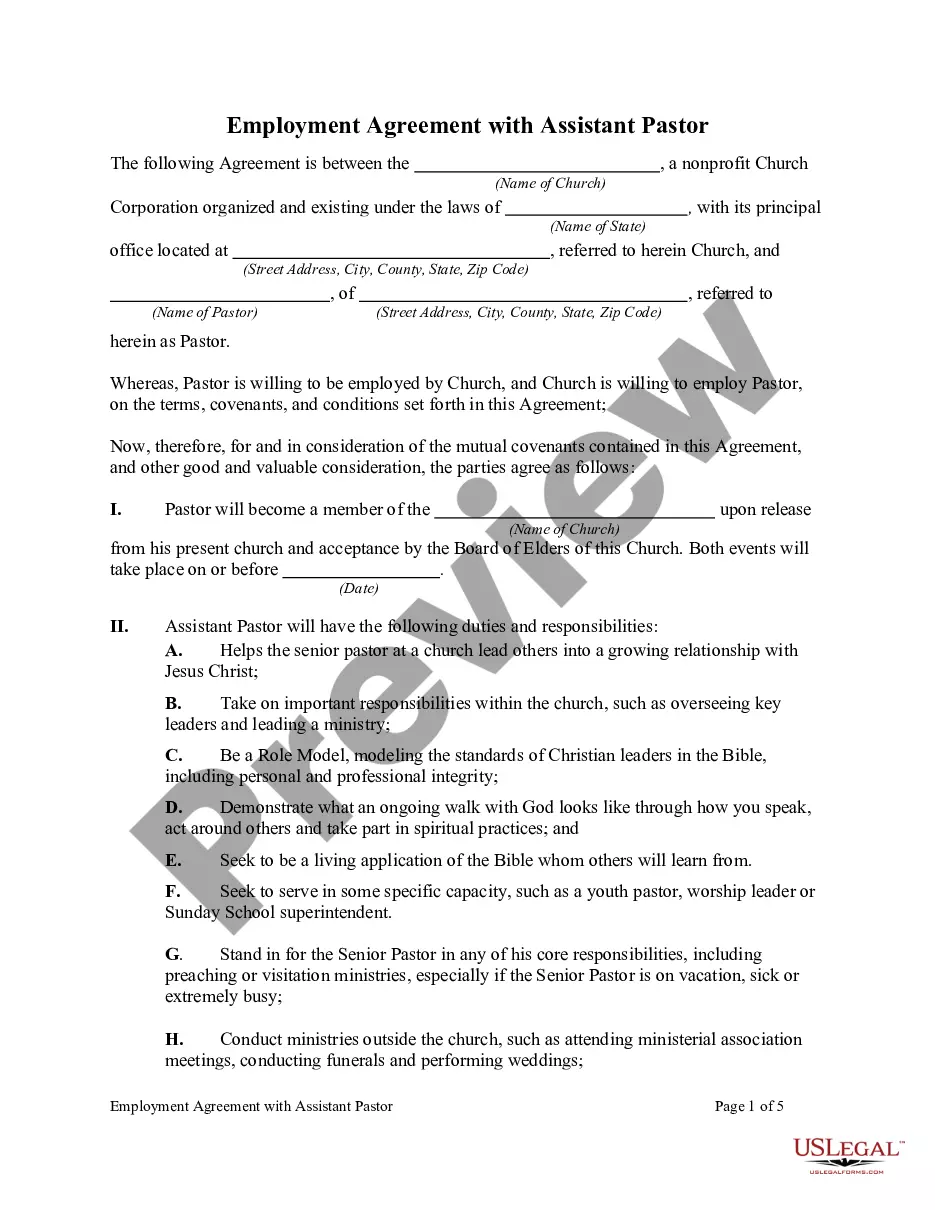
The Contract of Employment between Church and Organist is a legal agreement that outlines the terms of employment for an organist hired by a church. This form serves to formalize the relationship between the church and the musician, detailing expectations and compensation. Unlike other employment contracts, this agreement specifically addresses the provision of music for religious services, making it unique for churches seeking to formalize their musical arrangements.
Key parts of this document
- The agreement date and involved parties (church and organist).
- The purpose of the contract, specifying the need for devotional music.
- The organist's responsibilities, including attendance and performance quality.
- Compensation amount and payment schedule.
- Terms regarding substitution in case of absence and vacation allowances.
- The duration of the agreement and notice period for cancellation.
Situations where this form applies
This form should be used when a church intends to hire an organist for its services and choir rehearsals. It is applicable in situations where the church wants to ensure a clear understanding of duties, compensation, and conditions for absence and vacation. Using this contract helps avoid misunderstandings and provides clarity on the expectations between the church and organist.
Who needs this form
- Church administrators or leadership seeking to hire an organist.
- Musicians looking to formalize an employment arrangement with a church.
- Nonprofit religious organizations that may need clear terms for employment in music roles.
Steps to complete this form
- Fill in the date of the agreement at the beginning of the document.
- Identify the named parties: include the church's name and the organist's full name.
- Specify the organist's position and detailed responsibilities.
- Enter the compensation amount and specify the payment frequency.
- Detail the duration of the contract and the cancellation notice period.
- Ensure both parties sign and date the form to signify agreement.
Notarization guidance
In most cases, this form does not require notarization. However, some jurisdictions or signing circumstances might. US Legal Forms offers online notarization powered by Notarize, accessible 24/7 for a quick, remote process.
Get your form ready online
Our built-in tools help you complete, sign, share, and store your documents in one place.
Make edits, fill in missing information, and update formatting in US Legal Forms—just like you would in MS Word.
Download a copy, print it, send it by email, or mail it via USPS—whatever works best for your next step.
Sign and collect signatures with our SignNow integration. Send to multiple recipients, set reminders, and more. Go Premium to unlock E-Sign.
If this form requires notarization, complete it online through a secure video call—no need to meet a notary in person or wait for an appointment.
We protect your documents and personal data by following strict security and privacy standards.

Make edits, fill in missing information, and update formatting in US Legal Forms—just like you would in MS Word.

Download a copy, print it, send it by email, or mail it via USPS—whatever works best for your next step.

Sign and collect signatures with our SignNow integration. Send to multiple recipients, set reminders, and more. Go Premium to unlock E-Sign.

If this form requires notarization, complete it online through a secure video call—no need to meet a notary in person or wait for an appointment.

We protect your documents and personal data by following strict security and privacy standards.
Typical mistakes to avoid
- Failing to include specific compensation terms, such as payment frequency.
- Not specifying the role of a substitute organist in case of absence.
- Leaving sections on cancellation notice incomplete.
- Neglecting to sign the agreement, which makes it unenforceable.
Why complete this form online
- Convenience of downloading and printing the form at any time.
- Editable document allows users to customize terms as necessary.
- Access to professional templates drafted by licensed attorneys, ensuring legal compliance.
- Cost-effective solution, avoiding legal fees for creating custom agreements.
Legal use & context
- This contract serves to legally bind the organist to the agreed terms of employment.
- It is enforceable as long as both parties adhere to its provisions and applicable laws.
- Failure to meet the conditions outlined can lead to disputes or termination of the contract.
Main things to remember
- The Contract of Employment between Church and Organist is essential for defining roles and responsibilities.
- Clear terms about compensation and expectations help prevent disputes.
- This form is adaptable for various church settings and needs.
Looking for another form?
Form popularity
FAQ
In most cases, church musicians do not pass the test of being an independent contractor because of the control that the employer exercises over the musician's work. In two Private Letter Rulings, the IRS has maintained that church organists and choir directors are employees, not independent contractors.
The salaries of Church Musicians in the US range from $10,063 to $180,583 , with a median salary of $32,817 . The middle 57% of Church Musicians makes between $32,817 and $82,005, with the top 86% making $180,583.
Choir members should never be paid. Singing is their act of worship, using their gifts for edifying the church.
Currently, Simply Hired states the median worship leader/pastor salary as $43,000 per year. If your church is in the thousands, pay more.
It is biblical to pay musicians for the work that they do in the church.1 Chronicles says and these are the singers, chief of the fathers of the levites, who remaining in the chambers were free: for they were employed in that work day and night.
Recording company details (name, contact info) Artist details (group name, names of each artist, contact info) Production details, e.g. studio address, recording session dates, control over song selections on the recording, and control over album title.
Most churches hire musicians on a part-time basis. At a large church, with five services, a musician might earn $100 per service; that's $500 a week or $26,000 a year. Music directors, on the other hand, usually need a degree in music theory or conducting to get a job.