Structuring Transactions to Evade Reporting Requirements
What is this form?
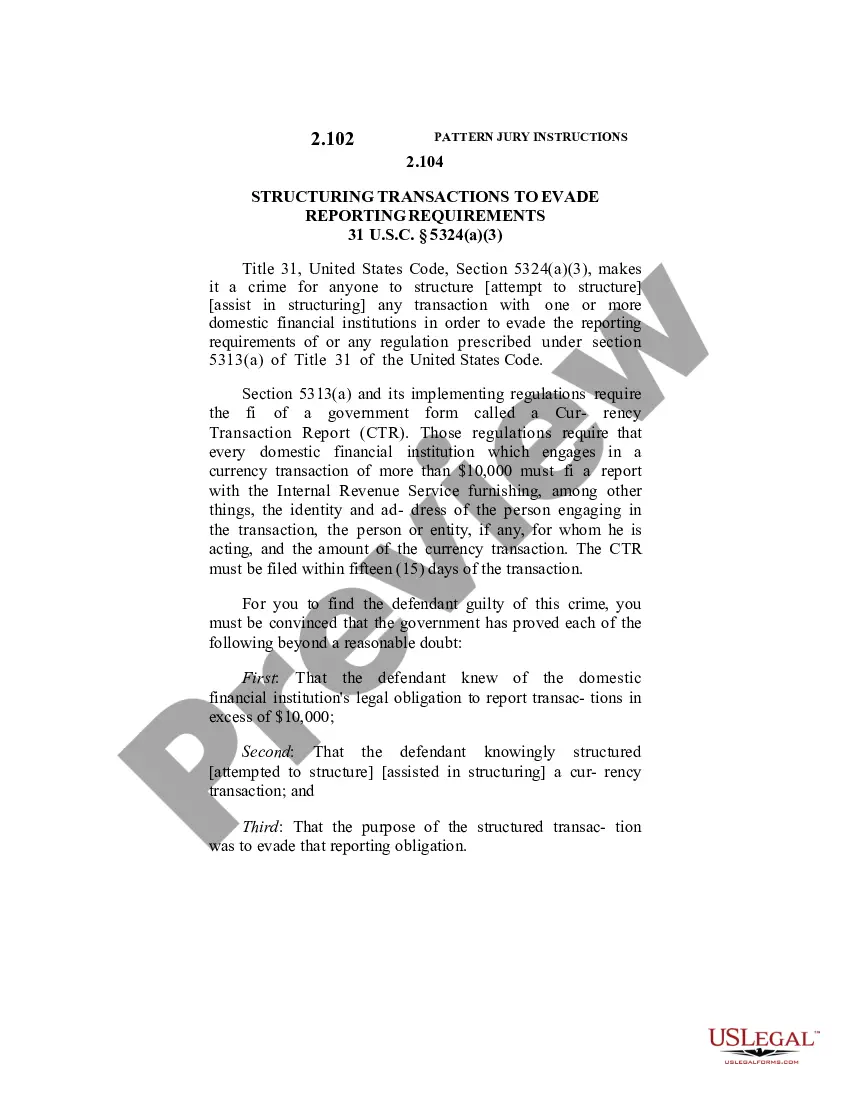
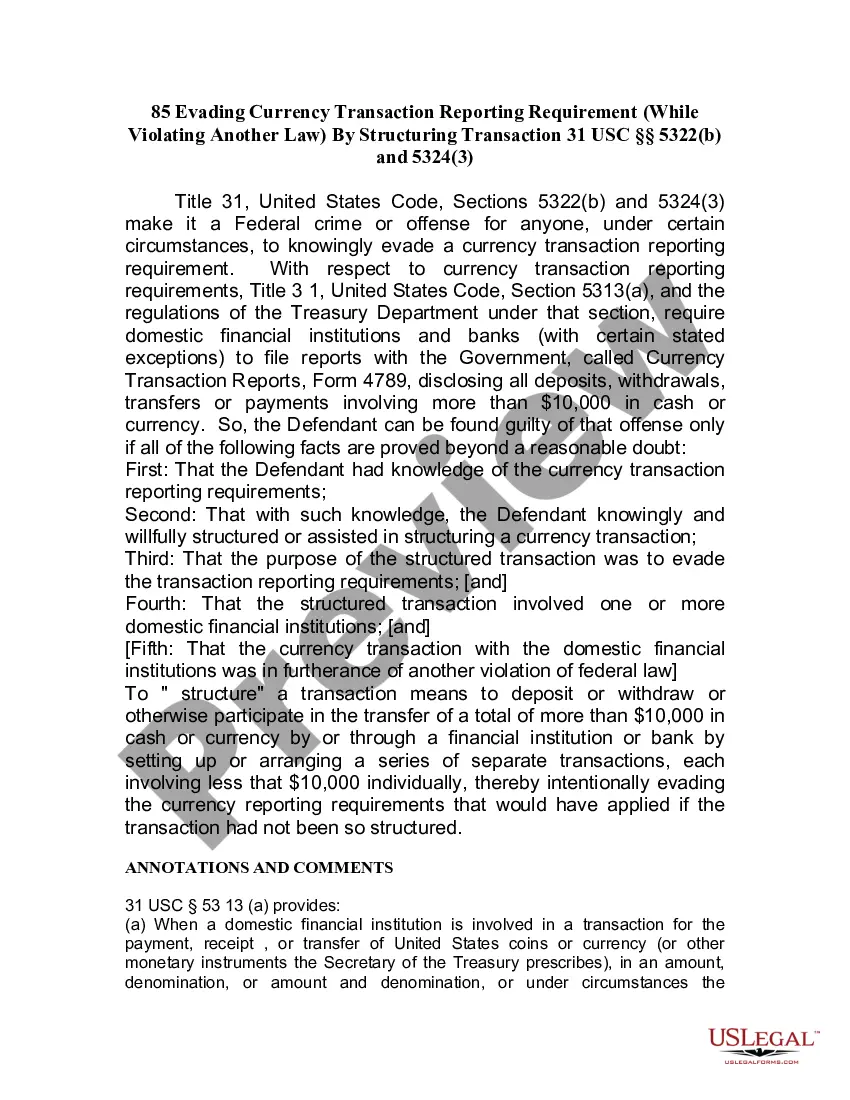
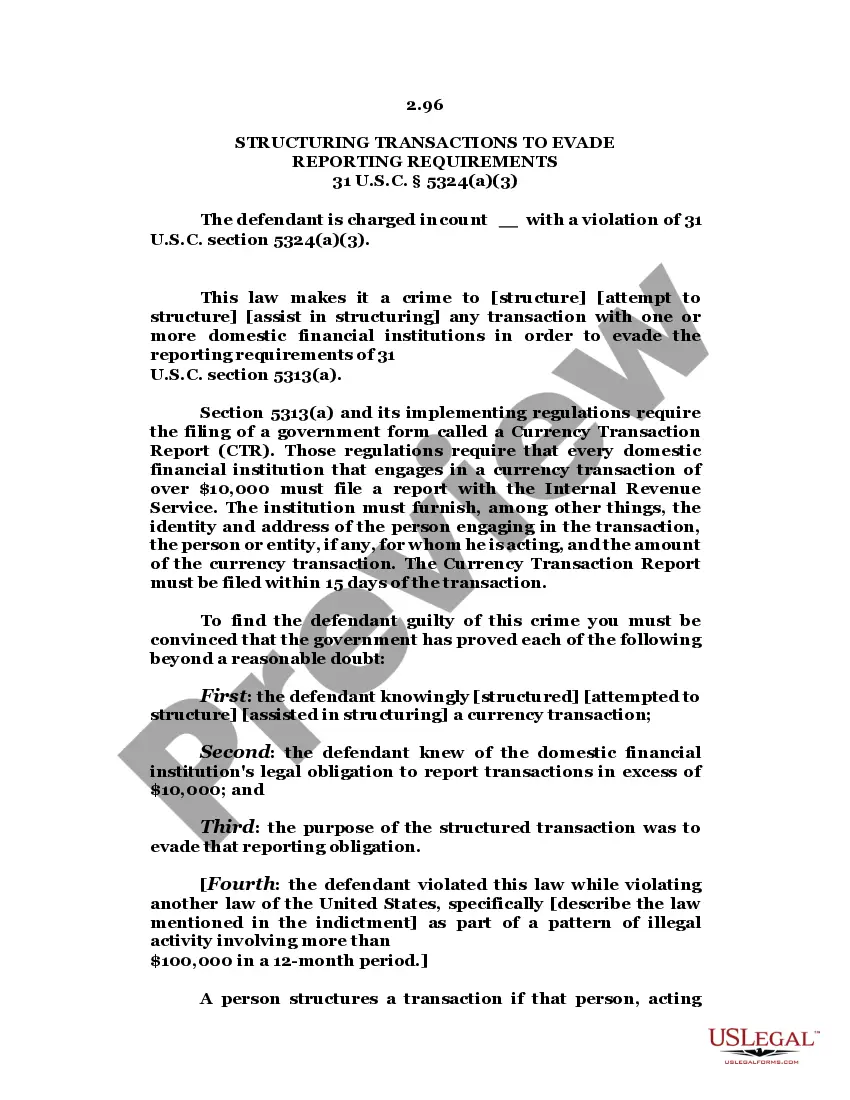
The "Structuring Transactions to Evade Reporting Requirements" form provides a legal framework for understanding the consequences of illegally structuring currency transactions. This form outlines the crime defined in Title 31, United States Code, Section 5324(a)(3), and how such acts are intended to avoid federal reporting requirements for financial transactions exceeding $10,000. Unlike other financial forms, this one focuses specifically on compliance with federal obligations regarding transaction reporting, ensuring users grasp the legal implications of structuring actions.
What’s included in this form
- Description of the illegal act of structuring transactions.
- Clarification of reporting requirements for domestic financial institutions.
- Details about the penalties associated with the crime.
- Instructions for jury considerations in legal cases linked to structuring.
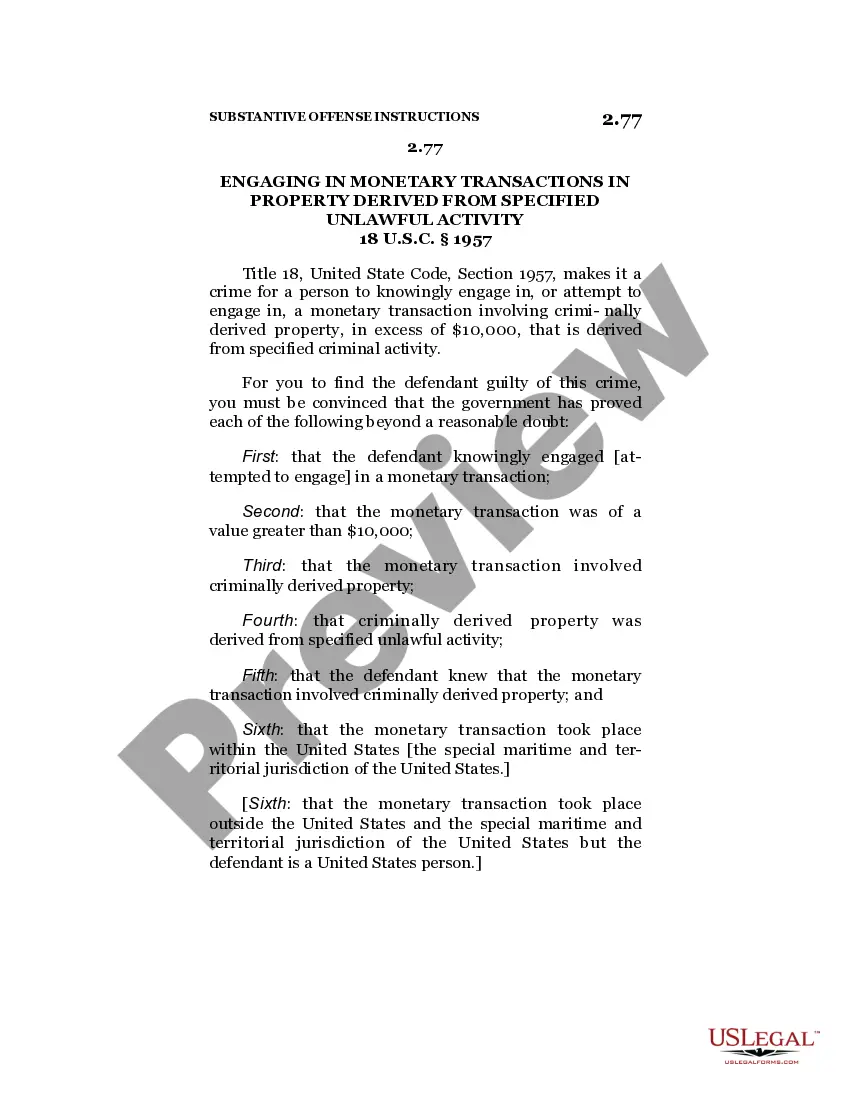
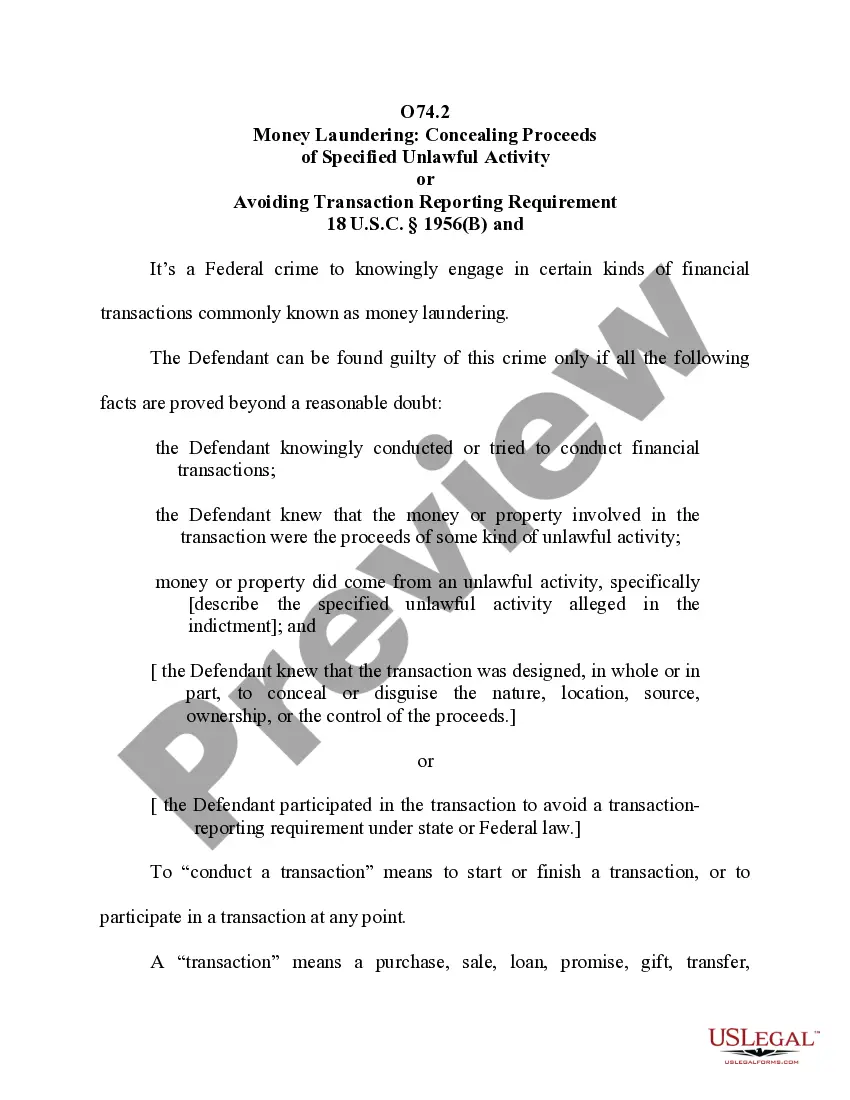
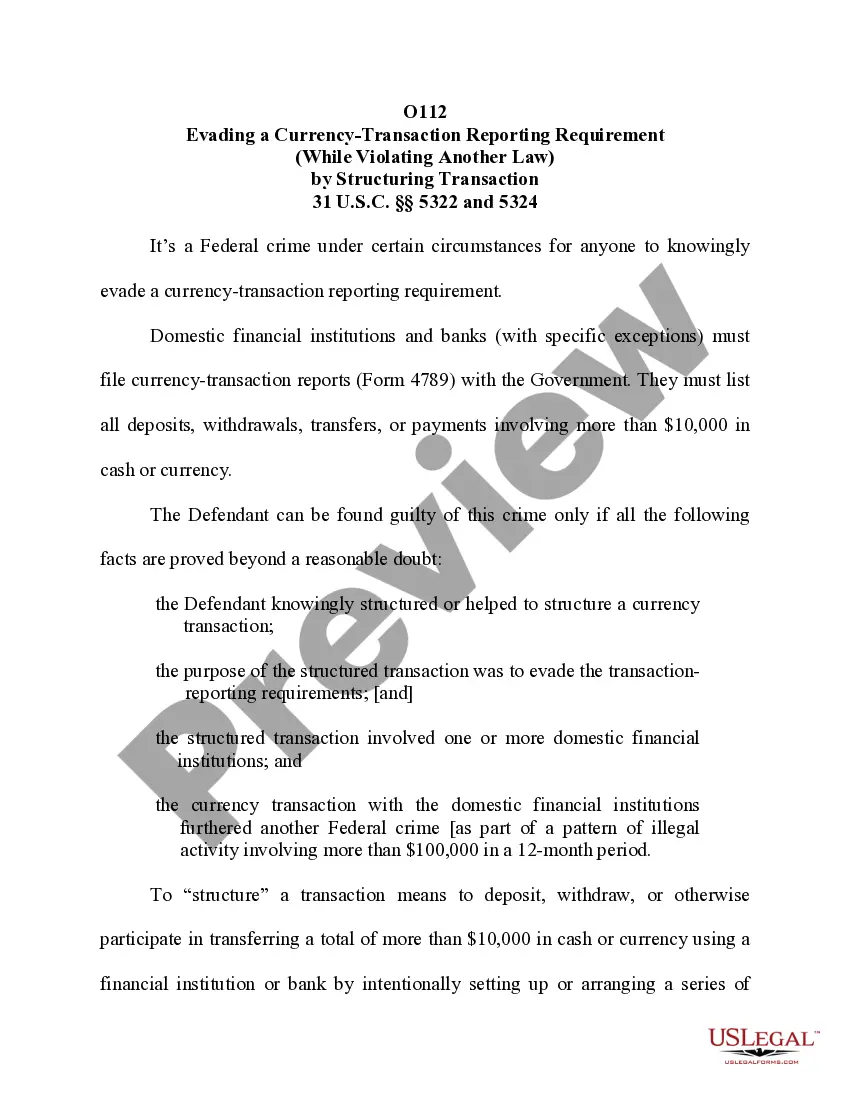
- Contextual information regarding related statutes and penalties.


When to use this form
This form is relevant in legal contexts where individuals or entities are accused of structuring transactions to evade federal reporting requirements. It can be utilized by defense attorneys or prosecutors in preparing legal arguments regarding the intent and actions of the accused based on the established criteria within the statute.
Who should use this form
- Attorneys representing clients in financial crime cases.
- Individuals facing accusations of illegal structuring.
- Financial institutions needing guidance on compliance and reporting practices.
- Legal professionals analyzing statutory implications of transaction structuring.
Completing this form step by step
- Review the specific allegations against the defendant concerning transaction structuring.
- Gather evidence demonstrating knowledge of financial institution reporting obligations.
- Identify and document instances of currency transactions that were structured to evade reporting.
- Clearly outline the intent behind the structuring actions to establish the case's context.
- Compile any pertinent legal references to support arguments made in court.
Notarization guidance
This form does not typically require notarization to be legally valid. However, some jurisdictions or document types may still require it. US Legal Forms provides secure online notarization powered by Notarize, available 24/7 for added convenience.
Get your form ready online
Our built-in tools help you complete, sign, share, and store your documents in one place.
Make edits, fill in missing information, and update formatting in US Legal Forms—just like you would in MS Word.
Download a copy, print it, send it by email, or mail it via USPS—whatever works best for your next step.
Sign and collect signatures with our SignNow integration. Send to multiple recipients, set reminders, and more. Go Premium to unlock E-Sign.
If this form requires notarization, complete it online through a secure video call—no need to meet a notary in person or wait for an appointment.
We protect your documents and personal data by following strict security and privacy standards.

Make edits, fill in missing information, and update formatting in US Legal Forms—just like you would in MS Word.

Download a copy, print it, send it by email, or mail it via USPS—whatever works best for your next step.

Sign and collect signatures with our SignNow integration. Send to multiple recipients, set reminders, and more. Go Premium to unlock E-Sign.

If this form requires notarization, complete it online through a secure video call—no need to meet a notary in person or wait for an appointment.

We protect your documents and personal data by following strict security and privacy standards.
Avoid these common issues
- Failing to understand the full scope of regulations regarding currency transactions.
- Overlooking the importance of documentation linking structuring to intent.
- Neglecting to address state-specific laws that may complement federal regulations.
Benefits of using this form online
- Accessible 24/7 for immediate use in legal situations.
- Easy to download and complete at your convenience.
- Reliable templates created by licensed attorneys, ensuring compliance with legal standards.
Legal use & context
- Understanding structuring is crucial for compliance with federal law.
- The form can provide a basis for defense strategies in legal proceedings.
- Awareness of penalties can aid individuals in making informed decisions regarding transactions.
Main things to remember
- Structuring transactions to evade reporting requirements is a serious legal offense.
- Awareness and understanding of transaction laws can prevent legal issues for individuals and businesses.
- This form provides essential clarity about the legal framework surrounding currency structuring.
Looking for another form?

Form popularity
FAQ
For example, if someone has $50,000 in cash to deposit in their bank, should they choose to deposit it through five deposits of $9,999 and one deposit of $5, with the intent to avoid the reporting requirement, they have committed the crime of structuring.
A structured transaction is a series of transactions broken up from a larger sum in order to avoid reporting requirements under the Bank Secrecy Act (BSA), which requires financial institutions to report all transactions of $10,000 or more.
A "structured transaction" is a series of related transactions that could have been conducted as one transaction, but the financial institution and/or the transactor intentionally broke it into several transactions for the purpose of circumventing the reporting requirements of the Bank Secrecy Act (BSA).
31 USC § 5324 defines structuring as a way of organizing large cash transactions into smaller deposits or payments in order to evade one's reporting requirements; causing or attempting to cause a financial institution to fail to perform its reporting requirements; obstructing or attempting to obstruct a business in
A "structured transaction" is a series of related transactions that could have been conducted as one transaction, but the financial institution and/or the transactor intentionally broke it into several transactions for the purpose of circumventing the reporting requirements of the Bank Secrecy Act (BSA).
Structuring and smurfing examples Let's say that someone has $90,000 in cash. If they want to avoid reporting requirements, they can split this into 10 transactions of $9,000. This is an example of structuring. Remember, structuring transactions in this way is illegal.
In order to show that a person is guilty of structuring to avoid having a bank file a Currency Transaction Report (CTR) with the IRS, the government must prove three elements: (1) the defendant (or a claimant in a civil forfeiture case) must have engaged in acts of structuring cash desposits or withdrawals at a