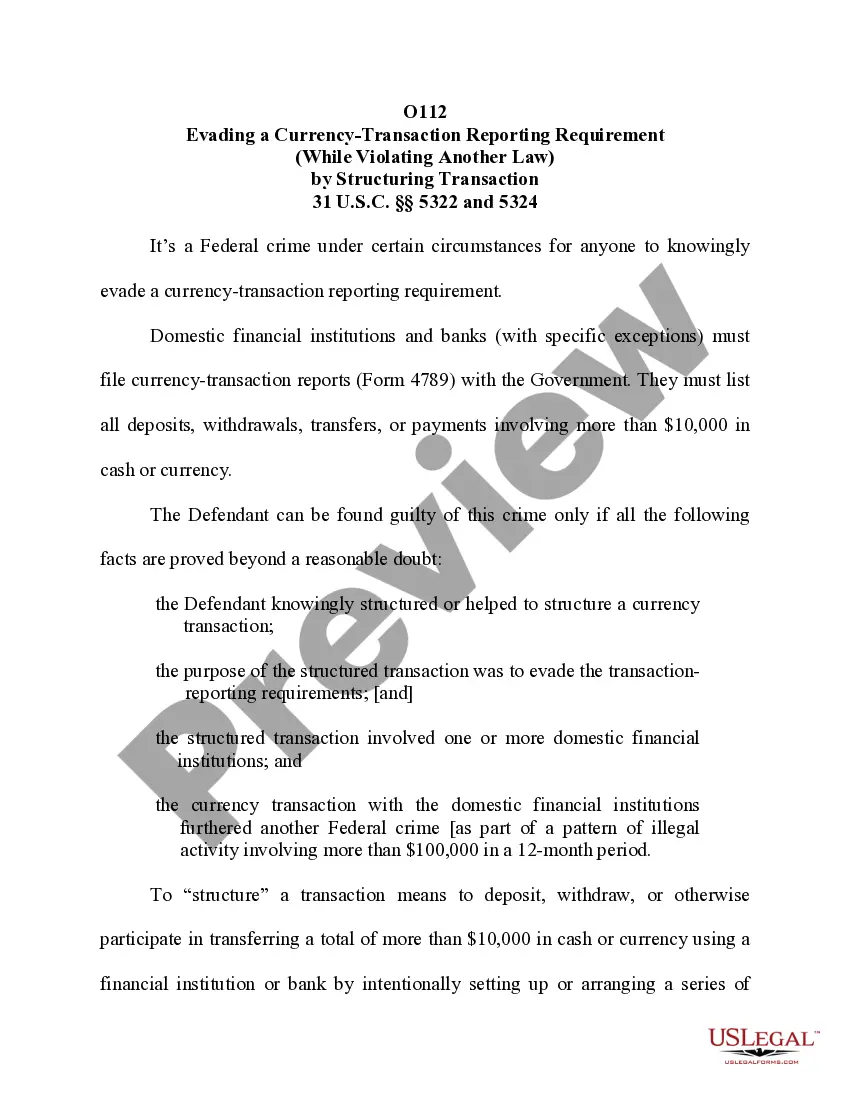
Jury Instruction - Evading Currency Transaction Reporting Requirement While Violating Another Law By Structuring Transaction
What this document covers
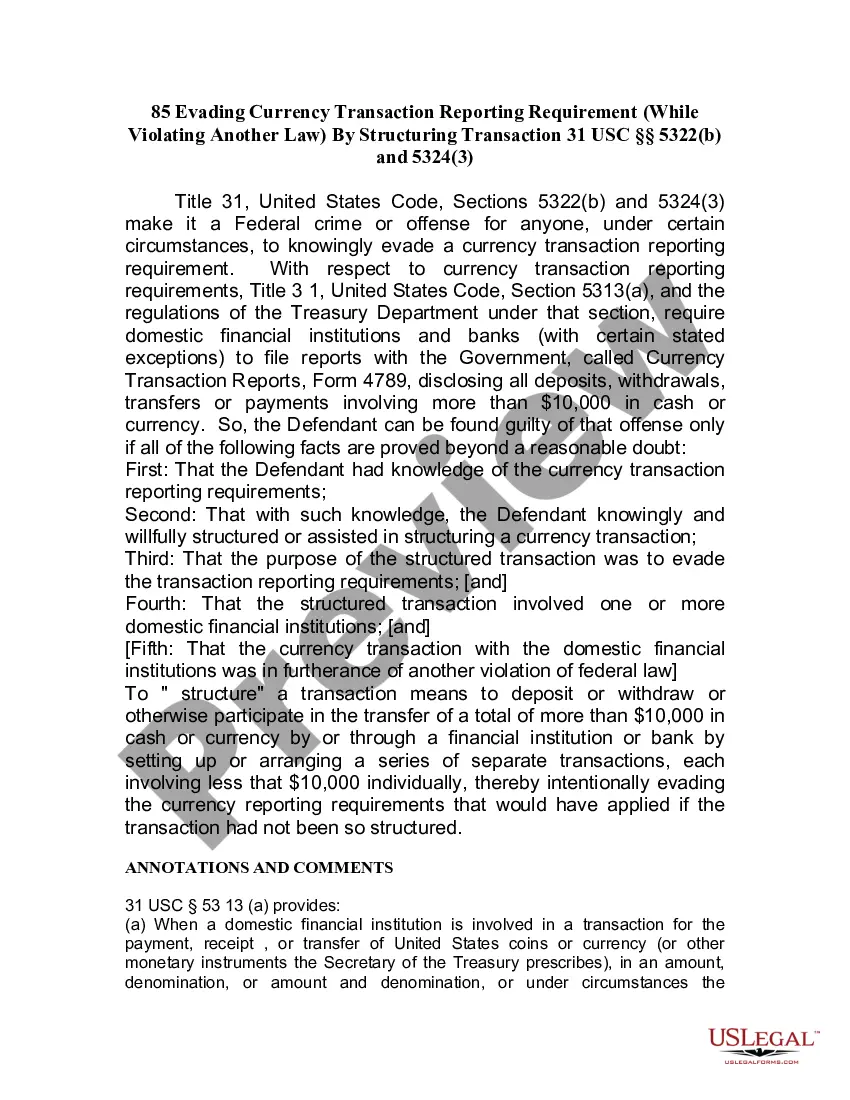
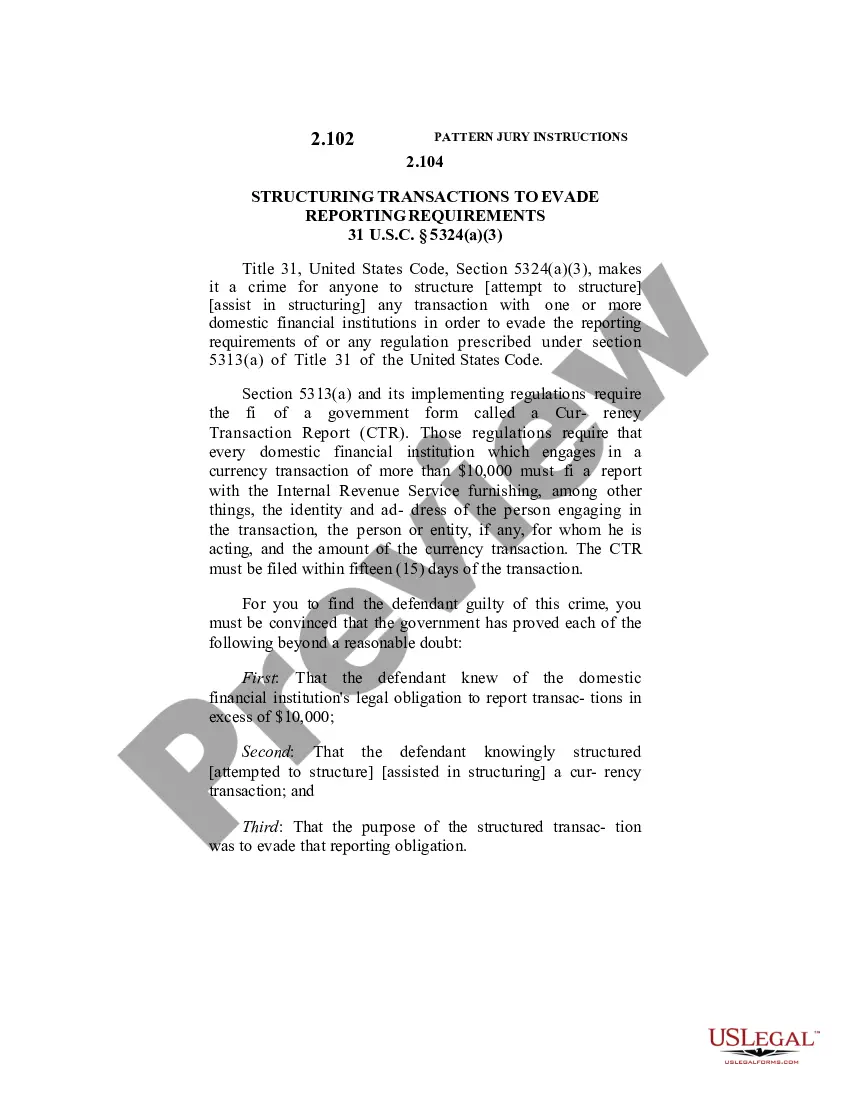
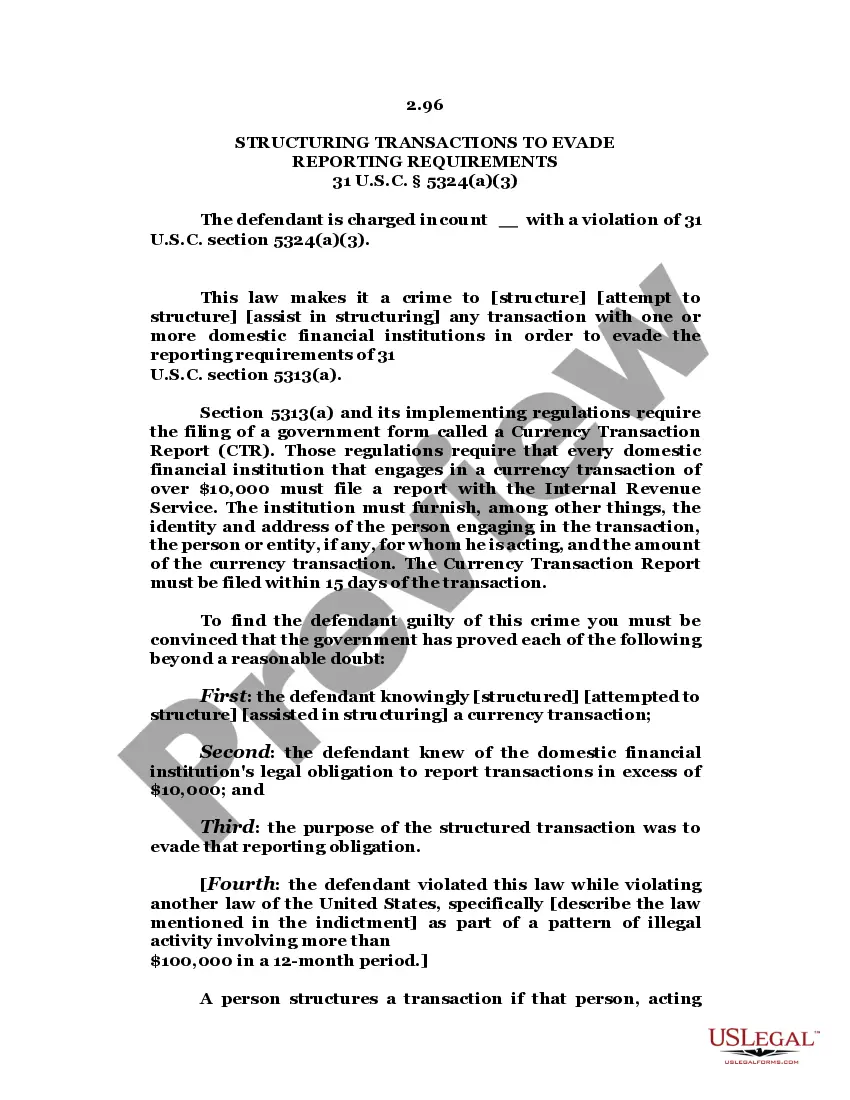
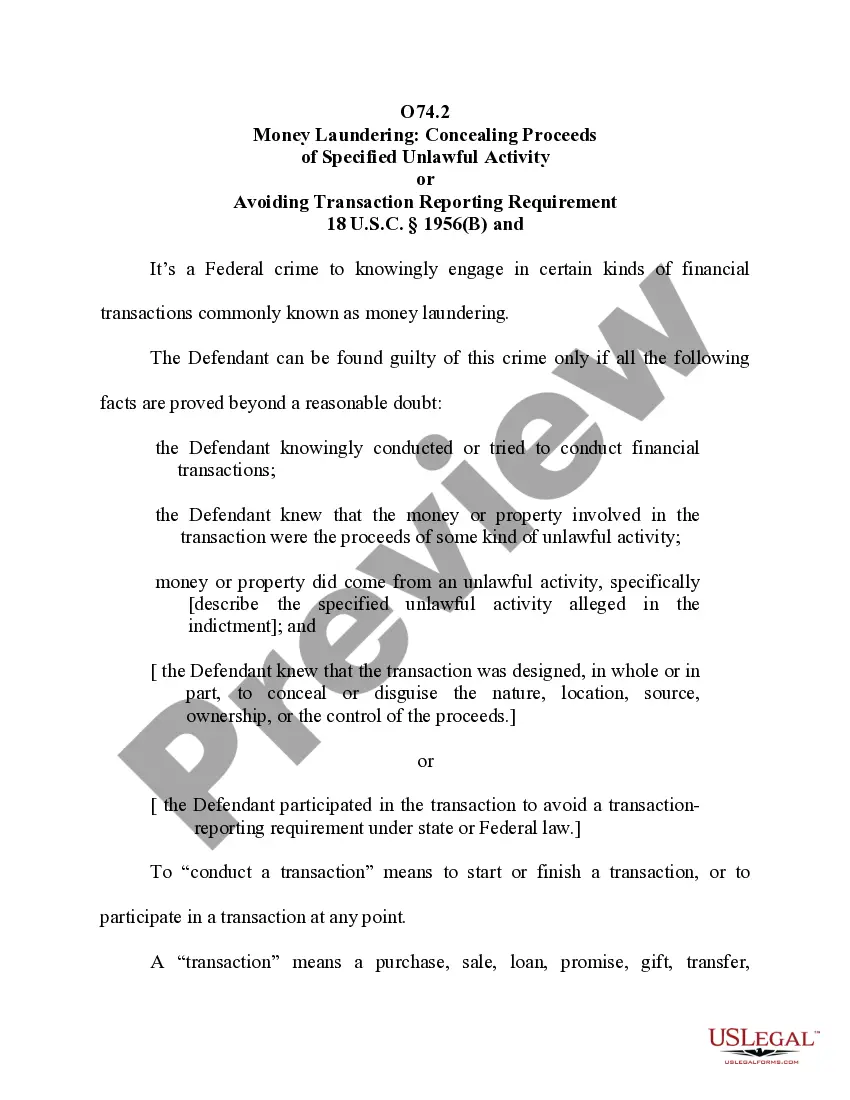
This Jury Instruction form is designed to provide guidance on the federal crime of evading currency transaction reporting requirements while violating another law by structuring a transaction. The instructions detail the necessary legal considerations and definitions to inform jurors during a trial, ensuring they understand the elements that must be proven beyond a reasonable doubt. This form serves as a model and may be adjusted to fit specific cases, distinguishing it from general jury instruction templates.
What’s included in this form
- Definition of structuring a transaction to evade reporting requirements.
- Elements that need to be proven for a guilty verdict.
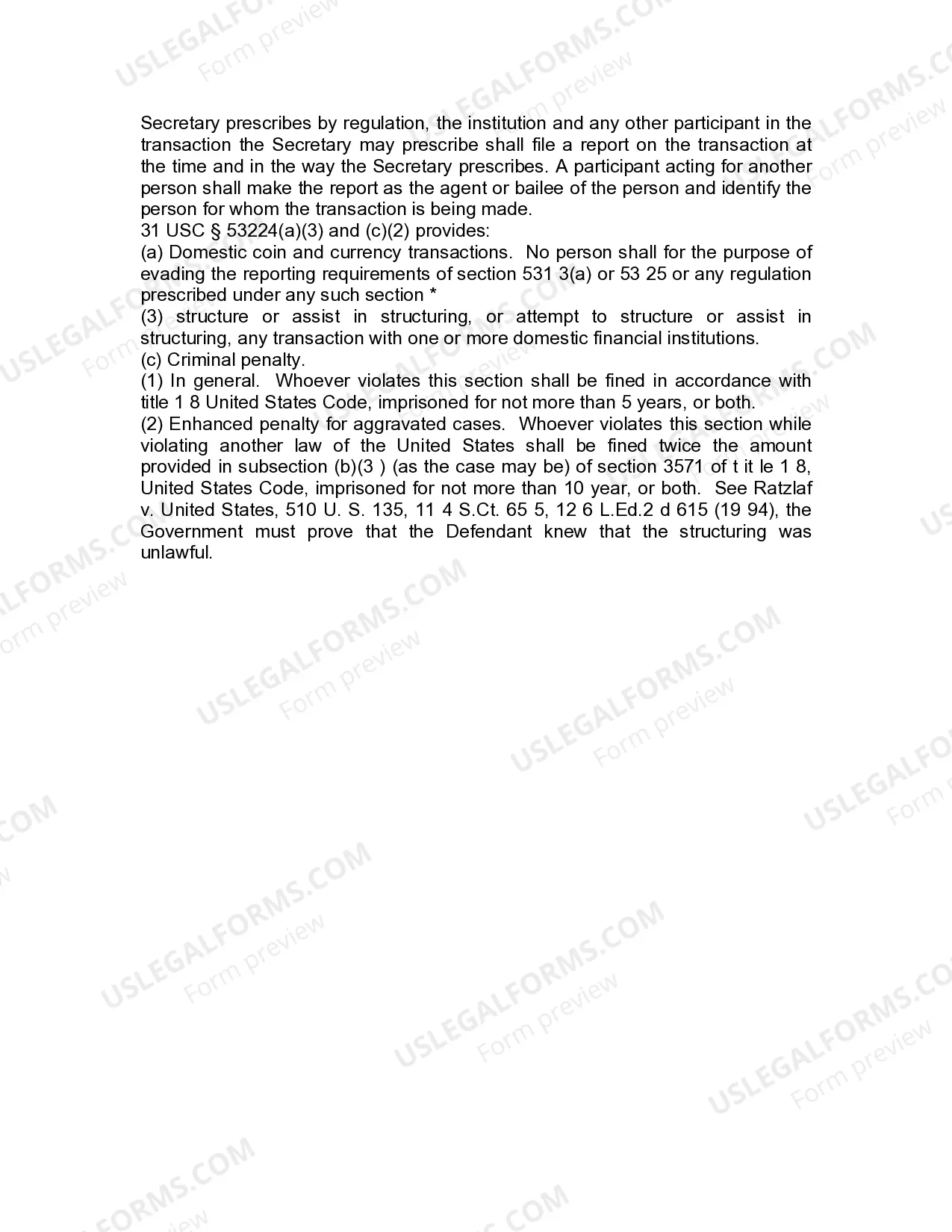
- Reference to relevant U.S. Code sections related to currency transaction reporting.
- Clarification of penalties for violations of these laws.
- Importance of the defendant's knowledge regarding the requirements.
When to use this document
This form should be used in federal court cases where a defendant is accused of violating currency transaction reporting requirements by structuring transactions. It is important during jury deliberations to provide jurors with clear guidance on the legal definitions and necessary elements to establish guilt.
Who this form is for
- Prosecutors preparing jury instructions in cases involving currency reporting violations.
- Defense attorneys who need to understand the elements their case must address.
- Judges seeking a standardized model for jury instructions in relevant cases.
- Legal educators and students studying federal crime instruction.
How to complete this form
- Review the elements required for a prosecution case based on U.S. Code sections.
- Ensure clarity in the definitions, especially regarding what constitutes structuring.
- Adapt the instructions as needed to reflect the specifics of the case at hand.
- Confirm that all sections are clear for the jury's understanding.
- Distribute the completed jury instructions to all relevant parties prior to trial.
Notarization guidance
This form does not typically require notarization to be legally valid. However, some jurisdictions or document types may still require it. US Legal Forms provides secure online notarization powered by Notarize, available 24/7 for added convenience.
Get your form ready online
Our built-in tools help you complete, sign, share, and store your documents in one place.
Make edits, fill in missing information, and update formatting in US Legal Forms—just like you would in MS Word.
Download a copy, print it, send it by email, or mail it via USPS—whatever works best for your next step.
Sign and collect signatures with our SignNow integration. Send to multiple recipients, set reminders, and more. Go Premium to unlock E-Sign.
If this form requires notarization, complete it online through a secure video call—no need to meet a notary in person or wait for an appointment.
We protect your documents and personal data by following strict security and privacy standards.

Make edits, fill in missing information, and update formatting in US Legal Forms—just like you would in MS Word.

Download a copy, print it, send it by email, or mail it via USPS—whatever works best for your next step.

Sign and collect signatures with our SignNow integration. Send to multiple recipients, set reminders, and more. Go Premium to unlock E-Sign.

If this form requires notarization, complete it online through a secure video call—no need to meet a notary in person or wait for an appointment.

We protect your documents and personal data by following strict security and privacy standards.
Common mistakes to avoid
- Failing to clearly define structuring, which can confuse jurors.
- Not including all necessary elements that must be proven for conviction.
- Using unclear language that may lead to misinterpretation of obligations.
- Overlooking applicable local requirements or specific court instructions.
Advantages of online completion
- Immediate access to professionally drafted legal language.
- Ability to download and edit the form as needed for specific cases.
- Enhanced reliability through the use of up-to-date legal references.
- Convenient access from anywhere at any time.
Legal use & context
- Provides a standardized method for informing jurors of specific legal duties.
- Directly relates to compliance with federal law regarding currency transactions.
- Serves as an essential tool in ensuring accurate legal processes in trials involving currency transactions.
Looking for another form?


Form popularity
FAQ
An IRS Currency Transaction Report is a form filed by U.S. banks and casinos each time you make a deposit or withdrawal of $10,000 or more. It is filed in secret, without your knowledge, you don't receive a copy, and it becomes part of your permanent IRS file.
The reporting requirement for a CTR is triggered when a bank customer initiates a transaction of more than $10,000, not when they complete it. If a bank customer refuses the transaction or modifies it to fall below the threshold, the bank employee is required to file a suspicious activity report.
A currency transaction report (CTR) is a report that U.S. financial institutions are required to file with FinCEN for each deposit, withdrawal, exchange of currency, or other payment or transfer, by, through, or to the financial institution which involves a transaction in currency of more than $10,000.
When a bank processes a transaction involving more than $10,000, most bank software will automatically create a CTR electronically and fill in tax and other customer information automatically.Habitual transactions just under the $10,000 threshold may also attract scrutiny and the filing of a SAR.
Federal law requires financial institutions to report currency (cash or coin) transactions over $10,000 conducted by, or on behalf of, one person, as well as multiple currency transactions that aggregate to be over $10,000 in a single day. These transactions are reported on Currency Transaction Reports (CTRs).
To potentially avoid one being filed, business entities can elect to complete Form 8300, which will absolve the bank from having to complete a CTR. This must be done within 15 days of the transaction's completion.
Under Phase 1, transactions conducted by banks, government departments or agencies, and listed public companies and their subsidiaries are exempt from CTR reporting. Under Phase 2, transactions in currency by businesses that meet specific requirements are exempt from CTR reporting.
If you deposit less than $10,000 cash in a specific time period, it may not have to be reported. However, when a customer makes multiple smaller cash payments in a 12-month period, the 15 days countdown for reporting to the IRS starts as soon as the total paid exceeds $10,000.