Church Legal Documents Package
Understanding this form package
The Church Legal Documents Package is designed to simplify the management of legal matters related to church operations. It contains essential forms that help churches handle employment, donations, liability waivers, and event planning efficiently. This package offers significant savings of more than 50% compared to purchasing each form individually, making it a valuable resource for church leaders and administrators.
What’s included in this form package
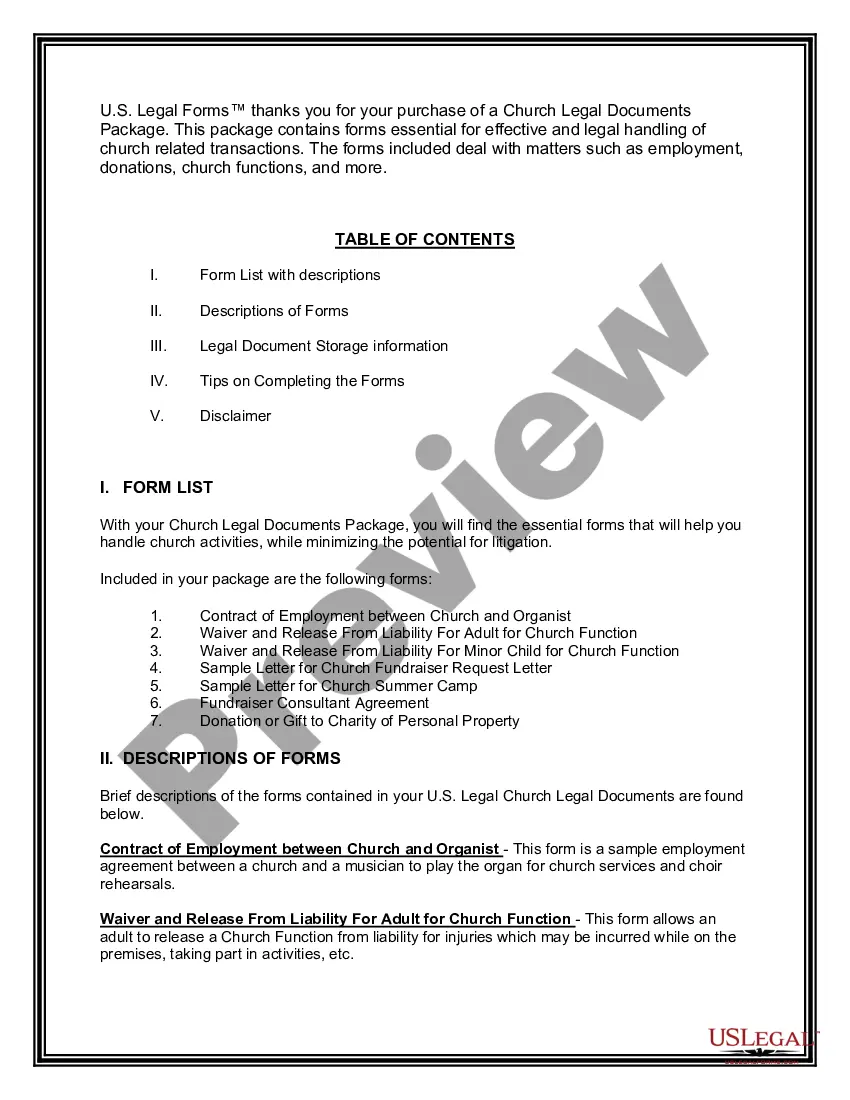
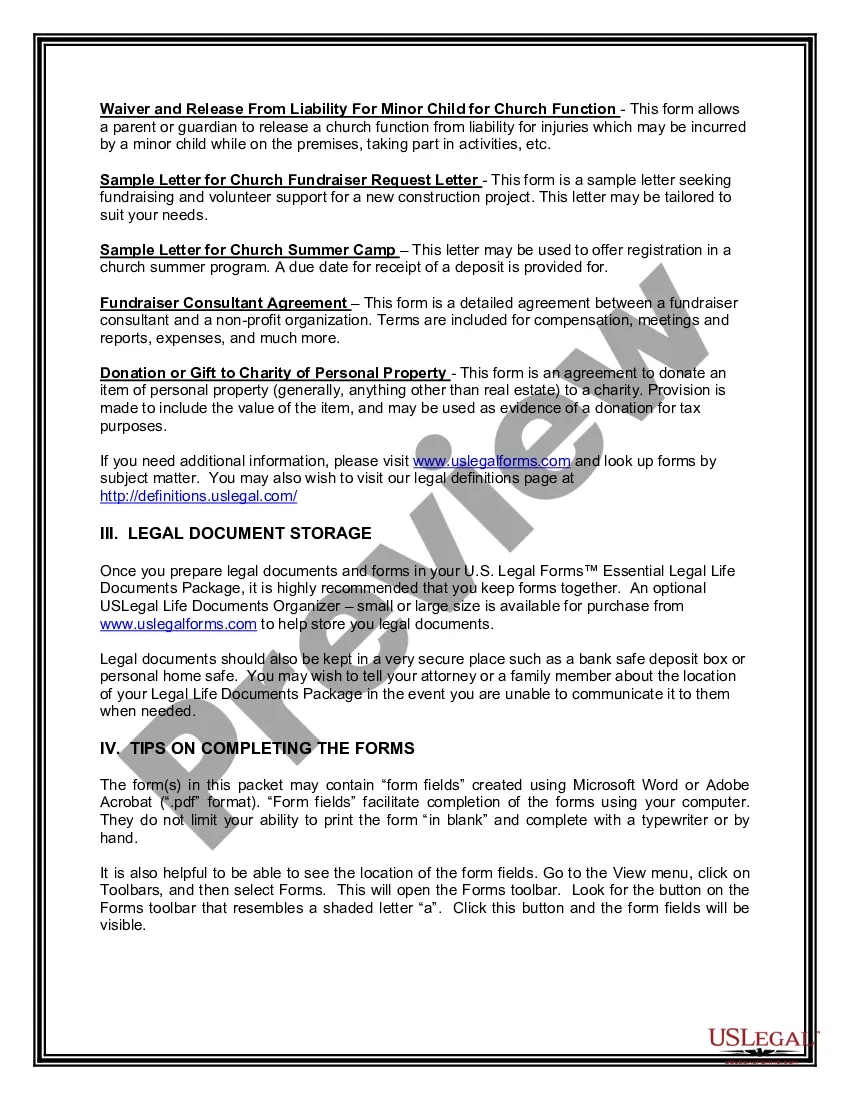
- Donation or Gift to Charity of Personal Property
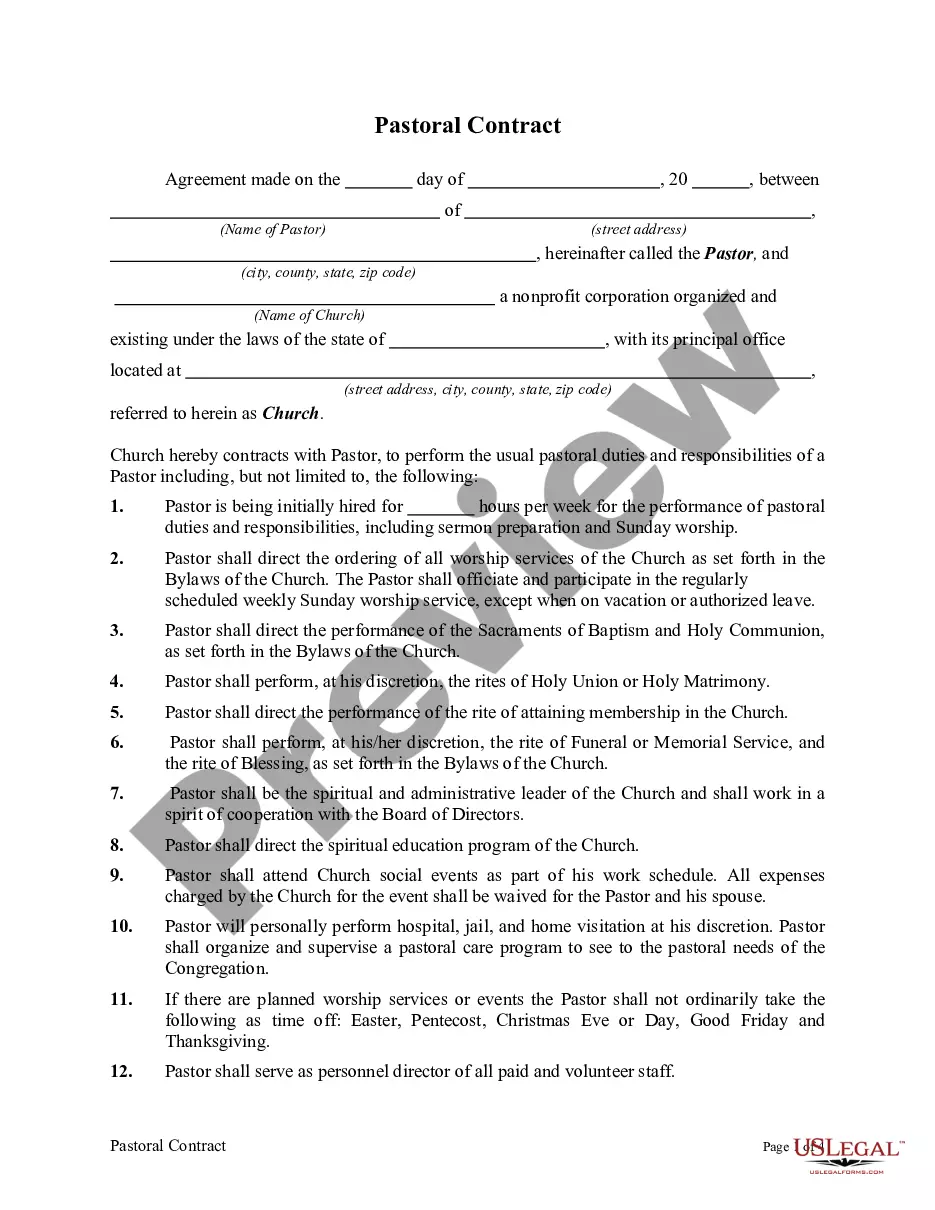
- Contract of Employment between Church and Organist
- Fundraiser Consultant Agreement
- Sample Letter for Church Fundraiser Request Letter
- Sample Letter for Church Summer Camp
- Waiver and Release From Liability For Adult for Church Function
- Waiver and Release From Liability For Minor Child for Church Function
When to use this form package
This package is ideal for use in various scenarios, including:
- Hiring musicians or staff for church services.
- Organizing church events and functions that require liability waivers.
- Requesting donations or fundraising assistance for church projects.
- Setting up registration for summer camps and other programs.
- Documenting donations for tax purposes.
Who can use this document
- Church administrators and leaders looking to formalize employment and volunteer agreements.
- Parents or guardians participating in church activities that involve minors.
- Individuals responsible for organizing and managing church events and fundraising efforts.
- Non-profit organizations affiliated with churches seeking to establish agreements with consultants.
Instructions for completing these forms
- Review the included forms to understand their purpose and requirements.
- Identify the parties involved in each document (e.g., church, employees, parents).
- Enter the relevant dates and details in the provided fields.
- Ensure all parties sign the necessary documents as required.
- Store completed forms securely for easy access when needed.
Notarization guidance for this package
Notarization is not commonly needed for forms in this package. However, if your state’s laws require it, our notarization service, powered by Notarize, allows you to finalize documents online 24/7 without in-person visits.
Get your form ready online
Our built-in tools help you complete, sign, share, and store your documents in one place.
Make edits, fill in missing information, and update formatting in US Legal Forms—just like you would in MS Word.
Download a copy, print it, send it by email, or mail it via USPS—whatever works best for your next step.
Sign and collect signatures with our SignNow integration. Send to multiple recipients, set reminders, and more. Go Premium to unlock E-Sign.
If this form requires notarization, complete it online through a secure video call—no need to meet a notary in person or wait for an appointment.
We protect your documents and personal data by following strict security and privacy standards.

Make edits, fill in missing information, and update formatting in US Legal Forms—just like you would in MS Word.

Download a copy, print it, send it by email, or mail it via USPS—whatever works best for your next step.

Sign and collect signatures with our SignNow integration. Send to multiple recipients, set reminders, and more. Go Premium to unlock E-Sign.

If this form requires notarization, complete it online through a secure video call—no need to meet a notary in person or wait for an appointment.

We protect your documents and personal data by following strict security and privacy standards.
Avoid these common issues
- Failing to collect signatures from all parties involved.
- Not reviewing specific requirements for liability waivers.
- Inadequately customizing letters for fundraising requests.
- Neglecting to keep copies of all completed forms for records.
Why use this package online
- Convenience of downloading forms anytime, from anywhere.
- Editable options that allow for customization of documents.
- Reliability of forms vetted by licensed attorneys for legal compliance.
- Efficient organization of necessary documents in one package.
Legal use & context
- These forms provide documentation that helps mitigate legal risks for churches.
- Liability waivers are essential for protecting the church from potential claims during events.
- Employment contracts outline clear expectations and terms for church staff and volunteers.
- Donation agreements clarify the terms of giving, providing evidence for tax purposes.
Key takeaways
- The Church Legal Documents Package offers essential forms for managing church affairs.
- It is suitable for a variety of church-related scenarios including employment and fundraising.
- Using this package can save time and money compared to individual form purchases.
Looking for another form?

Form popularity
FAQ
Create a Mission Statement. Create a ministry mission statement. Make your mission statement brief and concise. Establish a Board of Directors. Establish a board of directors. File Articles of Incorporation. File Articles of Incorporation. Create Your Ministry Bylaws. Create your ministry bylaws.
One fact is sure: a nonprofit's bylaws are considered a legal document that dictates how the organization must be governed. Failure by a board to follow the stipulations outlined in the bylaws can have devastating consequences to the organization2026and potentially even to the board members themselves.
Corporate bylaws. Non-disclosure agreements. Purchase agreements. Employment contracts. Loan agreements. Employment and independent contractor agreements. Consulting agreements. Partnership agreements.
Legal documents are defined as a written proof of the limitations and extent of a person's rights and privileges in a clear and specific manner. A common example of a legal document that you may be familiar to is the Last Will and Testament.
Documents such as wills, trusts, deedswhich must last for decadescall for archival quality paper. Archival paper also suits the import of such documents. Archival paper is acid free and made with cotton. The best is 100% cotton although 50% and 25% grades also resist discoloration and deterioration.
Affidavit. An Affidavit is a sworn written statement made before an official or anyone who may legally administer an oath. Amending Agreement. Amortization Schedule. Articles of Incorporation. Assignment. Assignment of Partnership Interest. Assignment of Trade Name.
Plan Out the Document Before You Begin. Write with Clear and Concise Language. Ensure the Correct Use of Grammar. Be as Accurate as Possible. Make Information Accessible. Ensure All Necessary Information Is Included. Always Use an Active Voice.
What are Bylaws?Bylaws are legally binding. And while your Bylaws aren't a public document (like your IRS Form 990), they also aren't confidential. You can share them, for instance, with a prospective board member who asks to review them before joining your board.
Management voting rules. Specifying how important decisions get made is a key part of a church's bylaws. Rules governing meetings. Management powers and responsibilities. Procedures for replacing directors and officers. Designating the church's mission and denomination.