Agreement with Church Pianist
About this form
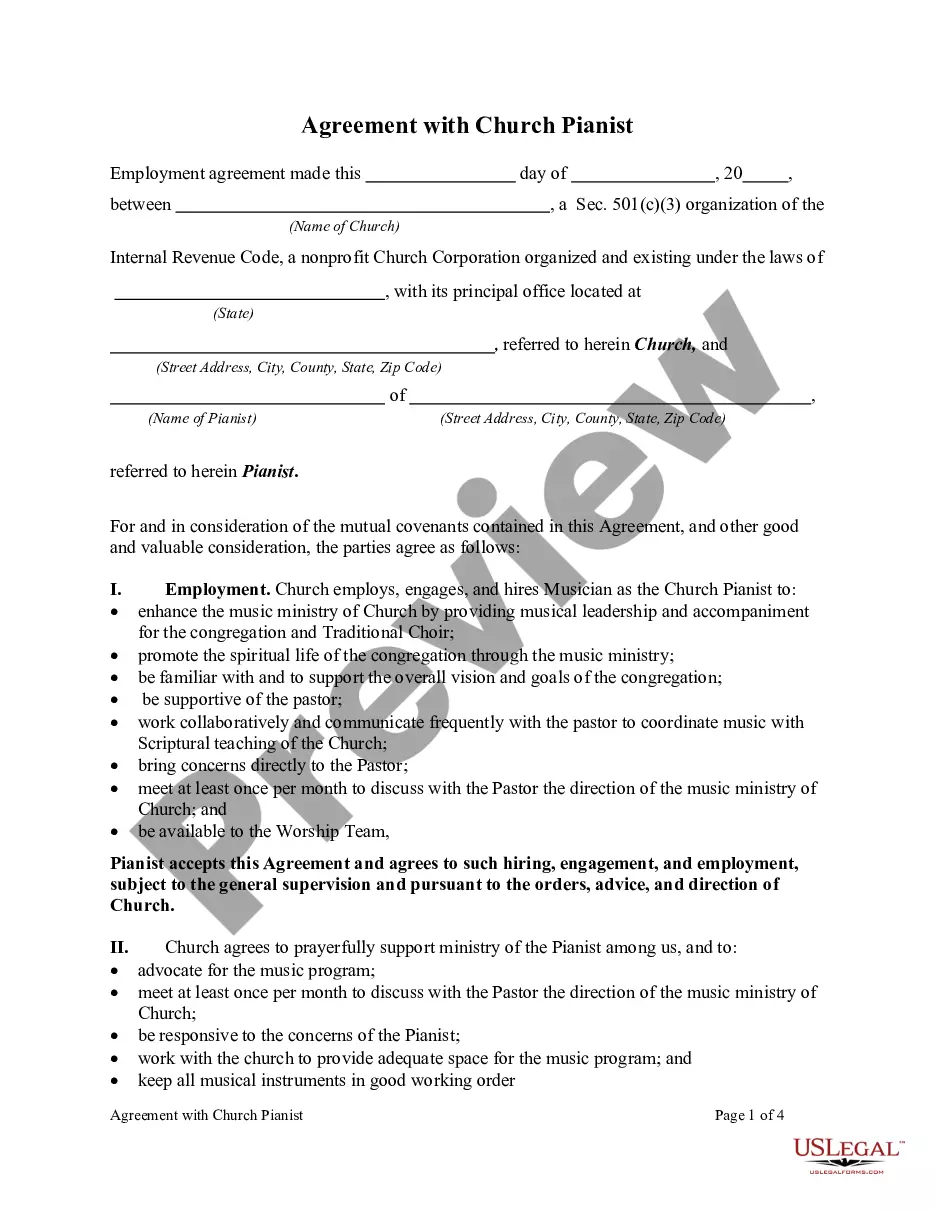
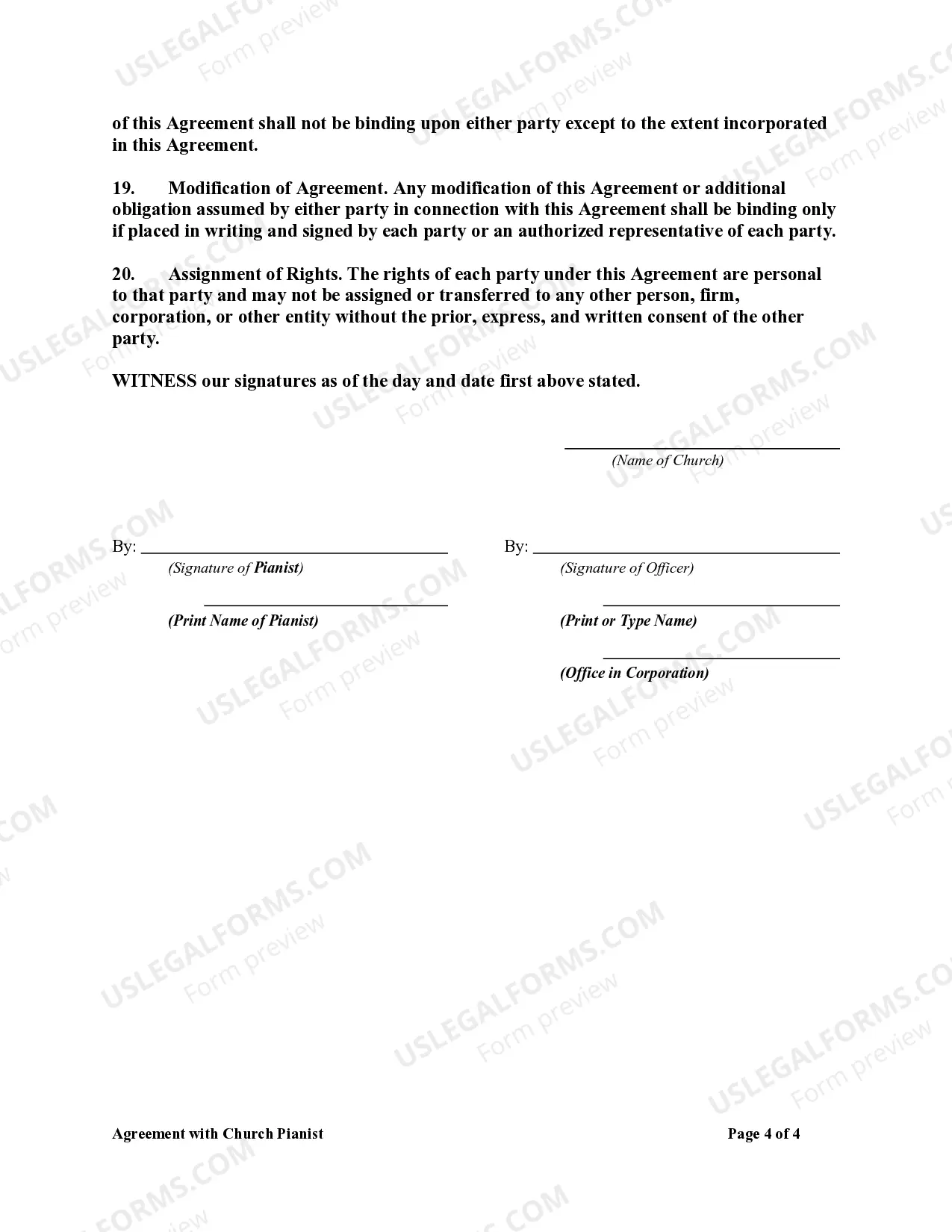
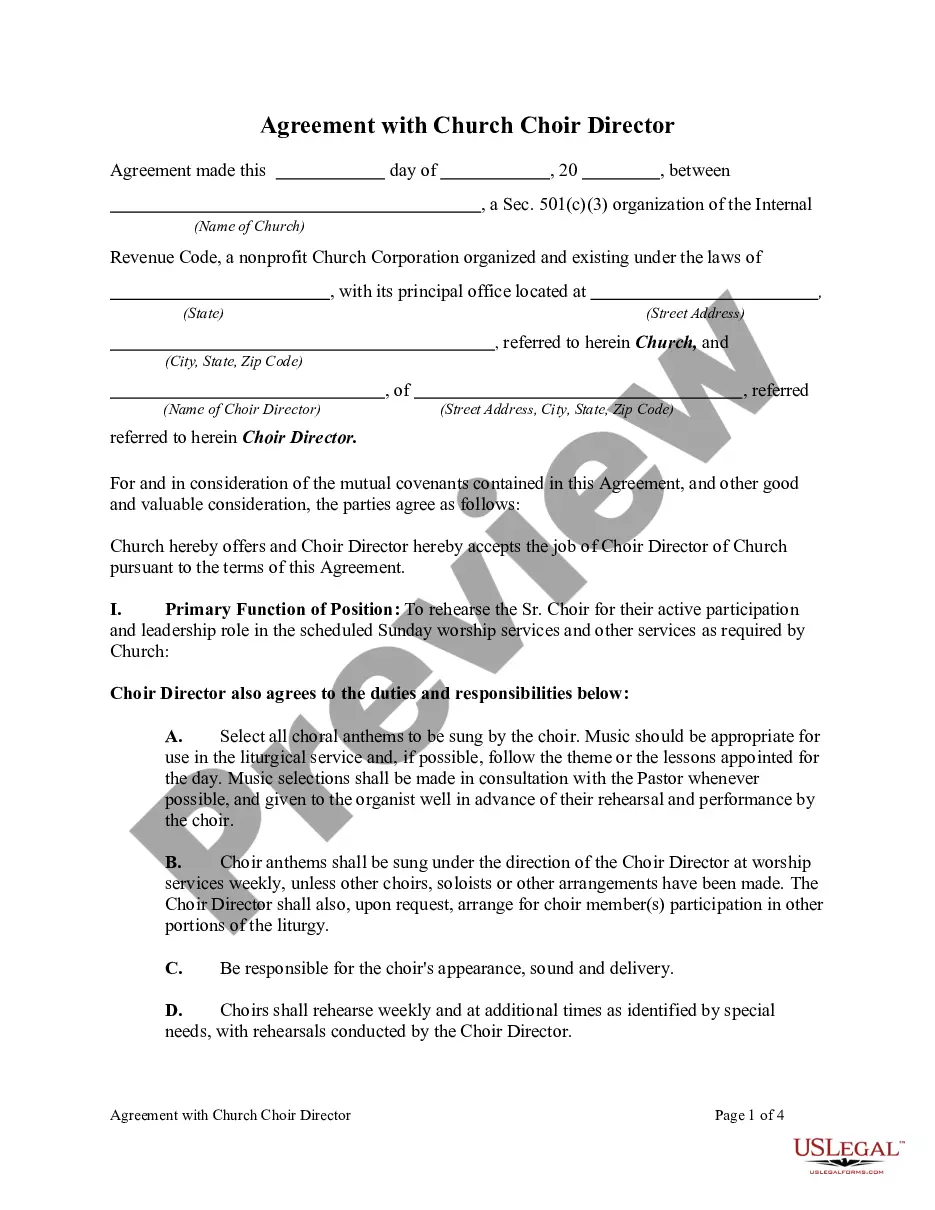
The Agreement with Church Pianist is a legal contract that formalizes the understanding between a church and a musician hired to serve as the church pianist. This form outlines the responsibilities of the pianist, the church's commitments, and the terms of employment. It serves as a guide to help prevent misunderstandings and ensure a positive collaboration between the church and the pianist, distinguishing it from other musician agreements by its specific focus on church settings and spiritual goals.
Form components explained
- Employment clause defining the relationship between the church and the pianist.
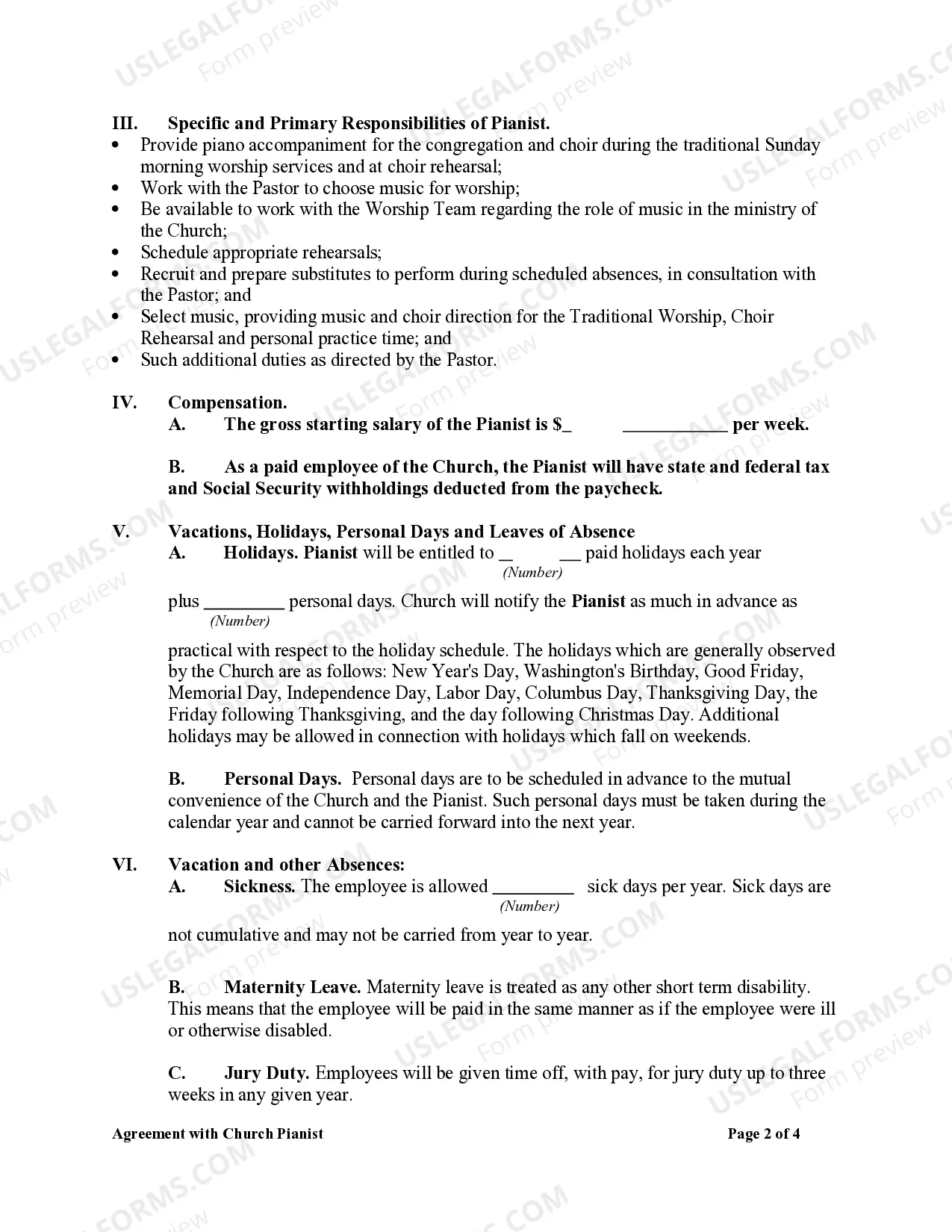
- Responsibilities of the pianist, including providing musical accompaniment and collaborating with church leadership.
- Church commitments to support the pianist's ministry and address concerns.
- Provisions for maternity leave and jury duty allowances.
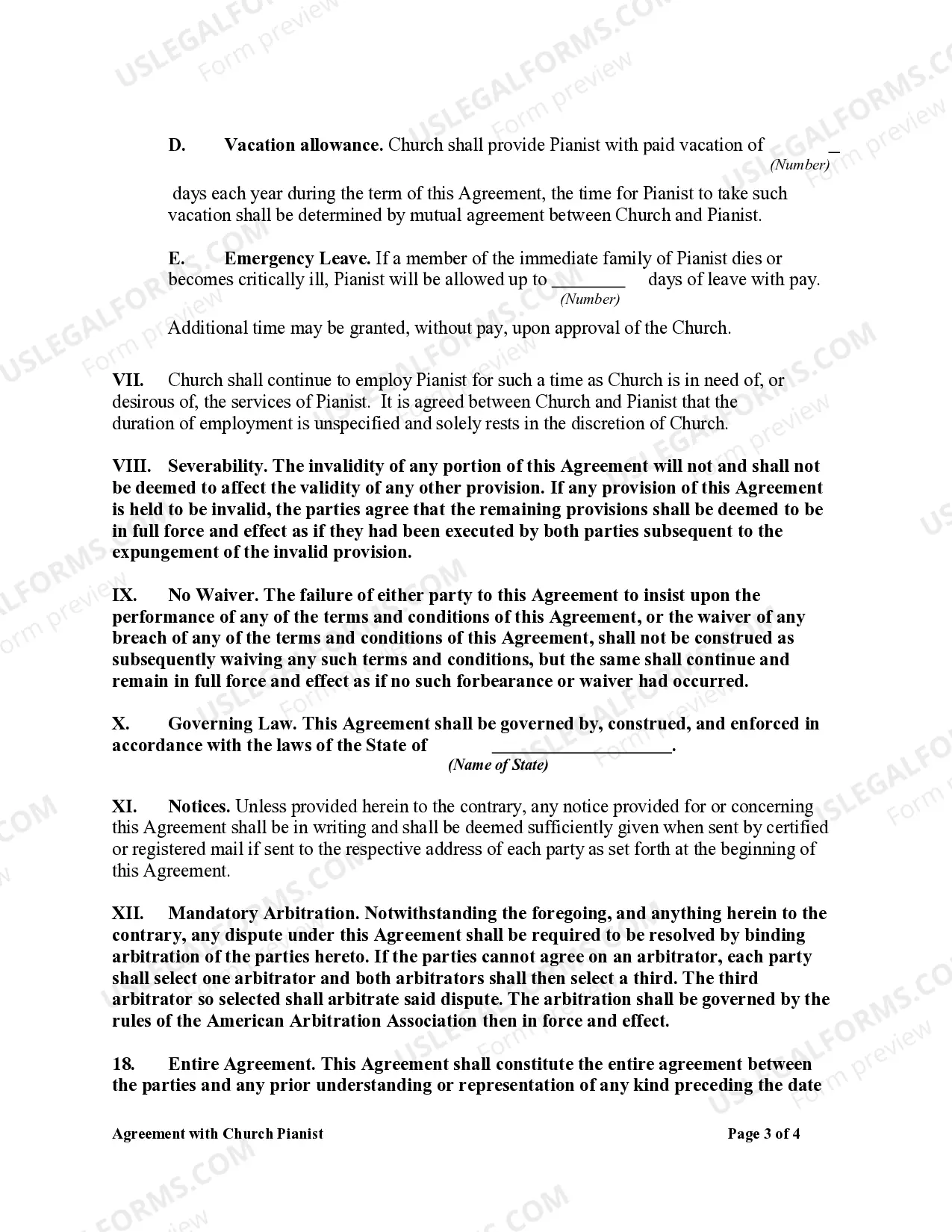
- Severability clause ensuring the validity of the agreement's remaining parts if one provision is invalidated.
When to use this form
This agreement is useful when a church is hiring a pianist to enhance its music ministry. It should be used to formalize the expectations and responsibilities of both parties, particularly when starting a new music program or when a new pianist is brought on board. By using this form, both the church and the pianist can have a clear understanding of their roles and commitments, reducing the chance of future disputes.
Intended users of this form
- Churches seeking to hire a musician for their worship services.
- Musicians interested in a formal agreement with a church regarding their role.
- Church leadership and administration responsible for managing music programs.
How to prepare this document
- Identify the parties involved: the church and the musician.
- Specify the primary duties expected of the pianist during worship services and rehearsals.
- Detail the church's commitments to support the pianist and the music program.
- Include terms for leave, notice of termination, and other employment conditions.
- Sign and date the agreement to make it legally binding.
Notarization requirements for this form
This form does not typically require notarization unless specified by local law. It is advisable to check with your local legal norms to confirm if notarization is necessary.
Get your form ready online
Our built-in tools help you complete, sign, share, and store your documents in one place.
Make edits, fill in missing information, and update formatting in US Legal Forms—just like you would in MS Word.
Download a copy, print it, send it by email, or mail it via USPS—whatever works best for your next step.
Sign and collect signatures with our SignNow integration. Send to multiple recipients, set reminders, and more. Go Premium to unlock E-Sign.
If this form requires notarization, complete it online through a secure video call—no need to meet a notary in person or wait for an appointment.
We protect your documents and personal data by following strict security and privacy standards.

Make edits, fill in missing information, and update formatting in US Legal Forms—just like you would in MS Word.

Download a copy, print it, send it by email, or mail it via USPS—whatever works best for your next step.

Sign and collect signatures with our SignNow integration. Send to multiple recipients, set reminders, and more. Go Premium to unlock E-Sign.

If this form requires notarization, complete it online through a secure video call—no need to meet a notary in person or wait for an appointment.

We protect your documents and personal data by following strict security and privacy standards.
Common mistakes
- Failing to specify the pianist's responsibilities clearly, leading to misunderstandings.
- Omitting terms related to leave and other employment benefits.
- Not including a provision for regular meetings with church leadership to discuss the music ministry.
Benefits of using this form online
- Convenient access to templates created by licensed attorneys to ensure legal compliance.
- Editability allows you to customize the agreement based on your specific church needs.
- Fast downloading means you can quickly formalize agreements and start your music ministry.
Legal use & context
- This agreement is enforceable as a contract between the church and the pianist, provided it is signed by both parties.
- It is designed to clarify roles and responsibilities, making it a valuable tool for conflict resolution.
- Understanding local laws regarding employment and contractual agreements is essential for effective use.
What to keep in mind
- This agreement helps establish a clear professional relationship between a church and its pianist.
- It minimizes misunderstandings about responsibilities and support expected from both parties.
- Properly completing and signing this document enhances the legal standing of both parties' commitments.
Looking for another form?
Form popularity
FAQ
Recording company details (name, contact info) Artist details (group name, names of each artist, contact info) Production details, e.g. studio address, recording session dates, control over song selections on the recording, and control over album title.
While I certainly got some pushback, our decision aligns with the more recent cases affirming that most musicians and performers engaged by ministries are employees, even if they only perform for the Easter or Christmas program.
Church musicians should be paid. Being a musician is a legitimate career path, therefore those who do it deserve to be paid for their services.It's quite cruel to believe that someone shouldn't be fairly compensated for dedicating 1025 hours of their time every week to the church.
Most churches hire musicians on a part-time basis. At a large church, with five services, a musician might earn $100 per service; that's $500 a week or $26,000 a year. Music directors, on the other hand, usually need a degree in music theory or conducting to get a job.
Simplyhired.com lists the average yearly salaries for church musicians at $35,000. Church pianists in New York average $41,000 per year, and church pianists in New Orleans make $39,00 per year on average. A January 2010 job posting for ChristianJobs 1 offers an annual salary of $9,000 for a church pianist.
There are people who believe musicians should not be paid because music is a ministry and therefore it must be done with volunteers. In some churches they pay their musicians and have no problem doing so.
Question: Do musicians pay taxes? Yes, if you're in a country that requires it, all musicians should pay taxes. Musicians do after all deal with an exchange in money, so taxes will need to be paid on these exchanges.If however you're an independent musician, you will need to sort paying taxes out by yourself.
In most cases, a church musician does not pass the test of being an independent contractor because of the control that the employer exercises over the musician's work.In addition to income taxes, you will also be responsible for paying both the employee's and employer's share of Social Security and Medicare taxes.