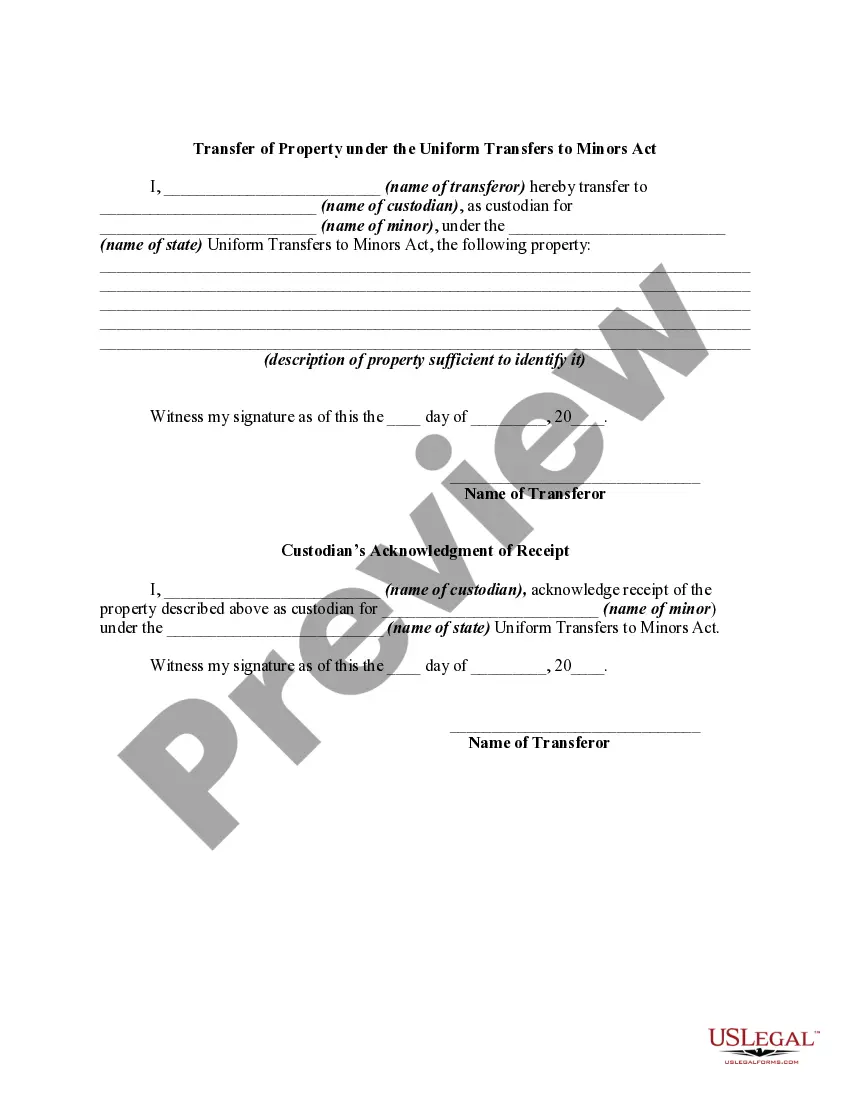
Transfer of Property under the Uniform Transfers to Minors Act
What is this form?
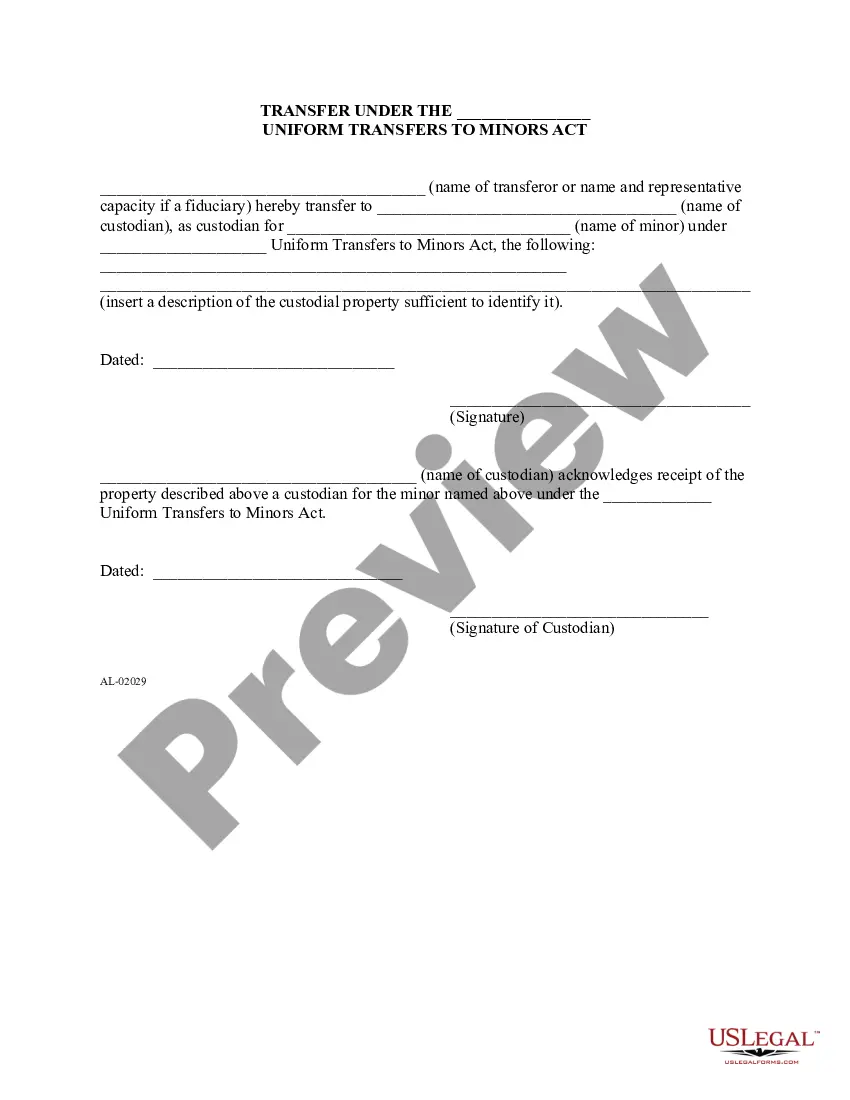
The Transfer of Property under the Uniform Transfers to Minors Act is a legal document used to transfer personal property to a custodian for the benefit of a minor. This form ensures that the property is managed by a responsible adult until the minor reaches the age of majority. The form is specifically tailored to comply with the Uniform Transfers to Minors Act (UTMA), setting it apart from a general gift deed or other similar transfer documents.
Key components of this form
- Name of the transferor - the person transferring the property.
- Name of the custodian - the adult managing the property for the minor.
- Name of the minor - the beneficiary of the property transfer.
- Description of the property - details sufficient to identify the property being transferred.
Situations where this form applies
This form should be used when an adult wishes to transfer ownership of personal property to a minor, ensuring that a custodian is appointed to manage that property. Common scenarios include gifting assets such as savings accounts, stocks, or personal items to a child or grandchild, particularly when the item holds significant value or importance.
Who this form is for
- Parents or legal guardians wishing to transfer assets to their children.
- Relatives or friends making a gift of property to a minor.
- Custodians appointed to manage property for minors under the UTMA.
How to complete this form
- Identify the parties - fill in the names of the transferor, custodian, and minor.
- Specify the property - provide a detailed description of the property being transferred.
- Enter dates - indicate the date of the transfer in the specified fields.
- Signatures - ensure both the transferor and custodian sign the document in the designated areas.
Does this document require notarization?
This form usually doesn’t need to be notarized. However, local laws or specific transactions may require it. Our online notarization service, powered by Notarize, lets you complete it remotely through a secure video session, available 24/7.
Get your form ready online
Our built-in tools help you complete, sign, share, and store your documents in one place.
Make edits, fill in missing information, and update formatting in US Legal Forms—just like you would in MS Word.
Download a copy, print it, send it by email, or mail it via USPS—whatever works best for your next step.
Sign and collect signatures with our SignNow integration. Send to multiple recipients, set reminders, and more. Go Premium to unlock E-Sign.
If this form requires notarization, complete it online through a secure video call—no need to meet a notary in person or wait for an appointment.
We protect your documents and personal data by following strict security and privacy standards.

Make edits, fill in missing information, and update formatting in US Legal Forms—just like you would in MS Word.

Download a copy, print it, send it by email, or mail it via USPS—whatever works best for your next step.

Sign and collect signatures with our SignNow integration. Send to multiple recipients, set reminders, and more. Go Premium to unlock E-Sign.

If this form requires notarization, complete it online through a secure video call—no need to meet a notary in person or wait for an appointment.

We protect your documents and personal data by following strict security and privacy standards.
Typical mistakes to avoid
- Neglecting to provide a clear description of the property, which can create confusion regarding what is being transferred.
- Failing to have both parties sign the form, making it unenforceable.
- Using outdated or incorrect state-specific language or rules, which may vary under local laws.
Why use this form online
- Convenience - complete and access your form anytime, from anywhere.
- Editability - easy to fill out and make changes as necessary before finalizing.
- Reliability - forms are drafted by licensed attorneys to meet legal requirements.
Looking for another form?







Form popularity
FAQ
In California, the age of majority is 18 while the age of trust termination is 21. As a result, custodians can establish UTMA accounts for a minor and specify that they wait until age 21 to gain control of the funds. Once the account is funded, it is common to invest the funds in stocks, bonds, mutual funds etc.
Generally, the UTMA account transfers to the beneficiary when he or she becomes a legal adult, which is usually 18 or 21. However, the age of adulthood may be defined differently for custodial accounts, like UTMAs or 529 plans, depending on your state.
As the custodian of a UTMA/UGMA account, a parent can withdraw money whenever needed to benefit the child.
Custodial accounts are considered an asset of the child and are counted against financial aid, he said.But when your child reaches the age of majority - 18 or 21, or even older, depending on the state - you, as the custodian, lose all control over the account.
Unlike the Coverdell ESA, which limits you to an annual contribution of $2,000 per child, the UGMA/UTMA accounts allow you to contribute up to $13,000 per year (or $26,000 for couples filing jointly) per child without incurring gift tax. Contributions above $26,000 will incur the gift tax.
UTMA accounts can invest in typical securities, like stocks, bonds, mutual funds, and ETFs. They can also hold life insurance policies and real estate property, as well as other alternative assets like fine art. The custodian is responsible for managing the UTMA account, similar to how a trustee manages a trust.
When children reach the age of majority, the account can be transferred into their name only with custodian consent. Otherwise, they can remove the custodian from the account at the age of termination.
UGMA and UTMA accounts allow parents to save money and invest, maintain full control until their child is an adult. UTMA stands for Uniform Transfers to Minors Act, and UGMA stands for Universal Gifts to Minors Act. Both accounts allow you to transfer financial assets to a minor without establishing a trust.