Contract to Groom Small Animals such as Cats and Dogs
Understanding this form
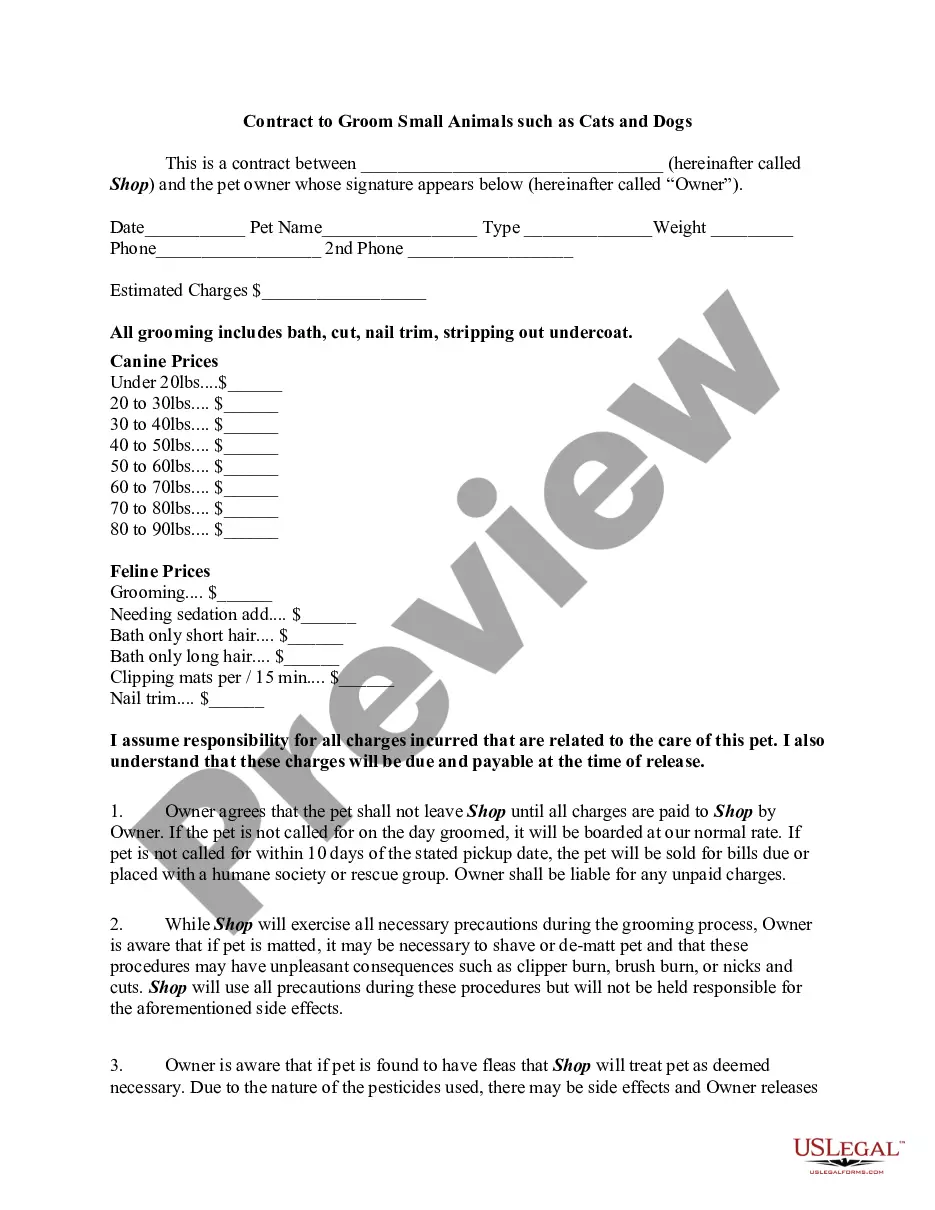
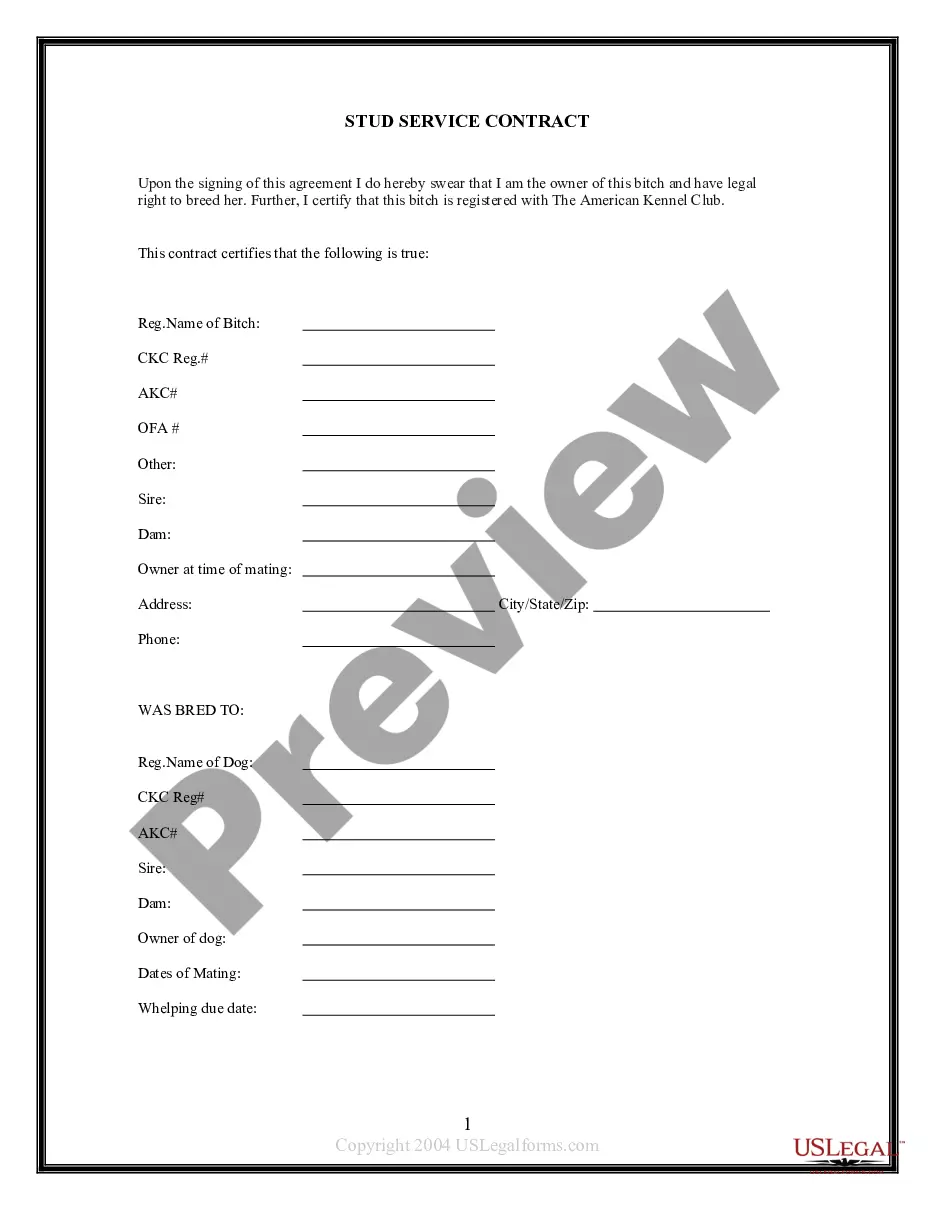
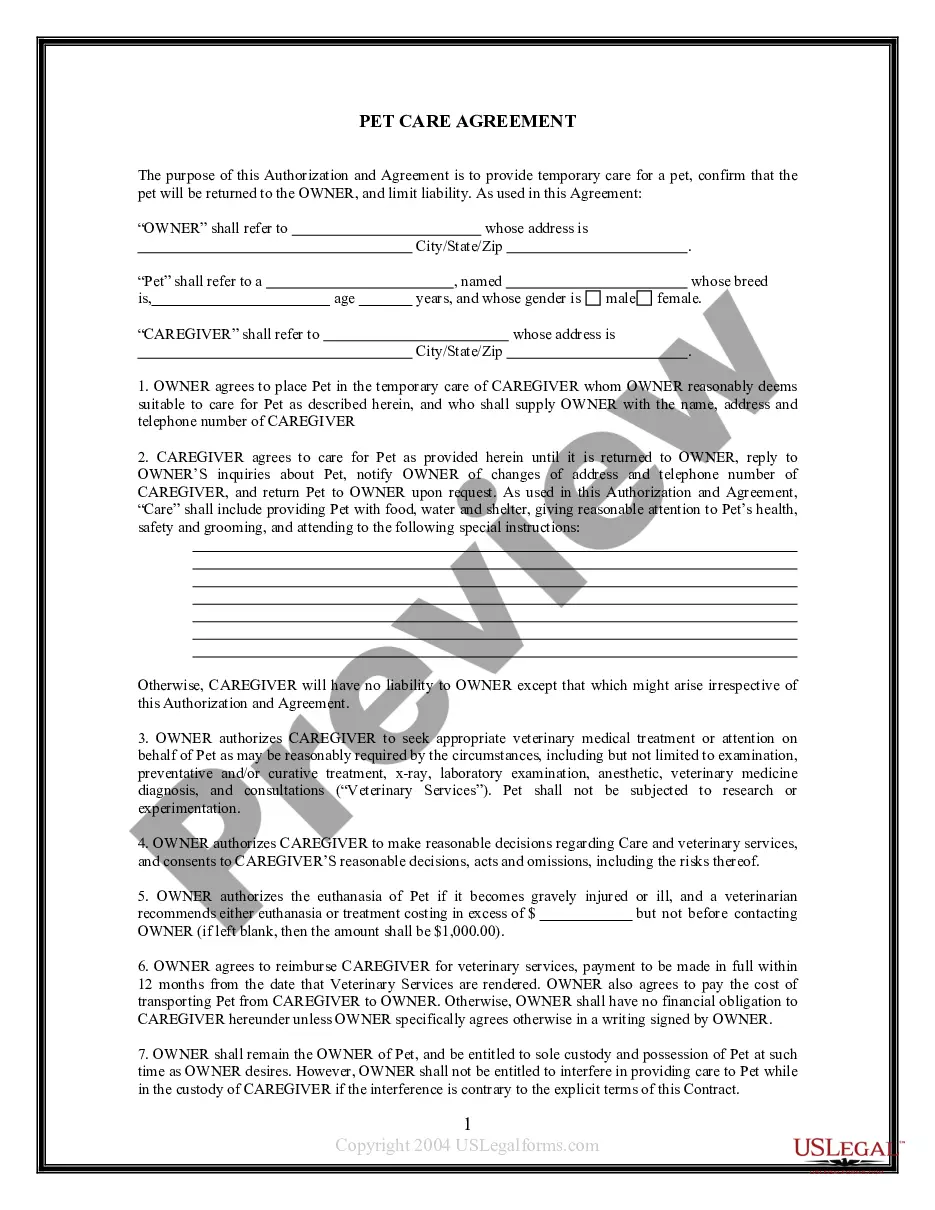
The Contract to Groom Small Animals is a legal agreement between a pet owner and a grooming shop. It outlines the terms under which a pet, such as a dog or cat, will be groomed. This contract ensures that both the owner and the groomer understand their responsibilities and liabilities, distinguishing it from veterinary services, which may involve medical care rather than grooming. The agreement addresses potential issues regarding the pet's health, estimated charges, and care during the grooming process.
Key components of this form
- Identification of the grooming shop and pet owner.
- Date and details about the pet (name, type, weight).
- Estimated charges for grooming services, including specific prices based on weight categories for dogs and types of services for cats.
- Responsibilities of the pet owner, including payment obligations and care instructions for matted pets.
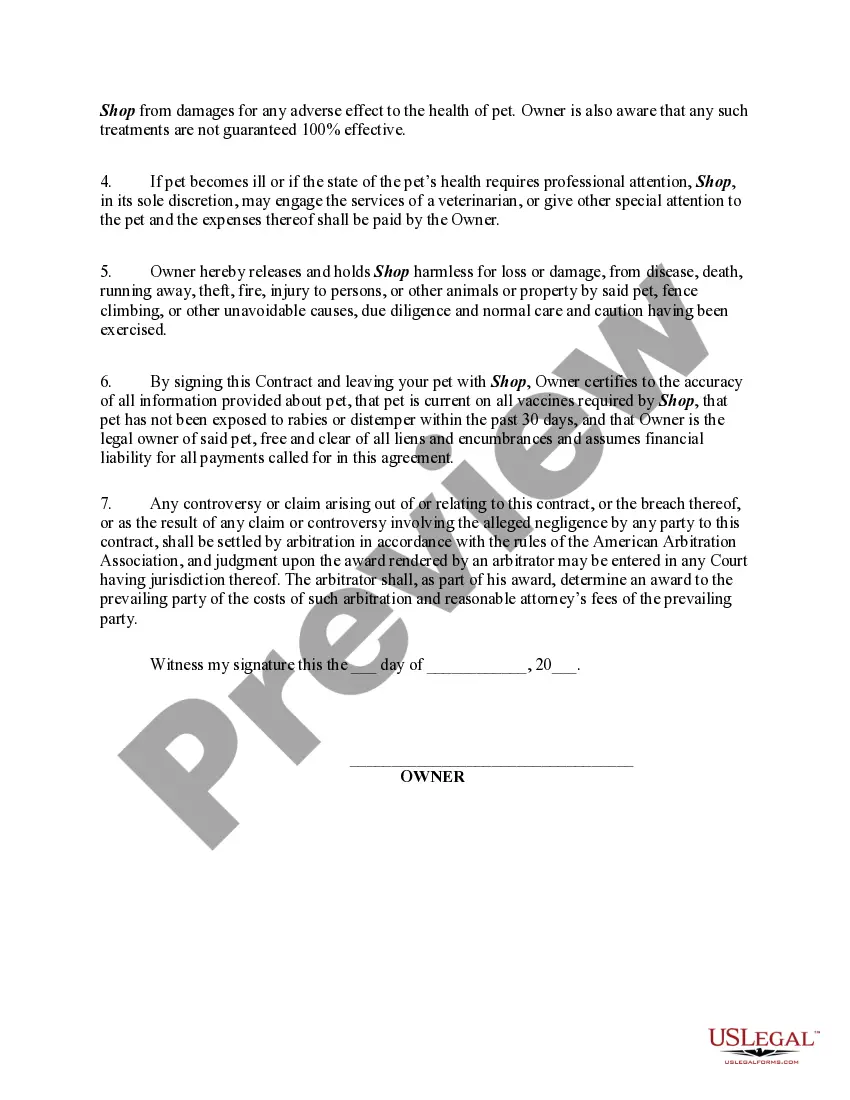
- Release of liability from the grooming shop for certain risks.
- Arbitration clause for resolving disputes.

When this form is needed
This form should be used whenever a pet owner seeks grooming services from a professional groomer. It is suitable for situations where the grooming shop is not affiliated with a veterinary practice. The contract helps protect both parties by clearly defining expectations related to the grooming process and any financial responsibilities that may arise.
Who should use this form
- Pet owners who need grooming services for their dogs or cats.
- Professional grooming shops operating independently from veterinary clinics.
- Individuals looking to clarify responsibilities and liabilities regarding pet grooming.
How to complete this form
- Identify the parties involved: enter the name of the grooming shop and the pet owner's details.
- Complete the date and pet information, including name, type, and weight.
- Specify the estimated charges for the grooming services desired.
- Read and understand the responsibilities outlined in the contract.
- Sign and date the contract at the bottom to indicate acceptance of the terms.
Is notarization required?
Notarization is generally not required for this form. However, certain states or situations might demand it. You can complete notarization online through US Legal Forms, powered by Notarize, using a verified video call available anytime.
Get your form ready online
Our built-in tools help you complete, sign, share, and store your documents in one place.
Make edits, fill in missing information, and update formatting in US Legal Forms—just like you would in MS Word.
Download a copy, print it, send it by email, or mail it via USPS—whatever works best for your next step.
Sign and collect signatures with our SignNow integration. Send to multiple recipients, set reminders, and more. Go Premium to unlock E-Sign.
If this form requires notarization, complete it online through a secure video call—no need to meet a notary in person or wait for an appointment.
We protect your documents and personal data by following strict security and privacy standards.

Make edits, fill in missing information, and update formatting in US Legal Forms—just like you would in MS Word.

Download a copy, print it, send it by email, or mail it via USPS—whatever works best for your next step.

Sign and collect signatures with our SignNow integration. Send to multiple recipients, set reminders, and more. Go Premium to unlock E-Sign.

If this form requires notarization, complete it online through a secure video call—no need to meet a notary in person or wait for an appointment.

We protect your documents and personal data by following strict security and privacy standards.
Typical mistakes to avoid
- Failing to accurately complete the pet's information, such as weight and specific grooming needs.
- Not reading the release of liability clause before signing.
- Overlooking payment obligations related to additional services or late pickup.
Why complete this form online
- Convenient access to a legally vetted template that can be downloaded and printed.
- Editability allows users to customize details specific to their pets and grooming conditions.
- Reliable framework ensuring legal protections for both the pet owner and the grooming shop.
Legal use & context
- This contract is legally binding once both parties have signed, indicating agreement to the terms.
- It helps prevent disputes by clearly outlining the obligations of both the grooming shop and the pet owner.
- Ensures that both parties understand the potential risks involved in grooming services.
Key takeaways
- Always provide accurate information about your pet's health and vaccinations.
- Review the contract carefully before signing to ensure you understand all terms.
- This form protects both the grooming shop and pet owner by clarifying responsibilities and potential liabilities.
Looking for another form?
Form popularity
FAQ
2022 Recent experimental research shows that many mammals, including cats, dogs, bank voles, ferrets, fruit bats, hamsters, mink, pigs, rabbits, racoon dogs, tree shrews, and white-tailed deer can be infected with the virus.
A small number of pets (cats and dogs) have been confirmed to be infected with the virus that causes COVID-19, mostly after close contact with a person with COVID-19. Some pets did not show any signs of illness, but those pets that did get sick all had mild disease that could be taken care of at home.
A small number of pets (cats and dogs) have been confirmed to be infected with the virus that causes COVID-19, mostly after close contact with a person with COVID-19. Some pets did not show any signs of illness, but those pets that did get sick all had mild disease that could be taken care of at home.
2022 Recent experimental research shows that many mammals, including cats, dogs, bank voles, ferrets, fruit bats, hamsters, mink, pigs, rabbits, racoon dogs, tree shrews, and white-tailed deer can be infected with the virus.
There is no evidence that the virus can spread to people from the skin, fur, or hair of pets.
In the United States, there is no evidence that animals are playing a significant role in the spread of COVID-19. Based on the limited information available to date, the risk of animals spreading COVID-19 to people is considered to be low.
Infected pets might get sick or they might not have any symptoms. Of the pets that have gotten sick, most only had mild illness and fully recovered.