Title IX of the Education Amendments - 2009
Overview of this form
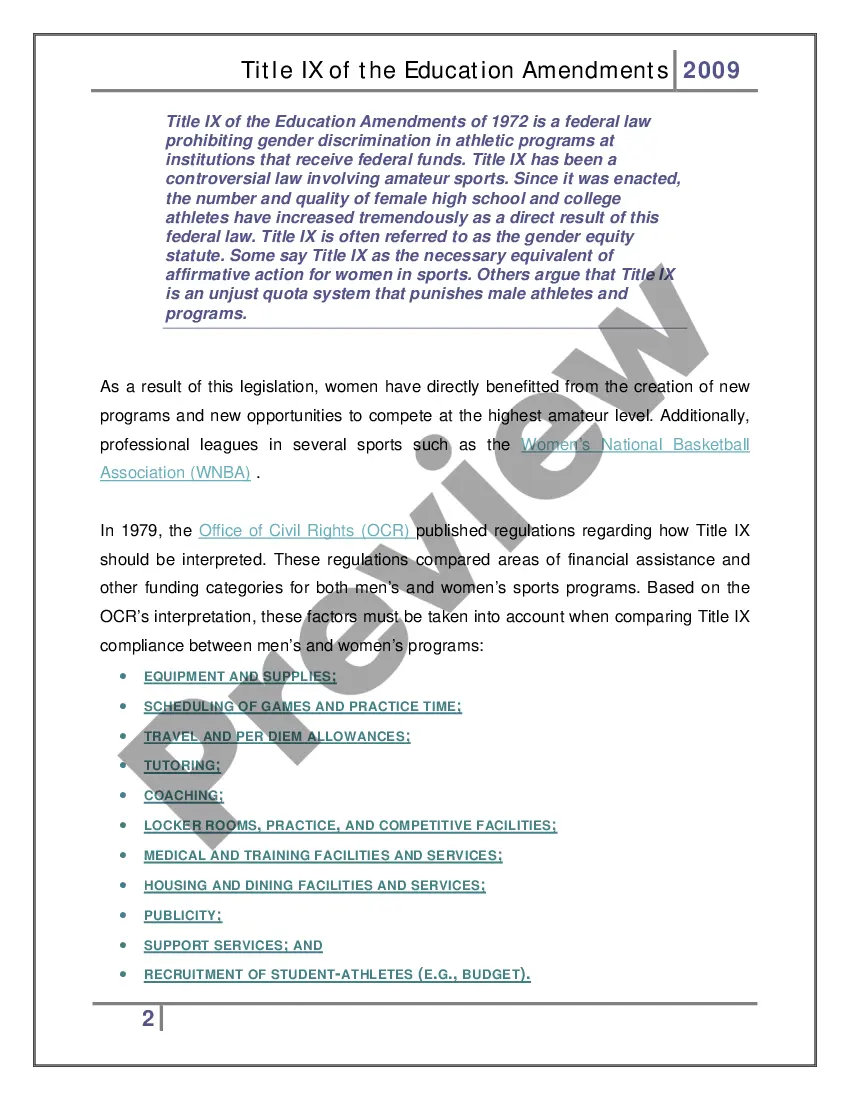
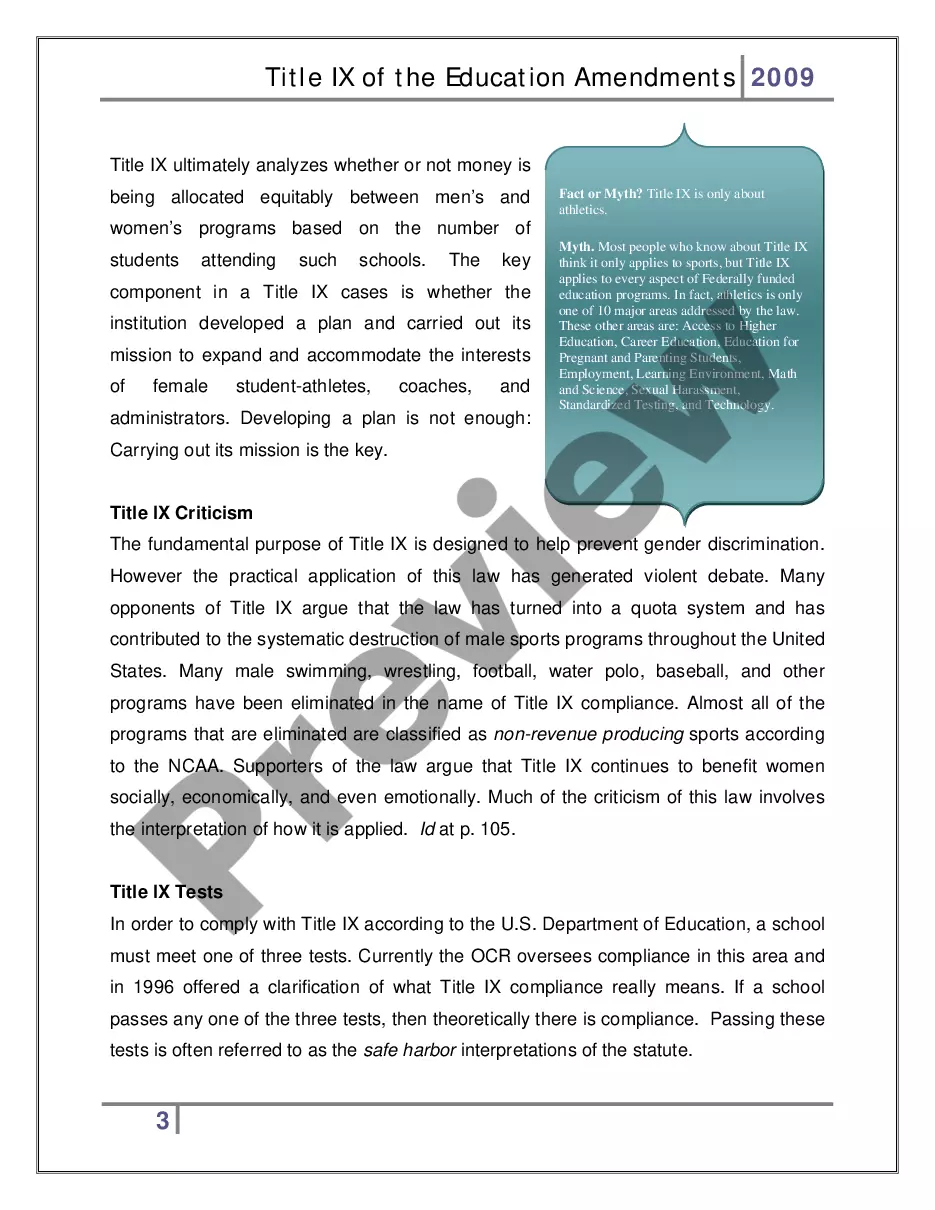
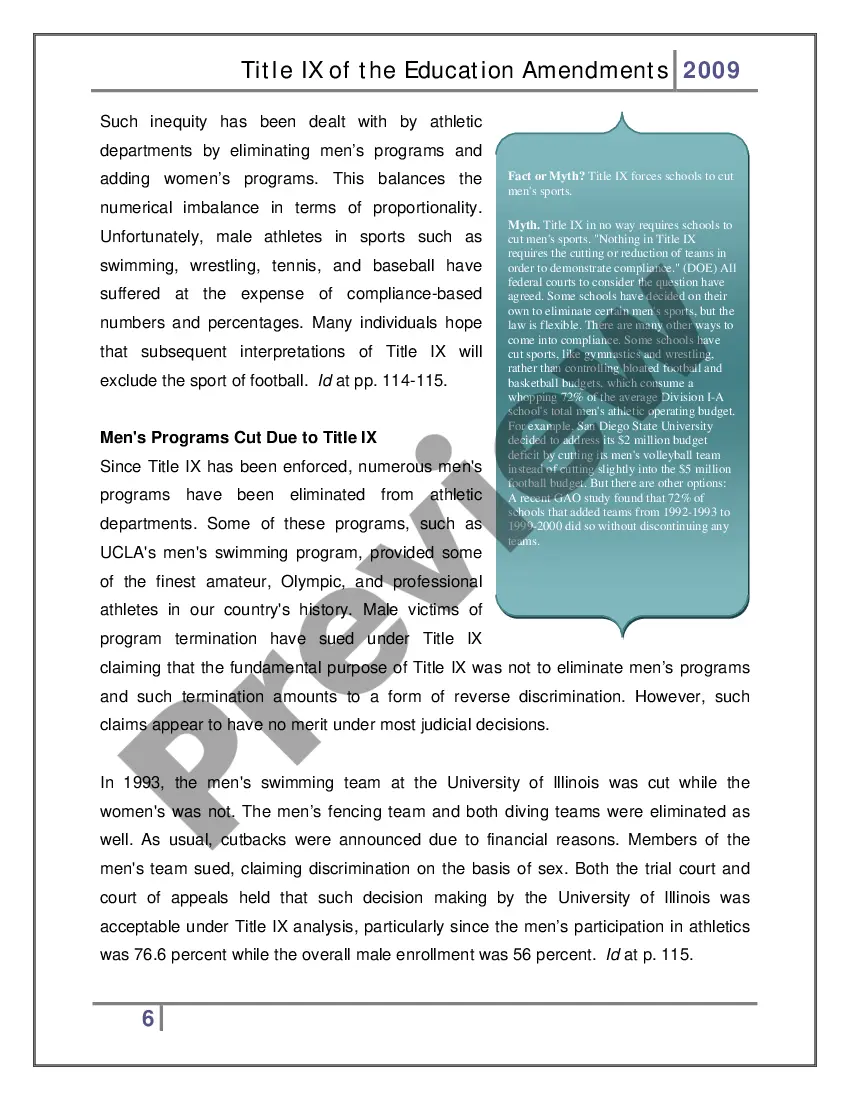
Title IX of the Education Amendments of 1972 is a federal law that prohibits gender discrimination in athletic programs at educational institutions receiving federal funding. This form serves as a comprehensive guide to understanding the implications and applications of Title IX, often referred to as the gender equity statute. Unlike other legal documents that may focus solely on individual programs, this guide addresses the broader context of Title IX, tackling both the benefits and criticisms associated with the law.
Key components of this form
- Overview of Title IX and its purpose in promoting gender equity in sports.
- Analysis of key court cases that have shaped the interpretation and enforcement of Title IX.
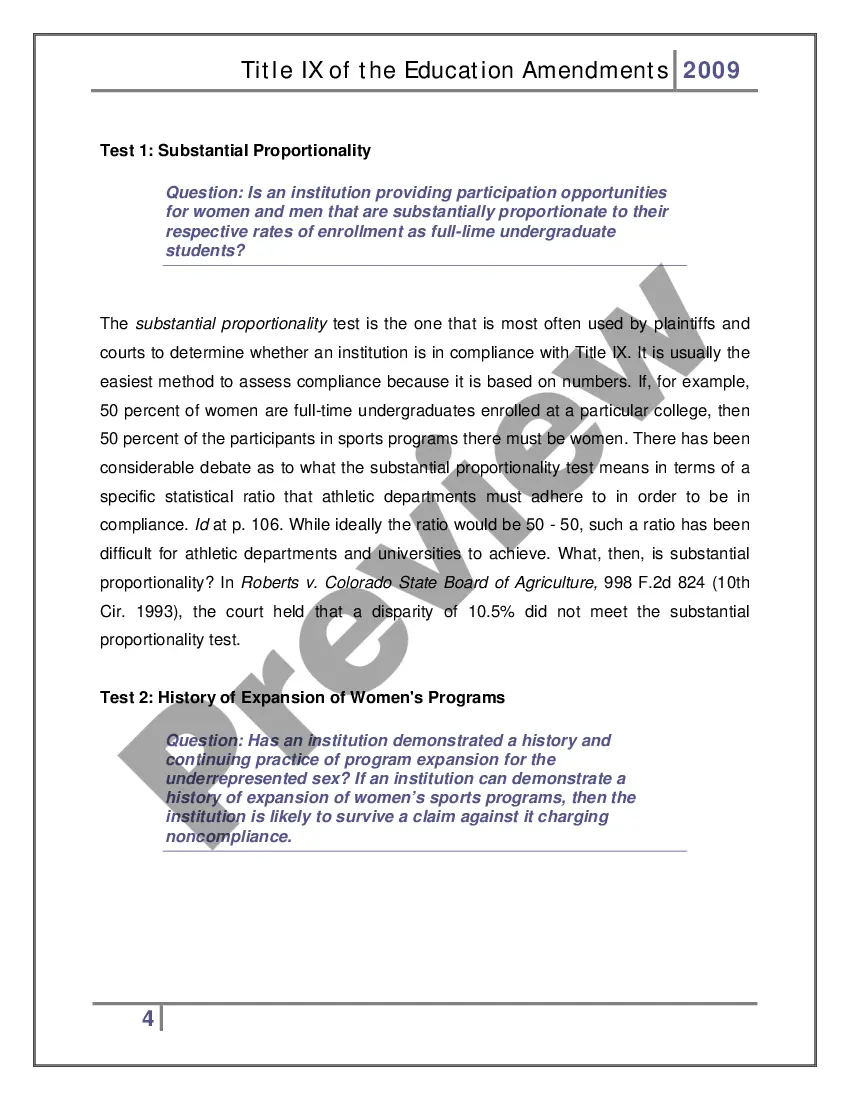
- Details the compliance tests set by the U.S. Department of Education.
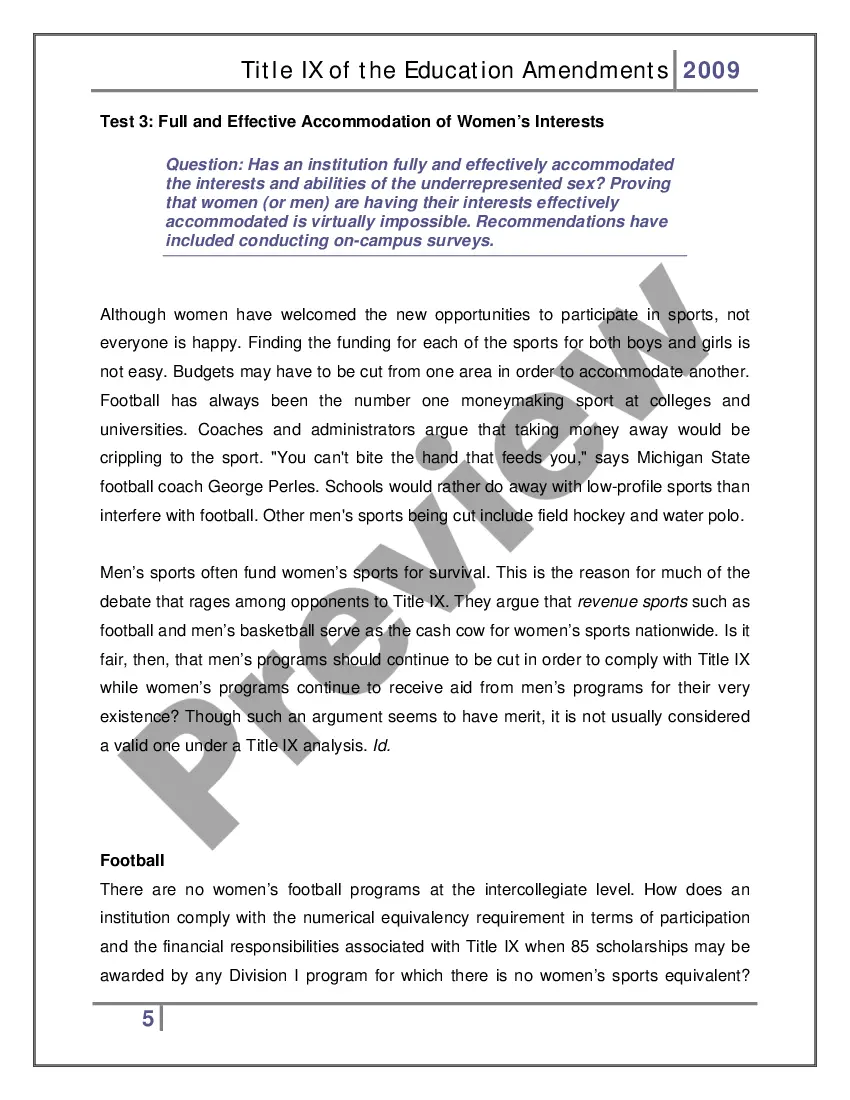
- Discussion of the impact on male sports programs due to Title IX enforcement.
- Examination of funding issues and the Contact Sports Exception.
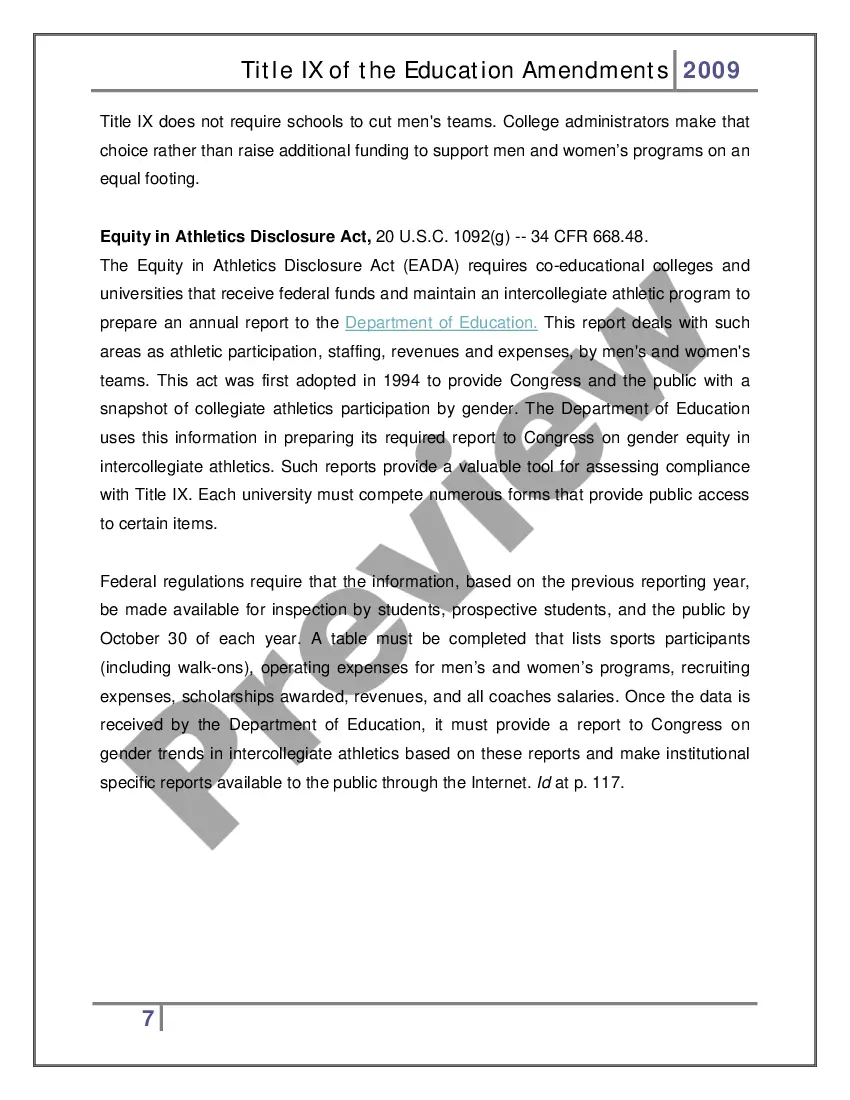
- Annual reporting requirements under the Equity in Athletics Disclosure Act.


When to use this form
This form is essential for educational institutions seeking to understand their obligations under Title IX. It is particularly relevant during program audits, when developing new athletic programs, or when addressing complaints related to gender discrimination in sports. Schools can use this guide to ensure compliance and to inform their policies and practices effectively.
Who needs this form
Intended audience for this form includes:
- College and university administrators responsible for athletic programs.
- Legal professionals specializing in education or sports law.
- Coaches and athletic directors seeking to understand Title IX requirements.
- Gender equity advocates within educational settings.
- Students and parents concerned about athletic opportunities and equity.
Completing this form step by step
To utilize this guide effectively, follow these steps:
- Familiarize yourself with the general principles and history of Title IX.
- Review the compliance tests outlined by the U.S. Department of Education.
- Examine case studies that illustrate practical applications of Title IX.
- Analyze your institution's current practices against Title IX requirements.
- Create a reporting plan that fulfills the Equity in Athletics Disclosure Act's requirements.
Does this form need to be notarized?
This form does not typically require notarization to be legally valid. However, some jurisdictions or document types may still require it. US Legal Forms provides secure online notarization powered by Notarize, available 24/7 for added convenience.
Get your form ready online
Our built-in tools help you complete, sign, share, and store your documents in one place.
Make edits, fill in missing information, and update formatting in US Legal Forms—just like you would in MS Word.
Download a copy, print it, send it by email, or mail it via USPS—whatever works best for your next step.
Sign and collect signatures with our SignNow integration. Send to multiple recipients, set reminders, and more. Go Premium to unlock E-Sign.
If this form requires notarization, complete it online through a secure video call—no need to meet a notary in person or wait for an appointment.
We protect your documents and personal data by following strict security and privacy standards.

Make edits, fill in missing information, and update formatting in US Legal Forms—just like you would in MS Word.

Download a copy, print it, send it by email, or mail it via USPS—whatever works best for your next step.

Sign and collect signatures with our SignNow integration. Send to multiple recipients, set reminders, and more. Go Premium to unlock E-Sign.

If this form requires notarization, complete it online through a secure video call—no need to meet a notary in person or wait for an appointment.

We protect your documents and personal data by following strict security and privacy standards.
Typical mistakes to avoid
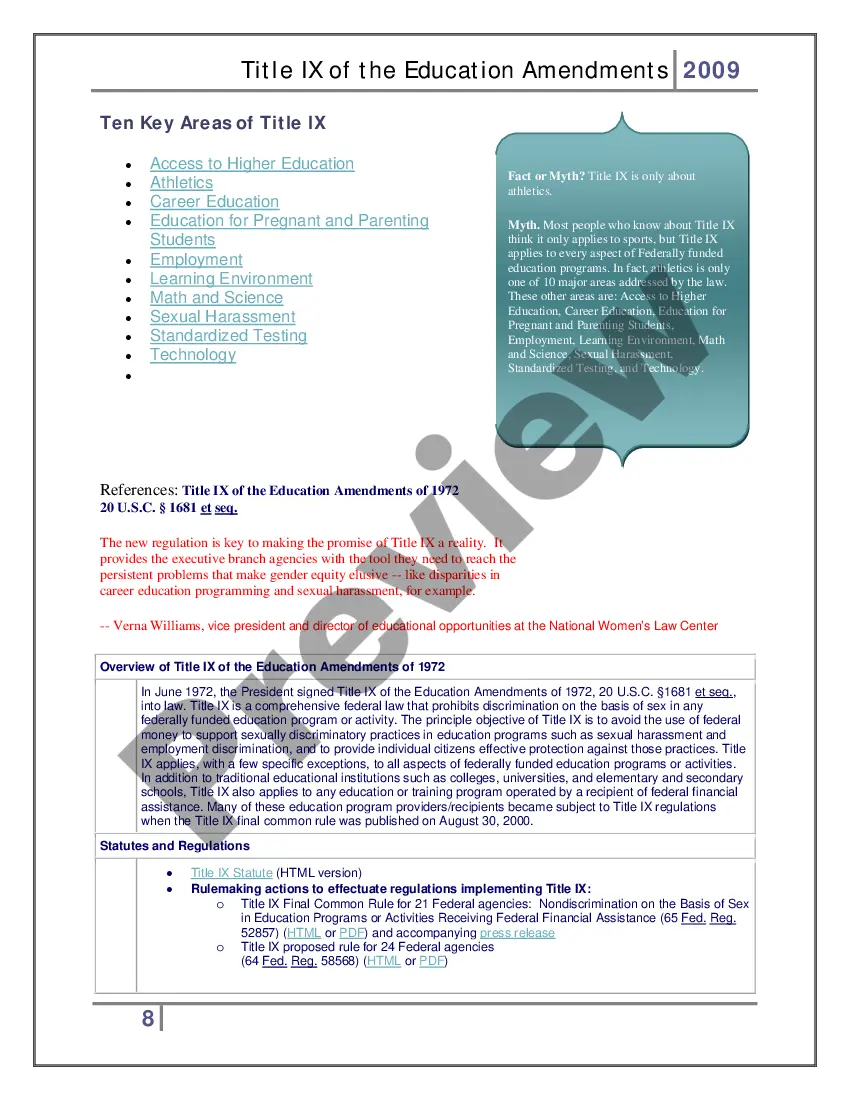
- Assuming Title IX only pertains to athletic programs without recognizing its broader scope.
- Ignoring the importance of proportionality in enrollment and sports participation.
- Failing to keep accurate records for annual reporting under the Equity in Athletics Disclosure Act.
Why use this form online
- Access to comprehensive and updated legal knowledge on Title IX.
- Ability to tailor institutional practices to meet federal compliance.
- Conveniently downloadable format for quick reference and editing.
- This guide outlines the legal requirements and benefits of Title IX compliance in education.
- It clarifies the necessity of funding equality between men's and women's programs.
- Understanding legal precedents and court decisions related to Title IX can help institutions navigate compliance challenges.
Quick recap
- Title IX ensures gender equity in athletic programs across federally funded educational institutions.
- The U.S. Department of Education's compliance tests are crucial for evaluating adherence to Title IX standards.
- Understanding the implications of Title IX helps prevent gender discrimination and promotes equal opportunities in sports.
Looking for another form?


Form popularity
FAQ
How to File. Title IX complaints are generally submit online, either through the electronic submission of the pre-prepared OCR complaint form or by email (OCR@ed.gov). However, you can submit your complaint, whether based on the online form or not, by snail mail.
Unwanted sexual behavior, advances, or requests for favors. Unwelcomed verbal, visual, or physical sexual conduct. Offensive, severe, and/or frequent remarks about a person's sex. Harassment of a sexual nature which interferes with an individual's right to an education and participation in a program or activity.
Title IX of the Education Amendments Act of 1972 is a federal law that states: "No person in the United States shall, on the basis of sex, be excluded from participation in, be denied the benefits of, or be subjected to discrimination under any education program or activity receiving Federal financial assistance."
Title IX requires schools to adopt and publish grievance procedures for students to file complaints of sex discrimination, including complaints of sexual harassment or sexual violence. Schools can use general disciplinary procedures to address complaints of sex discrimination.
Title IX of the Education Amendments Act of 1972 is a federal law that states: "No person in the United States shall, on the basis of sex, be excluded from participation in, be denied the benefits of, or be subjected to discrimination under any education program or activity receiving Federal financial assistance." Q.
Who does Title IX apply to? Title IX applies to all educational institutions, both public and private, that receive federal funds. Almost all private colleges and universities must abide by Title IX regulations because they receive federal funding through federal financial aid programs used by their students.
Title IX of the Education Amendments of 1972 (Title IX) prohibits sex discrimination in any education program or activity receiving federal financial assistance.
Title IX of the Education Amendments of 1972. Title IX of the Education Amendments of 1972 (Title IX) prohibits sex discrimination in any education program or activity receiving federal financial assistance.
Background on the Title IX Rule: Key provisions of the Department of Education's new Title IX regulation: Defines sexual harassment to include sexual assault, dating violence, domestic violence, and stalking, as unlawful discrimination on the basis of sex.