South Carolina Essential Legal Life Documents for Baby Boomers
About this form package
This South Carolina Essential Legal Life Documents for Baby Boomers form package provides crucial legal documents tailored for Baby Boomers addressing important issues pertinent to later stages of life. Unlike generic document packages, this collection features state-specific forms crafted by licensed attorneys to ensure compliance with South Carolina laws. The package includes a Last Will and Testament, Living Will, General Power of Attorney effective immediately, and other essential documents, offering a comprehensive toolkit for managing health and finances as one ages.
Forms included in this package
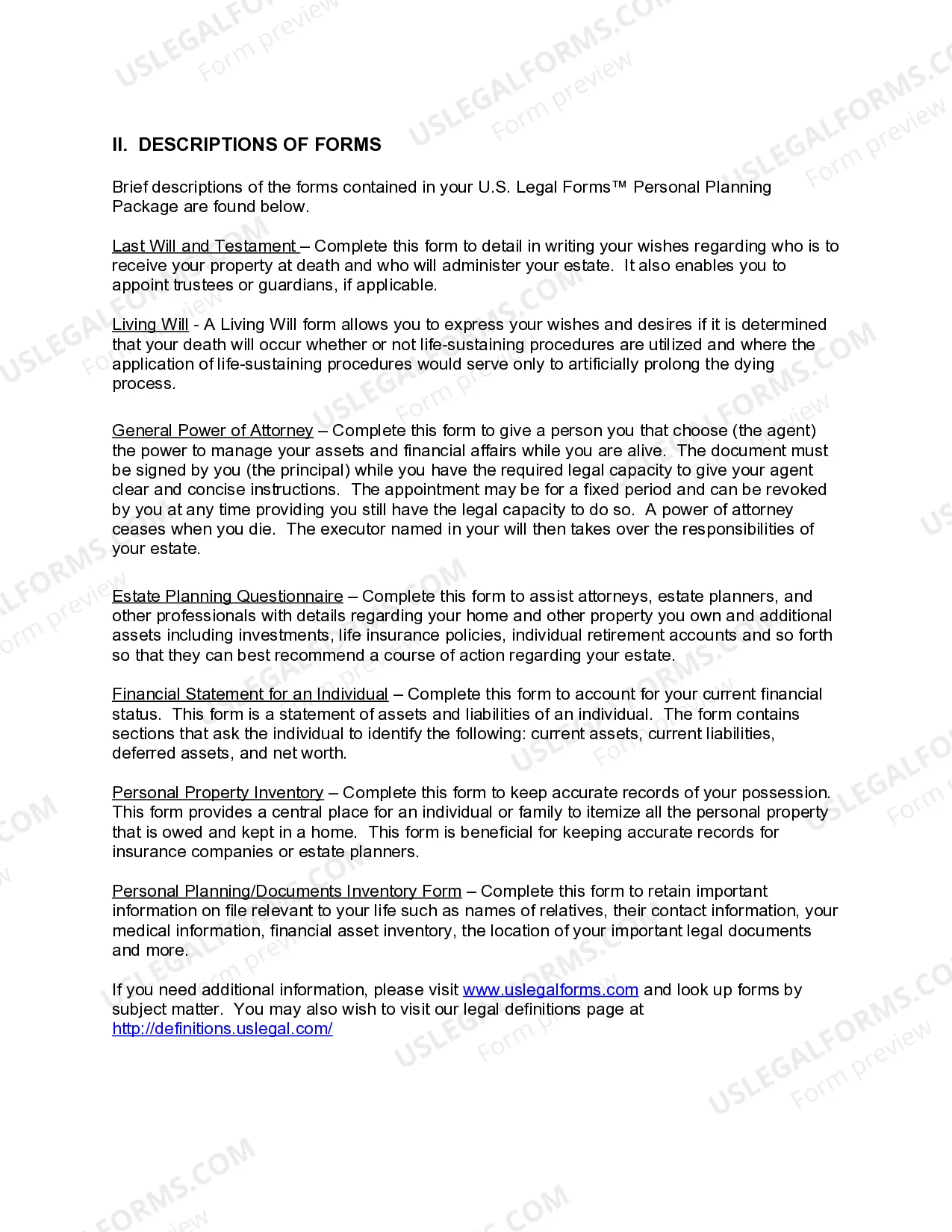
- General Durable Power of Attorney for Property and Finances or Financial Effective Immediately
- Statutory Equivalent of Living Will or Declaration for a Desire of a Natural Death - Statutory
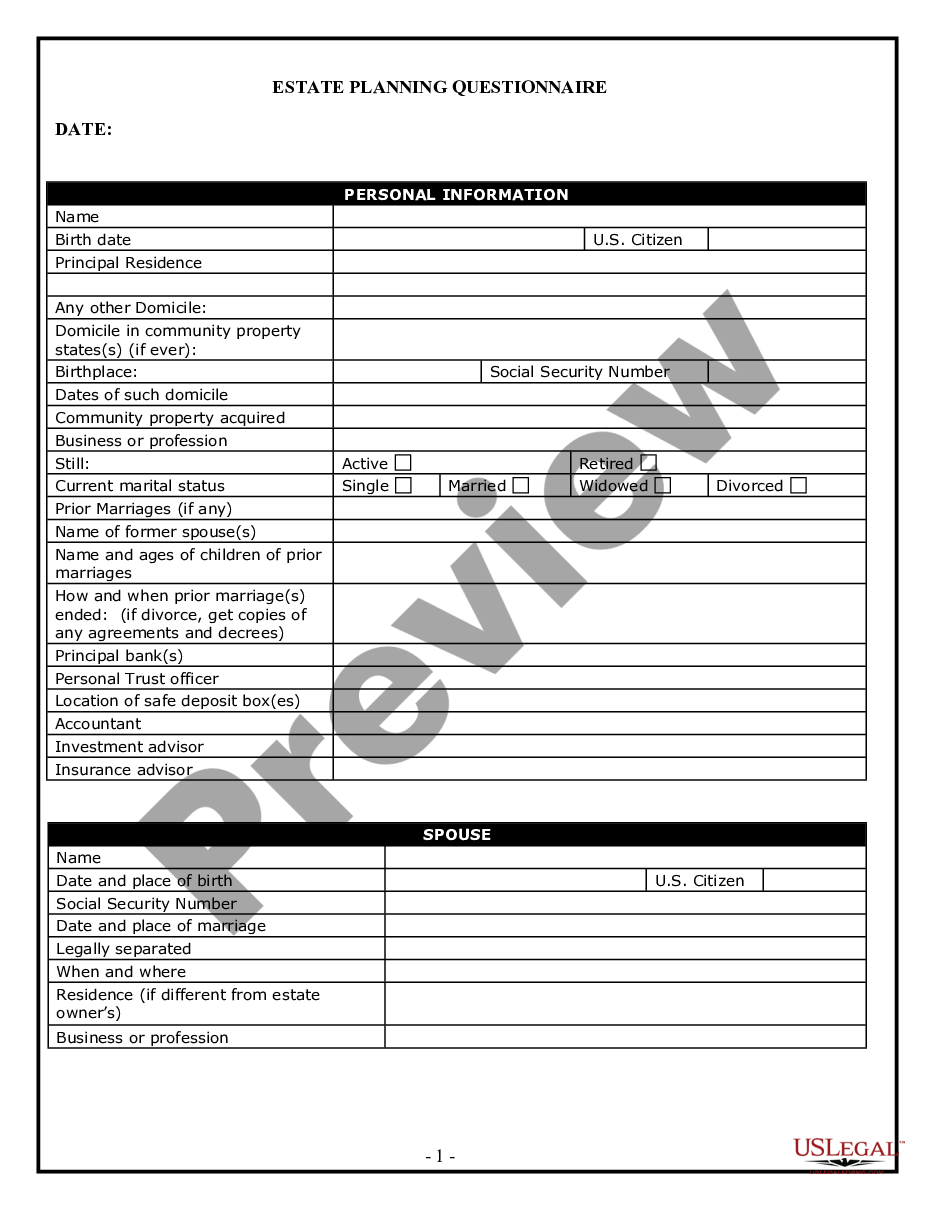
- Estate Planning Questionnaire and Worksheets
- Personal Property Inventory
- Financial Statement Form - Individual
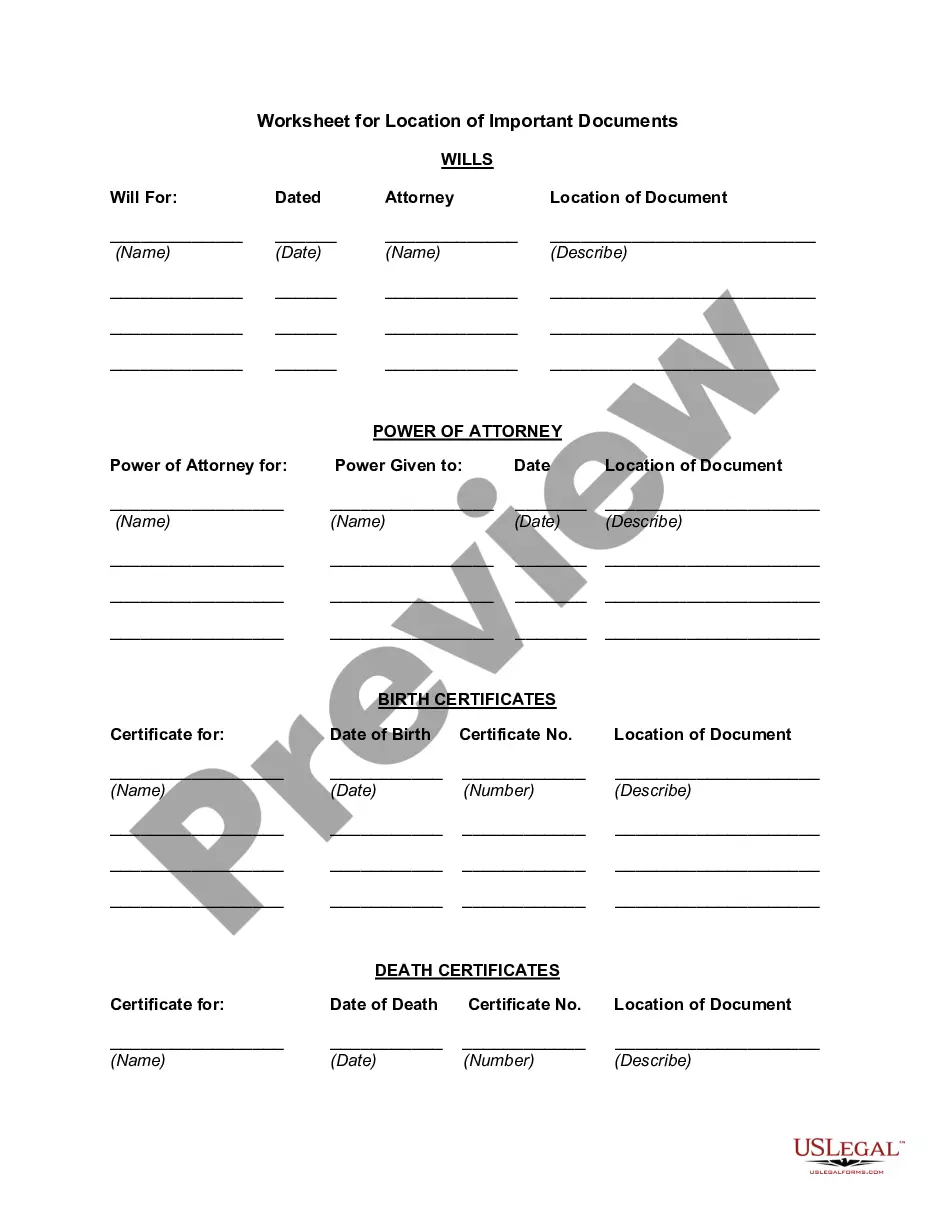
- Personal Planning Information and Document Inventory Worksheets - A Legal Life Document
Situations where these forms applies
This form package is ideal for Baby Boomers who wish to ensure their legal matters are organized and their wishes respected as they enter later stages of life. Scenarios include:
- Creating a Last Will and Testament to dictate asset distribution after death.
- Preparing a Living Will to outline medical preferences in the event of severe illness.
- Designating a General Power of Attorney to manage financial affairs if one becomes incapacitated.
- Conducting an estate planning assessment to understand current assets and liabilities.
- Maintaining an inventory of personal property for insurance and estate planning purposes.
Who should use this form package
- Baby Boomers residing in South Carolina.
- Individuals seeking to organize their legal documents for health and financial matters.
- Those wanting to plan their estate in line with state laws.
- Adults who want to express their medical and financial preferences for the future.
How to prepare this document
- Review all included forms carefully to understand their purposes and requirements.
- Fill out the Estate Planning Questionnaire to provide relevant details to assist in your planning.
- Complete the Last Will and Testament, clearly stating your wishes for asset distribution.
- Designate an agent in the General Power of Attorney to manage your financial affairs.
- Maintain an updated Personal Property Inventory to track your possessions.
- Store completed forms securely and inform a trusted individual about their location.
Notarization guidance for this package
Notarization is required for one or more forms in this package. US Legal Forms provides secure online notarization powered by Notarize, allowing you to complete the process through a verified video call.
Get your form ready online
Our built-in tools help you complete, sign, share, and store your documents in one place.
Make edits, fill in missing information, and update formatting in US Legal Forms—just like you would in MS Word.
Download a copy, print it, send it by email, or mail it via USPS—whatever works best for your next step.
Sign and collect signatures with our SignNow integration. Send to multiple recipients, set reminders, and more. Go Premium to unlock E-Sign.
If this form requires notarization, complete it online through a secure video call—no need to meet a notary in person or wait for an appointment.
We protect your documents and personal data by following strict security and privacy standards.

Make edits, fill in missing information, and update formatting in US Legal Forms—just like you would in MS Word.

Download a copy, print it, send it by email, or mail it via USPS—whatever works best for your next step.

Sign and collect signatures with our SignNow integration. Send to multiple recipients, set reminders, and more. Go Premium to unlock E-Sign.

If this form requires notarization, complete it online through a secure video call—no need to meet a notary in person or wait for an appointment.

We protect your documents and personal data by following strict security and privacy standards.
Typical mistakes to avoid
- Failing to update the documents when life circumstances change, such as marriage or death.
- Not specifying preferences clearly in the Living Will.
- Leaving blank fields in important forms, which can lead to ambiguity.
- Forgetting to store the forms in a secure but accessible location.
Why use this package online
- Convenience of downloading and completing forms from home without the need for an appointment.
- Editability allows you to make changes easily as your plans or situations change.
- Reliable access to state-specific forms drafted by licensed attorneys.
- Cost savings by purchasing a comprehensive package rather than individual documents.
Looking for another form?

Form popularity
FAQ
For an estate to go through probate, no estate planning is required. A person's estate can pass through probate whether they died without a will or with one, as long as it has assets that are subject to the process. For an estate to avoid probate, the deceased must own no assets subject to probate at the time of death.
If the total value of all the assets you leave behind is less than a certain amount, the people who inherit your personal property -- that's anything except real estate -- may be able to skip probate entirely. The exact amount depends on state law, and varies hugely.
South Carolina's intestacy law says that if you die without a Will and have children and a spouse, your spouse will receive one-half of your intestate estate and your children will receive the other half. If there are no children, the surviving spouse would receive the entire intestate estate.
You can use the simplified small estate process in South Carolina if the value of property passing by will or under state law, less liens and encumbrances, is $25,000 or less (not counting exempt property, costs of administration, funeral expenses, and medical expenses of last illness).
Children - if there is no surviving married or civil partner If there is no surviving partner, the children of a person who has died without leaving a will inherit the whole estate. This applies however much the estate is worth. If there are two or more children, the estate will be divided equally between them.
In South Carolina, probate for small estates is required. A small estate is considered to be an estate that is valued at $25,000 or less in assets and no real property. If those two conditions are met for a small estate, a case will have to be filed with the probate court.
In South Carolina, you can make a living trust to avoid probate for virtually any asset you ownreal estate, bank accounts, vehicles, and so on. You need to create a trust document (it's similar to a will), naming someone to take over as trustee after your death (called a successor trustee).
Itemize Your Inventory. Follow with Non-Physical Assets. Assemble a List of Debts. Make a Memberships List. Make Copies of Your Lists. Review Your Retirement Account. Update Your Insurance. Transfer on Death Designations.