- US Legal Forms
- Forms Catalog
- Landlord Tenant
-
South Carolina Residential Rental Lease Agreement
South Carolina Residential Rental Lease Agreement
-
No results found.
-
South Carolina
-
Alabama
-
Alaska
-
Arizona
-
Arkansas
-
California
-
Colorado
-
Connecticut
-
Delaware
-
District of Columbia
-
Florida
-
Georgia
-
Hawaii
-
Idaho
-
Illinois
-
Indiana
-
Iowa
-
Kansas
-
Kentucky
-
Louisiana
-
Maine
-
Maryland
-
Massachusetts
-
Michigan
-
Minnesota
-
Mississippi
-
Missouri
-
Montana
-
Multi-State
-
Nebraska
-
Nevada
-
New Hampshire
-
New Jersey
-
New Mexico
-
New York
-
North Carolina
-
North Dakota
-
Ohio
-
Oklahoma
-
Oregon
-
Pennsylvania
-
Rhode Island
-
South Dakota
-
Tennessee
-
Texas
-
Utah
-
Vermont
-
Virginia
-
Washington
-
West Virginia
-
Wisconsin
-
Wyoming
This form is part of a form package!
Get all related documents in one bundle, so you don’t have to search separately.
What is this form?
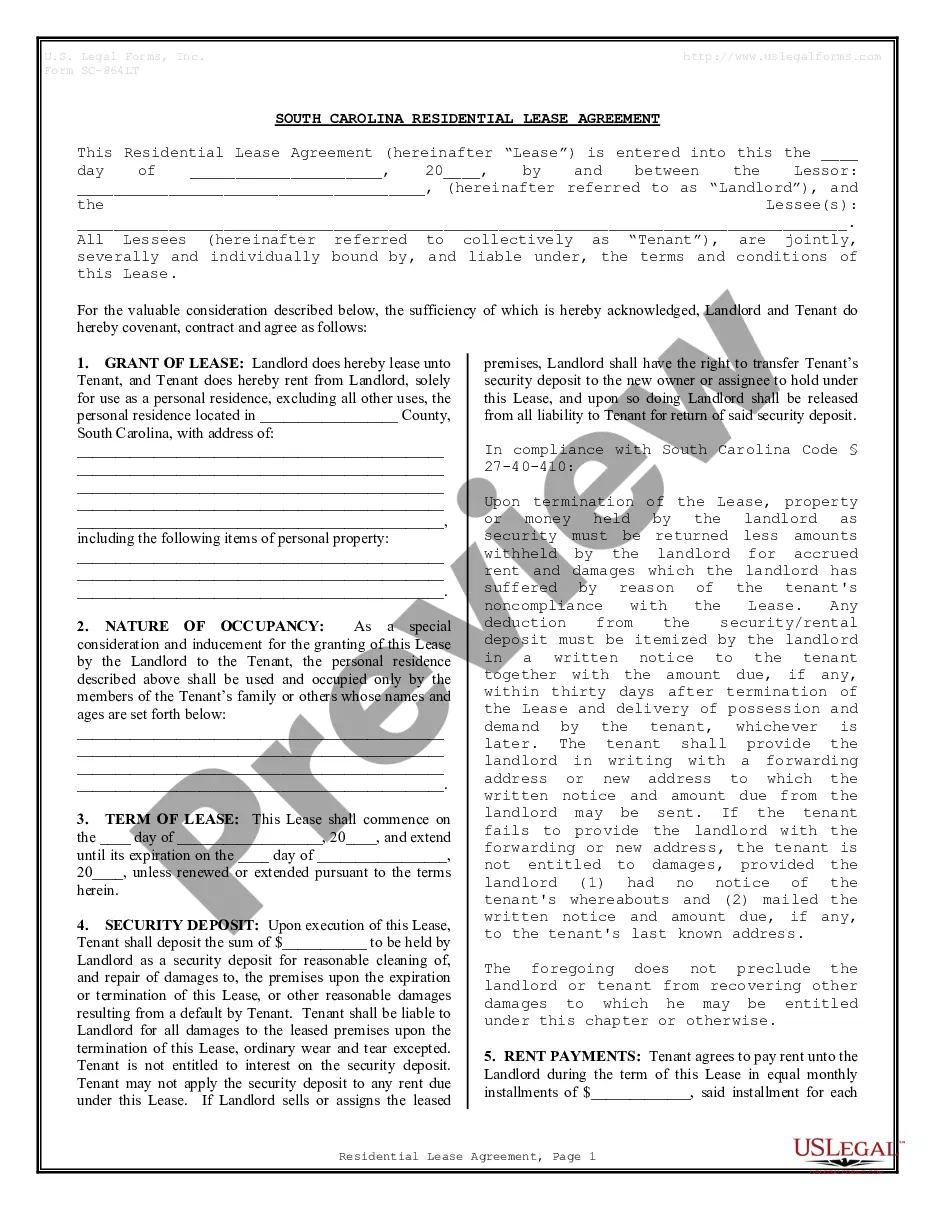
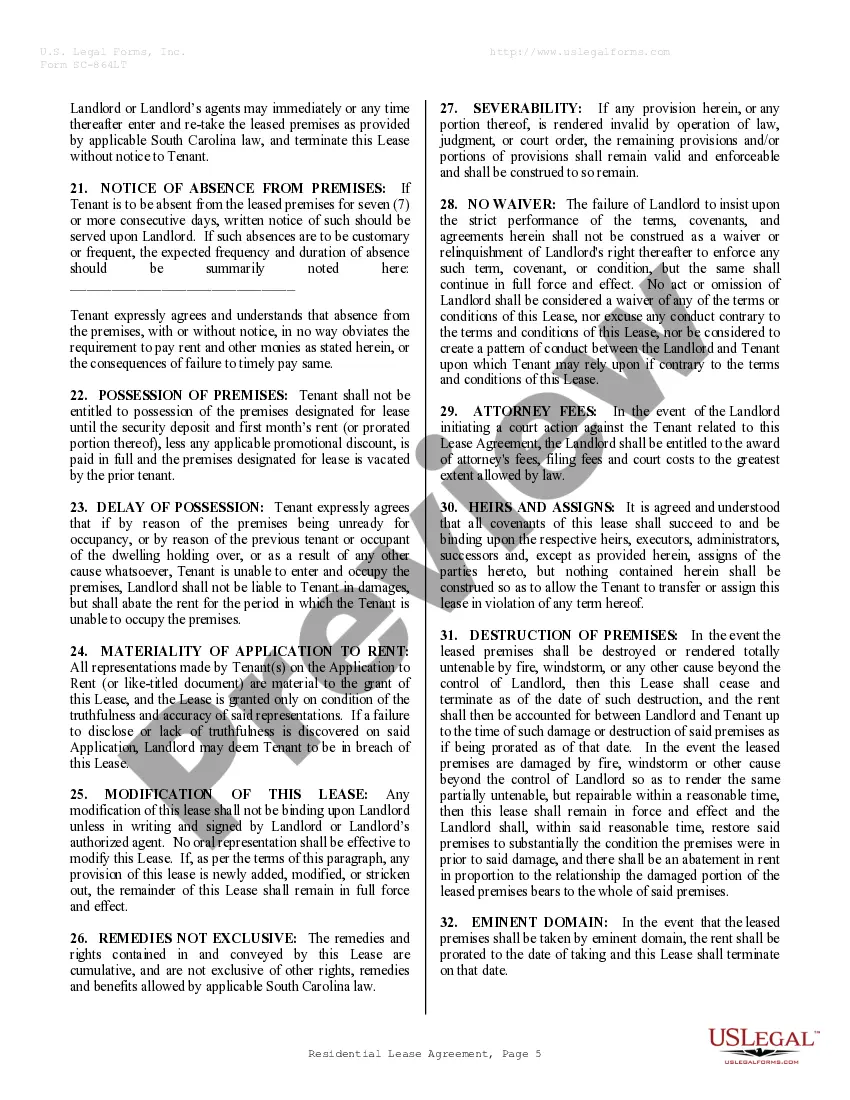
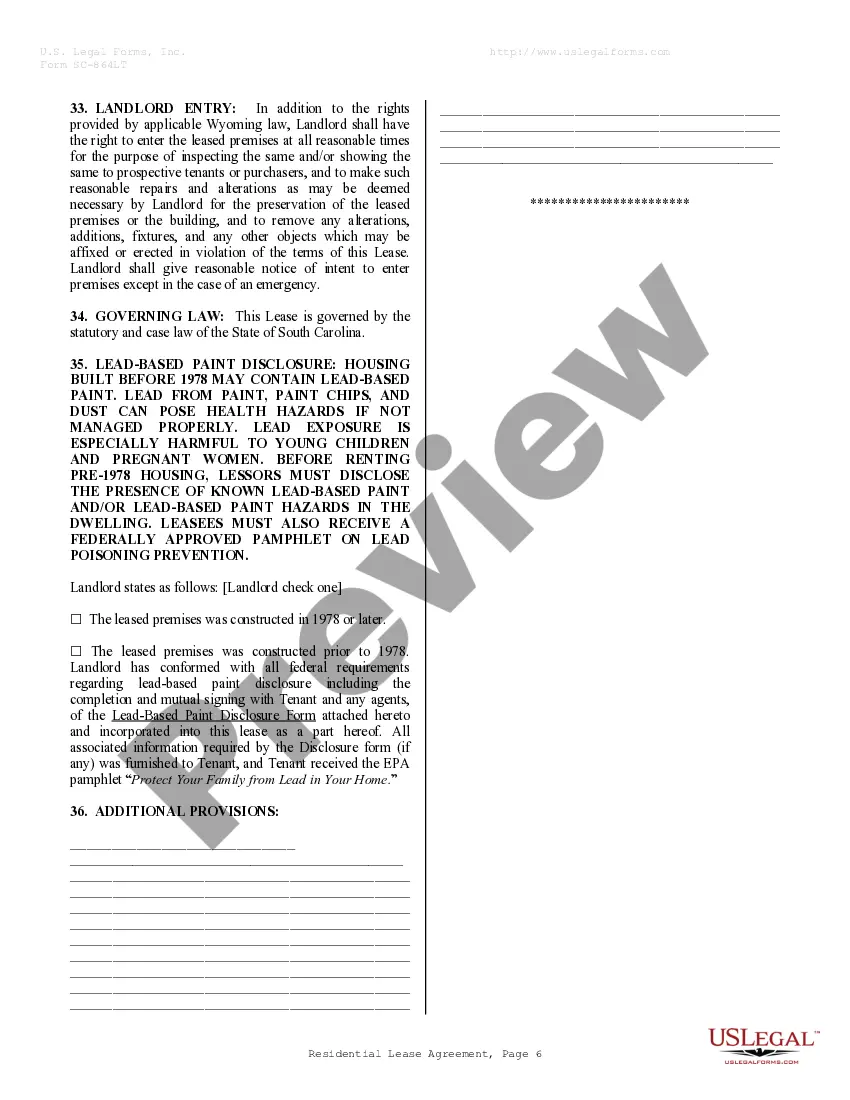
The Residential Rental Lease Agreement is a legal document that establishes the terms and conditions between a landlord and tenant for leasing a residential property. This lease typically covers a specific term, such as one year or six months. By outlining the rights and responsibilities of each party, this form helps to protect both the landlord's property and the tenant's living conditions. It differentiates itself from similar forms by including provisions specific to South Carolina state laws and regulations.
Form components explained
- Parties to the agreement: Identifies the landlord (lessor) and tenant (lessee).
- Grant of lease: Specifies the property, intended use, and any included personal property.
- Term of lease: Indicates the start and end dates of the rental period.
- Security deposit: Outlines the amount, purpose, and conditions for its return.
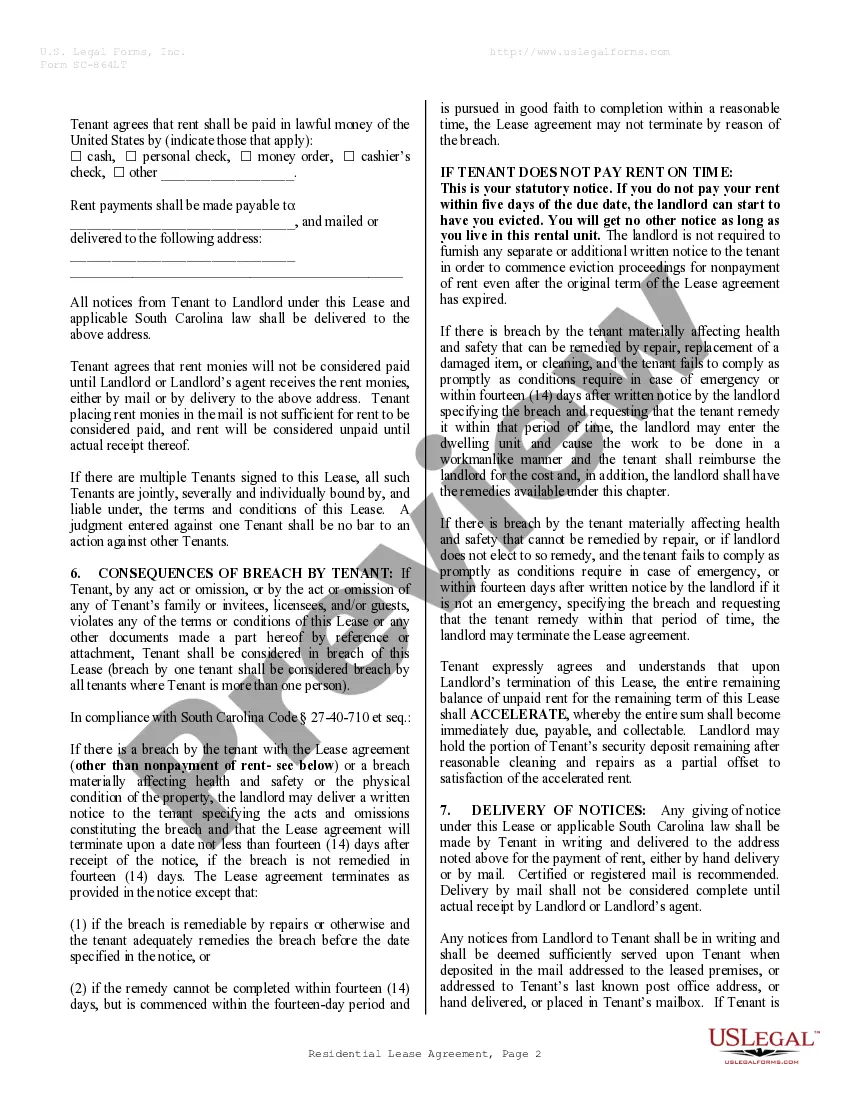
- Rent payments: Details the payment schedule, amount, and methods of payment.
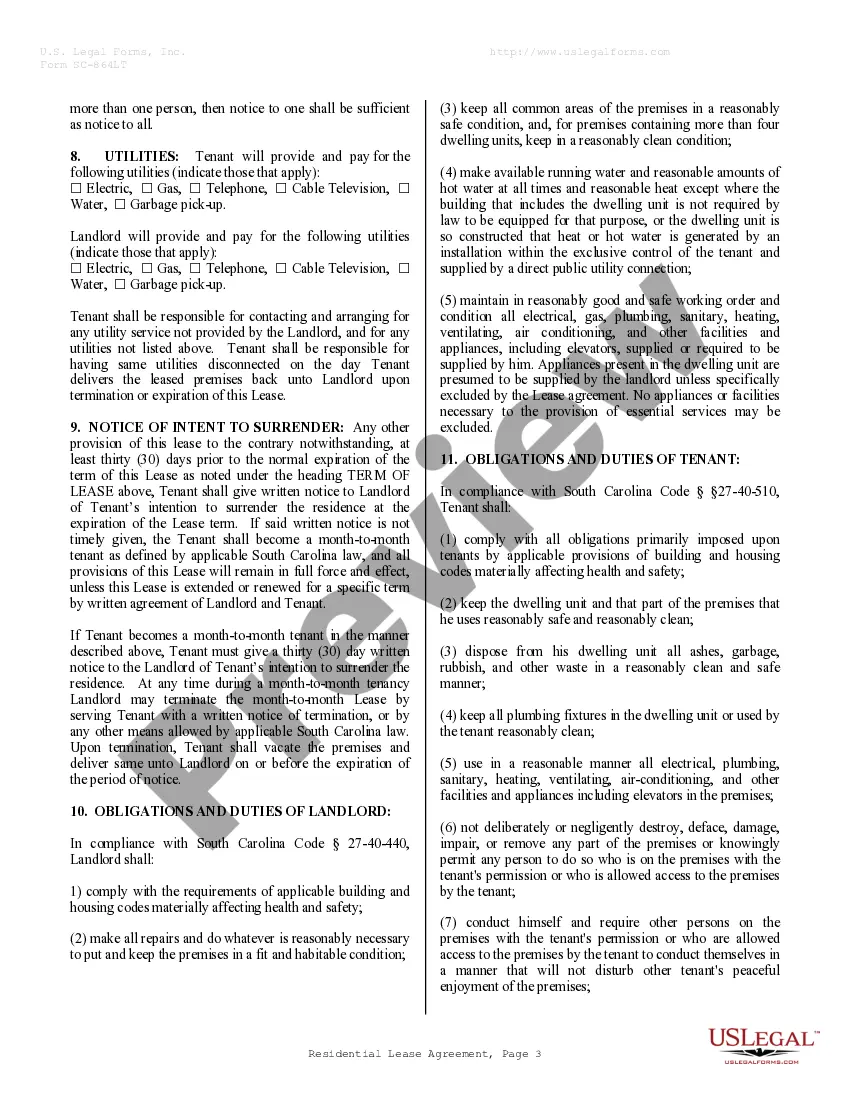
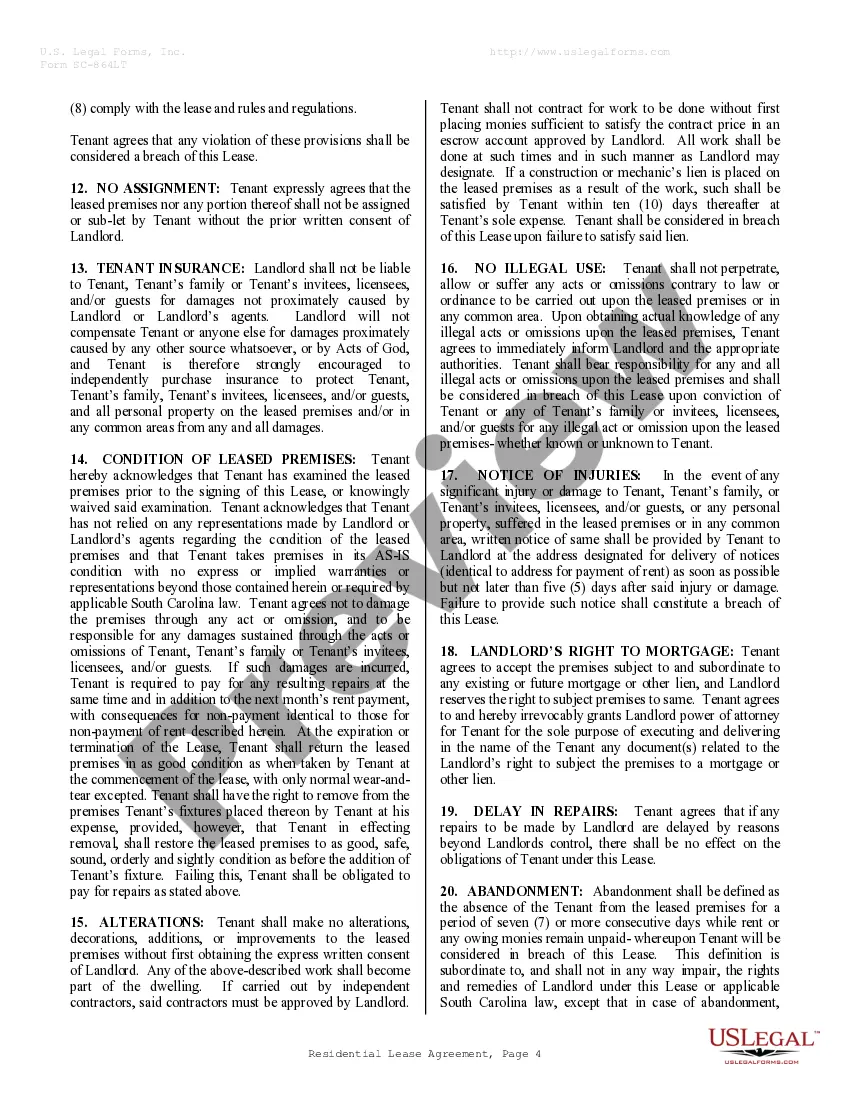
- Consequences of breach: Describes the process and repercussions if either party fails to comply with the lease terms.
Related forms
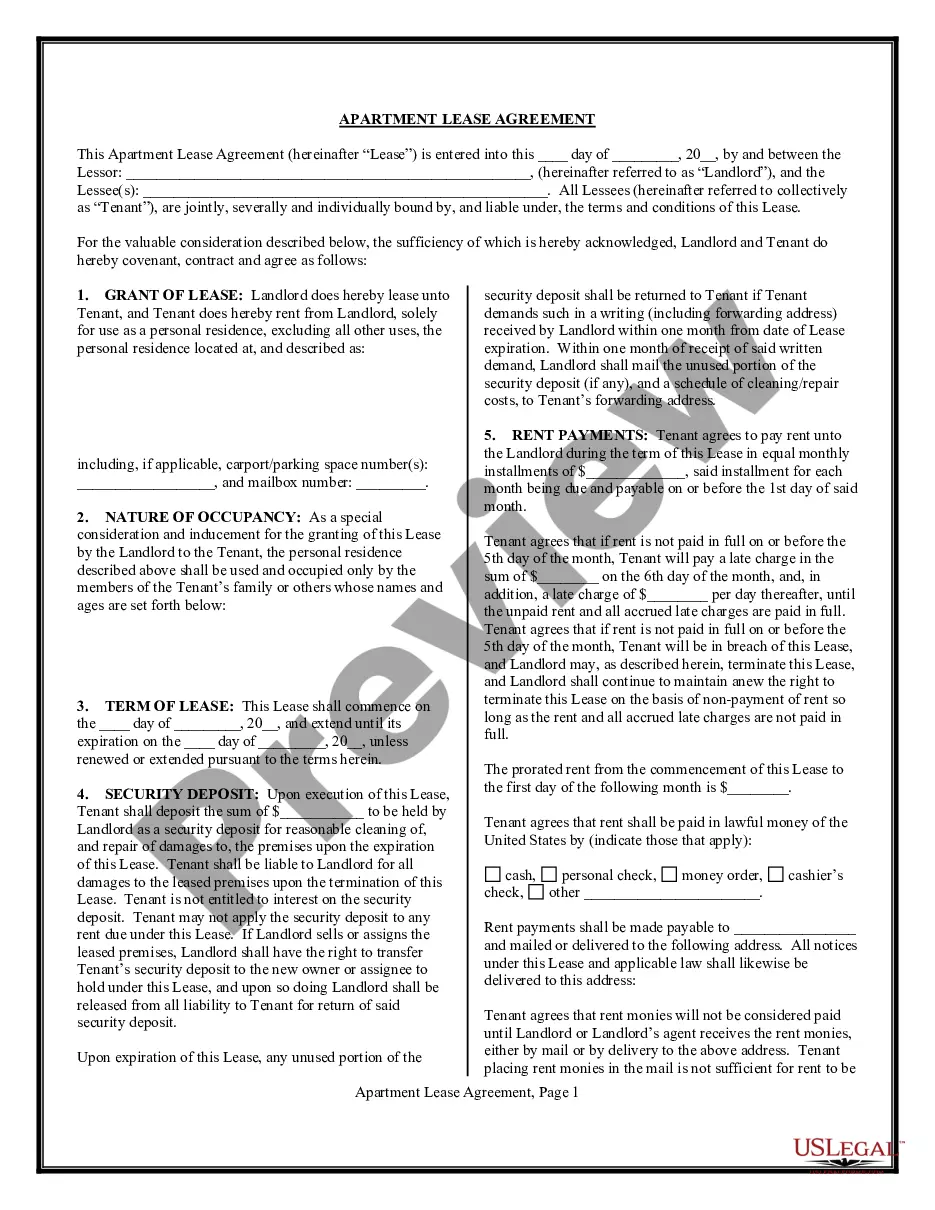
Apartment Lease Agreement
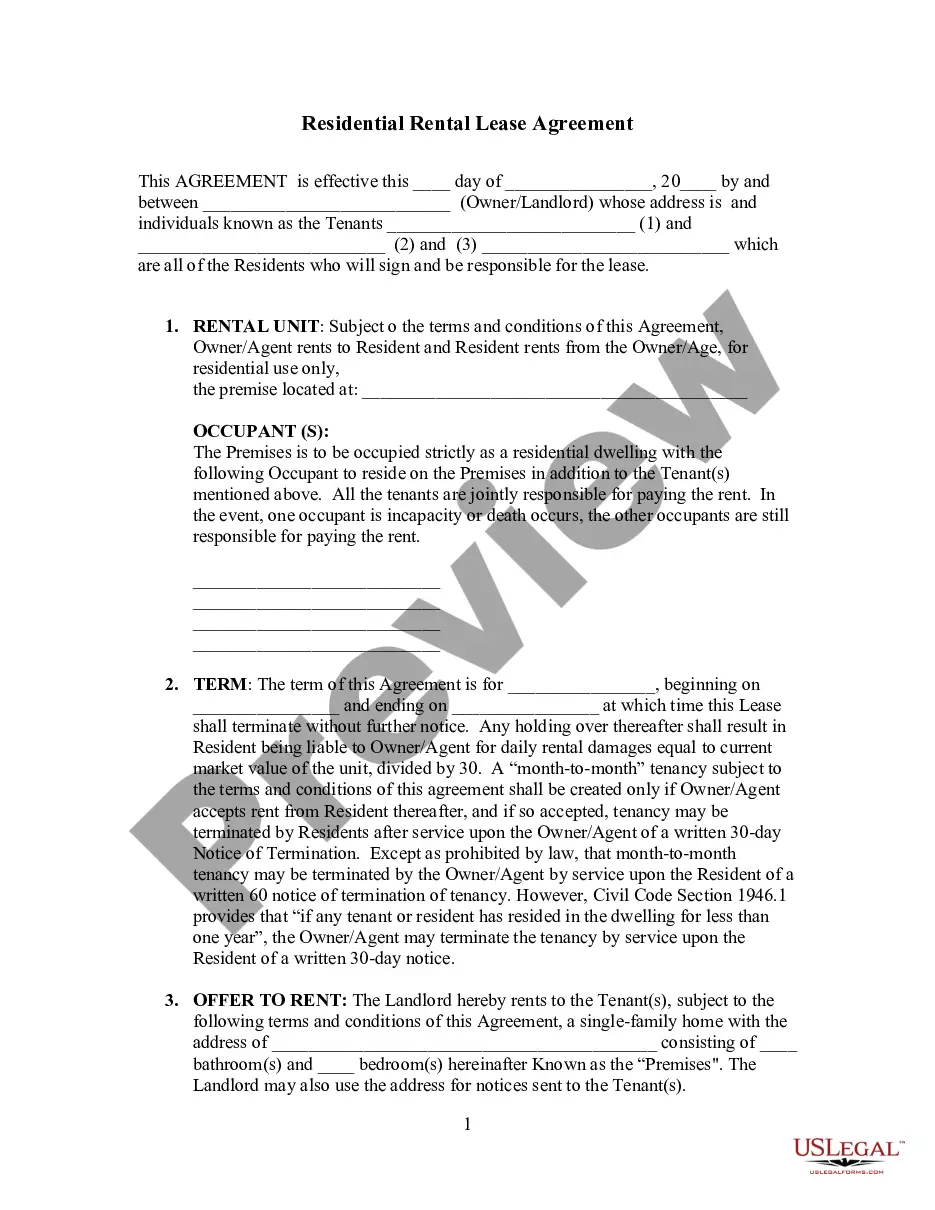
Residential Lease Agreement
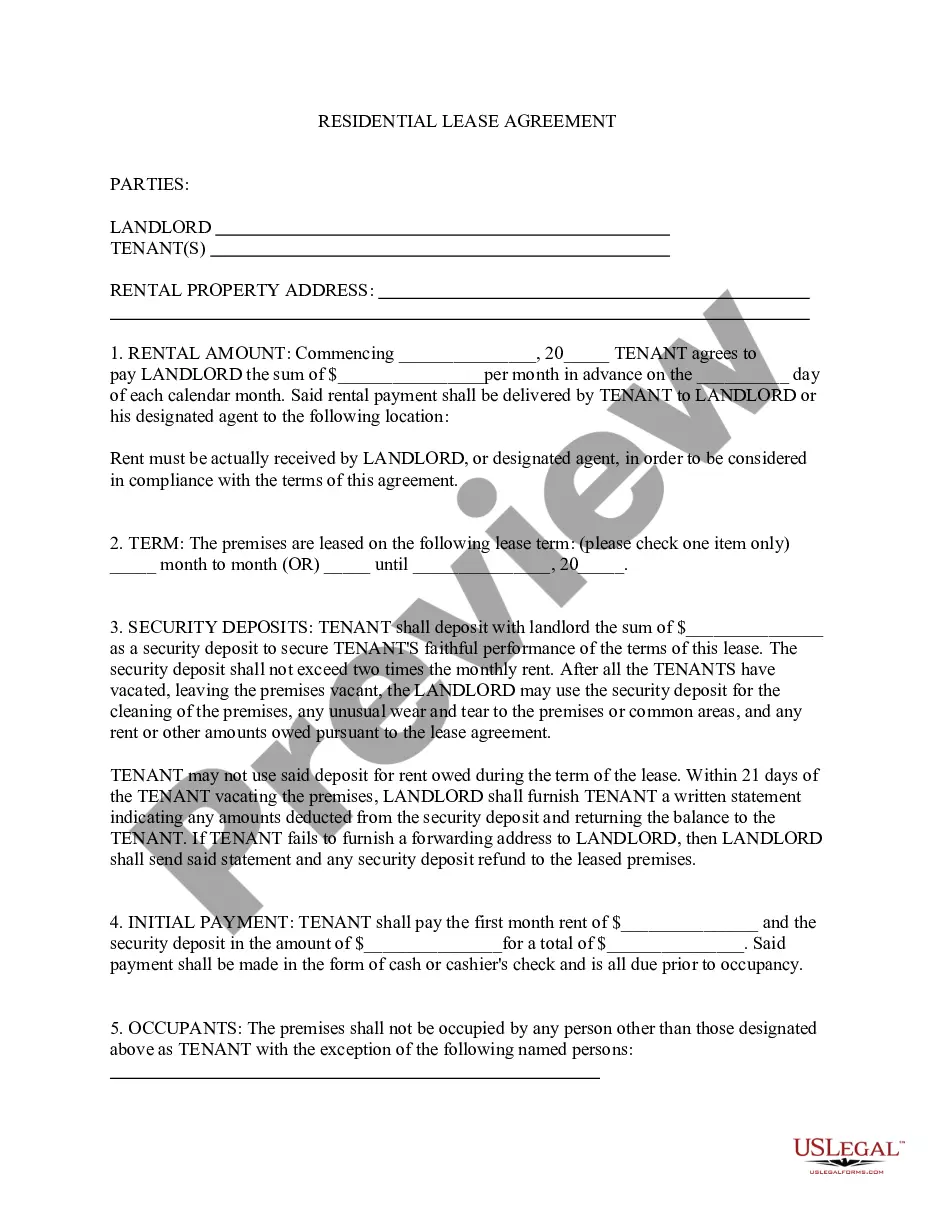
Residential Lease Agreement
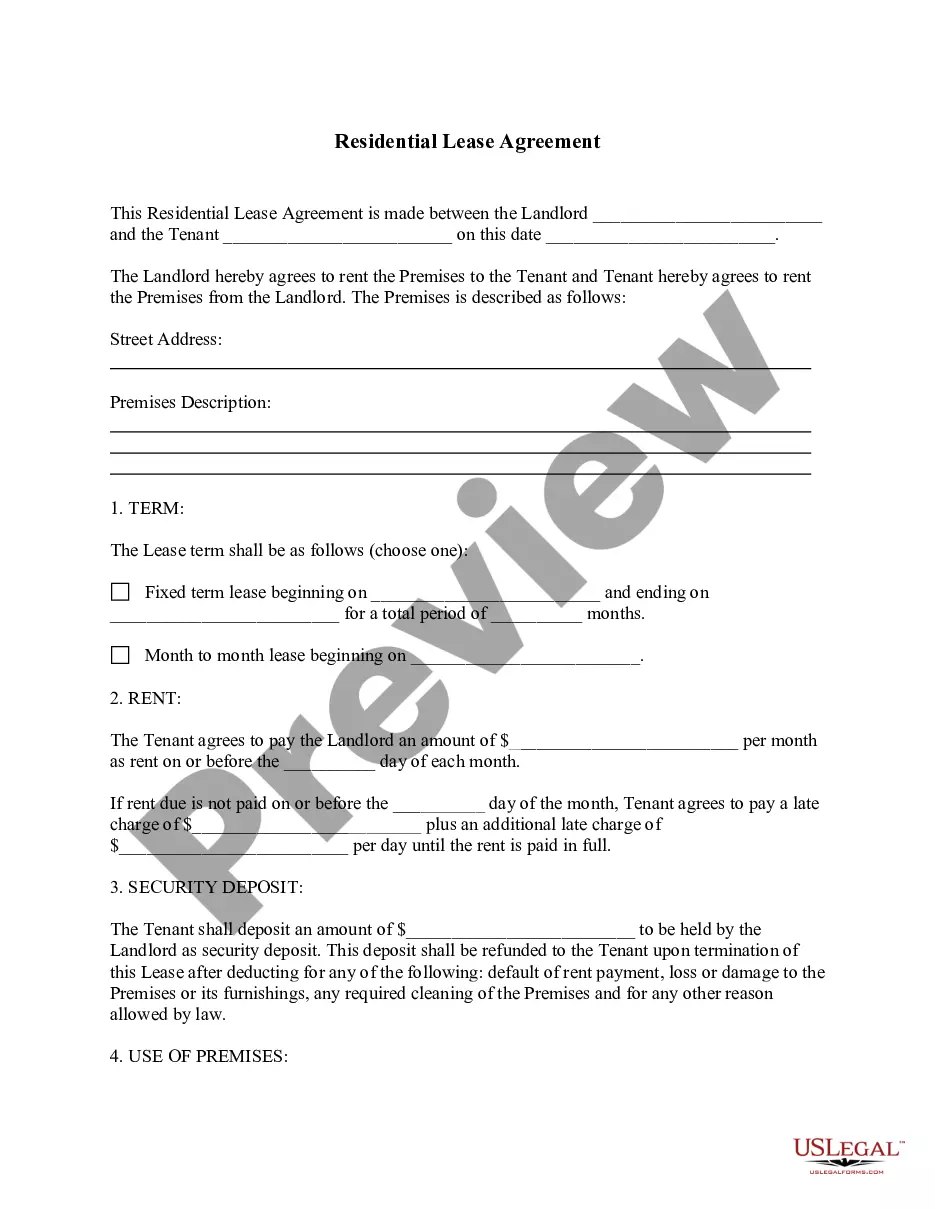
Basic Residential Lease Agreement
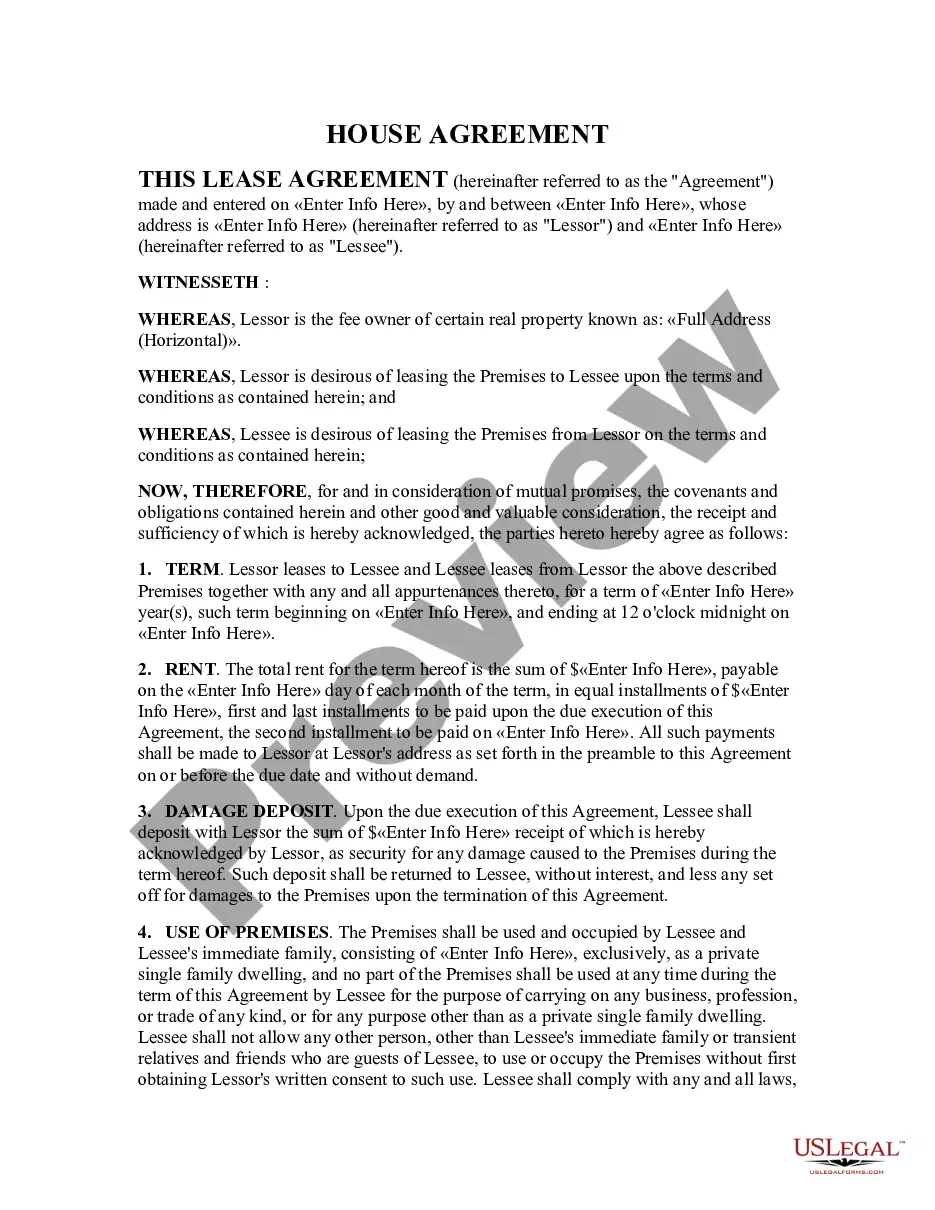
House Lease Agreement
Situations where this form applies
This form should be used when a landlord wants to rent out a residential property to a tenant, ensuring that both parties are aware of their rights and obligations. It is essential in various situations, such as leasing single-family homes, apartments, or other dwelling units within South Carolina, where specific lease term requirements and regulatory compliance are necessary.
Who can use this document
- Landlords looking to lease out their residential property.
- Tenants seeking a clear agreement regarding their rental terms.
- Property management companies managing residential leases on behalf of landlords.
- Individuals who wish to formalize rental agreements for personal or family housing arrangements.
Completing this form step by step
- Identify the parties: Enter the full names and contact information of the landlord and tenants involved.
- Specify the property: Provide the exact address and any personal property being leased.
- Enter the lease term: Fill in the lease start and end dates to define the rental period.
- Detail the rent and security deposit: Specify the monthly rent amount, security deposit, and payment details.
- Review and sign: Both parties should read the entire lease, make any necessary modifications, and sign it to create a binding agreement.
Is notarization required?
Notarization is not commonly needed for this form. However, certain documents or local rules may make it necessary. Our notarization service, powered by Notarize, allows you to finalize it securely online anytime, day or night.
Get your form ready online
Our built-in tools help you complete, sign, share, and store your documents in one place.
Make edits, fill in missing information, and update formatting in US Legal Forms—just like you would in MS Word.
Download a copy, print it, send it by email, or mail it via USPS—whatever works best for your next step.
Sign and collect signatures with our SignNow integration. Send to multiple recipients, set reminders, and more. Go Premium to unlock E-Sign.
If this form requires notarization, complete it online through a secure video call—no need to meet a notary in person or wait for an appointment.
We protect your documents and personal data by following strict security and privacy standards.

Make edits, fill in missing information, and update formatting in US Legal Forms—just like you would in MS Word.

Download a copy, print it, send it by email, or mail it via USPS—whatever works best for your next step.

Sign and collect signatures with our SignNow integration. Send to multiple recipients, set reminders, and more. Go Premium to unlock E-Sign.

If this form requires notarization, complete it online through a secure video call—no need to meet a notary in person or wait for an appointment.

We protect your documents and personal data by following strict security and privacy standards.
Typical mistakes to avoid
- Failing to provide accurate contact information for all parties involved.
- Not specifying the lease term clearly, leading to potential disputes.
- Omitting necessary clauses related to security deposits and late payments.
- Forgetting to review the local laws that may affect the lease terms.
Advantages of online completion
- Convenient access to legally vetted documents that save time.
- Editable templates allow landlords to customize the lease to fit their specific needs.
- Easy to download and print without the hassle of in-person appointments.
Looking for another form?
-
Alabama
-
Alaska
-
Arizona
-
Arkansas
-
California
-
Colorado
-
Connecticut
-
Delaware
-
District of Columbia
-
Florida
-
Georgia
-
Guam
-
Hawaii
-
Idaho
-
Illinois
-
Indiana
-
Iowa
-
Kansas
-
Kentucky
-
Louisiana
-
Maine
-
Maryland
-
Massachusetts
-
Michigan
-
Minnesota
-
Mississippi
-
Missouri
-
Montana
-
Nebraska
-
Nevada
-
New Hampshire
-
New Jersey
-
New Mexico
-
New York
-
North Carolina
-
North Dakota
-
Ohio
-
Oklahoma
-
Oregon
-
Pennsylvania
-
Puerto Rico
-
Rhode Island
-
South Carolina
-
South Dakota
-
Tennessee
-
Texas
-
Utah
-
Vermont
-
Virgin Islands
-
Virginia
-
Washington
-
West Virginia
-
Wisconsin
-
Wyoming
Viewed forms
Minimum Royalty Payments
Virginia Residential Landlord Tenant Rental Lease Forms and Agreements Package
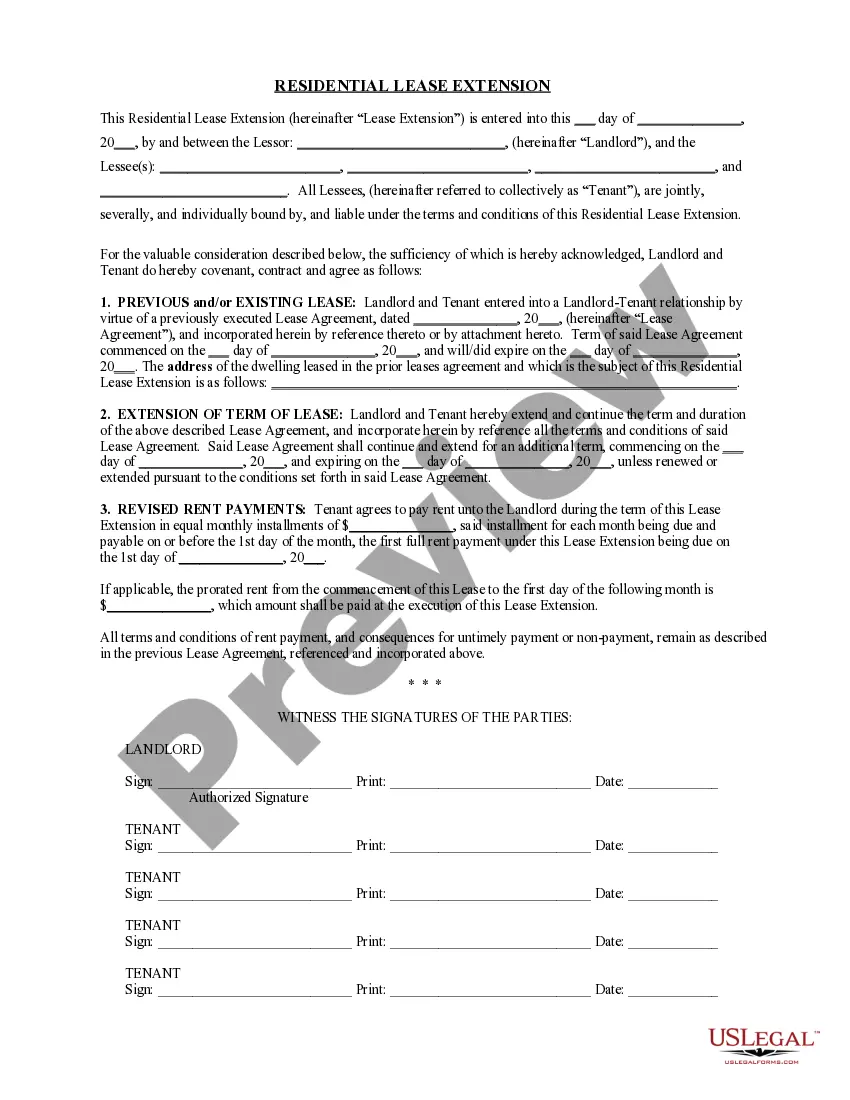
Residential or Rental Lease Extension Agreement
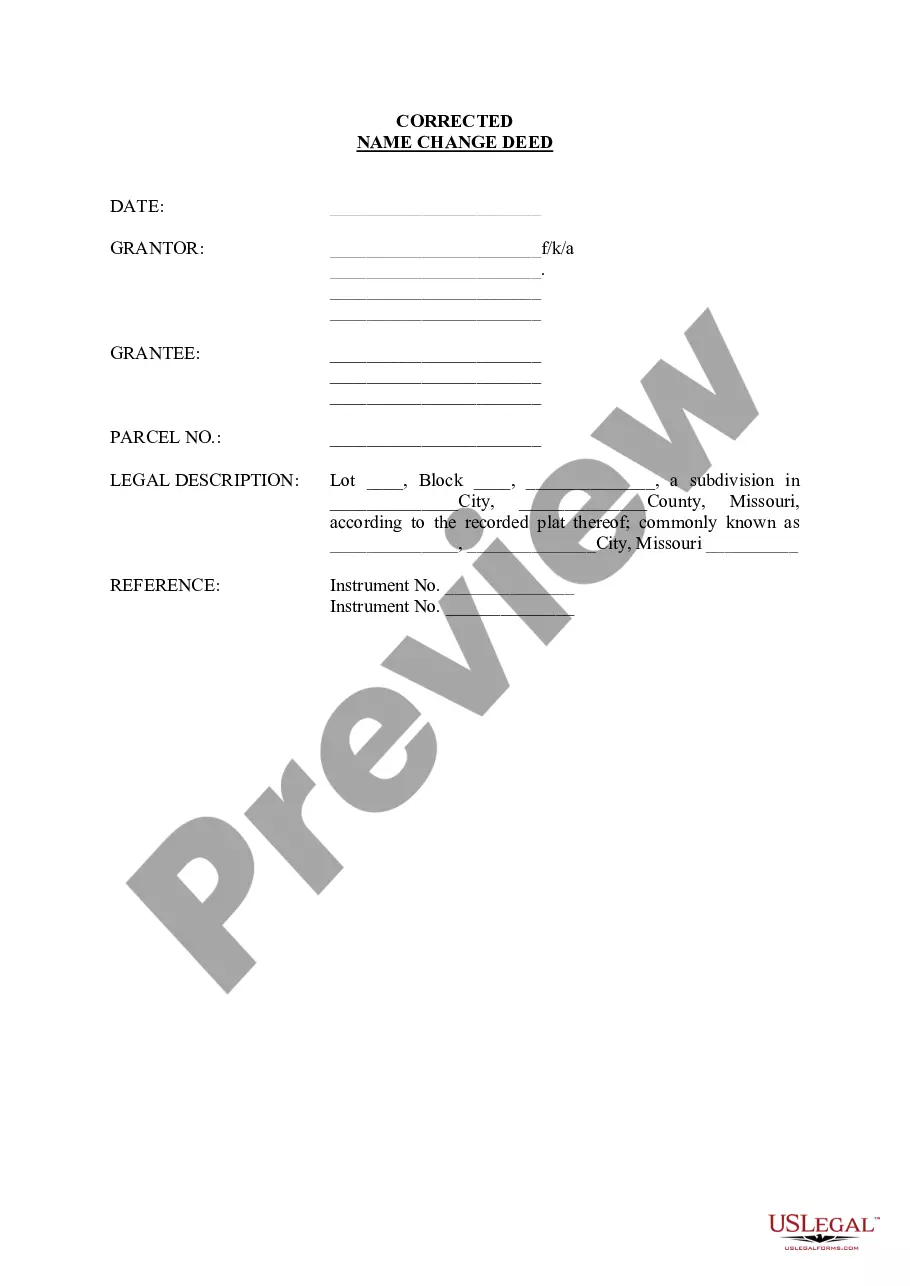
Corrected Name Change Deed
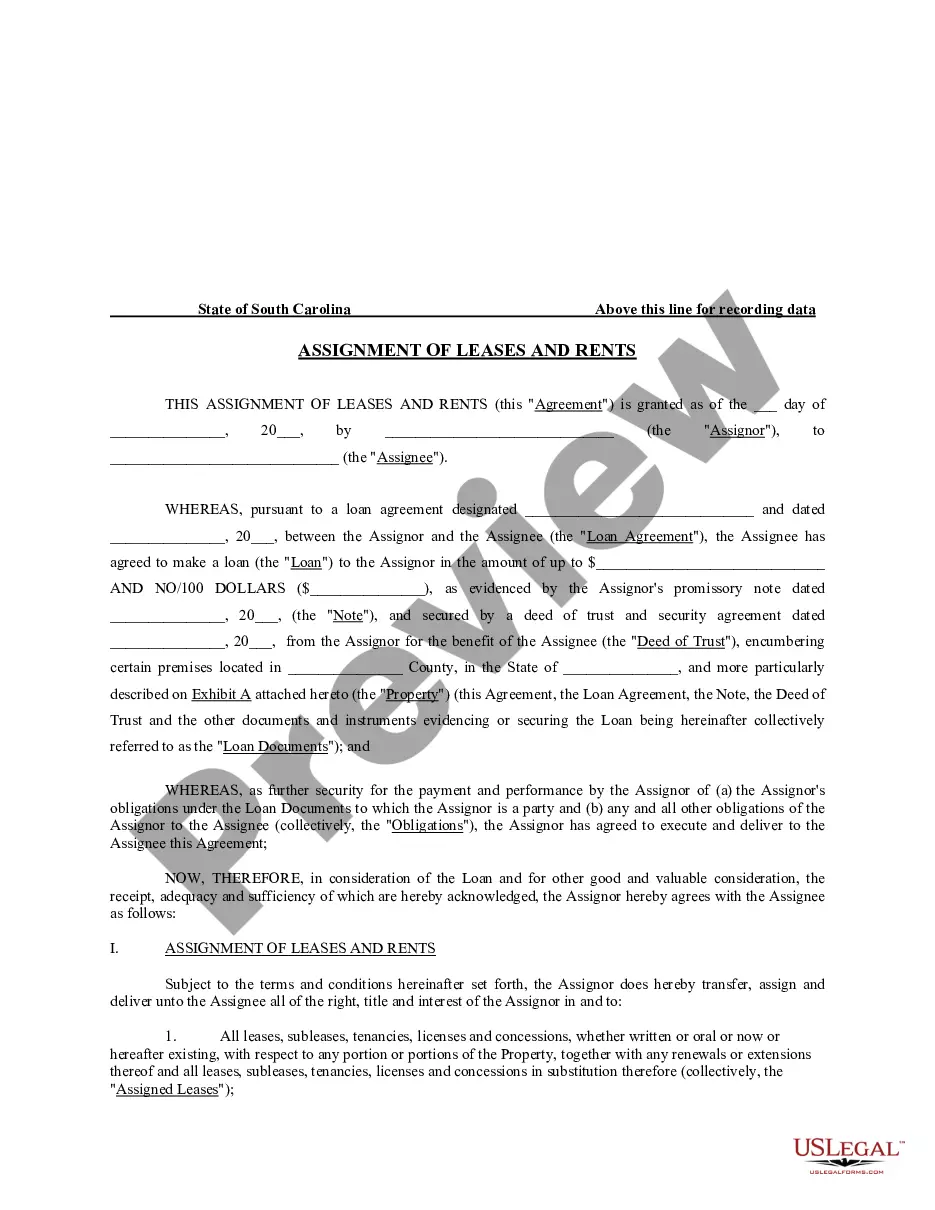
Assignment of Lease and Rent from Borrower to Lender
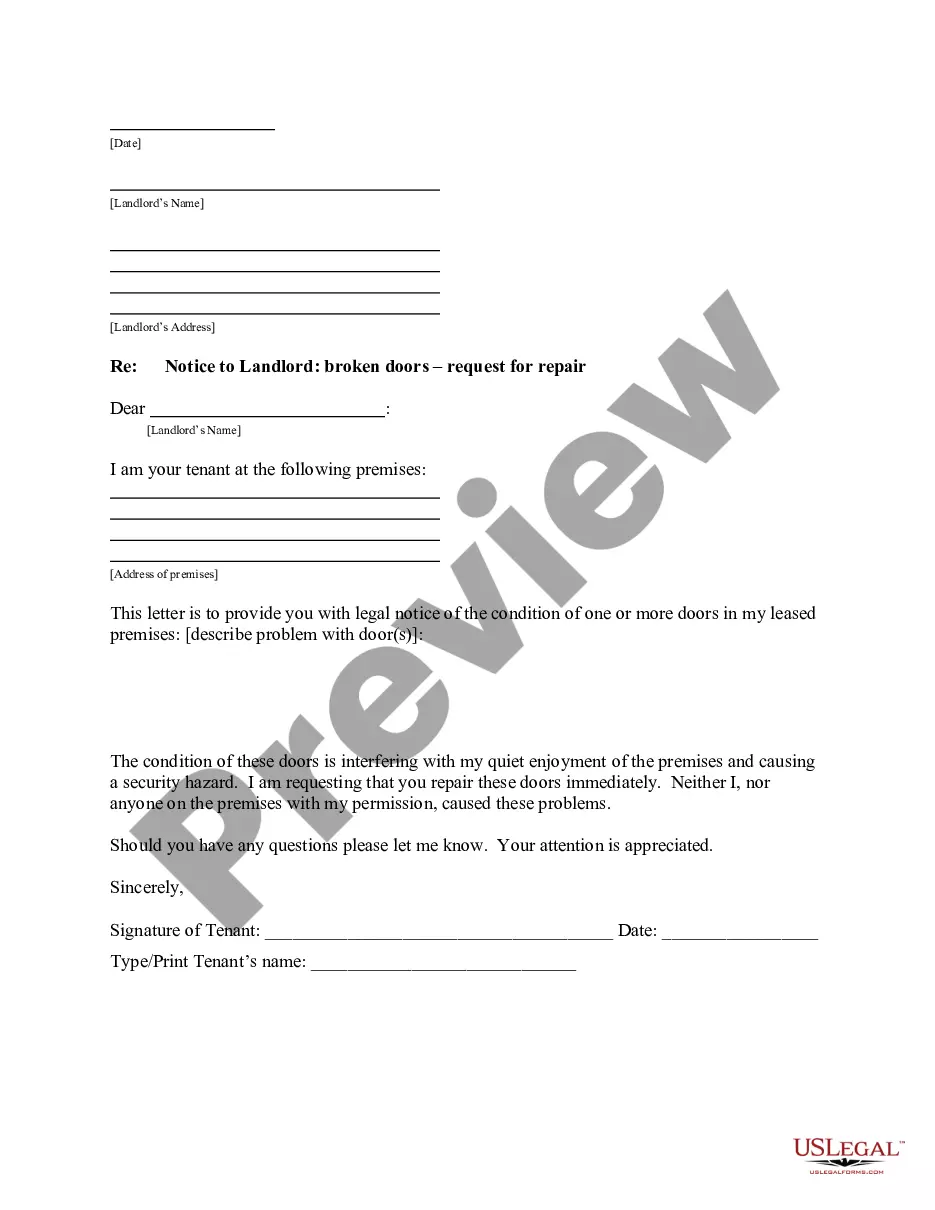
Letter from Tenant to Landlord containing Notice that doors are broken and demand repair

Montana Real Estate Home Sales Package with Offer to Purchase, Contract of Sale, Disclosure Statements and more for Residential House
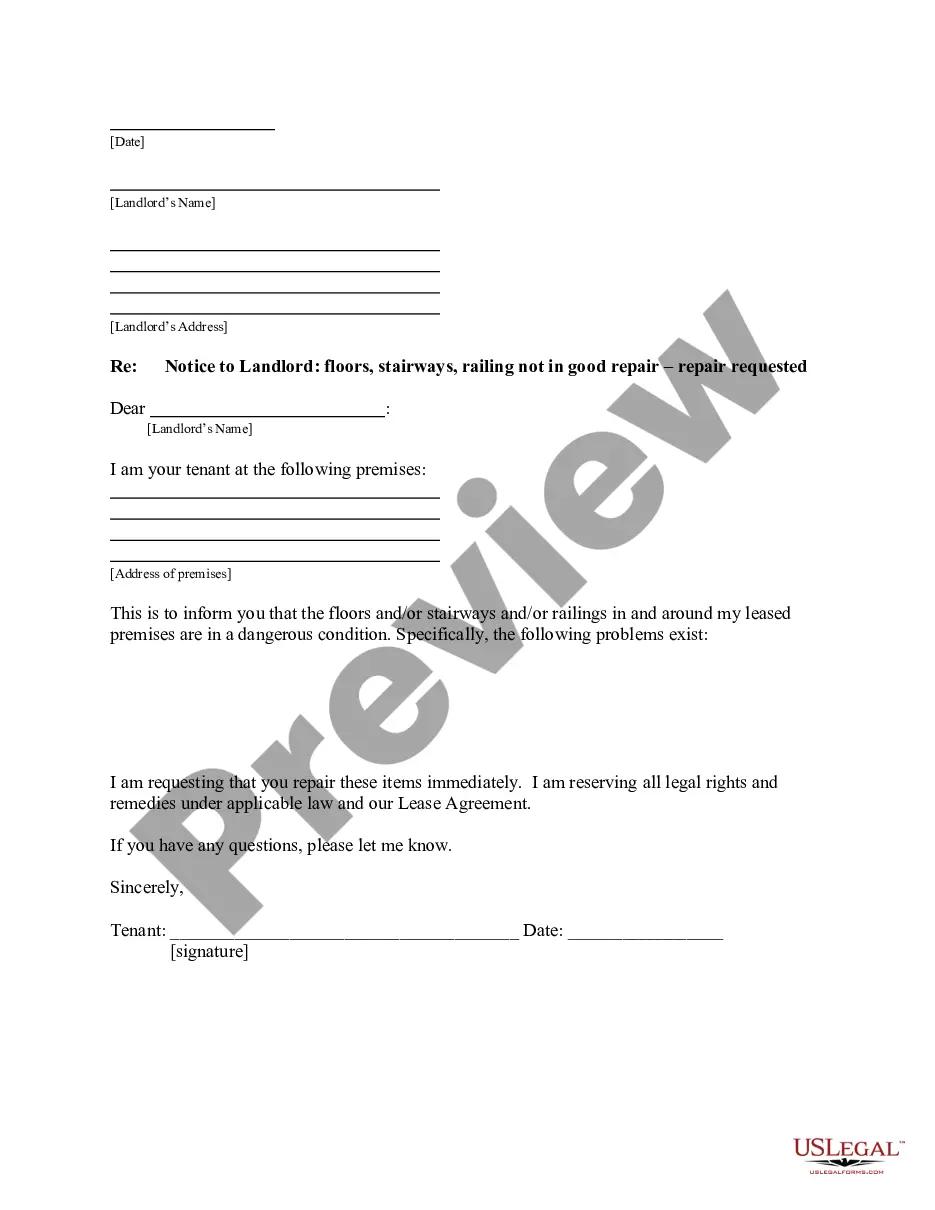
Letter from Tenant to Landlord with Demand that landlord repair floors, stairs or railings
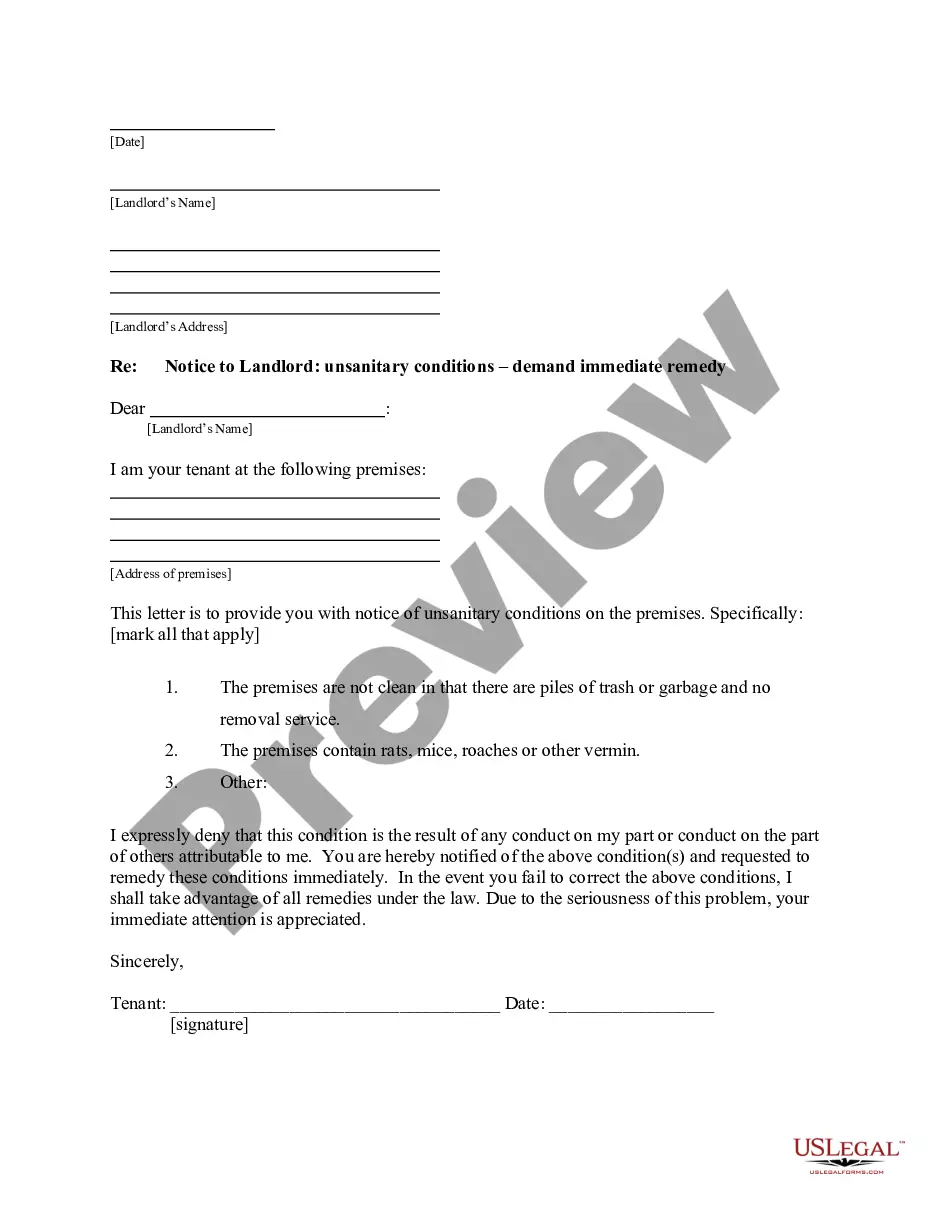
Letter from Tenant to Landlord with Demand that landlord remove garbage and vermin from premises
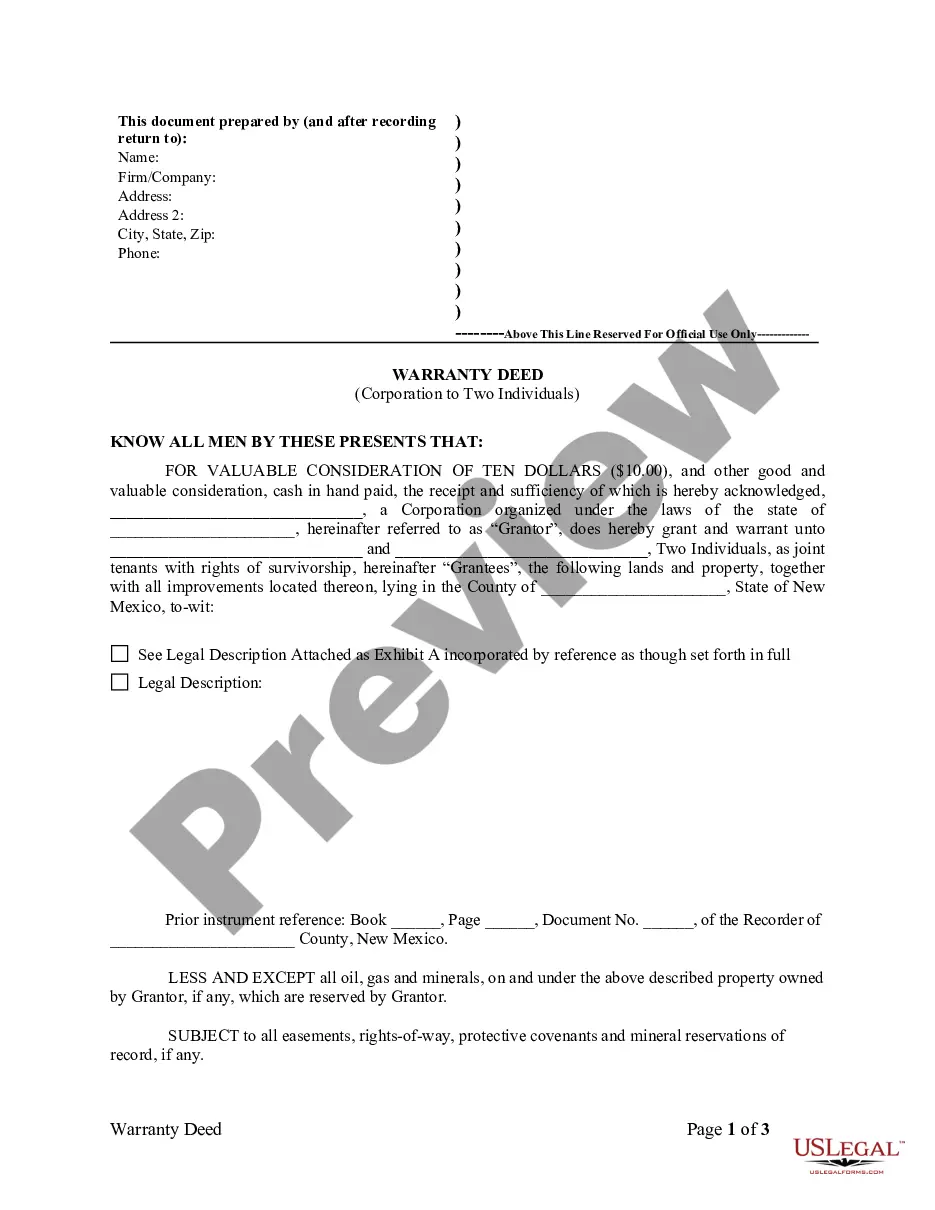
Warranty Deed from Corporation to Two Individuals
Form popularity
FAQ
The difference between lease and rent is that a lease generally lasts for 12 months while a rental agreement generally lasts for 30 days.That means the landlord can't raise the rent without your written consent or evict you without cause, and you can't stop paying rent or break the lease without consequence.
The lease is mutually beneficial. A tenant can't stop paying rent or vacate the property during the lease term this is a violation of the agreement.A rental agreement, by contrast, is a month-to-month agreement. At the end of each 30-day period, the landlord and tenant are both free to change the terms.
Yes, South Carolina is a landlord-friendly state as landlords have broad authority to set rental prices and evict tenants.
A written agreement can act as a roadmap for the landlord-tenant relationship, especially if a dispute arises. Also, real estate (land) leases for more than one year must be in writing. If a lease for over one year is not in writing, it will generally not be enforceable in court.
Collect each party's information. Include specifics about your property. Consider all of the property's utilities and services. Know the terms of your lease. Set the monthly rent amount and due date. Calculate any additional fees. Determine a payment method. Consider your rights and obligations.
A lease can be written or verbal, but a verbal lease can be very difficult to enforce.Most leases are fairly standard and cover basic components such as rent amount, duration of lease term, resposiblities of each party and penalties for not following the terms.
The lease becomes legally binding when all parties have signed: the landlord and all tenants living in the unit who are 18 and older. If you're worried about situations where a lease needs to end early, learn about breaking a lease and grounds for eviction.
Lease Termination Notice Requirements in South Carolina In South Carolina, a tenant is not required to provide notice for fixed end date leases. South Carolina tenants have to provide written notice for the following lease term: Notice to terminate a week-to-week lease. 7 days (§ 27-40-770(a))
The Lease Must be in Writing It does not matter if the lease is handwritten or typed.
Explore more forms

Warranty Deed from Individual to Husband and Wife
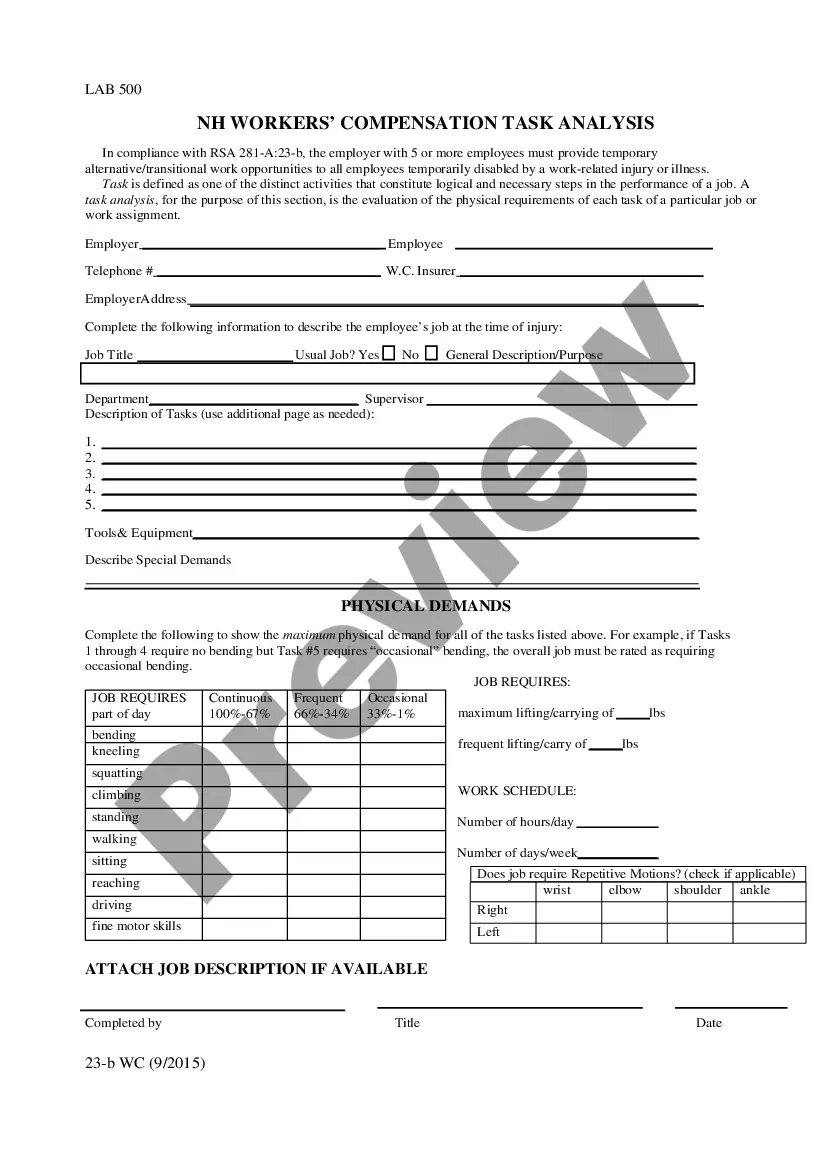
Workers' Compensation Task Analysis

Quitclaim Deed from Corporation to Husband and Wife

Warranty Deed from Corporation to Husband and Wife

Quitclaim Deed from Corporation to Individual
Trusted and secure by over 3 million people of the world’s leading companies
Title 27 - Property and Conveyances
CHAPTER 40.
SOUTH CAROLINA RESIDENTIAL LANDLORD AND TENANT ACT
ARTICLE 1.
GENERAL PROVISIONS AND DEFINITIONS
SUBARTICLE I.
SHORT TITLE, CONSTRUCTION, APPLICATION, AND SUBJECT MATTER OF CHAPTER
Short title.
This chapter is known and may be cited as the South Carolina Residential Landlord and Tenant Act. Title 27, Chap. 40, §27-40-10
Purposes; rules of construction.
(a) This chapter must be liberally construed and applied to promote its underlying purposes and policies.
(b) Underlying purposes and policies of this chapter are:
(1) to simplify, clarify, modernize, and revise the law governing rental of dwelling units and the rights and obligations of landlords and tenants;
(2) to encourage landlords and tenants to maintain and improve the quality of housing. Title 27, Chap. 40, §27-40-20.
Supplementary rules of law applicable.
Unless displaced by the provisions of this chapter, the principles of law and equity, including the law relating to capacity to contract, mutuality of obligations, principal and agent, real property, public health, safety and fire prevention, estoppel, fraud, misrepresentation, duress, coercion, mistake, bankruptcy, or other validating or invalidating cause shall supplement the provisions of this chapter. Title 27, Chap. 40, §27-40-30
Construction against implicit repeal.
This chapter being a general chapter intended as a unified coverage of its subject matter, no part of it is to be construed as impliedly repealed by subsequent legislation if that construction can reasonably be avoided. Title 27, Chap. 40, §27-40-40
Administration of remedies; enforcement.
(a) The remedies provided by this chapter must be so administered that an aggrieved party may recover appropriate damages. The aggrieved party has a duty to mitigate damages.
(b) Any right or obligation declared by this chapter is enforceable by action unless the provision declaring it specifies a different and limited effect. Title 27, Chap. 40, §27-40-50
Settlement of disputed claim or right.
A claim or right arising under this chapter or on a rental agreement, if disputed in good faith, may be settled by agreement. Title 27, Chap. 40, §27-40-60
SCOPE AND JURISDICTION
Territorial application.
This chapter applies to, regulates, and determines rights, obligations, and remedies under a rental agreement, wherever made, for a dwelling unit located within this State. Title 27, Chap. 40, §27-40-110
Exclusions from application of chapter.
The following arrangements are not governed by this chapter:
(1) residence at an institution, public or private, if incidental to detention or the provision of medical, geriatric, educational, counseling, religious, or similar service;
(2) occupancy under a contract of sale of a dwelling unit or the property of which it is a part, if the occupant is the purchaser or a person who succeeds to his interest;
(3) occupancy by a member or a fraternal or social organization in the portion of a structure operated for the benefit of the organization;
(4) transient occupancy in a hotel, motel, or other accommodations subject to the sales tax on accommodations as provided by SECTION 12-36-920;
(5) occupancy by an employee of a landlord whose right to occupancy is conditional upon employment in and about the premises;
(6) occupancy by an owner of a condominium unit or a holder of a proprietary lease in a cooperative;
(7) occupancy under a rental agreement covering the premises used by the occupant primarily for agricultural purposes;
(8) occupancy under a rental agreement in a premises regulated by the provisions of Chapter 32 of Title 27 of the 1976 Code (Vacation Time Sharing Plan Act).
(9) residence, whether temporary or not, at a charitable or emergency protective shelter, public or private. Title 27, Chap. 40, §27-40-120
Jurisdiction and service of process.
(a) The circuit courts and magistrate courts of this State shall exercise concurrent jurisdiction over any landlord with respect to any conduct in this State governed by this chapter or with respect to any claim arising from a transaction subject to this chapter. In addition to any other method provided by rule or by statute, personal jurisdiction over a landlord may be acquired in a civil action or proceeding instituted in the court of common pleas or magistrate court by the service of process in the manner provided by this section.
(b) If a landlord is not a resident of this State or is a corporation not authorized to do business in this State and engaged in any conduct in this State governed by this chapter, or engaged in a transaction subject to this chapter, he may designate an agent upon whom service of process may be made in this State. The agent must be a resident of this State or a corporation authorized to do business in this State. The designation must be in writing and filed with the Secretary of State. If no designation is made and filed or if process cannot be served in this State upon the designated agent, process may be served upon the Secretary of State, but service upon him is not effective unless the plaintiff or petitioner forthwith mails a copy of the process and pleading by registered or certified mail requiring a signed receipt to the defendant or respondent at his last reasonably ascertainable address. An affidavit of compliance with this section must be filed with the court of the county wherein the action is instituted on or before the return day of the process, if any, or within any further time the court allows. Title 27, Chap. 40, §27-40-130
GENERAL DEFINITIONS AND PRINCIPLES INTERPRETATION; NOTICE
General definitions.
Subject to additional definitions contained in subsequent articles of this chapter which apply to specific articles or parts of this chapter, and unless the context otherwise requires, in this chapter:
(1) "action" includes recoupment, counterclaim, set-off, suit in equity, and any other proceeding in which rights are determined, including an action for possession;
(2) "building and housing codes" include any law, ordinance, or governmental regulation concerning fitness for habitation, or the construction, maintenance, operation, occupancy, use, or appearance of any premise, or dwelling unit;
(3) "dwelling unit" means a structure or the part of a structure that is used as a home, residence, or sleeping place by one person who maintains a household or by two or more persons who maintain a common household and includes landlord-owned mobile homes. Property that is leased for the exclusive purpose of being renovated by the lessee is not considered a dwelling unit within the meaning of this chapter;
(4) "fair-market rental value" means the actual periodic rental payment for comparable rental property to which a willing landlord and a willing tenant would agree. In determining the fair-market rental value, the court may consider appraisals offered by the tenant, landlord, realty experts, licensed appraisers, and other relevant evidence;
(5) "good faith" means honesty in fact in the conduct of the transaction concerned;
(6) "landlord" means the owner, lessor, or sublessor of the premises, and it also means a manager of the premises who fails to disclose as required by SECTION 27-40-420;
(7) "organization" includes a corporation, government, governmental subdivision or agency, business trust, estate, trust, partnership or association, two or more persons having a joint or common interest, and any other legal or commercial entity;
(8) "owner" means one or more persons, jointly or severally, in whom is vested (i) all or part of the legal title to property or (ii) all or part of the beneficial ownership and a right to present use and enjoyment of the premises. The term includes a mortgagee in possession;
(9) "person" includes an individual or organization;
(10) "premises" means a dwelling unit and the structure of which it is a part and facilities and appurtenances therein and grounds, areas, and facilities held out for the use of tenants generally or whose use is promised to the tenant;
(11) "rent" means the consideration payable for use of the premises including late charges whether payable in lump sum or periodic payments, excluding security deposits or other charges;
(12) "rental agreement" means all agreements, written or oral, and valid rules and regulations adopted under SECTION 27-40-520 embodying the terms and conditions concerning the use and occupancy of a dwelling unit and premises;
(13) "roomer" means a person occupying a dwelling unit that does not include a toilet and either a bathtub or a shower and a refrigerator, stove, and kitchen sink, all provided by the landlord, and where one or more of these facilities are used in common by occupants in the structure;
(14) "single family residence" means a structure maintained and used as a single dwelling unit. Notwithstanding that a dwelling unit shares one or more walls with another dwelling unit, it is a single family residence if it has direct access to a street or thoroughfare and shares neither heating facilities, hot water equipment, nor any other essential facility or service with any other dwelling unit;
(15) "tenant" means a person entitled under a rental agreement to occupy a dwelling unit to the exclusion of others;
(16) "wilful" means an attempt to intentionally avoid obligations under the rental agreement or the provisions of this chapter;
(17) "essential services" means sanitary plumbing or sewer services; electricity; gas, where it is used for heat, hot water, or cooking; running water, and reasonable amounts of hot water and heat, except where the building that includes the dwelling unit is not required by law to be equipped for that purpose, or the dwelling unit is so constructed that heat or hot water is generated by an installation within the exclusive control of the tenant and supplied by a direct public utility connection.
(18) "security deposit" means a monetary deposit from the tenant to the landlord which is held in trust by the landlord to secure the full and faithful performance of the terms and conditions of the lease agreement as provided in Section 27-40-410. Title 27, Chap. 40, §27-40-210
Obligation of good faith.
Every duty under this chapter and every act which must be performed as a condition precedent to the exercise of a right or remedy under this chapter imposes an obligation of good faith in its performances or enforcement. Title 27, Chap. 40, §27-40-220
Unconscionability.
(a) If the court as a matter of law, finds:
(1) a rental agreement was unconscionable when made, the court may refuse to enforce the rental agreement;
(2) any provision of a rental agreement was unconscionable when made, the court may enforce the remainder of the agreement without the unconscionable provision or limit the application of any unconscionable provision to avoid an unconscionable result; or
(3) a settlement in which a party waives or agrees to forego a claim or right under this chapter or under a rental agreement was unconscionable when made, the court may refuse to enforce the settlement, enforce the remainder of the settlement without the unconscionable provision, or limit the application of any unconscionable provision to avoid an unconscionable result.
(b) If unconscionability is put into issue by a party or by the court upon its own motion, the parties must be afforded a reasonable opportunity to present evidence as to the setting, purpose, and effect of the rental agreement or settlement to aid the court in making the determination. Title 27, Chap. 40, §27-40-230
Notices.
(A) A person has notice of a fact if:
(1) the person has actual knowledge of it;
(2) the person has received a notice or notification of it; or
(3) from all the facts and circumstances known to him at the time in question he has reason to know that it exists. A person "knows" or "has knowledge" of a fact if he has actual knowledge of it.
(B) A person "notifies" or "gives" a notice or notification to another person by taking steps reasonably calculated to inform the other in ordinary course whether or not the other actually comes to know of it. A person "receives" a notice or notification when:
(1) it comes to his attention; or
(2) in the case of the landlord, it is delivered at the place of business of the landlord through which the rental agreement was made or at any place held out by the landlord as the place for receipt of the communication; or
(3) in the case of the tenant, it is delivered in hand to the tenant or mailed by registered or certified mail to the tenant at the place held out by him as the place for receipt of the communication, or in the absence of the designation, to the tenant's last known place of residence. Proof of mailing pursuant to this subsection constitutes notice without proof of receipt.
(C) "Notice", knowledge, or a notice or notification received by an organization is effective for a particular transaction from the time it is brought to the attention of the individual conducting that transaction, and in any event from the time it would have been brought to the individual's attention if the organization had exercised reasonable diligence.
(D) The time within which an act is to be done must be computed by reference to South Carolina Rules of Civil Procedure. Title 27, Chap. 40, §27-40-240
GENERAL PROVISIONS
Terms and conditions of rental agreement.
(a) A landlord and a tenant may include in a rental agreement terms and conditions not prohibited by this chapter or other rule of law, including rent, term of the agreement, and other provisions governing the rights and obligations of the parties.
(b) In absence of agreement, the tenant shall pay as rent the fair-market rental value for the use and occupancy of the dwelling unit.
(c) Rent is payable without demand or notice at the time and place agreed upon by the parties. Unless the tenant is otherwise notified in writing, rent is payable at the dwelling unit and periodic rent is payable at the beginning of any term of one month or less and otherwise in equal monthly installments at the beginning of each month. Unless otherwise agreed, rent is uniformly apportionable from day to day.
(d) Unless the rental agreement fixes a definite term, the tenancy is week to week in case of a roomer who pays weekly rent and in all other cases month to month. Title 27, Chap. 40, §27-40-310
Effect of unsigned or undelivered rental agreement.
(a) If the landlord does not sign and deliver a written rental agreement which has been signed and delivered to the landlord by the tenant, acceptance of rent without reservation by the landlord gives the rental agreement the same effect as if it had been signed and delivered by the landlord.
(b) If the tenant does not sign and deliver a written rental agreement which has been signed and delivered to the tenant by the landlord, acceptance of possession and payment of rent without reservation gives the rental agreement the same effect as if it had been signed and delivered by the tenant.
(c) If a rental agreement given effect by the operation of this section provides for a term longer than one year, it is effective for only one year. Title 27, Chap. 40, §27-40-320
Prohibited provisions in rental agreements.
(a) A rental agreement may not provide that the tenant:
(1) agrees to waive or forego rights or remedies under this chapter;
(2) authorizes any person to confess judgment on a claim arising out of the rental agreement;
(3) agrees to the exculpation or limitation of any liability of the landlord arising under law or to indemnify the landlord for that liability or the costs connected therewith.
(b) A provision prohibited by subsection (a) included in a rental agreement is unenforceable. If a landlord deliberately uses a rental agreement containing provisions known by him to be prohibited and attempts to exercise the rights created by the agreement, the tenant may recover in addition to his actual damages an amount not to exceed the security deposit and reasonable attorney's fees. If a landlord maliciously uses a rental agreement containing provisions known by him to be prohibited and attempts to exercise the rights created thereby, the tenant may recover in addition to his actual damages an amount not to exceed three months' periodic rent and reasonable attorney's fees.
(c) The provisions of this section shall not operate so as to invalidate bona fide liquidated damage provisions which shall establish the amount of damages for loss of rent resulting from a premature termination of a lease. Title 27, Chap. 40, §27-40-330
Separation of rents and obligations to maintain property forbidden.
A rental agreement, assignment, conveyance, trust deed, mortgage, or security instrument may not permit the receipt of rent absent the obligation to comply with SECTION 27-40-440(a). Title 27, Chap. 40, §27-40-340
ARTICLE 3.
LANDLORD OBLIGATIONS
Security deposits; prepaid rent.
(a) Upon termination of the tenancy, property or money held by the landlord as security must be returned less amounts withheld by the landlord for accrued rent and damages which the landlord has suffered by reason of the tenant's noncompliance with Section 27-40-510. Any deduction from the security/rental deposit must be itemized by the landlord in a written notice to the tenant together with the amount due, if any, within thirty days after termination of the tenancy and delivery of possession and demand by the tenant, whichever is later. The tenant shall provide the landlord in writing with a forwarding address or new address to which the written notice and amount due from the landlord may be sent. If the tenant fails to provide the landlord with the forwarding or new address, the tenant is not entitled to damages under this subsection provided the landlord (1) had no notice of the tenant's whereabouts and (2) mailed the written notice and amount due, if any, to the tenant's last known address.
(b) If the landlord fails to return to the tenant any prepaid rent or security/rental deposit with the notice required to be sent by the landlord pursuant to subsection (a), the tenant may recover the property and money in an amount equal to three times the amount wrongfully withheld and reasonable attorney's fees.
(c) If a landlord (1) rents more than four adjoining dwelling units on the premises, and (2) imposes different standards for calculating security/rental deposits required of different tenants on the premises, then, prior to the consummation of the rental agreement, the landlord shall either post in a conspicuous place on the premises, or at the place at which rental is paid a statement clearly indicating the standards by which such security/rental deposits are calculated, or shall provide each prospective tenant with a statement setting forth the standards. If a landlord fails to comply with this subsection as to a tenant, the difference between the security/rental deposit required of the tenant and the lowest security/rental deposit required of any other tenant of a comparable dwelling unit on the premises is not subject to deductions for damages by reason of the tenant's noncompliance with Section 27-40-510.
(d) This section does not preclude the landlord or tenant from recovering other damages to which he may be entitled under this chapter or otherwise.
(e) Subject to the provisions of Section 27-40-450, the holder of the landlord's interest in the premises at the time of the termination of the tenancy is bound by this section. Title 27, Chap. 40, §27-40-410
Disclosure.
(a) A landlord or any person authorized to enter into a rental agreement on his behalf shall disclose to the tenant in writing at or before the commencement of the tenancy the name and address of an owner of the premises or a person authorized to act on behalf of the owner as agent, inter alia, for purposes of service of process and receiving or receipting notices or demands.
(b) The information required to be furnished by this section must be kept current and this section extends to and is enforceable against any successor landlord, owner, or manager.
(c) A person authorized to enter in a rental agreement on behalf of a landlord who fails to comply with subsection (a) with regard to a rental agreement entered into on behalf of the landlord becomes an agent of the landlord for purposes of that rental agreement for:
(1) service of process and receiving and receipting for notices and demands;
(2) performing the obligations of the landlord under this chapter and under the rental agreement and expending or making available for the performance of the obligations all rent collected from the premises and retained by the person on behalf of the landlord. Title 27, Chap. 40, §27-40-420
Landlord to deliver possession of dwelling unit.
At the commencement of the term a landlord shall deliver possession of the premises to the tenant in compliance with the rental agreement and SECTION 27-40-440. The landlord may bring an action for possession against any person wrongfully in possession and may recover the damages provided in SECTION 27-40-760(c). Title 27, Chap. 40, §27-40-430
Landlord to maintain premises.
(a) A landlord shall:
(1) comply with the requirements of applicable building and housing codes materially affecting health and safety;
(2) make all repairs and do whatever is reasonably necessary to put and keep the premises in a fit and habitable condition;
(3) keep all common areas of the premises in a reasonably safe condition, and, for premises containing more than four dwelling units, keep in a reasonably clean condition;
(4) make available running water and reasonable amounts of hot water at all times and reasonable heat except where the building that includes the dwelling unit is not required by law to be equipped for that purpose, or the dwelling unit is so constructed that heat or hot water is generated by an installation within the exclusive control of the tenant and supplied by a direct public utility connection;
(5) maintain in reasonably good and safe working order and condition all electrical, gas, plumbing, sanitary, heating, ventilating, air conditioning, and other facilities and appliances, including elevators, supplied or required to be supplied by him. Appliances present in the dwelling unit are presumed to be supplied by the landlord unless specifically excluded by the rental agreement. No appliances or facilities necessary to the provision of essential services may be excluded.
(b) If the duty imposed by paragraph (1) of subsection (a) is greater than any duty imposed by any other paragraph of that subsection, the landlord's duty must be determined by reference to paragraph (1) of subsection (a).
(c) The landlord and tenant of a single family residence may agree in writing that the tenant perform the landlord's duties specified in paragraph (5) of subsection (a) and also specified repairs, maintenance tasks, alterations, and remodeling, but only if the transaction is entered into in good faith and not for the purpose of evading the obligations of the landlord.
(d) The landlord and tenant of any dwelling unit other than a single family residence may agree that the tenant is to perform specified repairs, maintenance tasks, alterations, or remodeling only if:
(1) the agreement of the parties is entered into in good faith and not for the purpose of evading the obligations of the landlord;
(2) the work is not necessary to cure noncompliance with subsection (a)(1) of this section;
(3) the agreement does not diminish or affect the obligations of the landlord to other tenants in the premises. Title 27, Chap. 40, §27-40-440
Limitation of liability.
(a) Unless otherwise agreed, a landlord who conveys the premises that include a dwelling unit subject to a rental agreement in a good faith sale to a bona fide purchaser is relieved of liability under the rental agreement and this chapter as to events occurring after written notice to the tenant of the conveyance. However, he remains liable to the tenant for security recoverable by the tenant under SECTION 27-40-410, unless the security deposit is transferred from the seller to the purchaser and the tenant is notified in writing a reasonable time after the transaction in which case the purchaser is liable under SECTION 27-40-410.
(b) Unless otherwise agreed, a manager of the premises that includes a dwelling unit is relieved of liability under the rental agreement and this chapter as to events occurring after written notice to the tenant of the termination of his management. Title 27, Chap. 40, §27-40-450
ARTICLE 5.
TENANT OBLIGATIONS
Tenant to maintain dwelling unit.
A tenant shall:
(1) comply with all obligations primarily imposed upon tenants by applicable provisions of building and housing codes materially affecting health and safety;
(2) keep the dwelling unit and that part of the premises that he uses reasonably safe and reasonably clean;
(3) dispose from his dwelling unit all ashes, garbage, rubbish, and other waste in a reasonably clean and safe manner;
(4) keep all plumbing fixtures in the dwelling unit or used by the tenant reasonably clean;
(5) use in a reasonable manner all electrical, plumbing, sanitary, heating, ventilating, air-conditioning, and other facilities and appliances including elevators in the premises;
(6) not deliberately or negligently destroy, deface, damage, impair, or remove any part of the premises or knowingly permit any person to do so who is on the premises with the tenant's permission or who is allowed access to the premises by the tenant;
(7) conduct himself and require other persons on the premises with the tenant's permission or who are allowed access to the premises by the tenant to conduct themselves in a manner that will not disturb other tenant's peaceful enjoyment of the premises;
(8) comply with the lease and rules and regulations which are enforceable pursuant to SECTION 27-40-520. Title 27, Chap. 40, §27-40-510
Rules and regulations.
(a) A landlord, from time to time, may adopt rules or regulations, however described, concerning the tenant's use and occupancy of the premises. They are enforceable against the tenant only if:
(1) their purpose is to promote the convenience, safety, or welfare of the tenants in the premises, preserve the landlord's property from abusive use, or make a fair distribution of services and facilities held out for the tenants generally;
(2) they are reasonably related to the purpose for which they are adopted;
(3) they apply to all tenants in the premises in a fair manner;
(4) they are sufficiently explicit in their prohibition, direction, or limitation of the tenant's conduct to fairly inform him of what he must or must not do to comply;
(5) they are not for the purpose of evading the obligations of the landlord;
(6) the tenant has notice of them at the time he enters into the rental agreement, or when they are adopted.
(b) Rules or regulations adopted after a tenant enters into a rental agreement are not valid as to such tenant if the rules or regulations substantially modify the tenant's bargain and after receiving notice upon adoption of his right to object, the tenant objects in writing to the landlord within thirty days after promulgation. Title 27, Chap. 40, §27-40-520
Access.
(a) A tenant shall not unreasonably withhold consent to the landlord to enter into the dwelling unit in order to inspect the premises, make necessary or agreed repairs, decorations, alterations, or improvements, supply necessary or agreed services, or exhibit the dwelling unit to prospective or actual purchasers, mortgagees, tenants, workmen, or contractors.
(b) A landlord or his agent may enter the dwelling unit without consent of the tenant:
(1) At any time in case of emergency - prospective changes in weather conditions which pose a likelihood of danger to the property may be considered an emergency;
(2) Between the hours of 9:00 a.m. and 6:00 p.m. for the purpose of providing regularly scheduled periodic services such as changing furnace and air-conditioning filters, providing termite, insect, or pest treatment, and the like, provided that the right to enter to provide regularly scheduled periodic services is conspicuously set forth in writing in the rental agreement and that prior to entering, the landlord announces his intent to enter to perform services; or
(3) Between the hours of 8:00 a.m. and 8:00 p.m. for the purpose of providing services requested by the tenant and that prior to entering, the landlord announces his intent to enter to perform services.
(c) A landlord shall not abuse the right of access or use it to harass the tenant. Except in cases under item (b) above, the landlord shall give the tenant at least twenty-four hours notice of his intent to enter and may enter only at reasonable times.
(d) A landlord has no other right of access except:
(1) pursuant to court order;
(2) as permitted by SECTIONS 27-40-720 and 27-40-730;
(3) when accompanied by a law enforcement officer at reasonable times for the purpose of service of process in ejectment proceedings; or
(4) unless the tenant has abandoned or surrendered the premises.
(e) A tenant shall not change locks on the dwelling unit without the permission of the landlord. Title 27, Chap. 40, §27-40-530
Tenant to use and occupy.
Unless otherwise agreed, a tenant shall occupy his dwelling unit only as a dwelling unit and shall not conduct or permit any illegal activities thereon. Title 27, Chap. 40, §27-40-540
ARTICLE 7.
REMEDIES
SUBARTICLE I.
TENANT REMEDIES
Noncompliance by landlord in general.
(a) Except as provided in this chapter, if there is a material noncompliance by the landlord with the rental agreement or a noncompliance with SECTION 27-40-440 materially affecting health and safety or the physical condition of the property, the tenant may deliver a written notice to the landlord specifying the acts and omissions constituting the breach and that the rental agreement will terminate upon a date not less than fourteen days after receipt of the notice if the breach is not remedied within fourteen days. The rental agreement shall terminate as provided in the notice except that:
(1) The rental agreement shall not terminate by reason of the breach:
(i) if the breach is remedial by repairs or otherwise and the landlord adequately remedies the breach before the date specified in the notice; or
(ii) if such remedy for a breach not affecting health and safety cannot be remedied within fourteen days, but is commenced within the fourteen-day period and is pursued in good faith to completion within a reasonable time.
(2) The tenant may not terminate for a condition caused by the deliberate or negligent act or omission of the tenant, a member of his family, or other person on the premises with the tenant's permission or who is allowed access to the premises by the tenant.
(b) Except as provided in this chapter, the tenant may recover actual damages and obtain injunctive relief in a magistrate's or circuit court, without posting bond, for any noncompliance by the landlord with the rental agreement or SECTION 27-40-440. If the landlord's noncompliance is wilful, the tenant may recover reasonable attorney's fees.
(c) If the rental agreement is terminated, the landlord shall return security recoverable by the tenant under SECTION 27-40-410. If the landlord's noncompliance is wilful, the tenant may recover reasonable attorney's fees. Title 27, Chap. 40, §27-40-610
Failure to deliver possession.
(a) If the landlord fails to deliver possession of the dwelling unit to the tenant as provided in SECTION 27-40-430, rent abates until possession is delivered and the tenant may:
(1) terminate the rental agreement upon at least five days' written notice to the landlord and upon termination the landlord shall return all prepaid rent and security; or
(2) demand performance of the rental agreement by the landlord and, if the tenant elects, maintain an action for possession of the dwelling unit against the landlord or any person wrongfully in possession and recover the actual damages sustained by him. Where the landlord is unable to deliver possession due to a previous tenant remaining in possession without the landlord's consent, after the expiration of the term of their rental agreement or its termination, the landlord is not liable for damages pursuant to this subsection, if the landlord made reasonable efforts to obtain possession of the premises.
(b) If a person's failure to deliver possession is wilful and not in good faith, an aggrieved person may recover from that person an amount not more than three months' periodic rent or twice the actual damages sustained, whichever is greater, and reasonable attorney's fees. Title 27, Chap. 40, §27-40-620
Wrongful failure to provide essential services.
(a) If the landlord is negligent or wilful in failing to provide essential services as required by the rental agreement or SECTION 27-40-440, the tenant may give written notice to the landlord specifying the breach and may:
(1) procure reasonable amounts of the required essential services during the period of the landlord's noncompliance and deduct their actual and reasonable cost from the rent; or
(2) recover damages based upon the diminution in the fair-market rental value of the dwelling unit and reasonable attorney's fees.
(b) If the tenant proceeds under this section, he may not proceed under SECTION 27-40-610 as to that breach.
(c) Under no circumstances should this section be interpreted to authorize the tenant to make repairs on the rental property and deduct the cost of the repairs from rent. In the event that the tenant unlawfully acts without the landlord's consent and authorizes repairs, any mechanic's lien arising therefrom shall be unenforceable.
(d) Rights of the tenant under this section do not arise until he has given notice to the landlord and the landlord fails to act within a reasonable time or if the condition was caused by the deliberate or negligent act or omission of the tenant, a member of his family, or other person on the premises with the tenant's permission or who is allowed access to the premises by the tenant. Title 27, Chap. 40, §27-40-630
Landlord's noncompliance as defense to action for possession or rent.
(a) In an action for possession based upon nonpayment of the rent or in an action for rent concerning a period when the tenant is in possession, the tenant may rely on the rental agreement or the provisions of this chapter to assert defenses and to counterclaim for any amount recoverable thereunder. If the defense or counterclaim by the tenant is without merit and is not raised in good faith, the landlord may recover, in addition to actual damages, reasonable attorney's fees.
(b) Notwithstanding the provisions of subsection (a), a tenant is considered to have waived violation of a landlord's duty to maintain the premises as set forth by the rental agreement or violation of the landlord's duties under SECTION 27-40-440 as a defense in an action for possession based upon nonpayment of rent or in an action for rent concerning a period where:
(1) the landlord has no notice of the violation of the duties fourteen days before rent is due for violations of SECTION 27-40-440 involving services other than essential services; or
(2) the landlord has no notice before rent is due which provides a reasonable opportunity to make emergency repairs necessary for the provision of essential services.
(c) In an action for rent concerning a period when the tenant is not in possession, he may assert defenses and counterclaims as provided in subsection (a) but is not required to pay any rent as required by SECTION 27-40-790. Title 27, Chap. 40, §27-40-640
Fire or casualty damage.
(a) If the dwelling unit or premises are damaged or destroyed by fire or casualty to the extent that normal use and occupancy of the dwelling unit is substantially impaired, the tenant may:
(1) immediately vacate the premises and notify the landlord in writing within seven days thereafter of his intention to terminate the rental agreement, in which case the rental agreement terminates as of the date of vacating; or
(2) if continued occupancy is lawful, vacate any part of the dwelling unit rendered unusable by the fire or casualty, in which case the tenant's liability for rent is reduced in proportion to the diminution in the fair-market rental value of the dwelling unit.
(b) Unless the fire or casualty was due to the tenant's negligence or otherwise caused by the tenant, if the rental agreement is terminated, the landlord shall return security recoverable under Section 27-40-410 and all prepaid rent. Accounting for rent in the event of termination or apportionment must be made as of the date of the fire or casualty. A landlord may withhold the tenant's security deposit or prepaid rent if the fire or casualty was due to the tenant's negligence or otherwise caused by the tenant; however, if the landlord withholds a security deposit or prepaid rent, he must comply with the notice requirement in Section 27-40-410(a). Title 27, Chap. 40, §27-40-650
Tenant's remedies for landlord's unlawful ouster or exclusion.
If a landlord unlawfully removes or excludes the tenant from the premises, or wilfully diminishes services to tenant by interrupting or causing interruption of essential services, the tenant may recover possession or terminate the rental agreement and, in either case, recover an amount equal to three months' periodic rent or twice the actual damages sustained by him, whichever is greater, and reasonable attorney's fees. If the rental agreement is terminated the landlord shall return security recoverable under SECTION 27-40-410. Title 27, Chap. 40, §27-40-660
LANDLORD REMEDIES
Noncompliance with rental agreement; failure to pay rent; removal of evicted tenant's personal property.
(A) Except as provided in this chapter, if there is a noncompliance by the tenant with the rental agreement other than nonpayment of rent or a noncompliance with Section 27-40-510 materially affecting health and safety or the physical condition of the property, or Section 27-40-540, the landlord may deliver a written notice to the tenant specifying the acts and omissions constituting the breach and that the rental agreement will terminate upon a date not less than fourteen days after receipt of the notice, if the breach is not remedied in fourteen days. The rental agreement terminates as provided in the notice except that:
(1) if the breach is remediable by repairs or otherwise and the tenant adequately remedies the breach before the date specified in the notice, or
(2) if the remedy cannot be completed within fourteen days, but is commenced within the fourteen-day period and is pursued in good faith to completion within a reasonable time, the rental agreement may not terminate by reason of the breach.
(B) If rent is unpaid when due and the tenant fails to pay rent within five days from the date due or the tenant is in violation of Section 27-40-540, the landlord may terminate the rental agreement provided the landlord has given the tenant written notice of nonpayment and his intention to terminate the rental agreement if the rent is not paid within that period. The landlord's obligation to provide notice under this section is satisfied for any lease term after the landlord has given one such notice to the tenant or if the notice is contained in conspicuous language in a written rental agreement. The written notice requirement upon the landlord under this subsection shall be considered to have been complied with if the rental agreement contains the following or a substantially equivalent provision:
"IF YOU DO NOT PAY YOUR RENT ON TIME
This is your notice. If you do not pay your rent within five days of the due date, the landlord can start to have you evicted. You will get no other notice as long as you live in this rental unit."
The presence of this provision in the rental agreement fully satisfies the "written notice" requirement under this subsection and applies to a month-to-month tenancy following the specified lease term in the original rental agreement. If the rental agreement contains the provision set forth in this subsection, the landlord is not required to furnish any separate or additional written notice to the tenant in order to commence eviction proceedings for nonpayment of rent even after the original term of the rental agreement has expired.
(C) Except as provided in this chapter, the landlord may recover actual damages and obtain injunctive relief, judgments, or evictions in magistrate's or circuit court without posting bond for any noncompliance by the tenant with the rental agreement or Section 27-40-510. A real estate broker-in-charge licensed in this State or a licensed property manager, in the conduct of his licensed business may, either in person or through one or more regular employees, complete a form writ of eviction and present facts to judicial officers on behalf of his landlord/principal in support of an action for eviction and/or distress and/or abandonment for which no separate charge is made for this service. If the tenant's noncompliance is wilful other than nonpayment of rent, the landlord may recover reasonable attorney's fees, provided the landlord is represented by an attorney. If the tenant's nonpayment of rent is not in good faith, the landlord is entitled to reasonable attorney's fees, provided the landlord is represented by an attorney.
(D) Personal property belonging to a tenant removed from a premises as a result of an eviction proceeding under this chapter which is placed on a public street or highway shall be removed by the appropriate municipal or county officials after a period of forty-eight hours, excluding Saturdays, Sundays, and holidays, and may also be removed by these officials in the normal course of debris or trash collection before or after a period of forty-eight hours. If the premises is located in a municipality or county that does not collect trash or debris from the public highways, then after a period of forty-eight hours, the landlord may remove the personal property from the premises and dispose of it in the manner that trash or debris is normally disposed of in such municipalities or counties. The notice of eviction must clearly inform the tenant of the provisions of this section. The municipality or county and the appropriate officials or employees thereof have no liability in regard to the tenant if he is not informed in the notice of eviction of the provisions of this section. Title 27, Chap. 40, §27-40-710
Noncompliance affecting health and safety.
(a) If there is noncompliance by the tenant with Section 27-40-510 materially affecting health and safety that can be remedied by repair, replacement of a damaged item, or cleaning, and the tenant fails to comply as promptly as conditions require in case of emergency or within fourteen days after written notice by the landlord specifying the breach and requesting that the tenant remedy it within that period of time, the landlord may enter the dwelling unit and cause the work to be done in a workmanlike manner and the tenant shall reimburse the landlord for the cost and, in addition, the landlord shall have the remedies available under this chapter.
(b) If there is noncompliance by the tenant with SECTION 27-40-510 materially affecting health and safety other than as set forth in subsection (a) above, and the tenant fails to comply as promptly as conditions require in case of emergency, or within fourteen days after written notice by the landlord if it is not an emergency, specifying the breach and requesting that the tenant remedy within that period of time, the landlord may terminate the rental agreement. Title 27, Chap. 40, §27-40-720
Remedies for absence, nonuse, and abandonment.
(a) The unexplained absence of a tenant from a dwelling unit for a period of fifteen days after default in the payment of rent must be construed as abandonment of the dwelling unit.
(b) If the tenant has voluntarily terminated the utilities and there is an unexplained absence of a tenant after default in payment of rent, abandonment is considered immediate and the fifteen day rule as described in (a) does not apply.
(c) If the tenant abandons the dwelling unit, the landlord shall make reasonable efforts to rent it at a fair rental. If the landlord rents the dwelling unit for a term beginning before the expiration of the rental agreement, it terminates as of the date of the new tenancy, subject to the landlord's remedies under Section 27-40-740. If the landlord fails to use reasonable efforts to rent the dwelling unit at a fair rental or if the landlord accepts the abandonment as a surrender, the rental agreement is considered to be terminated by the landlord as of the date the landlord has notice of the abandonment. If the tenancy is from month to month or week to week, the term of the rental agreement for this purpose is considered to be a month or a week, as the case may be.
(d) When a dwelling unit has been abandoned or the rental agreement has come to an end and the tenant has removed a substantial portion of his property or voluntarily and permanently terminated his utilities and has left personal property in the dwelling unit or on the premises with a fair-market value of five hundred dollars or less, the landlord may enter the dwelling unit, using forcible entry if required, and dispose of the property.
(e) When a dwelling unit has been abandoned or the rental agreement has come to an end and the tenant has left personal property in the dwelling unit or on the premises in the cases not covered by subsection (d) above, the landlord may have the property removed only pursuant to the provisions of Sections 27-37-10 to 27-37-150 of the 1976 Code.
(f) Where property is disposed of by the landlord pursuant to subsection (d) and the property was in excess of five hundred dollars, the landlord is not liable unless the landlord was grossly negligent. Title 27, Chap. 40, §27-40-730.
SECTION 27-40-735. [1992 Act No. 405, SECTION 3] Repealed by 1999 Act No. 59,
SECTION 2, eff June 11, 1999.
Former SECTION 27-40-735 was entitled: Removal from street of property of evicted tenant; no municipal or county liability for failure of eviction notice to inform tenant thereof.
Landlord's lien; distress proceeding.
(a) A contractual lien or contractual security interest on behalf of the landlord in the tenant's household goods is not enforceable unless perfected before the effective date of this chapter.
(b) A landlord may enforce collection of rent by distress only pursuant to Chapter 39, Title 27; however, the tenant may raise defenses to the issuance of a distress warrant pursuant to the provisions of this chapter or the rental agreement and may take advantage of the property exemptions found in SECTION 15-41-200. Title 27, Chap. 40, §27-40-740
Remedy after termination.
If the rental agreement is terminated, the landlord has a right to possession and for rent and a separate claim for actual damages for breach of the rental agreement and reasonable attorney's fees. Title 27, Chap. 40, §27-40-750
Recovery of possession limited.
A landlord may not recover or take possession of the dwelling unit by action or otherwise, including wilful diminution of required essential services to the tenant by interrupting or causing the interruption of services, except in case of abandonment, surrender, termination, or as permitted in this chapter. Title 27, Chap. 40, §27-40-760
Periodic tenancy; holdover remedies.
(a) The landlord or the tenant may terminate a week-to-week tenancy by a written notice given to the other at least seven days before the termination date specified in the notice.
(b) The landlord or the tenant may terminate a month-to-month tenancy by a written notice given to the other at least thirty days before the termination date specified in the notice.
(c) If the tenant remains in possession without the landlord's consent after expiration of the term of the rental agreement or its termination, the landlord may bring an action for possession. If the holdover is not in good faith, the landlord may recover reasonable attorney's fees. If the tenant's holdover is a wilful violation of the provisions of this chapter or the rental agreement, the landlord may also recover an amount not more than three months periodic rent or twice the actual damages sustained by him, whichever is greater and reasonable attorney's fees. If the landlord consents to the tenant's continued occupancy, SECTION 27-40-310(d) applies. Title 27, Chap. 40, §27-40-770
Landlord and tenant remedies for abuse of access.
(a) If the tenant refuses to allow lawful access, the landlord may obtain injunctive relief in magistrates' or circuit court without posting bond to compel access, or terminate the rental agreement. In either case the landlord may recover actual damages and reasonable attorney's fees.
(b) If the landlord knowingly makes an unlawful entry or repeated lawful entry in an unreasonable manner or makes repeated demands for entry otherwise lawful but which have the effect of unreasonably harassing the tenant, the tenant may obtain injunctive relief in magistrates' or circuit court without posting bond to prevent the recurrence of the conduct or terminate the rental agreement. In either case the tenant may recover actual damages and reasonable attorney's fees. Title 27, Chap. 40, §27-40-780
Payment of rent into court.
In any action where the landlord sues for possession and the tenant raises defenses or counterclaims pursuant to this chapter or the rental agreement:
(a) The tenant is required to pay the landlord all rent which becomes due after the issuance of a written rule requiring the tenant to vacate or show cause as rent becomes due and the landlord is required to provide the tenant with a written receipt for each payment except when the tenant pays by check. If the landlord and tenant disagree as to the amount of rent or the time of payments thereof, the court shall hold a hearing as soon as feasible after the issues have been joined, and preliminarily determine the matter. In the event that the basis for the disagreement of the amount of rent due is the landlord's alleged violation of the rental agreement or the provisions of this chapter, the rent to be paid must be the fair-market rental value of the premises at the time of the hearing. Rent must not be abated for a condition caused by the deliberate or negligent act or omission of the tenant, a member of his family, or other person on the premises with his permission or who is allowed access to the premises by the tenant.
(b) The tenant is required to pay the landlord all rent allegedly owed prior to the issuance of the rule, provided, however, that in lieu of the payment the tenant may be allowed to submit to the court a receipt and cancelled check, or both, indicating that payment has been made to the landlord. In the event that the amount of rent is in controversy, the court shall determine the amount of rent to be paid to the landlord in the same manner as in subsection (a) or (b) of this section.
(c) Should the tenant not appear and show cause within ten days, the court shall issue a warrant of ejectment pursuant to SECTION 27-37-40 of the 1976 Code. Should the tenant appear in response to the rule and allege that rent due under subsections (a) or (b) has been paid, the court shall determine the issue. If the tenant has failed to comply with subsections (a) or (b), the court shall issue a warrant of ejectment and the landlord must be placed in full possession of the premises by the sheriff, deputy, or constable.
(d) If the amount of rent due is determined at final adjudication to be less than alleged by the landlord, decision must be entered for the tenant if he has complied fully with the provisions of this section. Title 27, Chap. 40, §27-40-790
Undertaking on appeal and order staying execution.
(a) Upon appeal to the circuit court, the case must be heard, in a manner consistent with other appeals from magistrates' court, as soon as is feasible after the appeal is docketed.
(b) It is sufficient to stay execution of a judgment for ejectment that the tenant sign an undertaking that he will pay to the landlord the amount of rent, determined by the magistrate in accordance with SECTION 27-40-780, as it becomes due periodically after the judgment was entered. Any magistrate, clerk, or circuit court judge shall order a stay of execution upon the undertaking.
(c) The undertaking by the tenant and the order staying execution may be substantially in the following form:
State of South Carolina
County of __________
____________________ Landlord
vs.
____________________ Tenant
Bond to Stay
Execution on Appeal to Circuit Court
Now comes the tenant in the above entitled action and respectfully shows the court that a judgment of ejectment was issued against the tenant and for the landlord on the ___ day of __________, 19_, by the magistrate. Tenant has appealed the judgment to the circuit court.
Pursuant to the findings of the magistrate, the tenant is obligated to pay rent in the amount of $_____ per _____, due on the ___ day of each __________.
Tenant hereby undertakes to pay the periodic rent hereinafter due according to the aforesaid findings of the court and moves the circuit court to stay execution on the judgment for ejectment until this matter is heard on appeal and decided by the circuit court.
This the __________ day of __________, 19___
___
Tenant
Upon execution of the above bond, execution on the judgment of ejectment is hereby stayed until the action is heard on appeal and decided by the circuit court. If tenant fails to make any rental payment within five days of the due date, upon application of the landlord, the stay of execution shall dissolve, the appeal by the tenant to the circuit court on issues dealing with possession must be dismissed and the sheriff may dispossess the tenant.
This the __________ day of __________, 19___
___
Judge
(d) If either party disputes the amount of the payment or the due date in the undertaking, the aggrieved party may move for modification of the terms of the undertaking before the circuit court. Upon the motion and upon notice to all interested parties, the court shall hold a hearing as soon as is feasible after the filing of the motion and determine what modifications, if any, are appropriate. No judgment for ejectment may be executed pending a hearing on the motion, provided the tenant complied with the terms of the undertaking.
(e) If the tenant fails to make a payment within five days of the due date according to the undertaking and order staying execution, the clerk, upon application of the landlord, shall issue a warrant of ejectment to be executed pursuant to SECTION 27-37-40 of the 1976 Code.
(f) (1) Upon appeal to the Supreme Court or to the court of appeals, it is sufficient to stay execution of a judgment for ejectment that the tenant sign an undertaking that he will pay to the landlord the amount of rent, determined by order of the judge of the circuit court, as it becomes due periodically after judgment was entered. The judge of the court having jurisdiction shall order stay of execution upon the undertaking.
(2) The tenant's failure to comply with the terms of the undertaking entitles the landlord to execution of the judgment for possession in accordance with the provisions of subsection (e) of this section. Title 27, Chap. 40, §27-40-800
ARTICLE 9.
RETALIATORY CONDUCT PROHIBITED; MISCELLANEOUS
Retaliatory conduct prohibited.
(a) Except as provided in this section, a landlord shall not retaliate by increasing rent to an amount in excess of fair-market value or decreasing essential services or by bringing an action for possession after:
(1) the tenant has complained to a governmental agency charged with responsibility for enforcement of a building or housing code of a violation applicable to the premises materially affecting health and safety; or
(2) the tenant has complained to the landlord of a violation of this chapter.
(b) If the landlord acts in violation of subsection (a), the tenant is entitled to the remedies provided in SECTION 27-40-660 as a defense in any retaliatory action against him for possession. If the defense by the tenant is without merit, the landlord is entitled to reasonable attorney's fees. If the defense is raised in bad faith, the landlord may recover up to three month's periodic rent or treble the actual damages, whichever is greater. If the landlord recovers damages under this section, he may not also recover damages under SECTION 27-40-760.
(c) Notwithstanding subsections (a) and (b), a landlord may bring an action for possession if:
(1) the violation of the applicable building or housing code was caused primarily by lack of reasonable care by the tenant, a member of his family, or other person on the premises with his permission or who is allowed access to the premises by the tenant, or
(2) there is material noncompliance by the tenant under SECTION 27-40-710 or SECTION 27-40-720; or
(3) compliance with the applicable building or housing code requires alteration, remodeling, or demolition which would effectively deprive the tenant of use of the dwelling unit.
(d) The maintenance of an action under subsection (c) does not release the landlord from liability under subsection (b) of SECTION 27-40-610.
(e) Notwithstanding the provisions of subsection (a) a landlord who rents more than four adjoining dwelling units on the premises may increase rent without there being a presumption of retaliation, provided that the increase applies uniformly to all tenants, or so long as the rent does not exceed the fair-market value.
(f) In an action for possession where the tenant intends to raise a defense under this section, the tenant must notify the landlord in writing within ten days after service of the Rule to Vacate or Show Cause of his intent to do so. After the tenant has filed an Answer to the Rule, the court shall hear the matter as promptly as is feasible.
(g) If the landlord retaliates against the tenant for engaging in conduct protected under section (a) by refusing to renew the lease, and if the tenant is not in default as to payment of rent, the landlord may not recover possession of the dwelling unit for seventy-five days and may not increase rent to an amount in excess of fair-market value or decrease essential services pending the recovery of the dwelling unit, provided that the tenant proves the landlord's violation of this chapter, the landlord had notice of such violation, and the landlord had notice of the tenant's complaint prior to expiration of the lease.
(h) Any landlord who acts in retaliation against the tenant for engaging in protected conduct is liable for damages up to three month's rent or treble the actual damages sustained by the tenant, whichever is greater, and reasonable attorney's fees. Nothing in this section may be construed to prohibit an action for damages after a landlord has recovered possession of the dwelling unit in subsection (c), provided the ejectment was primarily in retaliation against the tenant's protected conduct. Title 27, Chap. 40, §27-40-910
Title 27 - Property and Conveyances
CHAPTER 40.
SOUTH CAROLINA RESIDENTIAL LANDLORD AND TENANT ACT
ARTICLE 1.
GENERAL PROVISIONS AND DEFINITIONS
SUBARTICLE I.
SHORT TITLE, CONSTRUCTION, APPLICATION, AND SUBJECT MATTER OF CHAPTER
Short title.
This chapter is known and may be cited as the South Carolina Residential Landlord and Tenant Act. Title 27, Chap. 40, §27-40-10
Purposes; rules of construction.
(a) This chapter must be liberally construed and applied to promote its underlying purposes and policies.
(b) Underlying purposes and policies of this chapter are:
(1) to simplify, clarify, modernize, and revise the law governing rental of dwelling units and the rights and obligations of landlords and tenants;
(2) to encourage landlords and tenants to maintain and improve the quality of housing. Title 27, Chap. 40, §27-40-20.
Supplementary rules of law applicable.
Unless displaced by the provisions of this chapter, the principles of law and equity, including the law relating to capacity to contract, mutuality of obligations, principal and agent, real property, public health, safety and fire prevention, estoppel, fraud, misrepresentation, duress, coercion, mistake, bankruptcy, or other validating or invalidating cause shall supplement the provisions of this chapter. Title 27, Chap. 40, §27-40-30
Construction against implicit repeal.
This chapter being a general chapter intended as a unified coverage of its subject matter, no part of it is to be construed as impliedly repealed by subsequent legislation if that construction can reasonably be avoided. Title 27, Chap. 40, §27-40-40
Administration of remedies; enforcement.
(a) The remedies provided by this chapter must be so administered that an aggrieved party may recover appropriate damages. The aggrieved party has a duty to mitigate damages.
(b) Any right or obligation declared by this chapter is enforceable by action unless the provision declaring it specifies a different and limited effect. Title 27, Chap. 40, §27-40-50
Settlement of disputed claim or right.
A claim or right arising under this chapter or on a rental agreement, if disputed in good faith, may be settled by agreement. Title 27, Chap. 40, §27-40-60
SCOPE AND JURISDICTION
Territorial application.
This chapter applies to, regulates, and determines rights, obligations, and remedies under a rental agreement, wherever made, for a dwelling unit located within this State. Title 27, Chap. 40, §27-40-110
Exclusions from application of chapter.
The following arrangements are not governed by this chapter:
(1) residence at an institution, public or private, if incidental to detention or the provision of medical, geriatric, educational, counseling, religious, or similar service;
(2) occupancy under a contract of sale of a dwelling unit or the property of which it is a part, if the occupant is the purchaser or a person who succeeds to his interest;
(3) occupancy by a member or a fraternal or social organization in the portion of a structure operated for the benefit of the organization;
(4) transient occupancy in a hotel, motel, or other accommodations subject to the sales tax on accommodations as provided by SECTION 12-36-920;
(5) occupancy by an employee of a landlord whose right to occupancy is conditional upon employment in and about the premises;
(6) occupancy by an owner of a condominium unit or a holder of a proprietary lease in a cooperative;
(7) occupancy under a rental agreement covering the premises used by the occupant primarily for agricultural purposes;
(8) occupancy under a rental agreement in a premises regulated by the provisions of Chapter 32 of Title 27 of the 1976 Code (Vacation Time Sharing Plan Act).
(9) residence, whether temporary or not, at a charitable or emergency protective shelter, public or private. Title 27, Chap. 40, §27-40-120
Jurisdiction and service of process.
(a) The circuit courts and magistrate courts of this State shall exercise concurrent jurisdiction over any landlord with respect to any conduct in this State governed by this chapter or with respect to any claim arising from a transaction subject to this chapter. In addition to any other method provided by rule or by statute, personal jurisdiction over a landlord may be acquired in a civil action or proceeding instituted in the court of common pleas or magistrate court by the service of process in the manner provided by this section.
(b) If a landlord is not a resident of this State or is a corporation not authorized to do business in this State and engaged in any conduct in this State governed by this chapter, or engaged in a transaction subject to this chapter, he may designate an agent upon whom service of process may be made in this State. The agent must be a resident of this State or a corporation authorized to do business in this State. The designation must be in writing and filed with the Secretary of State. If no designation is made and filed or if process cannot be served in this State upon the designated agent, process may be served upon the Secretary of State, but service upon him is not effective unless the plaintiff or petitioner forthwith mails a copy of the process and pleading by registered or certified mail requiring a signed receipt to the defendant or respondent at his last reasonably ascertainable address. An affidavit of compliance with this section must be filed with the court of the county wherein the action is instituted on or before the return day of the process, if any, or within any further time the court allows. Title 27, Chap. 40, §27-40-130
GENERAL DEFINITIONS AND PRINCIPLES INTERPRETATION; NOTICE
General definitions.
Subject to additional definitions contained in subsequent articles of this chapter which apply to specific articles or parts of this chapter, and unless the context otherwise requires, in this chapter:
(1) "action" includes recoupment, counterclaim, set-off, suit in equity, and any other proceeding in which rights are determined, including an action for possession;
(2) "building and housing codes" include any law, ordinance, or governmental regulation concerning fitness for habitation, or the construction, maintenance, operation, occupancy, use, or appearance of any premise, or dwelling unit;
(3) "dwelling unit" means a structure or the part of a structure that is used as a home, residence, or sleeping place by one person who maintains a household or by two or more persons who maintain a common household and includes landlord-owned mobile homes. Property that is leased for the exclusive purpose of being renovated by the lessee is not considered a dwelling unit within the meaning of this chapter;
(4) "fair-market rental value" means the actual periodic rental payment for comparable rental property to which a willing landlord and a willing tenant would agree. In determining the fair-market rental value, the court may consider appraisals offered by the tenant, landlord, realty experts, licensed appraisers, and other relevant evidence;
(5) "good faith" means honesty in fact in the conduct of the transaction concerned;
(6) "landlord" means the owner, lessor, or sublessor of the premises, and it also means a manager of the premises who fails to disclose as required by SECTION 27-40-420;
(7) "organization" includes a corporation, government, governmental subdivision or agency, business trust, estate, trust, partnership or association, two or more persons having a joint or common interest, and any other legal or commercial entity;
(8) "owner" means one or more persons, jointly or severally, in whom is vested (i) all or part of the legal title to property or (ii) all or part of the beneficial ownership and a right to present use and enjoyment of the premises. The term includes a mortgagee in possession;
(9) "person" includes an individual or organization;
(10) "premises" means a dwelling unit and the structure of which it is a part and facilities and appurtenances therein and grounds, areas, and facilities held out for the use of tenants generally or whose use is promised to the tenant;
(11) "rent" means the consideration payable for use of the premises including late charges whether payable in lump sum or periodic payments, excluding security deposits or other charges;
(12) "rental agreement" means all agreements, written or oral, and valid rules and regulations adopted under SECTION 27-40-520 embodying the terms and conditions concerning the use and occupancy of a dwelling unit and premises;
(13) "roomer" means a person occupying a dwelling unit that does not include a toilet and either a bathtub or a shower and a refrigerator, stove, and kitchen sink, all provided by the landlord, and where one or more of these facilities are used in common by occupants in the structure;
(14) "single family residence" means a structure maintained and used as a single dwelling unit. Notwithstanding that a dwelling unit shares one or more walls with another dwelling unit, it is a single family residence if it has direct access to a street or thoroughfare and shares neither heating facilities, hot water equipment, nor any other essential facility or service with any other dwelling unit;
(15) "tenant" means a person entitled under a rental agreement to occupy a dwelling unit to the exclusion of others;
(16) "wilful" means an attempt to intentionally avoid obligations under the rental agreement or the provisions of this chapter;
(17) "essential services" means sanitary plumbing or sewer services; electricity; gas, where it is used for heat, hot water, or cooking; running water, and reasonable amounts of hot water and heat, except where the building that includes the dwelling unit is not required by law to be equipped for that purpose, or the dwelling unit is so constructed that heat or hot water is generated by an installation within the exclusive control of the tenant and supplied by a direct public utility connection.
(18) "security deposit" means a monetary deposit from the tenant to the landlord which is held in trust by the landlord to secure the full and faithful performance of the terms and conditions of the lease agreement as provided in Section 27-40-410. Title 27, Chap. 40, §27-40-210
Obligation of good faith.
Every duty under this chapter and every act which must be performed as a condition precedent to the exercise of a right or remedy under this chapter imposes an obligation of good faith in its performances or enforcement. Title 27, Chap. 40, §27-40-220
Unconscionability.
(a) If the court as a matter of law, finds:
(1) a rental agreement was unconscionable when made, the court may refuse to enforce the rental agreement;
(2) any provision of a rental agreement was unconscionable when made, the court may enforce the remainder of the agreement without the unconscionable provision or limit the application of any unconscionable provision to avoid an unconscionable result; or
(3) a settlement in which a party waives or agrees to forego a claim or right under this chapter or under a rental agreement was unconscionable when made, the court may refuse to enforce the settlement, enforce the remainder of the settlement without the unconscionable provision, or limit the application of any unconscionable provision to avoid an unconscionable result.
(b) If unconscionability is put into issue by a party or by the court upon its own motion, the parties must be afforded a reasonable opportunity to present evidence as to the setting, purpose, and effect of the rental agreement or settlement to aid the court in making the determination. Title 27, Chap. 40, §27-40-230
Notices.
(A) A person has notice of a fact if:
(1) the person has actual knowledge of it;
(2) the person has received a notice or notification of it; or
(3) from all the facts and circumstances known to him at the time in question he has reason to know that it exists. A person "knows" or "has knowledge" of a fact if he has actual knowledge of it.
(B) A person "notifies" or "gives" a notice or notification to another person by taking steps reasonably calculated to inform the other in ordinary course whether or not the other actually comes to know of it. A person "receives" a notice or notification when:
(1) it comes to his attention; or
(2) in the case of the landlord, it is delivered at the place of business of the landlord through which the rental agreement was made or at any place held out by the landlord as the place for receipt of the communication; or
(3) in the case of the tenant, it is delivered in hand to the tenant or mailed by registered or certified mail to the tenant at the place held out by him as the place for receipt of the communication, or in the absence of the designation, to the tenant's last known place of residence. Proof of mailing pursuant to this subsection constitutes notice without proof of receipt.
(C) "Notice", knowledge, or a notice or notification received by an organization is effective for a particular transaction from the time it is brought to the attention of the individual conducting that transaction, and in any event from the time it would have been brought to the individual's attention if the organization had exercised reasonable diligence.
(D) The time within which an act is to be done must be computed by reference to South Carolina Rules of Civil Procedure. Title 27, Chap. 40, §27-40-240
GENERAL PROVISIONS
Terms and conditions of rental agreement.
(a) A landlord and a tenant may include in a rental agreement terms and conditions not prohibited by this chapter or other rule of law, including rent, term of the agreement, and other provisions governing the rights and obligations of the parties.
(b) In absence of agreement, the tenant shall pay as rent the fair-market rental value for the use and occupancy of the dwelling unit.
(c) Rent is payable without demand or notice at the time and place agreed upon by the parties. Unless the tenant is otherwise notified in writing, rent is payable at the dwelling unit and periodic rent is payable at the beginning of any term of one month or less and otherwise in equal monthly installments at the beginning of each month. Unless otherwise agreed, rent is uniformly apportionable from day to day.
(d) Unless the rental agreement fixes a definite term, the tenancy is week to week in case of a roomer who pays weekly rent and in all other cases month to month. Title 27, Chap. 40, §27-40-310
Effect of unsigned or undelivered rental agreement.
(a) If the landlord does not sign and deliver a written rental agreement which has been signed and delivered to the landlord by the tenant, acceptance of rent without reservation by the landlord gives the rental agreement the same effect as if it had been signed and delivered by the landlord.
(b) If the tenant does not sign and deliver a written rental agreement which has been signed and delivered to the tenant by the landlord, acceptance of possession and payment of rent without reservation gives the rental agreement the same effect as if it had been signed and delivered by the tenant.
(c) If a rental agreement given effect by the operation of this section provides for a term longer than one year, it is effective for only one year. Title 27, Chap. 40, §27-40-320
Prohibited provisions in rental agreements.
(a) A rental agreement may not provide that the tenant:
(1) agrees to waive or forego rights or remedies under this chapter;
(2) authorizes any person to confess judgment on a claim arising out of the rental agreement;
(3) agrees to the exculpation or limitation of any liability of the landlord arising under law or to indemnify the landlord for that liability or the costs connected therewith.
(b) A provision prohibited by subsection (a) included in a rental agreement is unenforceable. If a landlord deliberately uses a rental agreement containing provisions known by him to be prohibited and attempts to exercise the rights created by the agreement, the tenant may recover in addition to his actual damages an amount not to exceed the security deposit and reasonable attorney's fees. If a landlord maliciously uses a rental agreement containing provisions known by him to be prohibited and attempts to exercise the rights created thereby, the tenant may recover in addition to his actual damages an amount not to exceed three months' periodic rent and reasonable attorney's fees.
(c) The provisions of this section shall not operate so as to invalidate bona fide liquidated damage provisions which shall establish the amount of damages for loss of rent resulting from a premature termination of a lease. Title 27, Chap. 40, §27-40-330
Separation of rents and obligations to maintain property forbidden.
A rental agreement, assignment, conveyance, trust deed, mortgage, or security instrument may not permit the receipt of rent absent the obligation to comply with SECTION 27-40-440(a). Title 27, Chap. 40, §27-40-340
ARTICLE 3.
LANDLORD OBLIGATIONS
Security deposits; prepaid rent.
(a) Upon termination of the tenancy, property or money held by the landlord as security must be returned less amounts withheld by the landlord for accrued rent and damages which the landlord has suffered by reason of the tenant's noncompliance with Section 27-40-510. Any deduction from the security/rental deposit must be itemized by the landlord in a written notice to the tenant together with the amount due, if any, within thirty days after termination of the tenancy and delivery of possession and demand by the tenant, whichever is later. The tenant shall provide the landlord in writing with a forwarding address or new address to which the written notice and amount due from the landlord may be sent. If the tenant fails to provide the landlord with the forwarding or new address, the tenant is not entitled to damages under this subsection provided the landlord (1) had no notice of the tenant's whereabouts and (2) mailed the written notice and amount due, if any, to the tenant's last known address.
(b) If the landlord fails to return to the tenant any prepaid rent or security/rental deposit with the notice required to be sent by the landlord pursuant to subsection (a), the tenant may recover the property and money in an amount equal to three times the amount wrongfully withheld and reasonable attorney's fees.
(c) If a landlord (1) rents more than four adjoining dwelling units on the premises, and (2) imposes different standards for calculating security/rental deposits required of different tenants on the premises, then, prior to the consummation of the rental agreement, the landlord shall either post in a conspicuous place on the premises, or at the place at which rental is paid a statement clearly indicating the standards by which such security/rental deposits are calculated, or shall provide each prospective tenant with a statement setting forth the standards. If a landlord fails to comply with this subsection as to a tenant, the difference between the security/rental deposit required of the tenant and the lowest security/rental deposit required of any other tenant of a comparable dwelling unit on the premises is not subject to deductions for damages by reason of the tenant's noncompliance with Section 27-40-510.
(d) This section does not preclude the landlord or tenant from recovering other damages to which he may be entitled under this chapter or otherwise.
(e) Subject to the provisions of Section 27-40-450, the holder of the landlord's interest in the premises at the time of the termination of the tenancy is bound by this section. Title 27, Chap. 40, §27-40-410
Disclosure.
(a) A landlord or any person authorized to enter into a rental agreement on his behalf shall disclose to the tenant in writing at or before the commencement of the tenancy the name and address of an owner of the premises or a person authorized to act on behalf of the owner as agent, inter alia, for purposes of service of process and receiving or receipting notices or demands.
(b) The information required to be furnished by this section must be kept current and this section extends to and is enforceable against any successor landlord, owner, or manager.
(c) A person authorized to enter in a rental agreement on behalf of a landlord who fails to comply with subsection (a) with regard to a rental agreement entered into on behalf of the landlord becomes an agent of the landlord for purposes of that rental agreement for:
(1) service of process and receiving and receipting for notices and demands;
(2) performing the obligations of the landlord under this chapter and under the rental agreement and expending or making available for the performance of the obligations all rent collected from the premises and retained by the person on behalf of the landlord. Title 27, Chap. 40, §27-40-420
Landlord to deliver possession of dwelling unit.
At the commencement of the term a landlord shall deliver possession of the premises to the tenant in compliance with the rental agreement and SECTION 27-40-440. The landlord may bring an action for possession against any person wrongfully in possession and may recover the damages provided in SECTION 27-40-760(c). Title 27, Chap. 40, §27-40-430
Landlord to maintain premises.
(a) A landlord shall:
(1) comply with the requirements of applicable building and housing codes materially affecting health and safety;
(2) make all repairs and do whatever is reasonably necessary to put and keep the premises in a fit and habitable condition;
(3) keep all common areas of the premises in a reasonably safe condition, and, for premises containing more than four dwelling units, keep in a reasonably clean condition;
(4) make available running water and reasonable amounts of hot water at all times and reasonable heat except where the building that includes the dwelling unit is not required by law to be equipped for that purpose, or the dwelling unit is so constructed that heat or hot water is generated by an installation within the exclusive control of the tenant and supplied by a direct public utility connection;
(5) maintain in reasonably good and safe working order and condition all electrical, gas, plumbing, sanitary, heating, ventilating, air conditioning, and other facilities and appliances, including elevators, supplied or required to be supplied by him. Appliances present in the dwelling unit are presumed to be supplied by the landlord unless specifically excluded by the rental agreement. No appliances or facilities necessary to the provision of essential services may be excluded.
(b) If the duty imposed by paragraph (1) of subsection (a) is greater than any duty imposed by any other paragraph of that subsection, the landlord's duty must be determined by reference to paragraph (1) of subsection (a).
(c) The landlord and tenant of a single family residence may agree in writing that the tenant perform the landlord's duties specified in paragraph (5) of subsection (a) and also specified repairs, maintenance tasks, alterations, and remodeling, but only if the transaction is entered into in good faith and not for the purpose of evading the obligations of the landlord.
(d) The landlord and tenant of any dwelling unit other than a single family residence may agree that the tenant is to perform specified repairs, maintenance tasks, alterations, or remodeling only if:
(1) the agreement of the parties is entered into in good faith and not for the purpose of evading the obligations of the landlord;
(2) the work is not necessary to cure noncompliance with subsection (a)(1) of this section;
(3) the agreement does not diminish or affect the obligations of the landlord to other tenants in the premises. Title 27, Chap. 40, §27-40-440
Limitation of liability.
(a) Unless otherwise agreed, a landlord who conveys the premises that include a dwelling unit subject to a rental agreement in a good faith sale to a bona fide purchaser is relieved of liability under the rental agreement and this chapter as to events occurring after written notice to the tenant of the conveyance. However, he remains liable to the tenant for security recoverable by the tenant under SECTION 27-40-410, unless the security deposit is transferred from the seller to the purchaser and the tenant is notified in writing a reasonable time after the transaction in which case the purchaser is liable under SECTION 27-40-410.
(b) Unless otherwise agreed, a manager of the premises that includes a dwelling unit is relieved of liability under the rental agreement and this chapter as to events occurring after written notice to the tenant of the termination of his management. Title 27, Chap. 40, §27-40-450
ARTICLE 5.
TENANT OBLIGATIONS
Tenant to maintain dwelling unit.
A tenant shall:
(1) comply with all obligations primarily imposed upon tenants by applicable provisions of building and housing codes materially affecting health and safety;
(2) keep the dwelling unit and that part of the premises that he uses reasonably safe and reasonably clean;
(3) dispose from his dwelling unit all ashes, garbage, rubbish, and other waste in a reasonably clean and safe manner;
(4) keep all plumbing fixtures in the dwelling unit or used by the tenant reasonably clean;
(5) use in a reasonable manner all electrical, plumbing, sanitary, heating, ventilating, air-conditioning, and other facilities and appliances including elevators in the premises;
(6) not deliberately or negligently destroy, deface, damage, impair, or remove any part of the premises or knowingly permit any person to do so who is on the premises with the tenant's permission or who is allowed access to the premises by the tenant;
(7) conduct himself and require other persons on the premises with the tenant's permission or who are allowed access to the premises by the tenant to conduct themselves in a manner that will not disturb other tenant's peaceful enjoyment of the premises;
(8) comply with the lease and rules and regulations which are enforceable pursuant to SECTION 27-40-520. Title 27, Chap. 40, §27-40-510
Rules and regulations.
(a) A landlord, from time to time, may adopt rules or regulations, however described, concerning the tenant's use and occupancy of the premises. They are enforceable against the tenant only if:
(1) their purpose is to promote the convenience, safety, or welfare of the tenants in the premises, preserve the landlord's property from abusive use, or make a fair distribution of services and facilities held out for the tenants generally;
(2) they are reasonably related to the purpose for which they are adopted;
(3) they apply to all tenants in the premises in a fair manner;
(4) they are sufficiently explicit in their prohibition, direction, or limitation of the tenant's conduct to fairly inform him of what he must or must not do to comply;
(5) they are not for the purpose of evading the obligations of the landlord;
(6) the tenant has notice of them at the time he enters into the rental agreement, or when they are adopted.
(b) Rules or regulations adopted after a tenant enters into a rental agreement are not valid as to such tenant if the rules or regulations substantially modify the tenant's bargain and after receiving notice upon adoption of his right to object, the tenant objects in writing to the landlord within thirty days after promulgation. Title 27, Chap. 40, §27-40-520
Access.
(a) A tenant shall not unreasonably withhold consent to the landlord to enter into the dwelling unit in order to inspect the premises, make necessary or agreed repairs, decorations, alterations, or improvements, supply necessary or agreed services, or exhibit the dwelling unit to prospective or actual purchasers, mortgagees, tenants, workmen, or contractors.
(b) A landlord or his agent may enter the dwelling unit without consent of the tenant:
(1) At any time in case of emergency - prospective changes in weather conditions which pose a likelihood of danger to the property may be considered an emergency;
(2) Between the hours of 9:00 a.m. and 6:00 p.m. for the purpose of providing regularly scheduled periodic services such as changing furnace and air-conditioning filters, providing termite, insect, or pest treatment, and the like, provided that the right to enter to provide regularly scheduled periodic services is conspicuously set forth in writing in the rental agreement and that prior to entering, the landlord announces his intent to enter to perform services; or
(3) Between the hours of 8:00 a.m. and 8:00 p.m. for the purpose of providing services requested by the tenant and that prior to entering, the landlord announces his intent to enter to perform services.
(c) A landlord shall not abuse the right of access or use it to harass the tenant. Except in cases under item (b) above, the landlord shall give the tenant at least twenty-four hours notice of his intent to enter and may enter only at reasonable times.
(d) A landlord has no other right of access except:
(1) pursuant to court order;
(2) as permitted by SECTIONS 27-40-720 and 27-40-730;
(3) when accompanied by a law enforcement officer at reasonable times for the purpose of service of process in ejectment proceedings; or
(4) unless the tenant has abandoned or surrendered the premises.
(e) A tenant shall not change locks on the dwelling unit without the permission of the landlord. Title 27, Chap. 40, §27-40-530
Tenant to use and occupy.
Unless otherwise agreed, a tenant shall occupy his dwelling unit only as a dwelling unit and shall not conduct or permit any illegal activities thereon. Title 27, Chap. 40, §27-40-540
ARTICLE 7.
REMEDIES
SUBARTICLE I.
TENANT REMEDIES
Noncompliance by landlord in general.
(a) Except as provided in this chapter, if there is a material noncompliance by the landlord with the rental agreement or a noncompliance with SECTION 27-40-440 materially affecting health and safety or the physical condition of the property, the tenant may deliver a written notice to the landlord specifying the acts and omissions constituting the breach and that the rental agreement will terminate upon a date not less than fourteen days after receipt of the notice if the breach is not remedied within fourteen days. The rental agreement shall terminate as provided in the notice except that:
(1) The rental agreement shall not terminate by reason of the breach:
(i) if the breach is remedial by repairs or otherwise and the landlord adequately remedies the breach before the date specified in the notice; or
(ii) if such remedy for a breach not affecting health and safety cannot be remedied within fourteen days, but is commenced within the fourteen-day period and is pursued in good faith to completion within a reasonable time.
(2) The tenant may not terminate for a condition caused by the deliberate or negligent act or omission of the tenant, a member of his family, or other person on the premises with the tenant's permission or who is allowed access to the premises by the tenant.
(b) Except as provided in this chapter, the tenant may recover actual damages and obtain injunctive relief in a magistrate's or circuit court, without posting bond, for any noncompliance by the landlord with the rental agreement or SECTION 27-40-440. If the landlord's noncompliance is wilful, the tenant may recover reasonable attorney's fees.
(c) If the rental agreement is terminated, the landlord shall return security recoverable by the tenant under SECTION 27-40-410. If the landlord's noncompliance is wilful, the tenant may recover reasonable attorney's fees. Title 27, Chap. 40, §27-40-610
Failure to deliver possession.
(a) If the landlord fails to deliver possession of the dwelling unit to the tenant as provided in SECTION 27-40-430, rent abates until possession is delivered and the tenant may:
(1) terminate the rental agreement upon at least five days' written notice to the landlord and upon termination the landlord shall return all prepaid rent and security; or
(2) demand performance of the rental agreement by the landlord and, if the tenant elects, maintain an action for possession of the dwelling unit against the landlord or any person wrongfully in possession and recover the actual damages sustained by him. Where the landlord is unable to deliver possession due to a previous tenant remaining in possession without the landlord's consent, after the expiration of the term of their rental agreement or its termination, the landlord is not liable for damages pursuant to this subsection, if the landlord made reasonable efforts to obtain possession of the premises.
(b) If a person's failure to deliver possession is wilful and not in good faith, an aggrieved person may recover from that person an amount not more than three months' periodic rent or twice the actual damages sustained, whichever is greater, and reasonable attorney's fees. Title 27, Chap. 40, §27-40-620
Wrongful failure to provide essential services.
(a) If the landlord is negligent or wilful in failing to provide essential services as required by the rental agreement or SECTION 27-40-440, the tenant may give written notice to the landlord specifying the breach and may:
(1) procure reasonable amounts of the required essential services during the period of the landlord's noncompliance and deduct their actual and reasonable cost from the rent; or
(2) recover damages based upon the diminution in the fair-market rental value of the dwelling unit and reasonable attorney's fees.
(b) If the tenant proceeds under this section, he may not proceed under SECTION 27-40-610 as to that breach.
(c) Under no circumstances should this section be interpreted to authorize the tenant to make repairs on the rental property and deduct the cost of the repairs from rent. In the event that the tenant unlawfully acts without the landlord's consent and authorizes repairs, any mechanic's lien arising therefrom shall be unenforceable.
(d) Rights of the tenant under this section do not arise until he has given notice to the landlord and the landlord fails to act within a reasonable time or if the condition was caused by the deliberate or negligent act or omission of the tenant, a member of his family, or other person on the premises with the tenant's permission or who is allowed access to the premises by the tenant. Title 27, Chap. 40, §27-40-630
Landlord's noncompliance as defense to action for possession or rent.
(a) In an action for possession based upon nonpayment of the rent or in an action for rent concerning a period when the tenant is in possession, the tenant may rely on the rental agreement or the provisions of this chapter to assert defenses and to counterclaim for any amount recoverable thereunder. If the defense or counterclaim by the tenant is without merit and is not raised in good faith, the landlord may recover, in addition to actual damages, reasonable attorney's fees.
(b) Notwithstanding the provisions of subsection (a), a tenant is considered to have waived violation of a landlord's duty to maintain the premises as set forth by the rental agreement or violation of the landlord's duties under SECTION 27-40-440 as a defense in an action for possession based upon nonpayment of rent or in an action for rent concerning a period where:
(1) the landlord has no notice of the violation of the duties fourteen days before rent is due for violations of SECTION 27-40-440 involving services other than essential services; or
(2) the landlord has no notice before rent is due which provides a reasonable opportunity to make emergency repairs necessary for the provision of essential services.
(c) In an action for rent concerning a period when the tenant is not in possession, he may assert defenses and counterclaims as provided in subsection (a) but is not required to pay any rent as required by SECTION 27-40-790. Title 27, Chap. 40, §27-40-640
Fire or casualty damage.
(a) If the dwelling unit or premises are damaged or destroyed by fire or casualty to the extent that normal use and occupancy of the dwelling unit is substantially impaired, the tenant may:
(1) immediately vacate the premises and notify the landlord in writing within seven days thereafter of his intention to terminate the rental agreement, in which case the rental agreement terminates as of the date of vacating; or
(2) if continued occupancy is lawful, vacate any part of the dwelling unit rendered unusable by the fire or casualty, in which case the tenant's liability for rent is reduced in proportion to the diminution in the fair-market rental value of the dwelling unit.
(b) Unless the fire or casualty was due to the tenant's negligence or otherwise caused by the tenant, if the rental agreement is terminated, the landlord shall return security recoverable under Section 27-40-410 and all prepaid rent. Accounting for rent in the event of termination or apportionment must be made as of the date of the fire or casualty. A landlord may withhold the tenant's security deposit or prepaid rent if the fire or casualty was due to the tenant's negligence or otherwise caused by the tenant; however, if the landlord withholds a security deposit or prepaid rent, he must comply with the notice requirement in Section 27-40-410(a). Title 27, Chap. 40, §27-40-650
Tenant's remedies for landlord's unlawful ouster or exclusion.
If a landlord unlawfully removes or excludes the tenant from the premises, or wilfully diminishes services to tenant by interrupting or causing interruption of essential services, the tenant may recover possession or terminate the rental agreement and, in either case, recover an amount equal to three months' periodic rent or twice the actual damages sustained by him, whichever is greater, and reasonable attorney's fees. If the rental agreement is terminated the landlord shall return security recoverable under SECTION 27-40-410. Title 27, Chap. 40, §27-40-660
LANDLORD REMEDIES
Noncompliance with rental agreement; failure to pay rent; removal of evicted tenant's personal property.
(A) Except as provided in this chapter, if there is a noncompliance by the tenant with the rental agreement other than nonpayment of rent or a noncompliance with Section 27-40-510 materially affecting health and safety or the physical condition of the property, or Section 27-40-540, the landlord may deliver a written notice to the tenant specifying the acts and omissions constituting the breach and that the rental agreement will terminate upon a date not less than fourteen days after receipt of the notice, if the breach is not remedied in fourteen days. The rental agreement terminates as provided in the notice except that:
(1) if the breach is remediable by repairs or otherwise and the tenant adequately remedies the breach before the date specified in the notice, or
(2) if the remedy cannot be completed within fourteen days, but is commenced within the fourteen-day period and is pursued in good faith to completion within a reasonable time, the rental agreement may not terminate by reason of the breach.
(B) If rent is unpaid when due and the tenant fails to pay rent within five days from the date due or the tenant is in violation of Section 27-40-540, the landlord may terminate the rental agreement provided the landlord has given the tenant written notice of nonpayment and his intention to terminate the rental agreement if the rent is not paid within that period. The landlord's obligation to provide notice under this section is satisfied for any lease term after the landlord has given one such notice to the tenant or if the notice is contained in conspicuous language in a written rental agreement. The written notice requirement upon the landlord under this subsection shall be considered to have been complied with if the rental agreement contains the following or a substantially equivalent provision:
"IF YOU DO NOT PAY YOUR RENT ON TIME
This is your notice. If you do not pay your rent within five days of the due date, the landlord can start to have you evicted. You will get no other notice as long as you live in this rental unit."
The presence of this provision in the rental agreement fully satisfies the "written notice" requirement under this subsection and applies to a month-to-month tenancy following the specified lease term in the original rental agreement. If the rental agreement contains the provision set forth in this subsection, the landlord is not required to furnish any separate or additional written notice to the tenant in order to commence eviction proceedings for nonpayment of rent even after the original term of the rental agreement has expired.
(C) Except as provided in this chapter, the landlord may recover actual damages and obtain injunctive relief, judgments, or evictions in magistrate's or circuit court without posting bond for any noncompliance by the tenant with the rental agreement or Section 27-40-510. A real estate broker-in-charge licensed in this State or a licensed property manager, in the conduct of his licensed business may, either in person or through one or more regular employees, complete a form writ of eviction and present facts to judicial officers on behalf of his landlord/principal in support of an action for eviction and/or distress and/or abandonment for which no separate charge is made for this service. If the tenant's noncompliance is wilful other than nonpayment of rent, the landlord may recover reasonable attorney's fees, provided the landlord is represented by an attorney. If the tenant's nonpayment of rent is not in good faith, the landlord is entitled to reasonable attorney's fees, provided the landlord is represented by an attorney.
(D) Personal property belonging to a tenant removed from a premises as a result of an eviction proceeding under this chapter which is placed on a public street or highway shall be removed by the appropriate municipal or county officials after a period of forty-eight hours, excluding Saturdays, Sundays, and holidays, and may also be removed by these officials in the normal course of debris or trash collection before or after a period of forty-eight hours. If the premises is located in a municipality or county that does not collect trash or debris from the public highways, then after a period of forty-eight hours, the landlord may remove the personal property from the premises and dispose of it in the manner that trash or debris is normally disposed of in such municipalities or counties. The notice of eviction must clearly inform the tenant of the provisions of this section. The municipality or county and the appropriate officials or employees thereof have no liability in regard to the tenant if he is not informed in the notice of eviction of the provisions of this section. Title 27, Chap. 40, §27-40-710
Noncompliance affecting health and safety.
(a) If there is noncompliance by the tenant with Section 27-40-510 materially affecting health and safety that can be remedied by repair, replacement of a damaged item, or cleaning, and the tenant fails to comply as promptly as conditions require in case of emergency or within fourteen days after written notice by the landlord specifying the breach and requesting that the tenant remedy it within that period of time, the landlord may enter the dwelling unit and cause the work to be done in a workmanlike manner and the tenant shall reimburse the landlord for the cost and, in addition, the landlord shall have the remedies available under this chapter.
(b) If there is noncompliance by the tenant with SECTION 27-40-510 materially affecting health and safety other than as set forth in subsection (a) above, and the tenant fails to comply as promptly as conditions require in case of emergency, or within fourteen days after written notice by the landlord if it is not an emergency, specifying the breach and requesting that the tenant remedy within that period of time, the landlord may terminate the rental agreement. Title 27, Chap. 40, §27-40-720
Remedies for absence, nonuse, and abandonment.
(a) The unexplained absence of a tenant from a dwelling unit for a period of fifteen days after default in the payment of rent must be construed as abandonment of the dwelling unit.
(b) If the tenant has voluntarily terminated the utilities and there is an unexplained absence of a tenant after default in payment of rent, abandonment is considered immediate and the fifteen day rule as described in (a) does not apply.
(c) If the tenant abandons the dwelling unit, the landlord shall make reasonable efforts to rent it at a fair rental. If the landlord rents the dwelling unit for a term beginning before the expiration of the rental agreement, it terminates as of the date of the new tenancy, subject to the landlord's remedies under Section 27-40-740. If the landlord fails to use reasonable efforts to rent the dwelling unit at a fair rental or if the landlord accepts the abandonment as a surrender, the rental agreement is considered to be terminated by the landlord as of the date the landlord has notice of the abandonment. If the tenancy is from month to month or week to week, the term of the rental agreement for this purpose is considered to be a month or a week, as the case may be.
(d) When a dwelling unit has been abandoned or the rental agreement has come to an end and the tenant has removed a substantial portion of his property or voluntarily and permanently terminated his utilities and has left personal property in the dwelling unit or on the premises with a fair-market value of five hundred dollars or less, the landlord may enter the dwelling unit, using forcible entry if required, and dispose of the property.
(e) When a dwelling unit has been abandoned or the rental agreement has come to an end and the tenant has left personal property in the dwelling unit or on the premises in the cases not covered by subsection (d) above, the landlord may have the property removed only pursuant to the provisions of Sections 27-37-10 to 27-37-150 of the 1976 Code.
(f) Where property is disposed of by the landlord pursuant to subsection (d) and the property was in excess of five hundred dollars, the landlord is not liable unless the landlord was grossly negligent. Title 27, Chap. 40, §27-40-730.
SECTION 27-40-735. [1992 Act No. 405, SECTION 3] Repealed by 1999 Act No. 59,
SECTION 2, eff June 11, 1999.
Former SECTION 27-40-735 was entitled: Removal from street of property of evicted tenant; no municipal or county liability for failure of eviction notice to inform tenant thereof.
Landlord's lien; distress proceeding.
(a) A contractual lien or contractual security interest on behalf of the landlord in the tenant's household goods is not enforceable unless perfected before the effective date of this chapter.
(b) A landlord may enforce collection of rent by distress only pursuant to Chapter 39, Title 27; however, the tenant may raise defenses to the issuance of a distress warrant pursuant to the provisions of this chapter or the rental agreement and may take advantage of the property exemptions found in SECTION 15-41-200. Title 27, Chap. 40, §27-40-740
Remedy after termination.
If the rental agreement is terminated, the landlord has a right to possession and for rent and a separate claim for actual damages for breach of the rental agreement and reasonable attorney's fees. Title 27, Chap. 40, §27-40-750
Recovery of possession limited.
A landlord may not recover or take possession of the dwelling unit by action or otherwise, including wilful diminution of required essential services to the tenant by interrupting or causing the interruption of services, except in case of abandonment, surrender, termination, or as permitted in this chapter. Title 27, Chap. 40, §27-40-760
Periodic tenancy; holdover remedies.
(a) The landlord or the tenant may terminate a week-to-week tenancy by a written notice given to the other at least seven days before the termination date specified in the notice.
(b) The landlord or the tenant may terminate a month-to-month tenancy by a written notice given to the other at least thirty days before the termination date specified in the notice.
(c) If the tenant remains in possession without the landlord's consent after expiration of the term of the rental agreement or its termination, the landlord may bring an action for possession. If the holdover is not in good faith, the landlord may recover reasonable attorney's fees. If the tenant's holdover is a wilful violation of the provisions of this chapter or the rental agreement, the landlord may also recover an amount not more than three months periodic rent or twice the actual damages sustained by him, whichever is greater and reasonable attorney's fees. If the landlord consents to the tenant's continued occupancy, SECTION 27-40-310(d) applies. Title 27, Chap. 40, §27-40-770
Landlord and tenant remedies for abuse of access.
(a) If the tenant refuses to allow lawful access, the landlord may obtain injunctive relief in magistrates' or circuit court without posting bond to compel access, or terminate the rental agreement. In either case the landlord may recover actual damages and reasonable attorney's fees.
(b) If the landlord knowingly makes an unlawful entry or repeated lawful entry in an unreasonable manner or makes repeated demands for entry otherwise lawful but which have the effect of unreasonably harassing the tenant, the tenant may obtain injunctive relief in magistrates' or circuit court without posting bond to prevent the recurrence of the conduct or terminate the rental agreement. In either case the tenant may recover actual damages and reasonable attorney's fees. Title 27, Chap. 40, §27-40-780
Payment of rent into court.
In any action where the landlord sues for possession and the tenant raises defenses or counterclaims pursuant to this chapter or the rental agreement:
(a) The tenant is required to pay the landlord all rent which becomes due after the issuance of a written rule requiring the tenant to vacate or show cause as rent becomes due and the landlord is required to provide the tenant with a written receipt for each payment except when the tenant pays by check. If the landlord and tenant disagree as to the amount of rent or the time of payments thereof, the court shall hold a hearing as soon as feasible after the issues have been joined, and preliminarily determine the matter. In the event that the basis for the disagreement of the amount of rent due is the landlord's alleged violation of the rental agreement or the provisions of this chapter, the rent to be paid must be the fair-market rental value of the premises at the time of the hearing. Rent must not be abated for a condition caused by the deliberate or negligent act or omission of the tenant, a member of his family, or other person on the premises with his permission or who is allowed access to the premises by the tenant.
(b) The tenant is required to pay the landlord all rent allegedly owed prior to the issuance of the rule, provided, however, that in lieu of the payment the tenant may be allowed to submit to the court a receipt and cancelled check, or both, indicating that payment has been made to the landlord. In the event that the amount of rent is in controversy, the court shall determine the amount of rent to be paid to the landlord in the same manner as in subsection (a) or (b) of this section.
(c) Should the tenant not appear and show cause within ten days, the court shall issue a warrant of ejectment pursuant to SECTION 27-37-40 of the 1976 Code. Should the tenant appear in response to the rule and allege that rent due under subsections (a) or (b) has been paid, the court shall determine the issue. If the tenant has failed to comply with subsections (a) or (b), the court shall issue a warrant of ejectment and the landlord must be placed in full possession of the premises by the sheriff, deputy, or constable.
(d) If the amount of rent due is determined at final adjudication to be less than alleged by the landlord, decision must be entered for the tenant if he has complied fully with the provisions of this section. Title 27, Chap. 40, §27-40-790
Undertaking on appeal and order staying execution.
(a) Upon appeal to the circuit court, the case must be heard, in a manner consistent with other appeals from magistrates' court, as soon as is feasible after the appeal is docketed.
(b) It is sufficient to stay execution of a judgment for ejectment that the tenant sign an undertaking that he will pay to the landlord the amount of rent, determined by the magistrate in accordance with SECTION 27-40-780, as it becomes due periodically after the judgment was entered. Any magistrate, clerk, or circuit court judge shall order a stay of execution upon the undertaking.
(c) The undertaking by the tenant and the order staying execution may be substantially in the following form:
State of South Carolina
County of __________
____________________ Landlord
vs.
____________________ Tenant
Bond to Stay
Execution on Appeal to Circuit Court
Now comes the tenant in the above entitled action and respectfully shows the court that a judgment of ejectment was issued against the tenant and for the landlord on the ___ day of __________, 19_, by the magistrate. Tenant has appealed the judgment to the circuit court.
Pursuant to the findings of the magistrate, the tenant is obligated to pay rent in the amount of $_____ per _____, due on the ___ day of each __________.
Tenant hereby undertakes to pay the periodic rent hereinafter due according to the aforesaid findings of the court and moves the circuit court to stay execution on the judgment for ejectment until this matter is heard on appeal and decided by the circuit court.
This the __________ day of __________, 19___
___
Tenant
Upon execution of the above bond, execution on the judgment of ejectment is hereby stayed until the action is heard on appeal and decided by the circuit court. If tenant fails to make any rental payment within five days of the due date, upon application of the landlord, the stay of execution shall dissolve, the appeal by the tenant to the circuit court on issues dealing with possession must be dismissed and the sheriff may dispossess the tenant.
This the __________ day of __________, 19___
___
Judge
(d) If either party disputes the amount of the payment or the due date in the undertaking, the aggrieved party may move for modification of the terms of the undertaking before the circuit court. Upon the motion and upon notice to all interested parties, the court shall hold a hearing as soon as is feasible after the filing of the motion and determine what modifications, if any, are appropriate. No judgment for ejectment may be executed pending a hearing on the motion, provided the tenant complied with the terms of the undertaking.
(e) If the tenant fails to make a payment within five days of the due date according to the undertaking and order staying execution, the clerk, upon application of the landlord, shall issue a warrant of ejectment to be executed pursuant to SECTION 27-37-40 of the 1976 Code.
(f) (1) Upon appeal to the Supreme Court or to the court of appeals, it is sufficient to stay execution of a judgment for ejectment that the tenant sign an undertaking that he will pay to the landlord the amount of rent, determined by order of the judge of the circuit court, as it becomes due periodically after judgment was entered. The judge of the court having jurisdiction shall order stay of execution upon the undertaking.
(2) The tenant's failure to comply with the terms of the undertaking entitles the landlord to execution of the judgment for possession in accordance with the provisions of subsection (e) of this section. Title 27, Chap. 40, §27-40-800
ARTICLE 9.
RETALIATORY CONDUCT PROHIBITED; MISCELLANEOUS
Retaliatory conduct prohibited.
(a) Except as provided in this section, a landlord shall not retaliate by increasing rent to an amount in excess of fair-market value or decreasing essential services or by bringing an action for possession after:
(1) the tenant has complained to a governmental agency charged with responsibility for enforcement of a building or housing code of a violation applicable to the premises materially affecting health and safety; or
(2) the tenant has complained to the landlord of a violation of this chapter.
(b) If the landlord acts in violation of subsection (a), the tenant is entitled to the remedies provided in SECTION 27-40-660 as a defense in any retaliatory action against him for possession. If the defense by the tenant is without merit, the landlord is entitled to reasonable attorney's fees. If the defense is raised in bad faith, the landlord may recover up to three month's periodic rent or treble the actual damages, whichever is greater. If the landlord recovers damages under this section, he may not also recover damages under SECTION 27-40-760.
(c) Notwithstanding subsections (a) and (b), a landlord may bring an action for possession if:
(1) the violation of the applicable building or housing code was caused primarily by lack of reasonable care by the tenant, a member of his family, or other person on the premises with his permission or who is allowed access to the premises by the tenant, or
(2) there is material noncompliance by the tenant under SECTION 27-40-710 or SECTION 27-40-720; or
(3) compliance with the applicable building or housing code requires alteration, remodeling, or demolition which would effectively deprive the tenant of use of the dwelling unit.
(d) The maintenance of an action under subsection (c) does not release the landlord from liability under subsection (b) of SECTION 27-40-610.
(e) Notwithstanding the provisions of subsection (a) a landlord who rents more than four adjoining dwelling units on the premises may increase rent without there being a presumption of retaliation, provided that the increase applies uniformly to all tenants, or so long as the rent does not exceed the fair-market value.
(f) In an action for possession where the tenant intends to raise a defense under this section, the tenant must notify the landlord in writing within ten days after service of the Rule to Vacate or Show Cause of his intent to do so. After the tenant has filed an Answer to the Rule, the court shall hear the matter as promptly as is feasible.
(g) If the landlord retaliates against the tenant for engaging in conduct protected under section (a) by refusing to renew the lease, and if the tenant is not in default as to payment of rent, the landlord may not recover possession of the dwelling unit for seventy-five days and may not increase rent to an amount in excess of fair-market value or decrease essential services pending the recovery of the dwelling unit, provided that the tenant proves the landlord's violation of this chapter, the landlord had notice of such violation, and the landlord had notice of the tenant's complaint prior to expiration of the lease.
(h) Any landlord who acts in retaliation against the tenant for engaging in protected conduct is liable for damages up to three month's rent or treble the actual damages sustained by the tenant, whichever is greater, and reasonable attorney's fees. Nothing in this section may be construed to prohibit an action for damages after a landlord has recovered possession of the dwelling unit in subsection (c), provided the ejectment was primarily in retaliation against the tenant's protected conduct. Title 27, Chap. 40, §27-40-910